DW says Turkey trying to stifle its online operation

DW says Turkey trying to stifle its online operation

DW says Turkey trying to stifle its online operation

Germany’s international broadcaster DW has responded to the Turkish media regulator’s call to apply for a licence for internet services.

In a statement, the German broadcaster said:

DW was given notice from Turkey’s media regulator RTUK on Monday [21 February] to obtain a broadcast license in Turkey within a period of 72 hours or have its online content (dw.com) blocked.

The Turkish media regulatory authority RTUK published a statement to this effect on its website on February 21, 2022.

DW Director General Peter Limbourg: “After having subjected the local media outlets in Turkey to such regulation, an attempt is now being made to restrict the reporting of international media services. This move does not relate to formal aspects of broadcasting, but to the journalistic content itself. It gives the Turkish authorities the option to block the entire service based on individual, critical reports unless these reports are deleted. This would open up the possibility of censorship. We will appeal against this decision and take legal action in the Turkish courts.”

DW, alongside other international broadcasters, is one of the few remaining news outlets from which people in Turkey can obtain independent information. In addition to DW, Voice of America and Euronews were also given notice to apply for a license.

DW had established a liaison office in Turkey in accordance with the 2019 law and has been registered with the relevant Turkish ministry since February 2020. This registration is independent of DW’s correspondent office in Istanbul.

Commenting on the situation, AIB chief executive Simon Spanswick said: “At the AIB, we are extremely concerned about the demand by Turkey’s media regulator that two of our members – Deutsche Welle and Voice of America – must apply for a licence to deliver their Turkish language service online in the country. The decision by RTÜK appears arbitrary and out of step with other regulators in Europe (RTUK is a member of the European Platform of Regulatory Authorities). There is a real danger that the decision will deprive Turkish citizens of access to the important international news sources that DW and VoA provide.”
 

VoA responds to Turkish regulator threat over Internet services

VoA responds to Turkish regulator threat over Internet services

VoA responds to Turkish regulator threat over Internet services

Following the announcement by Turkish media regulator RTüK about its plans to force international broadcasters to apply for licences to operate Internet-delivered services in the country [read the story here], Voice of America has issued a statement setting out its position.

On Monday, February 21, Turkish media regulator RTUK posted an official notice that the VOA Turkish language website would be blocked in 72 hours if VOA does not begin the process of applying for an “Internet broadcasting license.”

Many media organizations within and outside of Turkey have expressed significant concern that this licensing requirement is designed to enable censorship of unfavorable press coverage.

Licensing is the norm for radio and TV broadcasting, because broadcast spectrum is a finite public resource, and governments have a recognized responsibility to regulate the spectrum to ensure it is used in the broader public’s interest. The internet, by contrast, is not a limited resource, and the only possible purpose of a licensing requirement for internet distribution is enabling censorship.

VOA is a public service international broadcaster, VOA is legally required to provide “accurate, objective, and comprehensive” news coverage to audiences in all of the countries it serves. Accordingly, VOA’s Charter prevents VOA from agreeing to or allowing its coverage to be censored in any way. Our editorial decisions are required to be governed at all times by the highest professional standards of journalism. So VOA could not comply with directives from a regulator to censor or remove content; nor then could VOA willingly agree to subject itself to such censorship.

“The threat to block the websites of the Voice of America, Deutsche Welle, or any other independent, public service, professional news service in Turkey is worrisome,” said Acting VOA Director Yolanda López. “Voice of America’s independent journalism cannot be subject to this or any government’s control which results either in censorship or even the perception of it.”

Accordingly, absent an alternative, VOA believes that it will be obliged to file an objection with Turkish regulators to the request to apply for a license.

Commenting on the situation, AIB chief executive Simon Spanswick said: “At the AIB, we are extremely concerned about the demand by Turkey’s media regulator that two of our members – Deutsche Welle and Voice of America – must apply for a licence to deliver their Turkish language service online in the country. The decision by RTÜK appears arbitrary and out of step with other regulators in Europe (RTUK is a member of the European Platform of Regulatory Authorities). There is a real danger that the decision will deprive Turkish citizens of access to the important international news sources that DW and VoA provide.”
AIB provides cyber security briefing to Members

AIB provides cyber security briefing to Members

AIB provides cyber security briefing to Members

With increasing numbers of cyber attacks on broadcasters and heightened geopolitical tension, the Association for International Broadcasting has issued a cyber essentials briefing deck to its members across the world.

The deck offers practical advice and reminders to chief information security officers, chief technology officers, strategists and others who are responsible for ensuring broadcasters and associated companies remain on the air and safe from cyber attack.

“This briefing deck is part of the AIB’s continuing work on cyber security on behalf of its members globally,” says AIB chief executive Simon Spanswick. “Many AIB members have extensive cyber experience and expertise. However it’s important that as an Association we work to ensure that all our members are protected as far as they can be against attack. Broadcasters are major targets for malign actors and need all the help that they can get to safely maintain operations. This briefing deck is a modest contribution to that work.”

The AIB has a Cyber Security Working Group that facilitates the exchange of intelligence and information about cyber issues. It is also working with Royal Holloway University of London on the creation of a Media Broadcast Security Centre that will test and evaluate equipment and systems deployed in broadcasters around the world. The AIB also liaises with national security agencies in key territories on cyber security for broadcasting and media. 

For more information about the AIB’s work in this mission critical area, contact the AIB Secretariat on +44 20 7993 2557.

RFE/RL condemns six year sentence for Ukrainian Service journalist Vladyslav Yesypenko

RFE/RL condemns six year sentence for Ukrainian Service journalist Vladyslav Yesypenko

RFE/RL condemns six year sentence for Ukrainian Service journalist Vladyslav Yesypenko

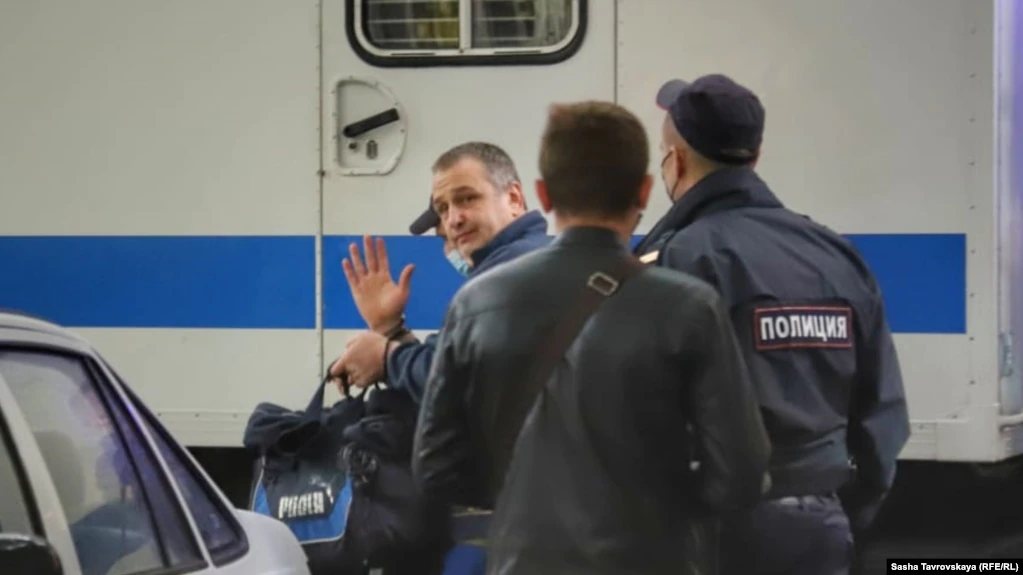
Radio Free Europe/Radio Liberty (RFE/RL) condemns today’s sentencing of RFE/RL freelance journalist Vladyslav Yesypenko to six years in prison by a Russian-controlled court in occupied Crimea.

Said RFE/RL President Jamie Fly, “This judgement against Vladyslav is a travesty. As a journalist doing nothing more than reporting the facts, he should never have been detained in the first place, much less put through the physical and mental torture that he has endured over the past eleven months. Vladyslav needs to be returned home to his wife and daughter immediately.”

Yesypenko, a dual Russian-Ukrainian citizen who contributes to Crimea.Realities, a regional news outlet of RFE/RL’s Ukrainian Service, was detained by Russia’s Federal Security Service (FSB) in Simferopol on March 10, 2021, on suspicion of collecting information for Ukrainian intelligence. Yesypenko left Crimea for mainland Ukraine with his wife, Kateryna, following the 2014 Russian annexation, where she gave birth to their daughter, Stephania; he would later return to Crimea periodically to report for RFE/RL on the social and environmental situation on the peninsula.

Following his detention, Yesypenko was brutally tortured by Russian FSB officers, to force him to make a false ‘confession’ on Russian television. Yesypenko was formally charged with possession and transport of explosives on July 15, 2021. He pleaded not guilty, facing up to 18 years in prison if convicted. The indictment made no mention of espionage or work for Ukrainian intelligence, as stated previously by the FSB.

Speaking at the Ukrainian Embassy in Washington on October 21, 2021, Yesypenko’s wife read out an appeal from her husband. In the letter dictated from his jail cell, Yesypenko called on U.S. President Joe Biden and U.S. lawmakers to do more to free the more than 100 political prisoners detained by the FSB over their activities in Crimea.

Sixteen Ukrainian human rights NGOs, Ukrainian Ombudswoman Lyudmyla Denisova, and the U.S. Embassy in Kyiv have denounced the verdict in online statements, as has Reporters Without Borders. In December 2021 Amnesty International launched an online petition demanding Yesypenko’s immediate release. Press-freedom advocates, including the Committee to Protect Journalists, along with Ukrainian Foreign Minister Dmytro Kuleba and the U.S. State Department, are among those who have called for the same in the absence of any evidence of wrongdoing.
[Source: RFE/RL press release]

Thomas Fenton appointed Deputy Director at France 24

Thomas Fenton appointed Deputy Director at France 24

Thomas Fenton appointed Deputy Director at France 24

Marie-Christine Saragosse, CEO of France Médias Monde, has appointed Thomas Fenton as Deputy Director of France 24, in charge of the English service. He will take up his post on March 4, 2022.

A French-American graduate of Duke University in the United States, Thomas Fenton has spent his entire career working for major international news networks. He joined CNN in 1986, where for 26 years he successively held the positions of  Deputy Managing International Editor in Atlanta, Bureau Chief in Frankfurt and Jerusalem, Executive Producer in London, and Managing Editor for the Middle East in Abu Dhabi.

In 2011, he joined Al Jazeera as Executive Producer in Doha and then in New York. In 2019, he was called by CBS to help relaunch the CBS Evening News. For the past year, he has been Story Editor for “The Take”, an AJ English-language flagship podcast. Thomas Fenton has received numerous awards, including three Emmy Awards for CNN (1993, 2001, and 2012) for coverage of events during the wars in Somalia, Sierra Leone, and the Egyptian revolution.

Three international broadcasters face online silence in Turkey

Three international broadcasters face online silence in Turkey

Three international broadcasters face online silence in Turkey

Three international broadcasters have been told their online services in Turkey will be silenced unless they apply for licences. 

DW, Voice of America and Euronews all face online blackouts in Turkey unless they apply for licences within 72 hours of an announcement made by Turkey’s media regulator RTUK on 9 February 2022.

“A decision was taken with a majority of votes that 72 hours be granted to the websites of amerikaninsesi.com, dw.com/tr, and tr.euronews.com to get licenses,” Ilhan Tasci, a member of RTUK’s board, said on Twitter.

Licences for online broadcasting cost 13,375 Turkish Lira (€865) for radio and 133,750 Turkish Lira (€8648) for television. Licences are granted for ten year periods. 

A new law came into force in 2019 that requires all broadcasters delivering online radio or TV services to apply for a licence, as well as establishing a Turkey-based company to represent them. It is unclear which services have already acquired licences as the RTUK website does not appear to provide details of licensees. Reports carried in the Turkish press suggest that streaming services Netflix and Amazon Prime acquired licences in 2020 to cover their Turkish operations. 

According to the International Press Institute, the regulator’s “decision puts international independent media operating in Turkey online under state scrutiny and risks making them the target of fines and even broadcast bans.”

Voice of America spokesperson Bridget Serchak said: “VOA believes any governmental efforts to silence news outlets is a violation of press freedom, a core value of all democratic societies.

“Should the Turkish government formally block our websites, VOA will make every effort to ensure that its Turkish-speaking audience retains access to a free and open internet using all available methods.” 

A DW spokesman said: “We have learned from the media about a possible decision by the RTÜK that could also have implications for DW.”

“However, we will be able to make a conclusive analysis and decide how to proceed only once we have received official notification from the authority.”

Turkey is a signatory to the European Convention of Transfrontier Television. This allows TV channels licensed in another ECTT signatory country to broadcast in Turkey, and Turkish channels to broadcast in all other ECTT signatory nations. Turkey operates international news channel TRT WORLD that is available on cable, satellite and online platforms in territories worldwide.