France 24 achieves highest ever ratings

France 24 achieves highest ever ratings

France 24 achieves highest ever ratings

In 2020, France 24 achieved its highest ever broadcast and online ratings. The French international news channel that operates in four languages (English, French, Arabic and Spanish) boasts 98.5 million weekly viewers (+13% vs. 2019), measured in 74 of the 184 countries where it is available. In addition, the channel registered 28.7 million visits (+54% vs. 2019) and 156 million video views (+58%) on its digital platforms each month.   

Strong results partly made possible by a vibrant community of followers – more than 53 million of them – across France 24’s social media accounts on Facebook, Twitter, Instagram and YouTube.  

France 24 is gaining ground in all its broadcast languages and in all the geographical areas where it is accessible.    

Available in 184 countries, France 24 is broadcast in 444 million households (+10% vs. 2019) as well as in more than 3 million hotel rooms around the world and in the halls of several institutions and international organizations, cultural organizations, airports, and other international hubs. 

France 24 says its success demonstrates the public’s fondness for the French international news channel and its major role in delivering reliable information to its viewers on all five continents, especially in the context of the Covid-19 pandemic.   

France 24 – programme highlights

France 24 – programme highlights

France 24 – programme highlights

Reporters Plus – Zambia: Under Chinese Influence

2010 GMT, Saturday 27 March

Over recent years, China has become an alternative source to Western aid for many African countries. In this “Reporters Plus”, France 24 focuses on Beijing’s influence on the continent with the example of Zambia. Indeed, it is the African country where China invested the most in 2020.

The relationship between the two countries goes back to the 1960s. Today, China owns a third of Zambia’s debt and Chinese companies are present in every key sector, from agriculture to mines and industry. While the Chinese presence in the country was praised at first, it is now facing growing criticism, openly voiced by those on the campaign trail in the run up to the presidential election.

With China using the Covid-19 crisis to strengthen its health diplomacy in Africa, France 24’s journalists Roméo LangloisNicolas Germain and Yi Song had unprecedented access to Chinese companies in Zambia, shared the daily lives of their directors and bring viewers an exclusive report.

Bangladesh #trending launches from BBC on Channel i

Bangladesh #trending launches from BBC on Channel i

Bangladesh #trending launches from BBC on Channel i

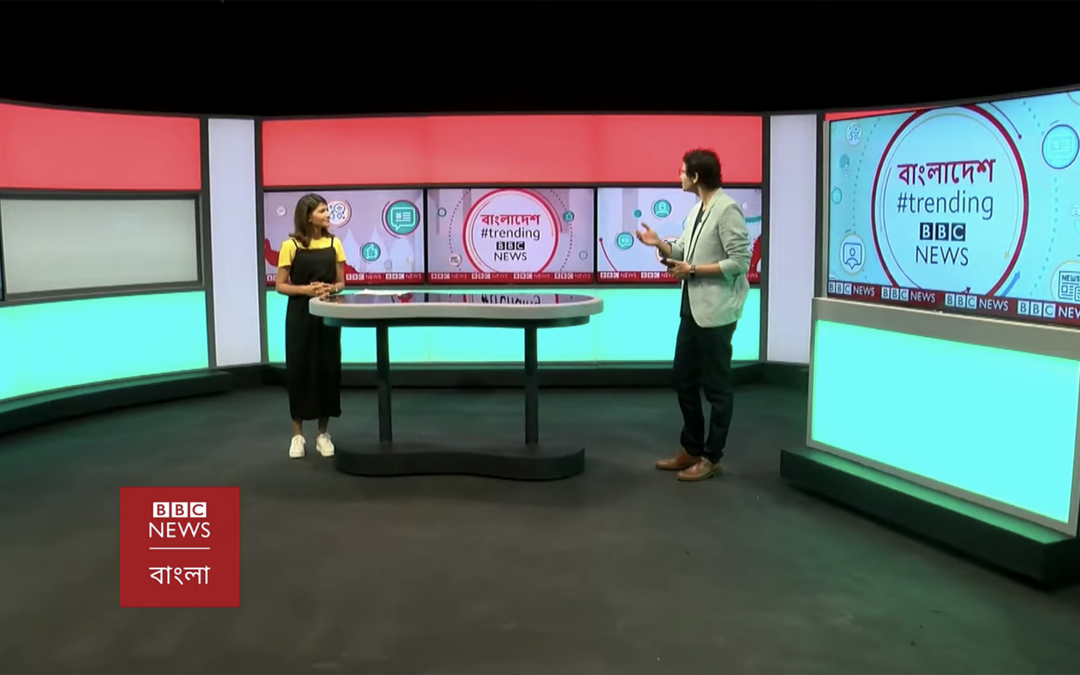
Bangladesh #trending, is a new programme from BBC News Bangla on Channel i, that aims to tap into social-media conversations among young audiences to engage them in discussion of viral and trending topics. Presented by the BBC’s Faisal Titumir, the weekly programme will explore trending topics from different angles as well as fact-checking the rumours that often go viral on social media.

BBC News Bangla editor, Sabir Mustafa, comments: “As Bangladeshi youth increasingly get their news from social media, we realised a need for a programme tailored for these younger audiences – to inform them about the trends and to explore together the truths and the untruths. There will be no topics that are out of reach or are taboo for Bangladesh #trending.”

With what the BBC describes as its slick story-telling, informal chats with young contributors, eye-catching graphics, social-media posts and topical interviews, Bangladesh #trending breaks new ground on the Bangladeshi TV scene. It also further diversifies the BBC News Bangla TV content broadcast by Channel i which broadcasts the current affairs programme, BBC Probaho, and the BBC’s technology programme, Click.  

Director and Head of News of Channel i, Shykh Seraj, says: “Channel i has been partnering with BBC for quite a long time, now presenting so many different programmes for the audience. The Bangladesh #trending initiative is going to be a landmark hashtag for people countrywide, and stories will spread even faster as the key topics will come out from the social-media trends that went viral. We will get to discover citizen journalism in the most exciting manner.”

Designed for young audiences, the dynamic show engages social-media activists from across the Bangladeshi socio-economic spectrum in lively debates, providing them with a platform to share their take on trending issues.

In each edition of Bangladesh #trending Faisal Titumir will moderate between two panellists from the programme’s pool of young social-media activists, to explore the week’s trending issues. Audiences will connect with the programme via Facebook and Twitter.

Faisal Titumir is known to those who watch BBC programmes on Channel i or via the BBC News Bangla website or YouTube channel, as the presenter and producer of the BBC’s weekly technology programme, Click. The BBC News Bangla radio listeners know him as a co-presenter of the Social-media Chit-Chat and the weekly sports round-up. 

Faisal, who has a major social-media following of his own, says: “Whether they connect with us by social-media posts or by talking directly on our programme, I want to make sure young audiences always see Bangladesh #trending as their platform where we get together to chat, informally and freely, about the week’s trending topics that have touched us.”

Aired by Channel i at 9.35pm Bangladesh time on Mondays – replacing the Monday edition of BBC Probaho – Bangladesh #trending is also streamed via the website bbc.com/bangla and is available on demand via the BBC News Bangla YouTube channel

BBC News Bangla reaches a weekly audience of 12.6m people (BBC Global Audience Measure 2020) across platforms.  Its radio programmes, produced in London and Dhaka, air on the state FM network, Bangladesh Betar, as well as on shortwave and via bbc.com/bangla

RFI condemns attack on journalist’s home

RFI condemns attack on journalist’s home

RFI condemns attack on journalist’s home

Radio France International (RFI) has condemned an arson attack that targeted several houses in Niger’s capital, Niamey, including that of its correspondent, Moussa Kaka.

“RFI notes that this attack comes four days after the second round of the presidential election and that Moussa Kaka was targeted as a journalist.

“This is a very serious attack on the freedom of the press. RFI gives its full support to its correspondent, condemns this act and will continue to defend the freedom to inform,” the Paris-headquartered broadcaster said in a statement

Moussa Kaka has been the target of attacks in the past, and has been imprisoned by the authorities in Niger for allegedly having ties with Tuareg rebels and plotting against the government. 

Facebook bans news in Australia – wherever it’s from

Facebook bans news in Australia – wherever it’s from

Facebook bans news in Australia – wherever it’s from

Global social media platform Facebook has, according to Australian Prime Minister Scott Morrison, “unfriended Australia”. Morrison’s comments follow the closing of all news providers’ Facebook pages – whether domestic or international – in response to a proposed law in the country that would force companies like Facebook pay for news content on their platforms.

The ban has taken away access to the Facebook feeds of public broadcasters ABC and SBS, commercial news channels such as Nine Network, as well as whole raft of other organisations that may have only the most tenuous connection with news – such as Brisbane-based Podnews which reports on developments in podcasting across the world. Commercial radio’s trade association, Commercial Radio Australia, has also had its page blocked, although the Community Broadcasting Association of Australia has escaped the Facebook axe as this article was being prepared. The AIB’s main Facebook page has been blocked and our awards website appears to have had its contents filtered

Many Australian government Facebook pages were blocked, along with pages of organisations such as the Bureau of Meterology and Queensland Health – both later restored. A list of affected pages was compiled on this Twitter feed. A Google document keeping tab on pages that are down has also been created by Elliott Bledsoe.

In addition, the pages of news organisations across the world – including the BBC, Al Jazeera, New York Times for example – are now not accessible in Australia.

In a statement on the issue made by Managing Director David Anderson, the ABC said:

ABC News is Australia’s number one digital news service and the nation’s most trusted news outlet.

The ABC’s digital news services will always remain free and accessible to all Australians on the ABC website and via the ABC News app, providing independent and reliable news, information and analysis.

Despite key issues such as the COVID-19 pandemic having ongoing effects on all Australians, Facebook has today removed important and credible news and information sources from its Australian platform. 

We will continue our discussions with Facebook today following this development.

Facebook’s Managing Director for Australia and New Zealand issued a statement saying that “with a heavy heart” it was choosing to stop allowing news content on its services in Australia.

The social platform is a major source of news in Australia, according to the Reuters Institute Digital News Report: In spite of this, Facebook says it generates little revenue from news although it is clear that news is one of the drivers for people to use the platform.


Unlike in Myanmar where VPNs allow the country’s citizens to circumvent the military’s ban on the Internet and social platforms, the use of virtual private networks does not help in Australia. That’s because Facebook has stopped the pages at source and disabled the content. It’s unclear whether the assets of all the items that a major news organisation such as the ABC are preserved on Facebook servers to allow the page to be reactivated if the social platform reverses its decision in the future.


Have you been affected? Let us know by sending us your comments or story at editorial [at] aib.org.uk.

Global Task Force for Public Media speaks out on China BBC ban

Global Task Force for Public Media speaks out on China BBC ban

Global Task Force for Public Media speaks out on China BBC ban

The following is a statement by the Global Task Force for public media:

The Global Task Force for public media is deeply concerned by the decision of the government of the People’s Republic of China to ban BBC World News from broadcasting in the country. The ban was announced on February 11, 2021 by the National Radio and Television Administration, China’s media regulator.

RTHK, Hong Kong’s public broadcaster, also announced that it will no longer carry BBC World Service or BBC News Weekly in Cantonese, as of February 12, 2021.

Taken together, these actions severely restrict access to trusted sources of news and media freedom within the region. Access to independent journalism is a basic right and critical for citizens everywhere to be informed.

Signed, Global Task Force for public media

David Anderson, Managing Director, ABC (Australia)
Thomas Bellut, Director General, ZDF (Germany)
Delphine Ernotte Cunci, President & CEO, France Télévisions (France)
Jim Mather, Chair of the Board, RNZ (New Zealand)
Hanna Stjärne, Director General, SVT (Sweden)
Catherine Tait, President & CEO, CBC/Radio-Canada, GTF Chair (Canada)
Yang Sung-dong, President & CEO, KBS (South Korea)

About the Global Task Force
The Global Task Force exists to promote and defend the values of public media—access, accuracy, accountability, creativity, impartiality, independence and high standards of journalism—all of which underpin an informed and healthy democracy.