They spent more on jamming than the broadcasts cost to produce. That’s the theory around the jamming of western radio broadcasters by the Soviet Bloc during the Cold War years.
Leaders of the communist states were determined to keep control of the information flow to their citizens, fearing that news from abroad would lead to the undermining of their totalitarian regimes.
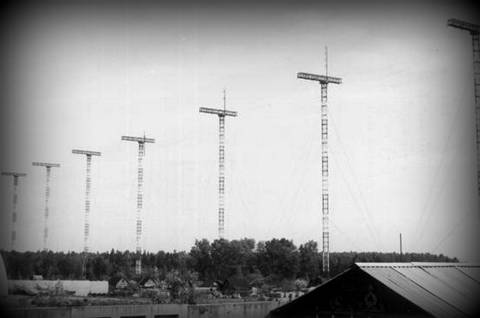
Immense shortwave transmitting stations were constructed across eastern Europe, from the Baltics to the Balkans, not to serve audiences but to hinder them. They were not listed in the International Telecommunication Union’s registers of transmitters in the “white book”, the hugely detailed dataset of the world’s shortwave broadcasting. They were, essentially, transmitters that everyone knew existed yet were maintained “off the books” as state secrets.
As jamming became ever more prevalent – aimed principally at the BBC External Services [now BBC World Service]; Deutsche Welle; Radio Free Europe/Radio Liberty; Voice of America – western broadcasters had to invest more in building ever greater numbers of high powered shortwave transmitters to ensure that their signals reached their listeners across eastern Europe.
If you tuned across the shortwave radio bands in the 1960s, 70s and 80s, you would have heard a cacophony of sound. Over-modulated speech, distorted music – anything that could have the effect of making the original programme all but impossible to hear was used to stop reception.
To understand the scale of the operation, it’s worth watching a video produced by RFE/RL about the Padorska jamming station (2012 aerial shot from Google Earth pictured) in central Bulgaria. The immense site is now in ruins, with the antennas removed in the last few years (although Google Maps has a Street View image from 2012 in which the site’s antennas are visible in the distance). One of the technicians who started working at the site in the late 1980s, shortly before the Iron Curtain was lifted, explains how the station operated.
There are a good number of anecdotes concerning jamming. One from 1985 when many BBC employees went on strike and programmes were replaced with music on World Service English and most of the language services. The Soviet jammers had a day off – at least until someone in Bush House, then the home to BBC World Service, decided to play “Back in the USSR” by the Beatles. Within minutes the jammers leapt into life, simply to drown out what was clearly thought to be decadent anti-Soviet music.
The end of the Cold War did not mark the cessation of jamming. It’s continued on shortwave over the past 30 years. At the time of the first Gulf War, Iraq jammed the BBC’s services in the Middle East and more recently North Korea has jammed the signals of Radio Free Asia.
Jamming continues from time to time today. As shortwave broadcasting has slowly faded away, satellites have become the target. Ethiopia has jammed satellites carrying opposition TV channels and Iran regularly jams satellites with Persian-language programmes from abroad. There are no longer immense jamming stations seeking to interfere with programmes from around the world; today’s satellite jammers can use commercially available uplink equipment to try and take out transponders on satellites. The satellite industry has responded, and now far greater levels of security exist that prevent almost all attempts to stop TV and radio signals from reaching their intended audiences.
This does not mean that the free flow of information across borders is guaranteed today. Some governments continue to try to restrict the work of international broadcasters, using tactics instead of wholesale jamming of the airwaves. It’s why the AIB continues to work on media freedom to try to ensure that everyone can access the information they want or need.
Two years since Russia-backed separatists in eastern Ukraine confirmed they were holding Ukrainian blogger and Radio Free Europe/Radio Liberty (RFE/RL) contributor Stanislav Aseyev prisoner, RFE/RL is redoubling efforts to secure his release.
“Stanislav has been held virtually incommunicado for two years because of his unflinching reporting from his native Donetsk,” said RFE/RL Acting President Daisy Sindelar. “I know I speak on behalf of a growing number of rights advocates, government officials, lawmakers, and journalists in deploring his detention and demanding his freedom.”
Aseyev, who also wrote for the Ukrainian publications Mirror of the Week and The Ukrainian Week, began blogging for RFE/RL’s Ukrainian Service in 2014 under the pen name Stanislav Vasin, contributing dozens of posts about the effects of the conflict on daily life, schooling, politics, and culture until his detention in the summer of 2017. Separatists have reportedly accused him of espionage and threatened him with up to 14 years in custody, although RFE/RL has no knowledge of him being formally charged by any recognized authority of any crime.
In August 2017, the Ukrainian government included his name among those officially listed for a possible prisoner exchange under the supervision of the Trilateral Contact Group, which oversees negotiations among the sides to the conflict. The bipartisan U.S. Congressional Freedom of the Press Caucus has condemned his detention, championing him as “one of the few independent journalists to remain in the region under separatist control to provide objective reporting.” In November 2018, the U.S. Mission to the OSCE urged “the Russian Federation to secure the release of Stanislav Aseyev.” In recent weeks, U.S. Senators Robert Menendez and Marco Rubio and U.S. Congressman Eliot Engel have called for his freedom.
Nobel laureate Svetlana Alexievich has added her voice to efforts on Aseyev’s behalf, writing, “It goes without saying, I am with you in your struggle on behalf of Stanislav Aseyev.”
RFE/RL has also urged the release of Ukrainian Service contributor Oleh Halaziuk, who has been held by Russia-backed separatists in Donetsk since August 2017. Crimean contributor Mykola Semena was convicted of separatism by a Russian court in 2017 and is banned from practicing journalism and leaving the peninsula.
In Isolation: Posts From Donbas is a collection of English-language translations of Aseyev’s reports from the conflict zone for RFE/RL’s Ukrainian Service.
RFE/RL’s Ukrainian Service, known locally as Radio Svoboda, together with its subsidiary Donbas.Realities and Crimea.Realities regional units, averaged 5 million monthly visits to its website in 2018, and sets a standard in the Ukrainian media market for independence, innovation, and professionalism.
[Source: RFE/RL press release]
Two U.S. Agency for Global Media (USAGM) networks-Radio Free Europe/Radio Liberty (RFE/RL) and Radio Free Asia (RFA)-have been named winners of the prestigious 2019 National Murrow Awards. This is the first time the two networks have received this honor, presented by the Radio Television Digital News Association (RTDNA) for excellence in electronic journalism.
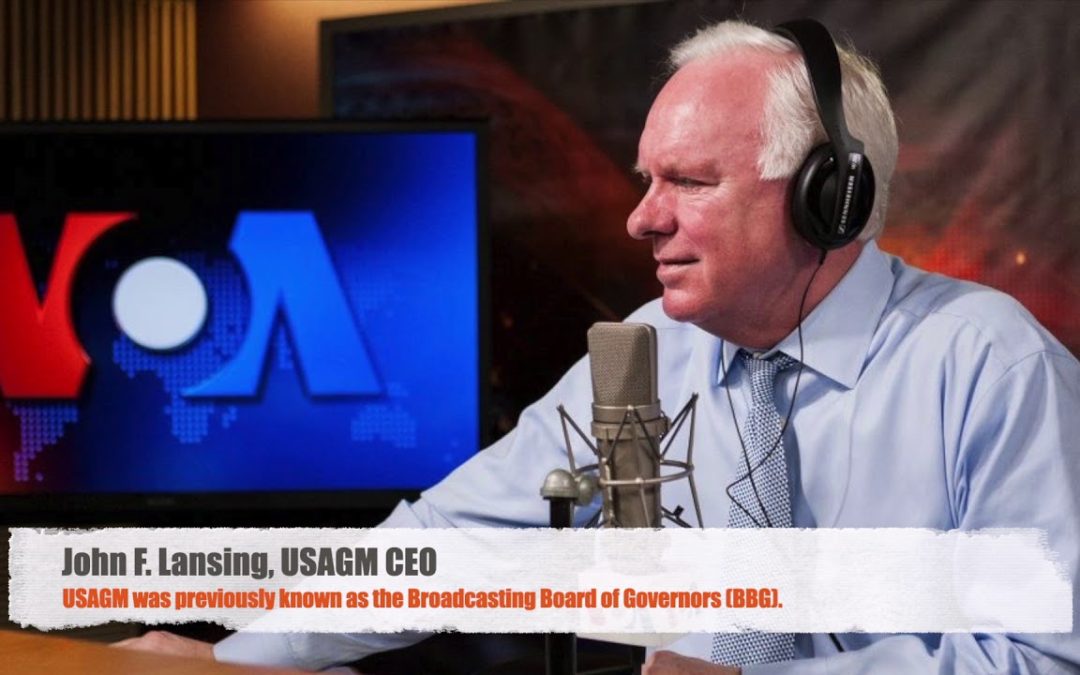
“I am thrilled that the RTDNA’s Edward R. Murrow Awards have recognized the high-caliber reporting that RFE/RL and RFA produce,” said USAGM CEO John F. Lansing. “My heartfelt congratulations go to the skillful journalists and storytellers who offer our global audiences accurate and professional journalism-the bedrock of what we do at USAGM.”
CEO Lansing added, “Edward R. Murrow, who in the early 1960s led the U.S. Information Agency, a predecessor to USAGM, would be proud of our modern media organization’s wide-reaching impact.”
Daisy Sindelar, Acting President of RFE/RL, and Libby Liu, President of RFA, offered praise for their award-winning networks, which provide compelling, uncensored and locally-oriented news and information to audiences in some of the harshest media environments around the world.
“We are honored to receive this recognition for providing our audiences with unique stories, powerfully told, on the most influential formats in our coverage area,” said Sindelar.
RFE/RL received the National Murrow Awards’ top honor for Multimedia in the Television Network category. Judges reviewed eleven examples of RFE/RL’s impressive domestic news coverage ranging from Armenia to Uzbekistan.
RFA Mandarin’s “The Women Against the State” won in the juried contest’s Excellence in Video category. The piece focuses on the aftermath of China’s “709 crackdown”- a nationwide roundup of lawyers and legal activists that began in July 2015 – and the wives of those still held in custody today.
“RFA Mandarin’s digital team deserves full credit for this prestigious award. Their hard work to spotlight these brave individuals and share their stories speaks to Radio Free Asia’s critical journalistic mission,” said Liu.
Although this marks the first time that RFA has won a National Murrow Award, the network won several Regional Murrow Awards in years past.
The United States Agency for Global Media (USAGM) today released its detailed Fiscal Year 2020 budget request, seeking $628 million to support key U.S. foreign policy goals, maximize impact and continue modernization initiatives while accommodating current spending constraints.
“Through unprecedented collaboration between the five USAGM networks and a strategic focus on language-based programming rather than national boundaries, we successfully meet the demand for accurate, compelling journalism that impacts lives and communicates America’s democratic values to our growing global audience,” said USAGM CEO and Director John F. Lansing, adding, “Our work is more important than ever.”
USAGM is in the midst of a significant multi-year transformation effort designed to improve the efficiency and effectiveness of the agency and to increase its impact on the audiences it serves worldwide. This undertaking aligns with the Administration’s National Security Strategy and the President’s management priorities of effectiveness, efficiency, and accountability, and advances USAGM’s 2018-2022 Strategic Plan.
The agency’s portion of the President’s FY 2020 Budget request will build on recent strategic investments, including:
Continuing to build VOA365, the new 24/7 Persian-language global network led by Voice of America (VOA) in cooperation with Radio Free Europe/Radio Liberty’s (RFE/RL) Radio Farda;
Creating a global Mandarin-language digital network, with collaboration between VOA and Radio Free Asia (RFA);
Expanding Russian-language content through Current Time;
Reaching critical audiences in Central and South America, particularly Venezuela;
Developing refugee-focused programming and broadcasts; and
Continuing the dynamic transformation and modernization of the Office of Cuba Broadcasting (Television and Radio Martí) and the Middle East Broadcasting Networks (MBN).
In FY 2018, USAGM reached a record weekly audience of 345 million across radio, television and the internet-a 24 percent increase from the FY 2017 audience of 278 million. This growth continues the agency’s upward trend in audience reach in recent years, reflecting both the quality of USAGM content and its duty as a trusted source of news and information in a complex global media environment.
Radio Free Europe/Radio Liberty (RFE/RL) President Thomas Kent has announced he is leaving the organization effective October 1, 2018, after a two-year stint during which the company dramatically expanded efforts to combat disinformation and extremist propaganda in its coverage region.
In farewell remarks, Kent said, “It’s been an honor to lead RFE/RL, an essential source of professional, unbiased journalism for the countries we serve. I leave with gratitude to the entire RFE/RL staff for their commitment to our mission, and especially to our courageous correspondents working in some of the world’s most challenging environments.”
During Kent’s tenure, Current Time TV, a fresh alternative to Kremlin-controlled media, increased its brand recognition as a 24/7 Russian-language digital and TV network, with 84 affiliates in 19 countries and upwards of 540 million video views — at least half from inside Russia — for the 12-month period ending in July 2018. RFE/RL also launched targeted websites providing independent news to Russia’s North Caucasus, Middle Volga, and Siberian regions; laid the groundwork to resume local news coverage in Romania and Bulgaria; and developed high-impact programs providing the only sustained journalistic response to extremism in Central Asia and the Balkans. Under Kent’s leadership, RFE/RL’s measured weekly audience grew by 15.6 percent, from 26.9 million in FY2016 to an estimated 31.1 million in FY2018.
Kent was appointed RFE/RL president in June 2016, after completing a 44-year career as a journalist and editor with the Associated Press.
A successor has not yet been named. In the interim, RFE/RL Vice President and Editor-in-Chief Nenad Pejic is serving as Acting President.
About RFE/RL RFE/RL relies on its networks of local reporters to provide accurate news and information in 25 languages and 20 countries where media freedom is restricted, or where a professional press has not fully developed. Its videos were viewed over 1.5 billion times on Facebook and YouTube in 2017. RFE/RL is an editorially independent media company funded by a grant from the U.S. Congress through the U.S. Agency for Global Media (USAGM).


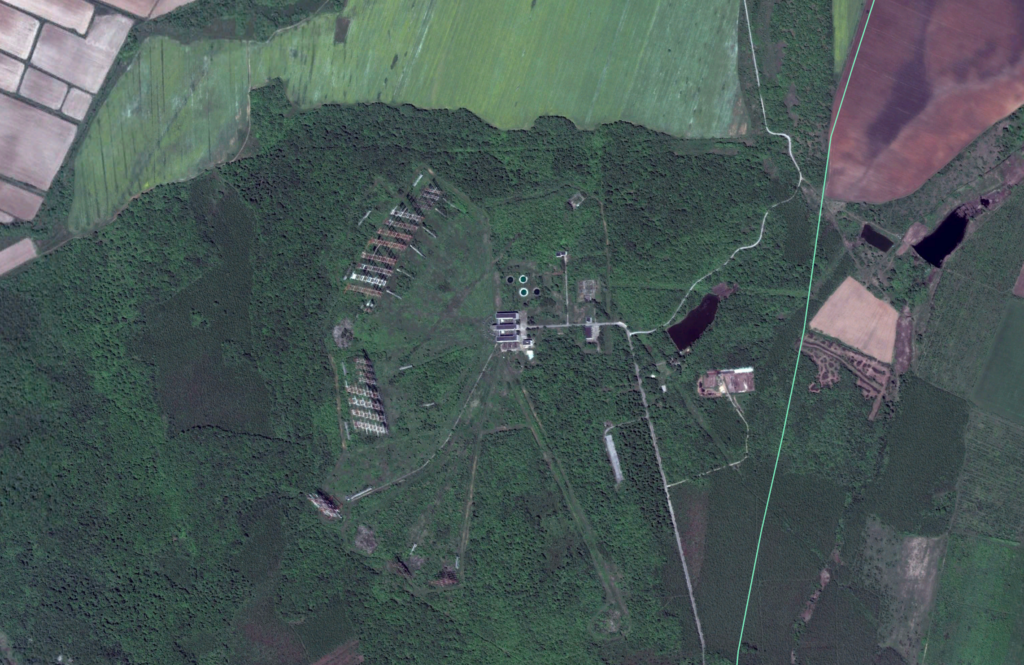 To understand the scale of the operation, it’s worth watching a video produced by RFE/RL about the Padorska jamming station (2012 aerial shot from Google Earth pictured) in central Bulgaria. The immense site is now in ruins, with the antennas removed in the last few years (although Google Maps has a Street View image from 2012 in which the site’s antennas are visible in the distance). One of the technicians who started working at the site in the late 1980s, shortly before the Iron Curtain was lifted, explains how the station operated.