RFE/RL journalists targeted as Kazakhstan protests spiral

RFE/RL journalists targeted as Kazakhstan protests spiral

RFE/RL journalists targeted as Kazakhstan protests spiral

RFE/RL President Jamie Fly criticized the targeting of Kazakh journalists covering fuel price protests that have spiraled beyond the government’s control.

Said Fly, “Reports of gunfire and other violence directed at those reporting on these protests, are deeply concerning—as are attempts to limit the flow of information within and out of the country, by targeting the internet and social media and blocking media websites, including that of our Kazakh Service. At such an unstable time, journalists must be allowed to report the facts as they unfold.”

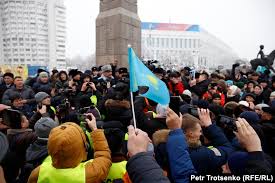
Today, while covering protests in the central square of Almaty, individuals in a security forces vehicle opened fire indiscriminately at protesters and journalists who were wearing their legally-mandated “Press” vests—including those reporting for RFE/RL. Yesterday, two RFE/RL journalists were detained by police while reporting on the protests in Almaty and Nur-Sultan—Darkhan Umirbekov, an editor in Nur-Sultan who was detained and held for 4.5 hours for questioning, and acting Almaty bureau chief Kasym Amanzhol, who was held for 2 hours of questioning after being picked up as he filmed protests earlier in the day.

RFE/RL journalists have been providing on-the-ground coverage of the recent wave of nationwide protests sparked by a sharp, unexpected doubling of retail prices for liquefied petroleum gas (LPG) used in vehicles, which amplified worries among Kazakhs of knock-on effects to the prices of other daily commodities such as food. The protests, which started in Kazakhstan’s long-restive western Mangystau region, quickly expanded to urban centers throughout the country, including the capital, Nur-Sultan and commercial hub of Almaty, where protesters stormed city hall, set fire to a presidential residence, and seized control of the airport. A nationwide state of emergency has been declared.

Access to the website of RFE/RL’s Kazakh Service was blocked within Kazakhstan today, along with those of several other independent media outlets including Orda.kz and KazTAG. Mobile Internet communications were down for much of the day; access remains blocked to popular social media platforms including WhatsApp, Telegram, and Skype.

RFE/RL’s Kazakh Service, known locally as Radio Azattyq, reports accurate news and informed analysis in both the Kazakh and Russian languages that state-controlled media is often unable or unwilling to provide, while serving as a platform for the free exchange of ideas. In FY 2021, the service’s azattyq.org website logged 50 million visits and 69.7 million page views. More than 1.23 million people subscribe to its YouTube feed, and 612,000 follow its Instagram page.

Current Time is a 24/7 Russian-language digital and TV network led by RFE/RL in cooperation with VOA. In addition to reporting uncensored news, it is the largest provider of independent, Russian-language films to its audiences. Despite rising pressure on Current Time from the Russian government, which has designated the network a media “foreign agent,” Current Time videos were viewed over 1.3 billion times on YouTube, Facebook, and Instagram/IGTV in FY2021.

About RFE/RL
RFE/RL relies on its networks of local reporters to provide accurate news and information to more than 37 million people every week in 27 languages and 23 countries where media freedom is restricted, or where a professional press has not fully developed. Its videos were viewed 7 billion times on Facebook, YouTube, and Instagram/IGTV in FY2021. RFE/RL is an editorially independent media company funded by a grant from the U.S. Congress through the U.S. Agency for Global Media.

[Source: RFE/RL press release]

RFE/RL denounces Russia’s escalating efforts to force RFE/RL out of the country

RFE/RL denounces Russia’s escalating efforts to force RFE/RL out of the country

RFE/RL denounces Russia’s escalating efforts to force RFE/RL out of the country

Radio Free Europe/Radio Liberty (RFE/RL) President Jamie Fly today denounced Russia’s escalating efforts to force RFE/RL – including its Russian Service and 24/7 digital network Current Time – out of the country.

Fly stated that “RFE/RL is being targeted by the Russian authorities because we continue to provide a growing audience in Russia with objective news and information at a moment when the Kremlin is trying to limit access to information. We will continue to fight these attacks on our ability to operate in Russia through all possible means. We believe that the Russian people want more choices.”

Fly made his comments as RFE/RL learned that Russia’s media regulator, Roskomnadzor, would be serving RFE/RL with a new round of 130 charges beginning on April 16 – bringing the total number of violations charged by Roskomnadzor to 520, and the anticipated total amount of fines assessed to $2.3 million.

Over the past five years, RFE/RL has nearly doubled its audience in Russia to a current weekly reach of at least 6.5% of Russian adults, or nearly 6.7 million people. Between October 2019 and September 2020, Current Time-produced videos were viewed more than 1.5 billion times on social media platforms, and the number of subscribers to Current Time’s social media pages more than doubled to over 5 million; online audiences for RFE/RL’s Russian Service also grew dramatically, with 250 million video views on all media platforms in 2020.

Roskomnadzor has already served RFE/RL with 390 violation charges in the past three months, resulting in anticipated fines of $1.4 million, for violating invasive self-labeling rules that would require that RFE/RL label every piece of text, video, audio, or social media content with a prominent, lengthy, state-mandated disclaimer. Video content is obligated to carry a 15-second disclaimer at the start of each clip, and disclaimers published with text articles and social media posts must be published in a font size twice that of the text. RFE/RL has not complied with these labeling rules, which it says violate the Russian Constitution and Russia’s media law and would detract audiences looking for alternatives to Russian state media.

Russian regulators have singled out RFE/RL, whose editorial independence is also enshrined in U.S. law, over other foreign news operations in Russia. In 2017, Russian regulators put RFE/RL’s Russian Service onto a list of news media deemed to receive foreign funding for political activity as “foreign agents,” along with RFE/RL’s regional Russian-language news services and Current Time, the network run by RFE/RL in cooperation with Voice of America. The law also puts RFE/RL journalists at risk for criminal prosecution. With nearly 270 freelancers and more than 50 local contractors, RFE/RL has one of the largest networks of independent journalists in Russia and has maintained a bureau in Moscow since 1991, when it was invited into the country by Russian President Boris Yeltsin.

On April 6, U.S. Secretary of State Antony Blinken expressed his “concern over Russia’s efforts to close Radio Free Europe/Radio Liberty and silence this valued source of independent reporting” via Twitter following a meeting with U.S. Agency for Global Media Acting CEO Kelu Chao. State Department spokesman Ned Price had previously said the U.S. is “deeply concerned” about the Russian government’s actions against RFE/RL, which have also been criticized by the European Union, senior members of both the U.S. Senate and House of Representatives, The Washington Post, and media freedom groups including the Committee to Protect Journalists and Reporters without Borders.

About RFE/RL
RFE/RL relies on its networks of local reporters to provide accurate news and information to more than 41 million people in 27 languages and 23 countries where media freedom is restricted, or where a professional press has not fully developed. Its videos were viewed 6.5 billion times on Facebook, YouTube, and Instagram/IGTV  in FY2020. RFE/RL is an editorially independent media company funded by a grant from the U.S. Congress through the U.S. Agency for Global Media.

[Source: RFE/RL press release]

USAGM condemneds Russian court’s decision to fine RFE/RL

USAGM condemneds Russian court’s decision to fine RFE/RL

USAGM condemneds Russian court’s decision to fine RFE/RL

The U.S. Agency for Global Media (USAGM) today condemned a Russian court’s decision to levy steep fines against Radio Free Europe/Radio Liberty (RFE/RL).

“USAGM is very disappointed with the court’s decision, which can only be interpreted as an assault on media freedom and the free flow of information to Russia’s citizens. I have every confidence in RFE/RL as they continue to provide audiences in Russia with access to truthful, impactful reporting,” said USAGM Acting Chief Executive Officer Kelu Chao.

Russia’s revised “foreign agent” law requires designated news organizations in Russia that receive foreign funding to prominently label all content, including social media, as foreign agent-produced. Most of the organizations so designated by the Russian Ministry of Justice are USAGM public service media outlets, predominantly associated with RFE/RL. The law, originally passed in 2012 and amended in 2020 to include individual journalists, also imposes regular financial reporting requirements on these outlets. Given that USAGM’s legislatively mandated firewall prohibits its networks from accepting editorial direction from the U.S. government, RFE/RL has refused to label its content in such a wholly inaccurate manner.

In filing more than 250 violations of “foreign agent” regulations, the Kremlin has specifically targeted nine of RFE/RL’s reporting projects: Radio Liberty, its main service for Russia; the Current Time TV and digital network serving a global Russian-speaking audience; the regional reporting projects North.Realities, Siberia.Realities, Caucasus.Realities, Idel.Realities, and Crimea.Realities; the Tatar-Bashkir Service; and the fact-checking website Factograph.info. Additionally, in late December, the Kremlin named three RFE/RL freelance reporters as individual “foreign agent” journalists.

The Committee to Protect Journalists said Russia should repeal the foreign agent law and “ensure that the country’s regulator is not used to censure journalists and harass and threaten media organizations.” Amnesty International said Russia’s foreign agent law further erodes freedom of expression and association” in that country.

[Source: USAGM press release; Image: P Photo/Pavel Golovkin/Associated Press/Alamy Stock Photo]

Radio Liberty fined in Russia – again

Radio Liberty fined in Russia – again

Radio Liberty fined in Russia – again

Russian courts have fined Radio Liberty – the Russian-language service of Prague-based RFE/RL – twice in two weeks over the organisation’s alleged failure to ensure that its output is marked as being produced by a “foreign agent”.

In late January, a court in Moscow fined RFE/RL and its head in Russia a total of 1.1m roubles (around $14,500). Then at the beginning of February, RFE/RL was fined a further 2m roubles ($26,500). Andrei Shary, RFE/RL’s head in Russia, was fined 200,000 roubles in the February ruling.

Fines were also levied against websites Krym.Realii and Factograph that carried the RFE/RL output, according to Interfax News Agency, reported by BBC Monitoring.

In a statement issued on 5 February, Radio Free Europe/Radio Liberty announced that it has appealed what it says is: “a string of Russian court decisions to fine several of the broadcaster’s Russian-language endeavours and the general director of its operations in Russia for allegedly failing to comply with new restrictions under the country’s controversial “foreign-agent” law.

“RFE/RL’s lawyers on February 5 filed the appeals against the decisions by the Tverskoi District Court in Moscow to approve several administrative protocols submitted by Russian media regulator Roskomnadzor “for noncompliance by the media performing the functions of a foreign agent with the requirements of the law on labeling information disseminated by them.”

RFE/RL’s lawyers stated in their appeals that Roskomnadzor’s moves prevent journalists from performing professional activities and contradict the Russian Constitution and laws on media by restricting competition.

The appeals also say that censorship is officially banned in Russia, stressing that Roskomnadzor’s orders will “distort the essence of reports [and] change the way they are received by the audience.”

According to the lawyers, following Roskomnadzor’s requests would create distrust and rejection of the reports and materials of RFE/RL’s projects, while many of the requests cannot even be technically executed.

“These fines represent nothing less than a state-sponsored campaign of coercion and intimidation, targeting a media company whose editorial independence is protected by law,” RFE/RL’s Regional Director for Europe and TV Production Kiryl Sukhotski said.

“Our audiences in Russia have long depended on RFE/RL to be trustworthy, credible, and factual; to be an alternative to disinformation and spin. These qualities are, and will always remain, at the core of RFE/RL’s reporting,” Sukhotski said.

Russian regulators have singled out RFE/RL, whose editorial independence is also enshrined in U.S. law, over other foreign news operations in Russia.

New leaders at US international broadcasters

New leaders at US international broadcasters

New leaders at US international broadcasters

​The United States Agency for Global Media (USAGM) Acting Chief Executive Officer Kelu Chao has replaced the heads of the three U.S.-funded international broadcasting grantees. Radio Free Europe/Radio Liberty (RFE/RL), Radio Free Asia (RFA) and the Middle East Broadcasting Networks (MBN) now have leadership that will promote democracy and other American values abroad.

“I have great faith in these leaders in ensuring the highest standards of independent, objective, and professional journalism,” said Acting CEO Chao.

In addition, Acting CEO Chao named new corporate board directors for the three grantees, replacing the board directors named by former CEO Michael Pack just days before he resigned at President Biden’s request on January 20. The new directors are Ambassador Karen Kornbluh (chair), Ambassador Ryan Crocker, and Michael Kempner.

“Now more than ever,” said Kornbluh, “U.S. international media must serve as an accurate, reliable source of news and information in places where illuminating truth is needed the most.”

The new leaders at the three grantees are now:

  • Daisy Sindelar as Acting RFE/RL President, replacing Ted Lipien; a permanent president will be named shortly.
  • Bay Fang returns to her post as RFA President, replacing Stephen Yates.
  • Kelley Sullivan as Acting MBN President, replacing Victoria Coates.

President Joseph R. Biden named Chao as Acting CEO on January 20, 2021.