14 May 2019
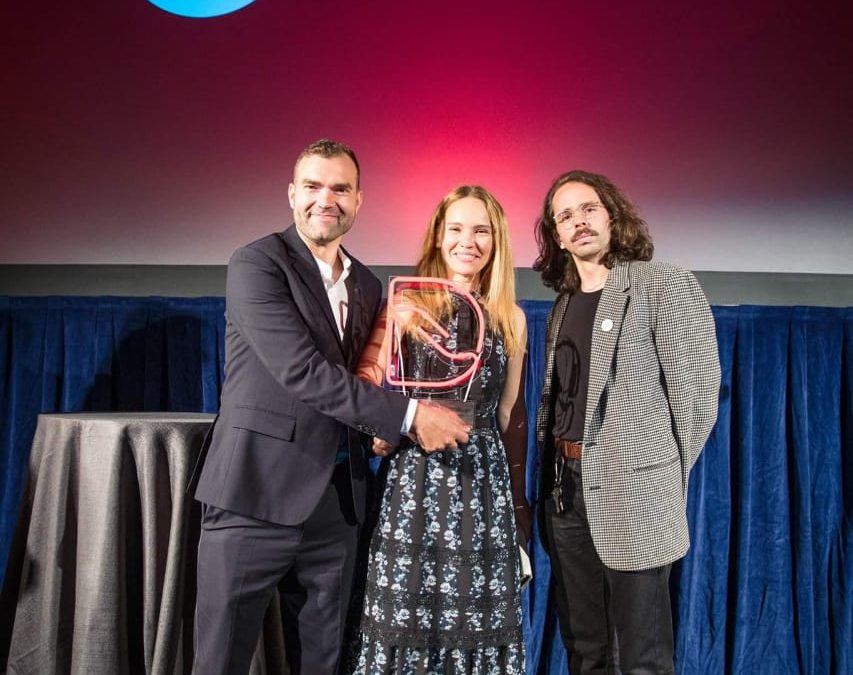
Ruptly’s innovative live platform, Ruptly Live, has received a top prize in the Best Use of Live category (re-ordered sentence) at the Digiday Awards Europe.
Dmitry Keshishev, Chief Digital Officer, said: “this award is testament to our commitment to developing accessible ways of sourcing and delivering live content in a way that resonates with a real demand for innovation among media publishers.”
Ruptly Live is a live distribution platform designed for broadcasters and publishers, as well as individual bloggers, empowering them to broadcast ground-breaking moments directly as they are taking place. Users of Ruptly Live are able to stream up to 9 simultaneous live events, including those covered in 360 degrees, from Ruptly’s platform direct to social media in just three clicks.
The platform enables access to world events on an array of topics, from breaking news to entertainment and sports, with a possibility to feature simultaneous translations to multiple languages. Ruptly’s Live coverage, distributed through the platform, received Gold distinction in Live News Coverage by The Shorty Awards and is recognised by the The Drum Online Media Awards as a finalist of the Breaking News Story of the Year.
The award ceremony took place in London, on 9th May. Other finalists for Best Use of Live were Hearst UK & The Laughing Cow (Good Housekeeping), Singular.Live (The Kick Off) and TheNewsMarket (PwC’s 21st Annual Global CEO Survey).

3 May 2019
As World Press Freedom Day is marked with events across the globe, journalists working at BBC Persian have spoken out about the attempts that the Iranian regime are making to try to silence the broadcaster that has been on the air with radio broadcasts since 1940 and television since 2009.
Watch the video here.

2 May 2019
The digital services company Levira has invested €150,000 in the Estonian start-up Votemo as the company is preparing for expansion. The money will be used for product development and entry into new markets. This week the companies are visiting London together as Levira is organising a Business seminar for UK-based broadcasters in partnership with the Embassy of Estonia in London.
More than 60% of the audience is browsing on 2nd screen while watching TV or streaming online. TV Channels are losing money as 32% of the audience is browsing or speaking on the content they are watching at on someone else’s platforms.
Tõnis Vassar, Co-Founder and CCO of Votemo: “Our goal is to provide the broadcasters and live event organisers a set of tools to build a bridge between their audiences and their own digital channels, instead of sending people to social media portals where they can get lost while browsing cat videos.”
With Votemo, broadcasters can provide the audience an opportunity to participate in the show and influence the debates and conversations. Voting and commenting solutions, sending questions and emotions to Live studio are just some of the services Votemo is offering.
Commenting on the investment, Martti Kinkar, development manager for media services at Levira, said: “We believe that cooperation with Votemo will give Levira the opportunity to offer its customers innovative services and attract new customers. We will continue our joint exhibitions and joint offers this year”.
Tõnis Vassar pointed out that “Over the past year, all major social media platforms have opened their own TV services. The audience wants to talk and share their moods with others. This habit has been encoded by the daily use of social media. Since television does not yet offer these possibilities directly, the television viewer tends to disappear into the exciting worlds of social media.”
Kinkar continued: “Votemo is already cooperating with many media and telecom companies in the Baltic-Nordic region and has won several awards during its first year of operation. Now that the product is ready and tested, the next step is to win the hearts of major European TV stations and here Levira can help”
Levira is one of the biggest independent TV playout centres in Northern Europe. Levira transmits programs to viewers in the Baltic States, Scandinavia and Europe as well as Turkey and United Arab Emirates. The majority of local TV programmes in Estonia are transmitted through Levira’s towers.
Levira has two shareholders: the Republic of Estonia (51%) and the French telecom and broadcasting company TDF (49%).
Votemo is Estonian startup and alumni of accelerator programs Elevator Startups, Telia Vunk Labs and Storytek Creative Hub. Votemo is a platform for Broadcasters to make programmes more engaging. In addition to voting and commenting, Votemo brings emotional icons from social media to TV for the audience to express their moods. Votemo can be used with all TV solutions, including web TV and TV applications. Votemo has started collaborating with the Baltic TV channels, such as TV3, TV6, TTV, ETV (Estonian Public Broadcasting) and Telia TV. The participation rate is about 7% of the audience.
Business seminar for UK-based broadcasters – “Why choose Estonia for a Post-Brexit EU Broadcasting Licence?”
The seminar will offer an opportunity for UK-based broadcasters to learn about Estonia and demonstrate how Estonia can serve as the European licensing base for you following the withdrawal of the United Kingdom from the European Union. The representatives of the Estonian government, the Association for International Broadcasting (AIB) and AS Levira will talk about the possibilities and digital solutions Estonia can offer to overcome potential challenges that broadcasters could face in the post-Brexit media landscape. The seminar is hosted by the Estonian Embassy in London at 44 Queen’s Gate Terrace, London SW7 5PJ. Thursday, May 2, 2019, from 2:30 pm to 5:00pm.
Key contacts:
Mr. Tõnis Vassar, CCO & Co-Founder of Votemo Phone: +372 5237 855, E-mail: tonis@votemo.eu
Mr. Martti Kinkar, Development Manager for Media Services, AS Levira Phone: +372 550 5451, E-mail: martti.kinkar@levira.com
EVENT RSVP: Ms. Kati Niin, Assistant to the Management Board, AS Levira Phone: +372 680 4000, E-mail: rsvp@levira.com

30 April 2019
Today’s technological landscape is one of constantly rising connectivity demands and ever-changing technology. Universal connectivity is no longer a pipe-dream, but instead a global requirement of connectivity providers who must deliver their services urgently and efficiently.
SatADSL’s first appearance at SATELLITE 2019 coincides with its recent confirmation as a finalist in the Teleport Technology of the Year category in the World Teleport Association Awards 2019 for its Cloud-based Service Delivery Platform (C-SDP). SatADSL will mark the occasion by showcasing its first-of-a-kind Cloud-based Service Delivery Platform (C-SDP) at the show. The C-SDP is aimed at operators looking to diversify and increase the profitability of their operations in both new and existing global markets.
For teleport operators, the investment needed to provide easy-to-use satellite services often comes with a prohibitive price tag. If operators want to utilize satellite technology to the fullest, they are also faced with the prospect of uncertain ROI, vendor lock-in and the uncertainty created by the rapid rate at which the satellite market and technology are changing.
Platform as a service offering
Attendees at SATELLITE 2019, including teleport operators looking to capitalize on the satellite market, will witness SatADSL’s C-SDP Platform as a Service (PaaS) solution which provides a complete OSS/BSS, carrier-grade, fully redundant platform via the cloud, allowing operators to outsource their services.
As a PaaS solution, C-SDP enables operators to deliver satellite-based connectivity without committing to a high CapEx in physical infrastructure, therefore avoiding the traditional challenges often experienced when venturing in to the satellite connectivity market.
The platform offers a comprehensive range of services, coupled with a number of significant advantages:
- Fast time to market and quick implementation, no upfront investment and reduced Operational Expenditure (OpEx).
- Flexible white label capability through aggregation of multiple satellite operators. C-SDP also operates on all bands (Ku, C and Ka) and is technology-agnostic.
- Network is future-proof, with SatADSL continuously increasing its portfolio of solutions in line with the latest technologies to ensure cutting-edge services.
This is achieved by pre-configured, redundant routers which enable the operator to connect its hub to the C-SDP through redundant optical fiber links. Operators then choose how much Virtual Network Operator (VNO) capacity to sell and define their service packages portfolio and tariffs. SatADSL configures and implements this portfolio, along with online payment tools. SatADSL also provides the tools to manage and monitor the VNO bandwidth, as well as technical support.
Reaping the benefits
With the C-SDP in place, operators can extend their hubs’ capabilities to offer any kind of services on a hub, (contended, volume based, VNO, vouchers, etc.) whatever the technology (iDirect, Newtec, etc.). There are many kinds of service profile that are enabled by the C-SDP. Classical Services include dedicated capacity and contended services, while Packaged Services include pre-paid vouchers based on time, volume or both. Meanwhile, multi-casting and Virtual Network (VNO Flex) are available for VSAT networks.
C-SDP also includes the ground-breaking Customer Management Tool, a role-based hierarchical cloud application that allows operators to monitor and manage customers and reseller networks. Full control of remote equipment and services allows operators to activate, suspend and manage services for customer terminals at all times, while resellers can access a detailed dashboard for high-quality, first level support.
Thanks to SatADSL’s worldwide network of hubs, this can be done on any available capacity, optimizing bandwidth management. The built-in Customer Management Tool (CMT) – available as a white label service for operators and their resellers – is also included. This allows payments via pre-paid vouchers on an online portal, improving money collection.
There’s no investment or risk and payment is guaranteed, with billing being handled by SatADSL. In its mission to connect to as many teleports as possible, SatADSL acts as a broker for services. The capacity that is readily available can be resold by SatADSL’s ISPs and partner teleports through the C-SDP. This suits the majority of teleports who have excess capacity and are looking for an outlet to monetise it. SatADSL currently connects to 29 different capacity providers – 18 teleports with coverage already on 29 satellites. This means that there are already 29 different possibilities for capacity to be resold in this way.
New market penetration
C-SDP also enables new markets to be addressed. By leveraging SatADSL’s network of resellers, operators using the C-SDP can sell their satellite capacity across 36 Sub-Saharan countries via 80 local ISPs. Furthermore, because operators are sharing the same platform, they can sell and buy capacity to and from each other, monetizing their extra capacity. Operators can broaden their resellers network and open the door to extra revenue. Cost savings are also achieved by connecting to the C-SDP through the high automatization of services it provides as production costs are reduced.
An additional option is to access the SatADSL’s Hotspot Management System which lets remote hotspot networks be configured, managed and monitored through the cloud. This allows local operators to offer end-users billable or free of charge top up vouchers for volume or duration. These deployments typically include schools, post offices, service stations, banks and ATMs, shopping centers and hotels.
To find out more, please visit us at stand 2343.