BBC publishes Annual Plan and registers record-breaking performance

BBC publishes Annual Plan and registers record-breaking performance
The BBC’s Annual Plan published today reveals people across the UK have turned to the broadcaster in record numbers as a source of news, entertainment and companionship during the Covid-19 pandemic.
New figures show that as many as 94% of the UK adult population – and 86% of younger people – have turned to the BBC in some weeks, with the vast majority rating the BBC’s response highly and official figures showing it remains by far the most trusted source of news.
The BBC issued the following statement:
The plan is being published later than originally envisaged because our primary focus in recent weeks has been on keeping services on air and, like other organisations, responding to the significant challenges posed by the pandemic. Our aim has been to serve the nation to the best of our ability and use all of our resources to keep the nation informed, educated and entertained. We have used our airwaves for everything from exercise classes for older people to religious services and recipes and advice on food for those on low incomes. We have created the biggest education offering in the BBC’s history to help children, parents and teachers get through school closures. And we have launched an essential arts and culture service – Culture in Quarantine – to keep the arts alive in people’s homes and support the arts sector during challenging times.
We have had to change and adapt what we had planned for the months ahead. Some of the things we have done during this time – for instance around health and wellbeing – may be things we retain once we are past the pandemic.
Our annual plan outlines what the BBC has achieved so far, how we will manage the months ahead, and creates a strong foundation for the future – albeit one which leaves the BBC facing increased financial challenges.
Sir David Clementi, BBC Chairman, said:
“Like many organisations, the BBC faces some very real financial challenges in the year ahead, but I am delighted that our services are performing so strongly and making a real difference to the public during a challenging time. I am proud of the job the BBC has done informing, educating and entertaining the UK at this unprecedented time and the response from audiences has been humbling. I would like to thank our staff for their performance and for everything they have done.”
Tony Hall, BBC Director-General, said:
“The pandemic has had far reaching consequences for most organisations. The BBC is no different. In our response, we have always tried to put the public first and deliver our public service remit in its truest sense. The response from audiences has been remarkable.
“We have seen a huge leap in the usage of our services, particularly among young people. The digital improvements we’ve made over the past year mean the BBC is well placed to embrace the future. We can now give audiences the BBC they want – a better iPlayer with more quality programmes available for longer, and a BBC Sounds that is innovating and performing.
“No organisation from the smallest shop to the largest multinational will be unchanged by this pandemic, but I believe this is a moment where the BBC can do more than ever for the UK and help us out of this crisis.
“None of us have all the answers today. But I honestly believe that the BBC has demonstrated its unique value to the country, and future change – in whatever form – should always be guided by the values and principles that founded the BBC. They have more than stood the test of time.”
Our annual plan shows that:
- The BBC is the most used media organisation in the UK. As a result of our strong performance – and even at the height of lockdown when VOD growth was sharpest – the BBC is roughly 24% of all UK video, audio and online time spent by the average adult in a week – including YouTube, social media, general browsing, shopping and search. By contrast, Netflix is around 3% of that time. Even within linear and on-demand TV, we estimate the BBC is around 31% of time compared to around 9% for Netflix.
- Viewing of BBC TV has been nearly 50% higher than last year in some weeks, while viewing figures for TV news have hit their highest levels since 2003.
- 77% of the public think the BBC is currently effective at the moment in informing, educating and entertaining the UK, with a similar percentage for young adults.
- Investing in digital services means the BBC is better meeting the demands of audiences, particularly younger people:
- iPlayer has had a succession of record-breaking days, with news programmes, Killing Eve, The Nest and Normal People driving huge numbers of requests
- BBC Sounds has grown to have significantly more users than iPlayer Radio, hitting 3.6m users in a week.
- We have improved our performance with young adults in this period – we are reaching as many as eight out of ten young people. Far from “turning their backs on the BBC”, as some have suggested, they have been embracing our news and shows such as Normal People.
- BBC Three has delivered some of the BBC’s biggest performing programmes, with Normal People now having more than 38m requests to watch it on BBC iPlayer.
- Record numbers have been using our education offering while schools are closed. Within the first week the number of browsers coming to Bitesize was 5.2m, a new record week for the site and three times the equivalent figure last year.
- Through Culture in Quarantine we have been hosting regular pop-up ‘festivals’ with partners including Museums from Home, the Big Book Weekend and Get Creative at home, while also supporting independent artists through offering funding for projects across all nations of the UK.
What Next
It is clear the BBC can help support the country as it emerges from this crisis. Today, we are supporting more parts of the media industry than any other provider. We have joined forces with other broadcasters and the independent production sector to help restart production safely. We will be using our commissioning budgets to invest in creativity across the whole UK and to increase the diversity of our output, led by our plans for BBC Three. We will focus our local and regional portfolio to do more in the Midlands and the North of England. We will offer a platform to new talent, to diverse voices and to artists who cannot reach audiences live. We will be redoubling our efforts to reach the hard-to-reach, the less secure, and the young.
While the BBC has been showing live programming, much of our production work has been on hold. The BBC is now ready to return to programme production within weeks should conditions and government advice allow. Filming on EastEnders and Top Gear is due to start again by the end of next month.
We will step up our commitment to better serve young audiences who currently get less value from the BBC. BBC Three has been a hit machine. Such is its performance, we will consider the merit of restoring it as a linear channel. While young people would continue to predominately watch BBC Three content online, we believe that with the depth of content we now have available, there are still more people we could reach through a linear channel.
While we cannot know our full financial picture, we also hope to double the amount we spend on BBC Three commissions over the next two years. This money would have to be found from elsewhere in BBC content budgets.
While BBC TV news audiences during the crisis are at their highest for many years, our strongest growth has been in digital news where browsers have been nearly 60% higher than the previous record just five months ago. Our new story-led approach to increase the impact and quality of our digital journalism is more important than ever.
Local radio has yet again proved its worth during this pandemic, with more than 640,000 interactions with its Make a Difference campaign. But it cannot stay as it is. We need to have an increased focus on areas the BBC has traditionally served less well in the Midlands and North of England, such as Bradford, Sunderland, Wolverhampton, Blackpool and Peterborough. We are still developing these plans. We will continue to shift more activity across the UK, commissioning more content outside London and developing a new tech hub in Newcastle.
The financial challenges facing the BBC are real and acute. They cannot be addressed within the context of this annual plan for the simple reason that there are still many uncertainties. We will have a better understanding in the autumn.
The report also sets out more detail on plans for the coming year including:
- Developing BBC News Online to promote and amplify fewer, but more relevant and important, stories. BBC News will also use podcasts as a vehicle for investigative journalism, such as increasing Panorama podcasts on their key investigations on BBC Sounds.
- Celebrating major music events including 50 years since Glastonbury began and programming across the BBC to mark the 250th anniversary of Beethoven’s birth.
- Launching Tiny Happy People, an ambitious parent-facing campaign to help tackle the UK’s ‘word gap’ by helping build children’s vocabulary.
- An explosion of comedy from female writers on BBC Two.
- Reinvigorating what we do over the next year across the nations and regions to ensure we are in touch with diverse communities right across the UK.
- Building on the progress already made in making the BBC a more diverse place to work, including a Creative Diversity Festival later in the year and a virtual event in July to celebrate and promote talent from Black and Ethnic Minority backgrounds.
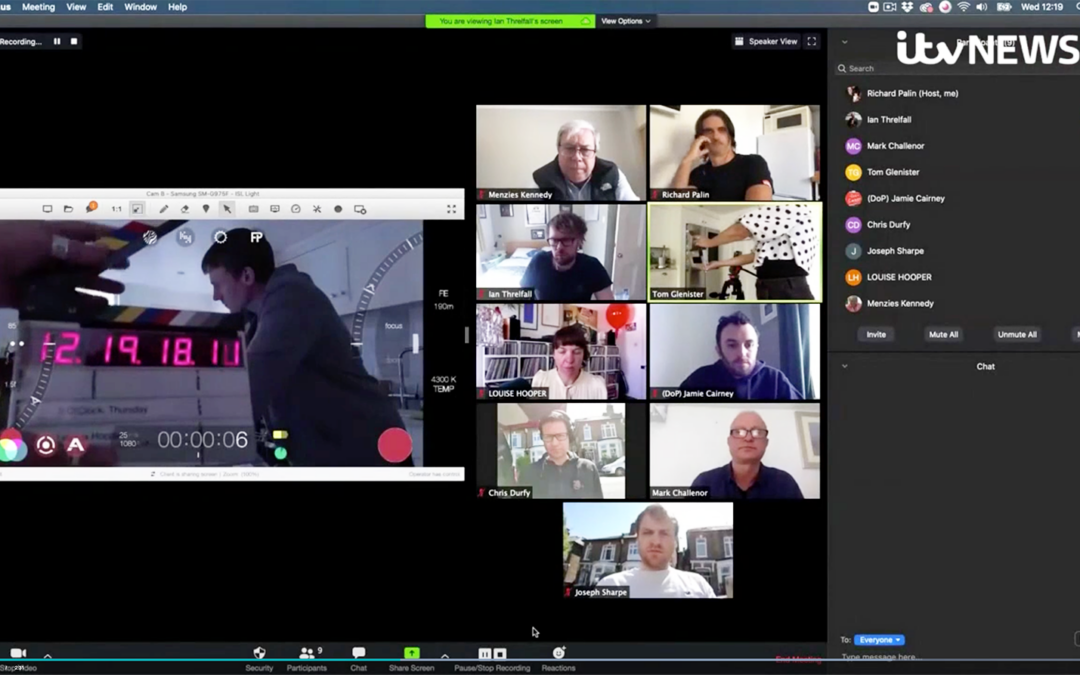
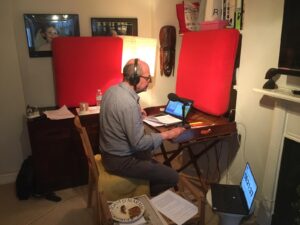 The need to provide safe working environments for staff has led to innovation in production techniques for both live and recorded shows. In radio, many presenters are working from home, contributing via IP-based systems from makeshift studios in front rooms, studies and basements, with clever use of home furnishings to provide sound deadening (our picture shows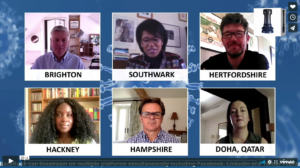
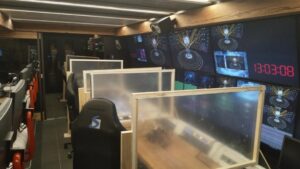 As, thankfully, the number of COVID-19 cases starts to decrease in many countries, the media industry is looking for ways to return to some level of normality. In Germany, football matches kicked off for the first time in many weeks over the weekend of 16/17 May, albeit played behind closed doors with no more than 300 people allowed into the stadia. Broadcasters were able to take the first matches with OB trucks deployed, with extensive social distancing in place using perspex screens between individual production teams’ positions and a reduced number of staff in the trucks (see photo, via SVG Europe).