France Télévisions Group hit by cyber attack

France Télévisions Group hit by cyber attack

France Télévisions Group hit by cyber attack

France Télévisions Group has been hit by a cyber attack that has impacted one of the Group’s websites although has not, apparently, caused programming to fall off the air.

The story, reported by Le Monde newspaper and confirmed in a press release issued by France Télévisions Group, reveals that although transmissions were not affected, the Group moved the output of France 3 to the headquarters building in Issy-les-Moulineaux and activated the broadcaster’s emergency backup centre.

The attack comes five years after French international broadcaster TV5 Monde was hit by a major cyber attack that affected the broadcaster’s output and its online presence. That attack took many months to fully recover from and cost the broadcaster significant sums to recover data and ensure that its systems were made more secure from attack.

The AIB instigated its Cyber Security Working Group as a result of the attack on TV5 and on Sony, bringing together our global membership to share intelligence and develop systems to help protect broadcasters from attack. The AIB is currently developing a broadcasting cyber security research project with the globally renowned Information Security department at Royal Holloway University of London.

Image of France Télévisions: Angel James de Ocampo/Flickr

BBC World Service delivers free minute bulletins in Nigeria

BBC World Service delivers free minute bulletins in Nigeria

BBC World Service delivers free minute bulletins in Nigeria

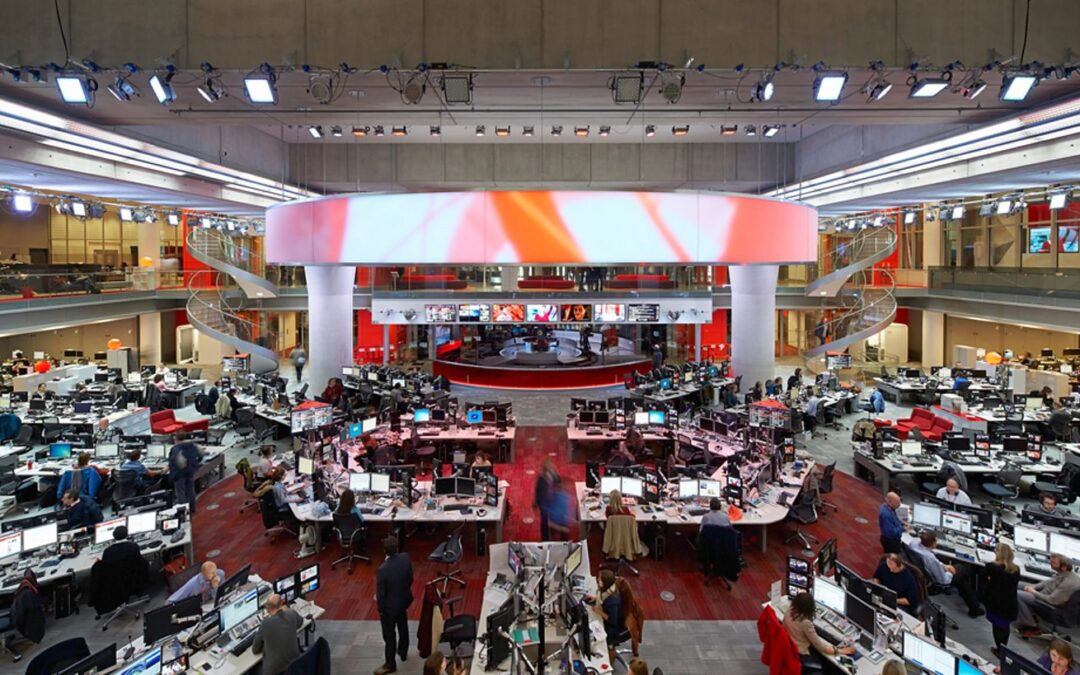
BBC World Service is partnering with MTN Nigeria to deliver BBC News Minute bulletins, free of charge to subscribers of the MyMTN App in English, Hausa, Igbo, Pidgin and Yoruba.

This is the first time an international news organisation will feature in the MyMTN App. BBC News Minute is the BBC’s 60-second news round-up that keeps audiences across different demographics up to date with what is trending and shared on social media as well as the latest local and global news – updated at regular intervals 24 hours a day seven days a week. It will showcase the latest news in sport, tech, entertainment, science and more to the BBC’s number one audience in Africa – Nigeria.

Audiences will be able to enjoy on demand BBC News Minute at various intervals during the day and night.

The partnership will serve Hausa, Igbo, Pidgin and Yoruba audience looking for curated short form news and bring BBC Minute in local languages to the fingertips of customers in Nigeria.

With the increase in fake news across Nigeria and the African media landscape this partnership will ensure that MTN customers receive accurate and verified news from the BBC.

MTN Nigeria is Africa’s largest provider of communications services, connecting over 64 million people in communities across the country with each other and the world. It has established an active community on the myMTN app with over four million monthly active users.

Oluwatoyosi Ogunseye, Head of West Africa Languages, BBC World Service says: “This partnership with MTN is at the core of the BBC’s commitment to reaching audiences wherever they may be. It is one of the ways in which the BBC is demonstrating its commitment to Nigeria and we are thrilled about this new engagement with young audiences in this country.”

Also speaking on the partnership, Chief Digital Officer, MTN Nigeria, Srinivas Rao says: “We are proud of this partnership. It is one of the ways we offer young Nigerians more channels to consume relevant information. In an era where fake news spread easily especially through social media, credible platforms like this make a lot of difference.”

Kolawole Oyeyemi, General Manager, Customer Experience, says: “It is also a demonstration of our passion to deliver the best customer experience possible to our customers who use myMTN App, so they have relevant and authentic news they can use on the go, completely free of charge.”

Mary Lusiba, Head of African Business Development, BBC World Service, says: “This exciting deal will raise brand and awareness of BBC World Service for young consumers. It will build on the well established reputation of the BBC for quality news and information and reach out to a new generation of Nigerians. The launch is timely as content will also update audiences on the Covid-19 pandemic in Africa.”

UN plans Pause: Take Care Before You Share “spike” day

UN plans Pause: Take Care Before You Share “spike” day

UN plans Pause: Take Care Before You Share “spike” day

As part of the United Nations COVID-19 Communications Response Initiative, the Department of Global Communications is planning a spike day/moment for the VERIFIED campaign on 30 June.

The spike day will push one central message “Pause: Take Care Before You Share”. Research shows that a significant way to reduce misinformation is by creating a culture of pausing, even for a few seconds, to reflect on the content before one shares it.

The design of the Pause: Take Care Before You Share campaign is to permit as much ownership as possible by those participating. While there are central assets available, we want to encourage you to adopt the language of the campaign and bring your own creativity and style to the messaging.

Ideas for engagement:

1. Provide advertising space such as pre-rolls or banner adverts for UN content
2. Commission journalists to write about the challenge of misinformation
3. Share the message “Pause. Take care before you share.” in your own brand identity on owned media channels

For more information, please contact Robb Skinner at skinner@un.org.

The AIB is a Member of the UN SDG Media Compact.

DW Global Media Forum kicks off, virtually

DW Global Media Forum kicks off, virtually

DW Global Media Forum kicks off, virtually

As restrictions on international travel continue, a range of conferences have migrated to the cloud, including Deutsche Welle’s Global Media Forum. It will launch the first in a series of online events on 24 June with a digital session on the responsibility of the media in times of the coronavirus pandemic. It is the first of a series of digital talks and will be hosted by DW journalist Jaafar Abdul Karim. A discussion titled “The blame game: What is the media’s responsibility in the corona crisis?” will take place on June 24, at 1500 CET (GMT/UTC +2) with speakers from Africa, Latin America and Europe and will be streamed on Facebook.  

The session will take a close look at how populists have hijacked the COVID-19 pandemic for their own gain. It will examine the trustworthiness of news outlets on which journalists are relying during the pandemic. It will also explore how journalists can combat misinformation and disinformation – tactics constantly employed by populists and demagogues.

The host is Jaafar Abdul Kari, an award-winning journalist and host of DW’s show Jaafartalk, which reaches an audience of millions in the Arab world.

The speakers:

John-Allan Namu, CEO of Africa Uncensored, Kenya

Africa Uncensored is an investigative and in-depth journalism production house in Nairobi, Kenya. Its aim is to be the premier source of unique, important and incisive journalism.

María Esperanza Casullo, Associate Professor at the University of Río Negro, Argentina

Casullo’s work focuses on populism, democratic theory and Latin American politics, with an emphasis on comparative studies and discourse analysis.

Guido Bülow, Head of News Partnerships Central Europe at Facebook, Germany 

Bülow is responsible for the strategic initiatives and programs to promote quality journalism and an informed society in the Europe, the Middle East and Africa (EMEA) region. These include cooperation with independent fact-checkers and Facebook’s accelerator program for local media.

More information on this session: https://p.dw.com/p/3dUfy 

Join the session here: https://www.facebook.com/events/281481139639894/

Attacks on journalists in US – AIB writes to Attorney General

Attacks on journalists in US – AIB writes to Attorney General

Attacks on journalists in US – AIB writes to Attorney General

Following the attacks on, and detention of, journalists covering the protests across the US that erupted after the death of George Floyd, the Association for International Broadcasting wrote to the US Attorney General William Barr.

Journalists and news crews from a number of AIB Member companies suffered attacks at the hand of US law enforcement officers, including injuries sustained from rubber bullets that were used against protestors in cities across the US.

The letter called on the Attorney General to respect the rights of journalists and news crews to work without hindrance. It highlighted the leadership role that the United States has in promoting democratic ideals across the world that the widespread incidents affecting the news media in the US have potentially damaged.

The AIB also wrote to the US Secretary of State Mike Pompeo, pointing out that the unlawful acts against journalists and news crews working in the US has the potential to endanger US journalists working in territories around the world as authoritarian governments use the example of the US to restrict media freedom.

“Journalists and news crews working for Al Jazeera, the BBC, CBC, Deutsche Welle and TRT WORLD among the AIB Membership suffered at the hands of US law enforcement agents,” said Simon Spanswick, AIB Chief Executive. “The attacks are unlawful, and the sheer volume is deeply troubling. We have called on the US to ensure that those responsible for the attacks are held to account for their actions.”

Photo: Lorie Shaull/www.lorieshaull.com

80th anniversary of iconic de Gaulle broadcast commemorated

80th anniversary of iconic de Gaulle broadcast commemorated

80th anniversary of iconic de Gaulle broadcast commemorated

Thursday 18 June marks the 80th anniversary of General Charles de Gaulle’s historic first broadcast to occupied France from the BBC’s Broadcasting House.

Just days after Paris surrendered to the invading Nazis, General de Gaulle made on the BBC his first broadcast to France, in which he called on the French soldiers and officers, military engineers and workers in the armament industry, who were or would be on the British soil, to rally under his command in London. “I ask you to believe me when I say that the cause of France is not lost… For, remember this, France does not stand alone… Whatever happens, the flame of French resistance must not and shall not die.”

The BBC’s Director General, Tony Hall, says: “Eighty years ago today, the BBC gave its airwaves to General Charles de Gaulle to address the people of occupied France. He called on them to keep the ‘flame of resistance’ alive. Although the world is very different today, there are still many places where media freedom is under threat. I’m proud that it is still the BBC World Service which allows people to speak freely to their compatriots.”

The broadcast, L’appel du 18 juin, became a defining moment of the French history. This and the following BBC broadcasts by de Gaulle – for which he was condemned in France to death for treason against the Vichy regime – helped to rally the French resistance movement and lift morale in the occupied country.

After the war, to thank the BBC for its singular World War Two broadcast contribution, the French government presented the BBC with a specially commissioned tapestry ‘Le Poète’ [pictured] made by Jean Lurçat, inspired by a poem by Paul Éluard, ‘Liberté’. A metaphor for the role of the Resistance in fighting against Nazism, but also for the importance of broadcasting and freedom of speech, it hangs in the Artists’ Lobby at the BBC’s Broadcasting House.

Photo credits: BBC