Organisations Launch Project Against Disinformation

Organisations Launch Project Against Disinformation

WASHINGTON, D.C. – Advances in technology to manipulate information and to spread disinformation have created a very real threat for media outlets and users alike. Fact-checking digital content on the internet and social media has become a top priority together with promoting media literacy. The DG7 members are entering into a long-term commitment for developing an effective response to the threat of AI-generated false information.

The members of DG7 are committed to collaborating on tools for validation and verification of digital content ranging from written articles to video. These are “Project Origin”, which was initiated by CBC/Radio-Canada, New York Times and the BBC as well as DW’s “TrulyMedia”. The cooperation to further develop these tools will lead to content on third-party platforms being published with proof of provenance, enabling users to distinguish objective news from disinformation. In this context, the DG7 are calling on social media companies to combat disinformation and protect digital platforms as a space for free expression.

The DG7 also discussed effective measures to counter the increasing pressure on the freedom of the press around the world, which ranges from censorship to the intimidation and the threatening of journalists.

The DG7 members stressed the profound importance of objectively distinguishing between public service media organizations, which are operating with editorial independence and state-controlled media entities.

With over a billion total weekly users, the DG7 broadcasters have a significant journalistic impact worldwide. Audiences and users, particularly in the world’s most repressive countries, rely on consistently trustworthy, fact-based reporting to circumvent censorship, disinformation, hate speech, and propaganda.

The DG7 calls on governments around the world to respect press freedom, to ensure the safety of journalists and their families, and to reject any legislative action which could lead to a system of law that criminalizes independent media.

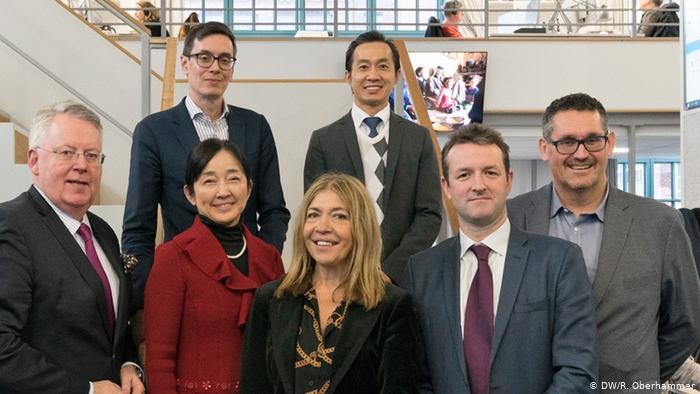
The DG7 comprises publicly funded international public service media organizations from seven democratic nations: ABC Australia, CBC/Radio-Canada, France Medias Monde, Deutsche Welle, NHK World-JAPAN, BBC World Service and U.S. Agency for Global Media, represented by their respective directors general or chief executive officers and heads.

Five programmes from BBC News Persian add to Ariana News TV schedule

Five programmes from BBC News Persian add to Ariana News TV schedule

Five programmes from BBC News Persian are adding to the schedule of one of Afghanistan’s leading national TV channels, Ariana News.  Thanks to this rebroadcasting collaboration, BBC News Persian will now bring Ariana News viewers the flagship news and analysis programme Shast Daghigeh (60 Minutes), Saturday to Wednesday, and the weekly programmes: the current-affairs programme Safheh Do (Page 2 weekend), the interview programme Be-ebarat-eh Digar (HARDtalk), the debate programme Pargar (Compass), and the guide to digital technology, Click.

BBC News Persian has a global weekly audience of 21m on TV, radio and digital. It currently reaches around 8.5m people in Afghanistan every week.

The BBC reaches 12.1m people in Afghanistan every week – 59% of the adult population – with content from BBC News Afghan in Pashto and Dari, BBC News Persian, BBC News Uzbek and the BBC’s English-language news content on radio, TV and digital.

BBC World Service Director of Business Development, Simon Kendall, says: “We are delighted that through this new partnership with Ariana News a suite of BBC News Persian programmes will be available to audiences in Afghanistan. We are excited to be increasing BBC presence on TV in the region and we hope that audiences will enjoy our programmes alongside our digital and audio offer. We look forward to working with Ariana as we establish this important new agreement.”

Ariana News is part of Ariana Radio & Television Network (ATN).  ATN’s Managing Director, Ali Kasemi, adds: “ATN was founded in 2005 with a mission to provide our viewers with a ‘Window to the World’ so that all Afghans could watch, share, and enjoy the best global news, entertainment, sports and information from around the world.  We are very proud to be adding BBC News Persian’s award-winning programming to our content package, and we see this partnership as an exciting continuation of our commitment to bring the world to Afghan viewers and families around the nation.”

Shast Daghigeh will air at 23.00 Kabul Time Saturday to Wednesday; Pargar – 12.00 on Sundays; Be-ebarat-eh Digar – 20.30 on Tuesdays; Safheh Do – 23.00 on Thursdays; Click – 21.30 on Fridays.

BBC News Persian TV is broadcast via satellite (Hotbird, YahSat and Telstar 12) and is streamed live online (and available on demand) on bbc.com/persian and YouTube.  BBC News Persian also reaches its audience via Facebook, TwitterInstagram and Telegram.  BBC News Persian radio broadcasts are visualized, enabling audiences to also watch radio programmes on TV and digital platforms.

AIB condemns asset freeze on Iran International staff and jamming of channel

AIB condemns asset freeze on Iran International staff and jamming of channel

Iranian government’s action mirrors attack on BBC Persian

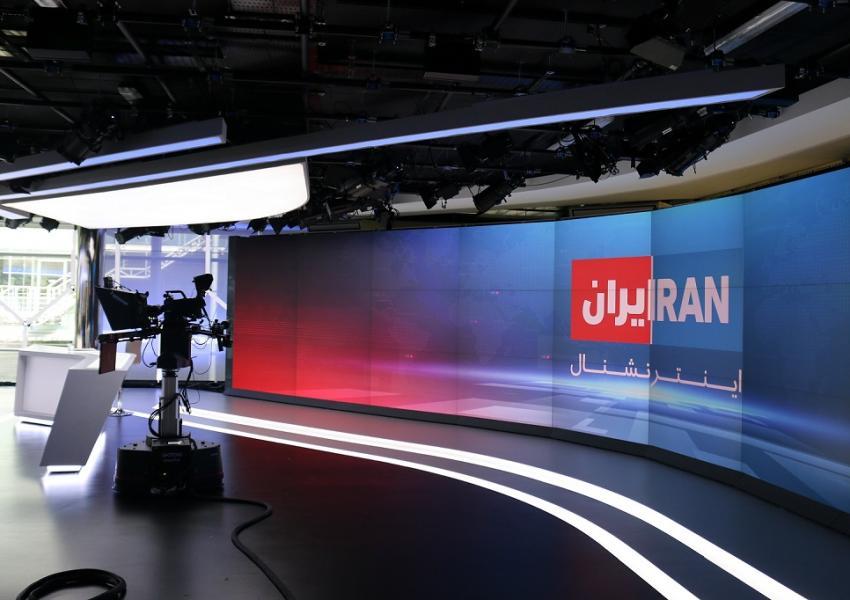
The Association for International Broadcasting today condemned the freezing of assets of journalists working for London-based Iran International by the Iranian authorities.

The move, reported by the Fars news agency in Tehran, imposes legal restrictions on journalists working at Iran International, the Persian-language TV network that broadcasts news, current affairs and feature programmes from its headquarters in west London. The asset freeze come in the wake of the Iranian government’s failure to stop reporting by Iran International of the crack down on protestors in the country following the threefold rise in petrol prices.

The asset freeze and legal restrictions mirror the actions taken by the Iranian authorities against BBC Persian journalists and staff based in the United Kingdom two years ago. The scale and severity of the Iranian authorities’ actions led the BBC to file a complaint at the United Nations, the first time the Corporation had taken such a step.

In addition to the asset freeze, Iran International’s satellite television signal has been jammed as the authorities in Tehran attempt to prevent viewers in Iran watch the channel.

“We are appalled by this latest attempt by Iran’s government to silence journalists who are reporting news from and about Iran,” said Simon Spanswick, Chief Executive of the Association for International Broadcasting. “The Iranian government is once again trying to use a jurisprudence dragnet to intimidate journalists and their families. At the same time, it is seeking to restrict access to news and information by its own citizens. The Association for International Broadcasting and its Members – who collectively serve audiences of over one billion people every week – call on the Iranian government to immediately cease from this act of harassment and intimidation and to lift the asset freezes immediately. The jamming of the channel’s signal must also end.”

In March 2019, the UN Special Rapporteur on Iran deplored the harassment of BBC Persian staff and reiterated the seriousness of the persecution of BBC staff, which included the publication of fake and defamatory news to undermine the reputation of BBC Persian journalists.

The Iranian authorities ban both Iran International and BBC Persian in the country. Despite the restrictions, both broadcasters reach significant numbers of people in the country, counted in the millions.

The AIB is supporting its Members around the world through its Media Freedom Initiative that seeks to increase the cost of infringements of media freedom to governments and other actors.

Sudan PM says international broadcasters welcome back in country

Sudan PM says international broadcasters welcome back in country

Sudan‘s newly appointed Prime Minister, Abdalla Hamdok, has told a meeting at the United Nations that international broadcasters are welcome back in the country to help build a democratic and free society.

At a UK-organised ministerial meeting on media freedom held at the UN headquarters in New York on 25 September, Hamdok said that he “grew up in Sudan in the 60s and 70s, where the BBC radio was probably the only source of international information for people. And the paradox, years after that, [is that the] BBC was prohibited from broadcasting from Sudan and people were not having access to it.”

He confirmed that the BBC was now allowed back onto FM in the country after an absence of a number of years. He also said that Monte Carlo Doualiya has been restored and that Al Jazeera which had also been banned was now back in the country. Not only were the broadcasters back on the air, but the country’s government is “very determined to create an environment that is open and allow journalists unfettered access to information but also to reporting, anywhere.

“This is actually not giving them any kind of privilege. It is good for our people. Free society, free people can only be productive, can be useful in their own lives but also for society. So I’m doing it precisely because of that.”

“The announcement by Sudan’s Prime Minister confirming the opening up of the country’s airwaves is highly positive,” said AIB Chief Executive Simon Spanswick. “It is good that AIB Members including the BBC, Al Jazeera and Monte Carlo Doualiya are now permitted to broadcast across the nation. The additional commitment to allowing journalists to report from the entire country is an immense step forward for the country and we look forward to supporting the Sudanese government and the international media community to develop Sudan’s media industry.”

The UN meeting, chaired by the UK’s special envoy on media freedom, Amal Clooney, also heard from Lord Ahmad, Foreign Office Minister, and Audrey Azoulay, UNESCO Director-General, all of whom spoke about the increasing need for media freedom globally and the Media Freedom Coalition to which 32 governments have agreed to join.

Journalist Mahmoud Hussein marks 1,000 days in Egyptian jail

Journalist Mahmoud Hussein marks 1,000 days in Egyptian jail

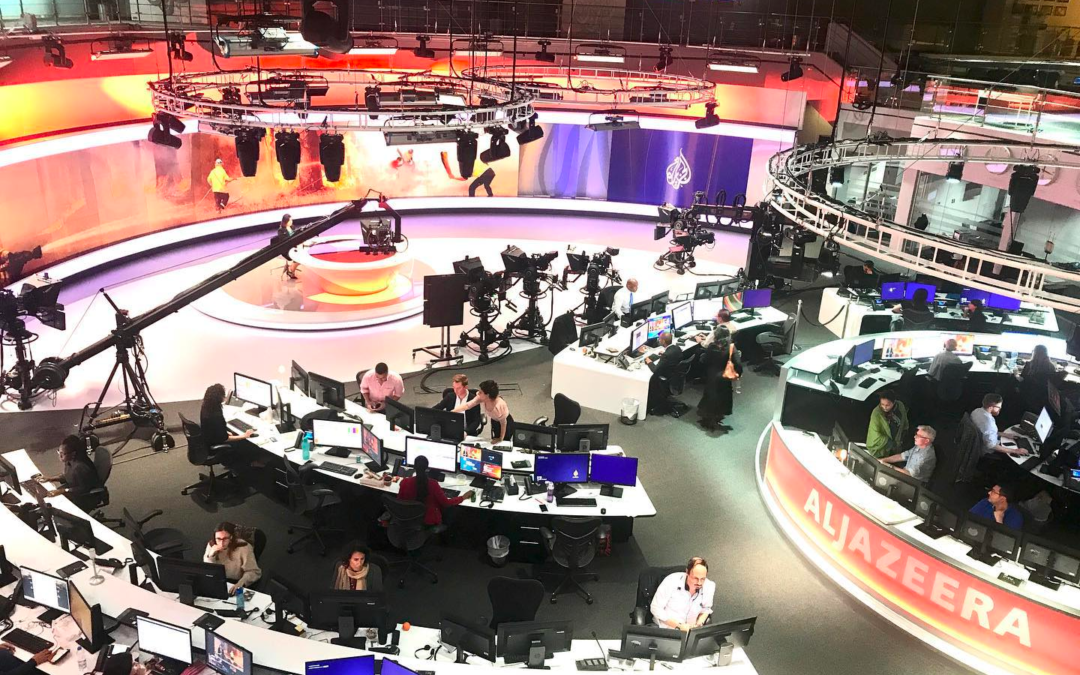
19 September will be the 1,000th day that Al Jazeera journalist Mahmoud Hussein has spent behind bars after being detained by Egyptian authorities while visiting his family in December 2016.

NC1362

Al Jazeera Media Network has renewed its call for the immediate release of Mahmoud Hussein. On 23 May 2019, a court in Egypt rejected the appeal by the prosecutor for the continued detention of Mahmoud and ordered his release from prison. However, in defiance of the court order, the authorities opened a new investigation against him with unspecified charges and has returned him to prison. The Network strongly condemns the Egyptian authorities’ decision to return Mahmoud Hussein to Tora prison despite the court ruling he be released. Mahmoud is being detained by the Egyptian government in flagrant violation of international law and an infringement of his fundamental rights.

The Association for International Broadcasting joins with Al Jazeera and other media organisations in calling on the Egyptian authorities to release Mahmoud Hussein immediately.

Egypt continues its crackdown on media freedom. The country has the greatest number of journalists detained in any country in the world. Mahmoud Hussein has been robbed from 1000 days of his life with no end in sight, all without legal justification. Al Jazeera continues to strongly condemn this and refutes all charges against him and calls on the international community, media professionals, and human rights advocates to raise awareness and demand his immediate freedom.

On Thursday 19 September 2019 Al Jazeera Media Network is launching a solidarity campaign coinciding with the 1000 days of detention of Mahmoud Hussein. The campaign aims to focus on publicising the inhumane conditions he endures under detention, and to mobilise support and shed light on his case and call for his immediate release. As part of the campaign an online petition demanding his immediate release has been launched, and it can be accessed at www.FreeMahmoudHussein.com.

View a short report on Mahmoud Hussein’s detention and the international solidarity campaign here:

Viewsat Announces New Name and Expansion of Services at IBC2019

Viewsat Announces New Name and Expansion of Services at IBC2019


Award-winning company is renamed Viewmedia

Viewsat, an established operator in the global media broadcast industry, announced its new name – Viewmedia – to reflect the expansion of their portfolio in order to service the requirements of broadcasters worldwide, the company announced at IBC (12 September 2019).

To facilitate this new development, the company has been rolling out a range of new services across the past six months including:

  • the launch of media and OTT services globally, including social media streaming
  • the launch of extended platform delivery with managed services to any platform anywhere
  • the launch of VS play, the company’s Playout solution which is seamlessly integrated with Phoenix 7

In addition to the above developments, Viewmedia will expand its satellite services.

CEO, Awaes Jaswal said: “For 13 years, our company has been passionate about finding solutions in delivering our clients’ content, while offering affordable broadcast services and world class customer care. We are now expanding the options to continue to meet our customers’ requirements.”

“Our service is flexible and tailored to suit each client and their business needs, and we are delighted that our new name now clearly reflects our portfolio of services.” Added Sandra Squire, Business Development Director.

Viewsat was founded in 2006 with clients predominantly in the Middle East and sub-Saharan Africa. Today, it provides broadcast services to 150 customers ranging from entertainment to news channels.