CDC excludes US international broadcaster – VoA responds

CDC excludes US international broadcaster – VoA responds

CDC excludes US international broadcaster – VoA responds

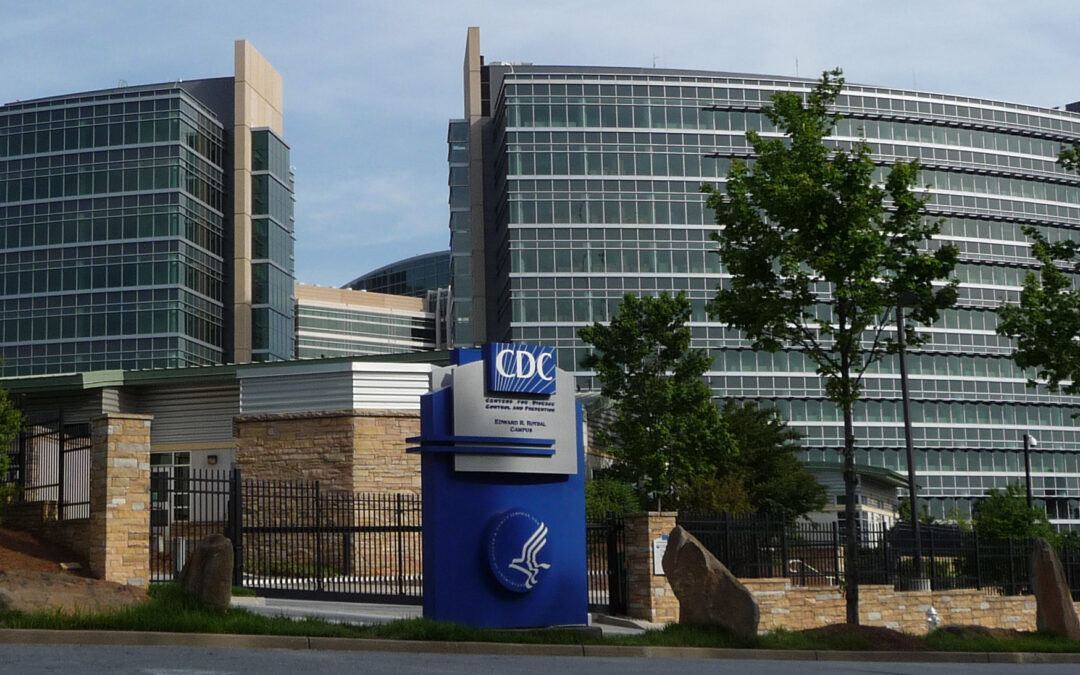
In an extraordinary situation uncovered through a Freedom of Information request by the Knight First Amendment Institute in  the USA, it has been revealed that the US Centers for Disease Control [CDC] has issued instructions that media requests from the Voice of America before they are sent to the Department of Health and Human Services or Office of the Vice President must not be approved.

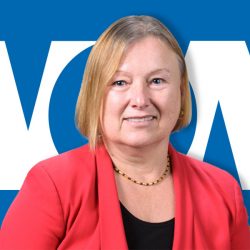
In a statement, VoA Director Amanda Bennett (pictured) said:
“We were shocked to read the internal CDC documents instructing the agency’s media relations office to refuse media requests from “anyone associated with Voice of America,” citing White House tweets accusing VOA of spreading Chinese propaganda. VOA, a federally-funded independent news organization, strongly rejects the accusations and calls on the CDC to immediately withdraw the instructions. The CDC documents were released this week in response to a Knight First Amendment Institute’s FOIA request.

“For a federal agency’s public affairs office to categorically deny in advance interview requests from VOA journalists, including our colleague Greta Van Susteren, based on a White House opinion statement referring to an Associated Press story about COVID-19 shared by the VOA newsroom as “propaganda,” is even more troubling.

“VOA issued a public response to that charge on April 10th – the same day as the White House statement was issued. A copy of our statement is here: https://www.insidevoa.com/a/a-statement-from-voa-director-amanda-bennett-/5367327.html

“Since this memo denying VOA journalists access to CDC officials was issued on April 30, 2020, it is impossible to immediately discern its effect on our coverage of the pandemic since that date across all of our newsrooms that report in 47 languages to audiences in nearly 100 countries.

“However, efforts such as those outlined in the CDC memo can result in the kind of chilling effect on our journalism that we regularly see in the markets we broadcast to that have no free press – including in China and Russia.

“As with any other major media outlet, VOA has clearly outlined editorial standards and a robust corrections policy. If the CDC – or any other organization – believes there are any errors in any VOA news stories, we encourage them to contact us immediately for a swift and thorough review so that any such errors can be corrected.”


RT’s 2020 Khaled Alkhateb awards for war journalism open for entries

RT’s 2020 Khaled Alkhateb awards for war journalism open for entries

RT’s 2020 Khaled Alkhateb awards for war journalism open for entries

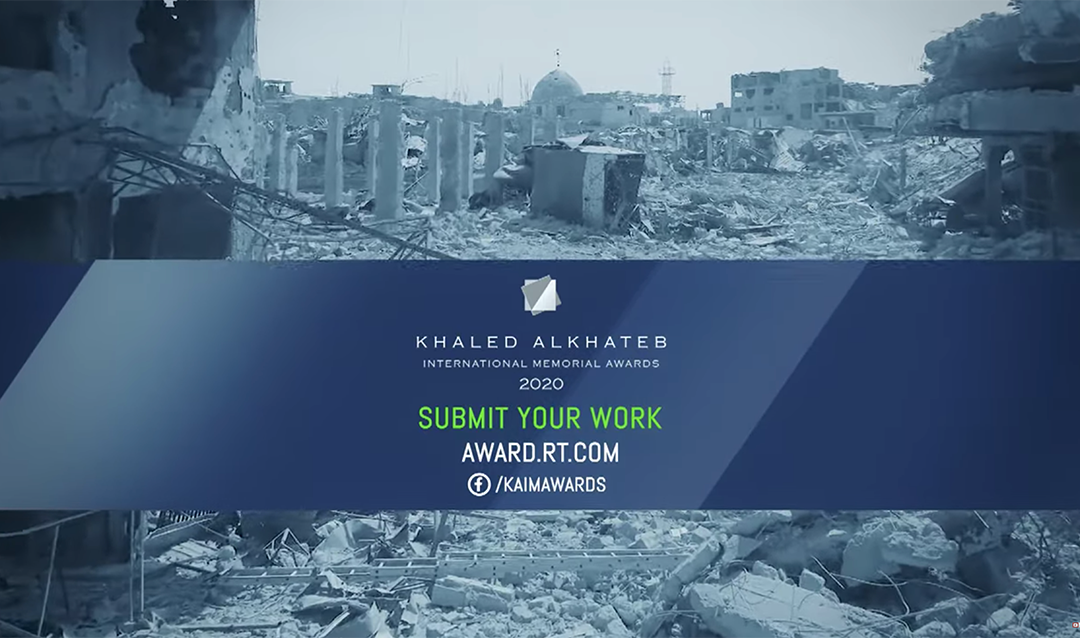
RT is now accepting entries for the 2020 Khaled Alkhateb Memorial Awards, an annual international competition that recognises the best journalism from conflict zones. The competition, now in its third year, was established in honor of RT Arabic freelancer, Khaled Alkhateb, who died in 2017 while reporting from the frontlines in Syria. 

The Khaled Alkhateb Memorial Awards is presented in three categories: Best Video Journalism from a Conflict Zone: Long Form; Best Video Journalism from a Conflict Zone: Short Form; and Best Written Journalism from a Conflict Zone.

The inaugural year of the competition in 2018 saw entries from more than 20 countries in 10 different languages. The winners were journalists from Iraq and Ireland, whose reporting shed light on the situation in Iraq and Syria following the expulsion of ISIS, and a journalist from Singapore for her coverage of the seizure of Marawi, Philippines by ISIS terrorists. Judging was conducted by an international jury of news media professionals and experts on the subject of war and armed conflicts, including former CBS correspondent Philip Ittner and the Association for International Broadcasting’s Tom Wragg.

In 2019, the jury selected the best entries from 25 countries. Journalists from Russia, the US, Italy, and India took top honors for their reports about conflicts in Syria, Iraq, and Libya. The 2019 awards ceremony took place as part of the RT Media Talk – ‘Covering Conflict: Dimensions, Risks And Responsibilities Of Journalism In The Hot Zone’. Acclaimed journalists from all over the world discussed impartiality when covering international conflicts, debunking fake news from the frontlines, and other important issues facing today’s media.

The winners of the third annual Khaled Alkhateb Memorial Awards will be announced on July 30, which marks the day on which 25-year-old RT Arabic stringer Khaled Alkhateb was killed by ISIS shelling in Homs, Syria, in 2017. Khaled had been covering the fighting between Syrian government forces and terrorists.

Find out more and submit your entry at https://award.rt.com/.

Promo https://www.youtube.com/watch?v=2xO_KKJmjmw

International Public Service Media’s essential role in global fight against the COVID-19 pandemic

International Public Service Media’s essential role in global fight against the COVID-19 pandemic

International Public Service Media’s essential role in global fight against the COVID-19 pandemic

Since the beginning of the global health crisis linked to the Covid-19 pandemic, the seven members of the DG7 group of international public service media (comprising France Médias Monde, Deutsche Welle, BBC World Service, USAGM, NHK World, CBC/Radio-Canada and ABC Australia) have recorded strong audience increases, illustrating the confidence of global audiences in the reliable and independent information they deliver on television, radio and digital media, in a large number of languages, on all continents.

The organisations have adapted to the consequences of the crisis and their teams – journalists, technicians, correspondents, part time workers and employees – have mobilised to pursue their mission tirelessly, informing people about the new coronavirus and helping to combat its spread by delivering prevention messages, in conjunction with the health authorities.

The international public service media in the seven countries have opened their platforms to the best scientific experts and specialists, to major political and economic leaders, on all aspects of the worst pandemic the world has seen in decades.

The fight against the proliferation, particularly on social networks, of fake news about the disease and its treatments has mobilised all the DG7’s editorial offices, which are used to cooperating in this field at a time when, more than ever, reliable information is protecting lives.

The international media are on the front lines, in all languages, even in the remotest corners of the globe to deliver reliable information, but also to entertain by bringing culture to life and artists to express themselves, or to educate by ensuring, through dedicated programmes, a mission of educational continuity for children and their parents.

The humanist values of solidarity that underpin our action have led the DG7 media to join in the worldwide drive to pay tribute to healthcare personnel, researchers and all frontline workers, and to pay special tribute to women, whose role has often been crucial at all levels of society. They have also sought to raise awareness of the increase in domestic and family violence in times of lockdown and how to prevent it.

The DG7 content is global and universal, but it is also local, thanks to their multilingualism, which makes it possible to reach the citizens of the world in their mother tongues, and to the hundreds of reports produced on the ground every day by their networks of correspondents in all countries.

DG7 leaders say that this period should encourage us to draw lessons about the way the world works and changes, about social relations, about the importance of public services and access to information. Their media contribute to the international reflection and debate needed to build the post-pandemic future and make the most of it.

This common mission at the service of the general interest, democratic values and freedom of expression, which brings us together, is particularly illustrated in the light of the health crisis. DG7 say they will do their utmost to build on on this public confidence in our media, which is more precious and greater than ever.

With more than one billion weekly users, DG7 media play a major role in the world in the service of free information.

All DG7 broadcasters are members of the Association for International Broadcasting.

DG7 members :

  • Marie-Christine Saragosse, Chairwoman and CEO, France Médias Monde
  • Peter Limbourg, Director General, Deutsche Welle
  • Jamie Angus, Director, BBC World Service Group
  • Grant Turner, Chief Executive Officer and Director, USAGM
  • Takai Takaaki, Managing Director, NHK World-Japan
  • Catherine Tait, President and Chief Executive Officer, CBC/Radio-Canada
  • David Anderson, Managing Director, ABC Australia
Thinking about Documentaries: A guide for potential documentary production

Thinking about Documentaries: A guide for potential documentary production

Thinking about Documentaries: A guide for potential documentary production

Logo of the Asia Pacific Broadcasting UnionJoin us for a webinar beginning on May 30, 2020 at 4:00 PM SGT.

Register now

ABU is presenting a Four – Part Workshop: Thinking about Documentaries. The four sessions will be held on 30 May, 31 May, 6 June and 7 June respectively.

The series will identify a way of approaching documentary programmes and films through history, technical developments and the processes required for successful productions. The four sessions will be:

  1. An introduction to Documentary making – Unraveling the “factual jigsaw” from news, features and current affairs to documentaries (30 May).
    2. The Documentary Maker … a brief history of genres into documentary development and trends of documentary making (31 May).
    3. A Documentary Template…… from concept to transmission (6 June).
    4. The Surgery. Participants’ ideas and questions… suggestions and feedback (7 June)WHO’S IT FOR

Broadcasters and associated professionals, who wish to expand their knowledge, skills and ability in factual programme making.

MEET THE TRAINER

Russell Isaac is a broadcaster with 40 years experience and has conceived, presented and produced documentaries since 1982. Working across the globe, he has produced programmes for the BBC, ITV, S4C, ESPN, Sky, Al Jazeera etc. and has tutored and guided documentary makers in Asia,the Middle East, Africa, Europe and Latin America. From an academic background in Social Science Russell became a TV and Radio broadcaster in news and current affairs reporting, presenting and producing from conflict and disaster zones across the world. For 20 years he was Managing Director of a number of UK Independent production companies producing documentaries and sports and was also a senior training consultant for the Thomson Foundation. He is currently a media consultant on Climate Change and Societal Development for a variety of international companies and organisations. He graduated from UCNW, Bangor University, Wales and conducted his MA research for the Social Science Research Council.

After registering, you will receive a confirmation email containing information about joining the webinar.

View System Requirements

Voyager Media Awards Recognise RNZ Journalism

Voyager Media Awards Recognise RNZ Journalism

Voyager Media Awards Recognise RNZ Journalism

RNZ excellence in journalism has been recognised at the prestigious Voyager Media Awards announced on 22 May 2020. The annual awards celebrate the very best in print, digital and broadcast journalism on all media platforms across New Zealand.

RNZ journalists have won an unprecedented seven Voyager awards and have received judging commendations as runners-up in two categories.

Guyon Espiner has won the coveted Reporter of the Year Award, with judges noting that he broke one of the biggest political stories of the year and demonstrated a strong commitment to reporting issues of public importance. Espiner’s Voyager award follows his recognition last week as Best News Journalist at the New Zealand Radio Awards.

RNZ podcasts have dominated in Voyager digital categories winning two awards. The RNZ / Stuff production, White Silence, has won Best Narrative Podcast – also backing up from a double success at last week’s New Zealand Radio Awards, and the Voyager award for Best Episodic Podcast is He Kakano Ahau, a collaboration with Ursula Grace Films.

Aaron Smale (Ngāti Porou), is the Voyager Feature Writer of the Year for his longform, hard-hitting, journalism addressing the impact of inequality on Māori. Judges said his work is deeply moving and beautifully written.

Te Aniwa Hurihanganui (Ngāti Porou, Ngāti Tuhourangi, Ngāti Tuwharetoa) receives the Te Tohu Kairangi trophy for Best Reporting – Māori Affairs. She was the inaugural recipient of the Henare te Ua Māori Journalism Internship established in 2017 by Radio New Zealand to support Te reo Māori and foster Māori journalism.

RNZ’s Logan Church won Best Junior Reporter for his insightful and compelling live radio cross in the aftermath of the Christchurch terrorist attack, with judges saying he displayed skills beyond his years.

In video journalism, Luke McPake was recognised as Best Feature or Current Affairs Video Journalist for Death Bed: The Story of Kelly Savage, which was described as captivating, powerful and creative storytelling.

Judging commendations as runners-up have been received by Phil Pennington in the individual Reporter of the Year category and the RNZ team for its investigation of the eviction of Tamaki state house tenants.

RNZ CEO Paul Thompson (pictured) congratulated all RNZ winners and finalists.

“These awards showcase excellence in New Zealand news and current affairs and I am proud to see our staff recognised as finalists and winners for their brilliant work – among such outstanding contenders. RNZ is committed to high quality, independent, and credible journalism and we value the opportunity to celebrate the industry with colleagues who represent the very best in New Zealand”

RNZ Voyager Media Award Winners for 2020:

Reporting

Guyon Espiner – Reporter of the Year

Te Aniwa Hurihanganui – Best Reporting – Māori Affairs

Logan Church – Best Reporter – Junior

Feature Writing

Aaron Smale, Feature Writer of the Year – Long Form

Video Journalism and Broadcasting–

Luke McPake, Best Feature of Current Affairs Video – Single Journalist

Digital

White Silence (RNZ/Stuff), Best Narrative Podcast

He Kakano Ahau (RNZ/Ursula Grace Films) Best Episodic Podcast

RNZ Runners-up are:

Phil Pennington – Runner-up Reporter of the Year RNZ- Runner-up Best Team Investigation

A full list of the 2020 Voyager Media Awards can be found here:

https://voyagermediaawards.nz/winners2020

Why freedom abroad affects us all

Why freedom abroad affects us all

Why freedom abroad affects us all

The CEO and Director of the U.S. Agency for Global Media, Grant Turner, has written about the importance of the work of USAGM broadcasters internationally

 
Just over four months ago, on December 30, a young Chinese ophthalmologist who worked at the central hospital in Wuhan, China, tried to warn colleagues about a contagious infection he’d noticed in several patients.
 
Within days, he was warned by police about “making false comments” and ordered to return to work. Months later, the infection he rang alarm bells about had made its way around the world and killed more than 80,000 Americans.
 
It’s impossible to know how many lives were lost as a result of silencing Dr. Li Wenliang. But it has never been more evident that freedom of information in other countries affects the lives of those in the United States.
 
Dr. Wenliang’s story is tragic, but unfortunately, not rare. For years, China has had one of the most repressive media environments in the world. But the explosive growth of coronavirus cases, as well as critical reporting on the government’s response to it, have only exacerbated censorship and repression of independent media and citizen journalists alike.
 
Personal attacks-like the one on Dr. Wenliang and other truth-tellers-and the subsequent oppressive media environment they create, are just two strategies for silencing the truth that is now amplified by the pandemic.
 
For example, according to the U.S. Department of State, Iran’s lack of transparency about its coronavirus outbreak has resulted in a devastating public health risk to the Iranian people, as well as to the region.
 
In taking a similar approach to obfuscating the facts, the governments of Hungary, Thailand, and Cambodia have made legislative moves to ban so-called “fake news.” In fact, they are using these powers to silence critics.
 
Even in environments where media exists in a free market, the coronavirus’s negative impact on advertising spends has been catastrophic for many independent and alternative publications.
 
These challenges to media environments are being augmented by the global health crisis. As press freedom declines around the world, the importance of the universal right to a free press has never been more apparent.
 
Journalists everywhere, including those who work for the public service networks of the U.S. Agency for Global Media (USAGM), are facing increasing risks while reporting on the pandemic. They are routinely harassed and threatened just for reporting the news. Three of USAGM’s journalists are currently in jail, and eighteen have been killed in the line of duty.
 
And, in this global health crisis, the threats are more complicated. Not only are governments taking stronger action against journalists, but reporters must also physically distance themselves to avoid contracting the virus.
 
As the Columbia Journalism Review so eloquently put it, newsrooms have had to make decisions about “how to keep an industry that relies on human contact running, even as public health experts and government officials mandate social isolation.”
 
I can say, without equivocation, that USAGM’s networks and others are managing those difficult decisions with clarity, insight and fortitude. Journalists around the world are essential workers – reporting the truth, engaging audiences and connecting people, despite the logistical challenges of reporting during a pandemic.
 
Before the health crisis began, research indicated that more than 350 million people each week seek out content from USAGM’s five networks-some with support from our newest entity devoted to internet freedom, the Open Technology Fund-despite the best efforts of governments to block it. Now, even more, audiences are seeking out our news and information.
 
The world marked World Press Freedom Day on May 3, and we reflected on the essential services journalists provide, especially during this unique time in history. By reporting on the spread of the virus and how the public can protect themselves, and by holding governments accountable for their public health response, journalists reporting in one country have the power to save lives in another. For that, we owe them a tremendous debt of gratitude and our ongoing commitment to protect them and their work.