India’s public service broadcaster helping nation

India’s public service broadcaster helping nation

India’s public service broadcaster helping nation

Prasar Bharati, India’s public service broadcaster, reports that it has been receiving accolades and praise from all over the world for its multidimensional approach to public service broadcasting during the COVID-19 pandemic.

A key element of this approach is the combination of high frequency infomercials on COVID-19 with iconic TV shows based on Indian epics such as RAMAYANMAHABHARAT, CHANAKYA and others. Similarly, All India Radio (AIR), the radio service of Prasar Bharati, has been regularly broadcasting the government advisories at high frequency while engaging celebrated authors such as Mr. Ruskin Bond to use the power of radio for some old fashioned book reading and story telling.

The re-telecast of RAMAYAN has seen more than 200 million viewers tuning in during the entire episode while the highest viewed episode with an audience of 77 million established a global record.

The Wall Street Journal (WSJ) on 28 April 2020 published an article titled “Coronavirus lockdown creates captive audience for 80’s show” highlighting how the series engaged audiences across India during the nationwide lockdown

Similarly, the British Broadcasting Corporation (BBC) on 4 May 2020 published an article titled “The Ramayan: why Indians are turning to nostalgic TV” covering a range of aspects of the popularity of the Doordarshan TV shows and has given a comparison of viewership garnered by the RAMAYANA and popular international TV shows.

Al Arabiya relaunches with new technology and design

Al Arabiya relaunches with new technology and design

Al Arabiya relaunches with new technology and design

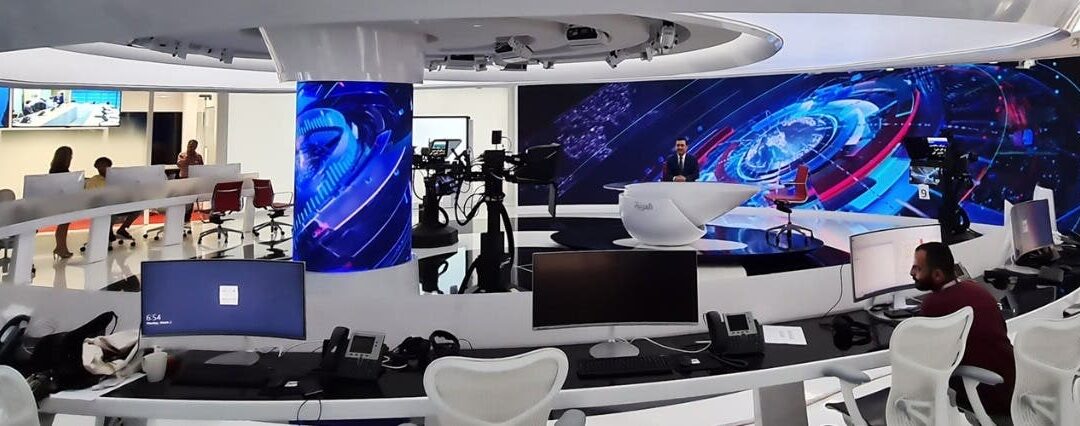
Dubai-based pan-Arabic broadcaster Al Arabiya has unveiled new technology, studios and design across its television and digital platforms in a move designed to retain its top spot in a highly competitive market.

The Al Arabiya News Channel, a 24/7 free-to-air news and current affairs satellite outlet, is ranked the top news channel across many countries in the region, reaching 36 million viewers a week. The network has seen strong growth in its social and digital platforms, including Al Arabiya English and other foreign language editions, with more than 20 million users viewing 88 million web pages every month.

“We are relaunching with new studios, a new design and more importantly, taking advantage of new technologies that will take the viewer into the next generation of journalism across not only our television screens but also our social media and digital offerings,” said Mamdouh Almuhaini, General Manager of the Al Arabiya Media Network. “The network has always stayed ahead of the curve compared to its competitors by renewing itself either through branding or improving its content.”
 

Partnering with global companies


The revamp involved rebuilding the broadcast studios in Dubai’s Media City to integrate new technology and set design. Al Arabiya partnered with New York-based Clickspring Design for the set design. The new studios are equipped with robotic Blackcam cameras that will enable the viewer to have a more immersive experience, showing not only the anchor but also the dozens of writers, reporters and editors that bring the content alive. Al Arabiya collaborated with Ross Video, whose Cambot cameras allow viewers to move anywhere around the studio floor. The network partnered with Belgian company Barco to deliver networked visualisation solutions.

New ‘organic and younger’ branding

Al Arabiya is also launching a new visual identity including an evolved logo, new on-air graphics and an updated font. The redesign of Al Arabiya’s unique Arabic font is the first since the channel launched in 2003.

“We created the original Al Arabiya font 17 years ago and it was the first font to be used on-screen. The font became so popular that it spread everywhere, being used by so many designers in the world, including big brands, as showcased on so many billboard brands and places,” said Fadi Radi, Head of Creative.

Al Arabiya’s staff began working on the revamp several months ago before the global coronavirus pandemic hit, which delayed the relaunch by a few weeks. But Al Arabiya’s General Manager Mamdouh Almuhaini said employees pushed through with limited people on site.

“We had to change some of our procedures as we had to reduce our physical staff to 20 percent at our studios, while the rest of our team worked from home. Despite the difficult circumstances, we are sure we will be providing something that is fitting of the Al Arabiya name and fitting of what Al Arabiya’s viewers expect of their network,” Almuhaini said.

Public Media Serving in the time of a pandemic…

Public Media Serving in the time of a pandemic…

Public Media Serving in the time of a pandemic…

The year 2020 will be forever etched in our minds. No matter where we live, we share common experiences of fear, grief and the suffering that comes with uncertainty.

And yet in this time of crisis, we are seeing communities come together as never before. We are discovering an even deeper respect for our health workers and other first responders, as well as for the many unsung heroes who are putting the needs of others ahead of their own, often at considerable risk.

Rarely has the role of public service media been of greater importance than it is now. That is why we, the members of the Global Task Force for public media, would like to add our salute to the essential service being provided at this time by public broadcasters around the world.

Our countries may differ by culture and language, but we all share the common duty to Inform, Educate and Entertain. Our engagement with audiences of all ages across a range of broadcast and online services is critical to our success in serving them whenever, wherever and however they want.

We are seeing audiences turn to public media in record numbers for the trusted news and reliable information that is our hallmark – and that has become a matter of life and death. As with all organisations, we have had to adapt to cover COVID-19 in depth. Each of us is also playing an important role for our democracies and holding our public institutions and politicians to account, to ensure there is transparency in their actions.

The Global Task Force is particularly proud of the speed with which public media across the world have responded to the challenge of supporting the education of children who are learning at home by bringing together brilliant partners from across the public and private spheres. Public service media is uniquely placed to play this role.

Meanwhile our promise to entertain helps keep spirits up, especially among our older audiences who are the most vulnerable. We continue to support the performers and creative talent who inspire us and help define our cultures, bringing us closer in a time of social distancing.

To achieve these aims, our employees, our freelancers, our creative industry partners, and of course our private media colleagues, have shown unwavering commitment to provide essential services in these difficult times. The audio, film and television production sectors are a vital and growing part of our economies. Policy makers must take steps to protect the long-term health of this sector.

For all these reasons, we, the members of the Global Task Force, urge policy makers and politicians to support and defend the independence of public media and of journalism more broadly. Truly independent public service media has never been more precious to democracies around the world. Together, we will get through the current crisis.

We thank you, our public, for your continued support and for inviting us into your homes and lives.

Signed, Global Task Force for public media

David Anderson, Managing Director, ABC (Australia)
Thomas Bellut, Director General, ZDF (Germany)
Delphine Ernotte Cunci, President & CEO, France Télévisions (France)
Tony Hall, Director General, BBC (United Kingdom)
Jim Mather, Chair of the Board, RNZ (New Zealand)
Hanna Stjärne, Director General , SVT (Sweden)
Catherine Tait, President & CEO, CBC/Radio-Canada, GTF Chair (Canada)

GEO TV Editor-in-Chief makes urgent appeal to UN over his politically motivated and arbitrary detention

GEO TV Editor-in-Chief makes urgent appeal to UN over his politically motivated and arbitrary detention

GEO TV Editor-in-Chief makes urgent appeal to UN over his politically motivated and arbitrary detention

The arrest and detention of Mir Shakil-ur-Rahman, Group Chief Executive, editor-in-chief, and principal shareholder of Pakistan’s largest media group, Jang Media Group, is politically motivated, arbitrary and unlawful, the United Nations has heard.

Today, an urgent appeal has been lodged on behalf of Mir Shakil-ur-Rahman with the UN Working Group on Arbitrary Detention, and a second complaint has been made to the UN Special Rapporteur on the Promotion and Protection of the Right to Freedom of Opinion and Expression. These urgent appeals call on the United Nations experts to take action to ensure that the Government of Pakistan and the National Accountability Bureau (NAB) complies with their obligations under international law, and that Mir Shakil-ur-Rahman be released immediately.

Mir Shakil-ur-Rahman was arrested on 12 March by the NAB in Pakistan in a case concerning a property transaction that dates back 34 years to 1986. He has been imprisoned since, in unsafe and unhygienic conditions and without meaningful and regular access to his lawyers. Jang Media Group owns Geo TV as well as some of Pakistan’s largest newspapers. Mr Shakil-ur-Rahman’s arrest and detention come following many attacks upon and targeting of him, Jang Media Group and its journalists by the Government of Pakistan and the NAB, and a deteriorating climate for media freedom in Pakistan.

Commenting on the arrest, a Jang Group spokesperson said:

“In the past 18 months, the NAB sent our reporters, producers and editors, directly and indirectly, over a dozen notices, threatening shutdown of our channels, due to the Jang/ Geo Group’s reporting and its programmes about the NAB. In its defence, the NAB has in writing said that it is a constitutionally-protected institution that can’t be criticised.”

The international counsel team for Mr Shakil-ur-Rahman, Caoilfhionn Gallagher QC, Tatyana Eatwell and Jennifer Robinson of Doughty Street Chambers, London, said:

“Mr Shakil-ur-Rahman’s arrest and imprisonment – on spurious charges dating from transactions in 1986, over three decades ago – raise grave concerns. This not only violates our client’s rights to freedom from arbitrary detention and a fair trial, but this is part of a wider pattern. This is a targeted and concerted attack upon our client’s freedom of expression rights and freedom of the media in Pakistan, weaponising NAB procedures to shut down critics of the Government. His detention is arbitrary and the authorities in Pakistan must comply with their international law obligations and release him forthwith.”

Simon Spanswick, Chief Executive of the Association for International Broadcasting (AIB), added,

The Association for International Broadcasting and its Members are deeply concerned that Mir Shakil-ur-Rahman, the head of one of Pakistan’s major media groups, has been detained in contravention of both Pakistan and international law. Due process appears not to have been followed in this case and we call on the Pakistan authorities to immediately release him. We are further concerned that the Pakistan government has for the past two years been attempting to restrict access to Geo TV channels across the country, in contravention of the channels’ licences and carriage agreements. This is a blatant attempt to reduce media freedom in Pakistan that this Association deplores.”

Release Mahmoud Hussein says Al Jazeera as coronavirus pandemic gathers pace

Release Mahmoud Hussein says Al Jazeera as coronavirus pandemic gathers pace

Release Mahmoud Hussein says Al Jazeera as coronavirus pandemic gathers pace

In light of grave threat posed by current pandemic, Al Jazeera calls on Egyptian Government to release Mahmoud Hussein and other detained journalists

Al Jazeera Media Network has said that is deeply concerned about the health condition of its detained journalist Mahmoud Hussein and has called on the Egyptian government to immediately release Mahmoud and other unjustly detained journalists. Overcrowded Egyptian prisons are known for notoriously unhygienic conditions, which can potentially lead to rapid spread of novel Coronavirus amongst prisoners.

“It is unacceptable that Mahmoud has been held by the Egyptian authorities for nearly 1200 days for merely being a journalist with baseless accusations and trumped up charges. Under current circumstances, with the spread of Coronavirus and the health hazards associated with it, Mahmoud and other journalists are exposed to extreme risks;” said Dr. Mostefa Souag, the Acting Director General of Al Jazeera Media Network.

He added “It’s scandalous that these detained journalists are subjected to such inhumane conditions! Consequently, we hold the Egyptian government fully responsible for their wellbeing, safety and security. We strongly urge the Egyptian authorities release Mahmoud and all other imprisoned journalists immediately.”

Al Jazeera has asked all journalists, human rights advocates and people of conscience to stand with Mahmoud and other imprisoned journalists; to express their solidarity through all available means and demand their immediate freedom; allowing them to reunite with their families and loved ones at this critical juncture. Al Jazeera says that it cannot and will not remain silent in the face of this abhorrent injustice that its colleagues continue to endure.

The AIB, as a member of the international Media Freedom Coalition Advisory Network, will raise the continuing detention of Mahmoud Hussein at its meeting on 18 March 2020.

#JournalismIsNotACrime

BBC News sets out its coronavirus output arrangements

BBC News sets out its coronavirus output arrangements

BBC News sets out its coronavirus output arrangements

BBC News has outlined its initial plans for how it will continue to offer its audiences trusted and accurate news throughout the Coronavirus crisis.

Director of News, Fran Unsworth (pictured), says: “These are unprecedented and difficult days. Trusted, accurate information is vital in a public health emergency and the BBC has a key role to play. We will continue offering our audience a continuous news service on TV, radio and online but this will look a bit different in the weeks ahead.

“Like many organisations we are unable to have all our staff on site due to the Coronavirus outbreak. We are therefore making some changes to what we do to streamline our output to ensure we can work with fewer people and protect the staff who are at work.”

Television

We will be making some visible changes to our output to focus on the latest news, information, live events and audience questions in the coming days. Breakfast, News At One, News At Six and News At Ten will continue to perform a vital role on BBC One, while we make some changes to support our continuous news channels.

We will be making some visible changes to our output to focus on the latest news, information, live events and audience questions in the coming days.

From tomorrow we will be moving to a core news service on the BBC News channel in the UK – with fewer branded programmes. This core service will replace some scheduled programmes on BBC Two including Politics Live and Victoria Derbyshire. We will be talking to these teams about how they can support the core operation, which will also provide live coverage of major news conferences and government briefings to BBC iPlayer, TV and News online.

There will also be a reduction in branded programmes on BBC World News – and more integrated working across live TV output behind the scenes. Some Persian TV programmes will be suspended.

Newsnight and The Andrew Marr Show will remain on air but will be operated by fewer technical staff; while The Andrew Neil Show, Newswatch and The Travel Show will be suspended. HARDtalk will also be suspended from next week.

Question Time will be broadcast at 8pm every Thursday without a studio audience for a period. From next Thursday it will be broadcast from a fixed location each week. Audiences will submit questions and we are particularly keen to hear from those in vulnerable groups.

Radio

We believe we can protect much of our regular, trusted output at this point – though we are keeping the situation under close review and will be making some initial changes.

On World Service English, The World This Week will be suspended from tomorrow, with World Update and Weekend suspended from next week.

In the UK, radio summaries on BBC Radio 2, 3, 4 and 5 live will be brought together into a single output from 1am on Friday, with 6 Music using the same script. There will be shared production and output on Asian Network and Newsbeat from tomorrow. The Week In Westminster on Radio 4 (Saturday mornings) will be suspended after 21 March. We are making some other changes to radio studio usage and working methods to protect our staff.

Digital

Over the last few weeks we have seen unprecedented use of our digital news services in the UK and around the world – with high consumption of our live pages, explanatory journalism and in-depth reporting. We will be making some changes to the way our teams are organised to sustain these vital services – and to ensure we can distribute important information via social media.

As a result of this we will be focusing content on the accounts that reach the widest number of people, drawing in effort from across the BBC to support our social media activity, and suspending posts on some smaller accounts over the coming days.

Podcasts

Newscast will change into a daily edition of The Coronavirus Podcast. Americast, Beyond Today and The Next Episode podcasts will be suspended.