The post-Brexit licensing conundrum

The post-Brexit licensing conundrum

The post-Brexit licensing conundrum

​Volker Schmits of AIB member firm SCHMITSPARTNERS looks at the issues for broadcasters with UK or EU channel licences wanting to continue targeting audiences in the UK or EU Member States

In three months – at the end of the transition period on 31 December 2020 – Brexit will be in full effect and the UK will leave the European Union.

Whilst the UK government and the Commission are still working on the wording of a Trade Deal, the English position prevailing since the Chequers White Paper of July 2018 has ultimately been accepted by the EU: There will be no mutual recognition of broadcasting licences between the UK and EU countries after the end of this year.

What might be regarded as merely a matter for the national media regulators and their market supervision, can directly affect the relationship between channels and have an impact on the liability of network operator: (i) Any television channel that is actively doing business in the EU without a proper licence is likely to violate national unfair competition laws and thus could be challenged by a law abiding competitor. And (ii) most aggregators, platforms and channel distributors are contracting with duly licenced broadcasters only in order to minimize their liability for violations of third party rights in the programme.

Quite a number of major television stations have relocated from the UK to the EU continent during 2019 and 2020. Discovery, Viacom CBS, Sony Pictures, DAZN and others have found new regulatory home bases for their international channels – predominantly in the Netherlands, Spain, Czech Republic but also in Germany and on Malta.

For those OFCOM regulated channels that are still balancing the pros and cons, on 30 January 2020 the UK regulator published a document entitled Frequently asked questions on linear television services and video on demand services after Brexit.

To some extent, this document is proposing that OCFOM licenced broadcasters should rely on the European Convention on Transfrontier Television of May 1989 (“ECTT”) for their distribution into the EU in future.

We believe that this approach may result in legal difficulties for the respective channel:

  • There are certain countries in the EU that have not signed the ECTT, namely Denmark, Greece, Ireland, Luxembourg, the Netherlands and Sweden.
  • The ECTT does not have any enforcement or dispute resolution mechanisms built in.
  • Many aspects of the 21st century TV business are not addressed at all by the ECTT (on demand/non-linear services, cable and satellite collective music rights matters, catch-up) -leaving aside all provisions that needed to be implemented into the member state’s legislation under the EU Audiovisual Media Services Directive of 14 November 2018.

SCHMITSPARTNERS has assisted numerous international broadcasters to identify the best suitable EU jurisdiction and to acquire a television broadcasting licence (see also www.broadcastinglicence.com).

In light of this experience, we would argue that there are multiple solutions and many can be tailored to the current circumstances of the channel. An OFCOM regulated channel does not necessarily need to relocate entirely: even a third party aggregator or a cross-licensing concept could eventually serve the broadcaster’s purpose.

In any case, the remaining weeks in 2020 are still more than adequate to apply for and receive an EU licence by a national regulator.

For more details contact v.schmits@schmitsparters.com / T +35699333920​

Shortlist for the AIBs 2020 published

Shortlist for the AIBs 2020 published

Shortlist for the AIBs 2020 published

Journalism and factual programmes from 18 countries shortlisted in the AIBs 2020

Work from 49 broadcasters and production companies selected to be judged by international panel of experts in 21 countries

London | 24 September 2020

The Association for International Broadcasting has announced the shortlist for its annual competition that celebrates journalism and factual productions on television, radio and digital platforms. Each year since 2005, the work of journalists and producers around the world has been recognised in this global competition and in 2020, the AIBs have attracted as wide a range of entries as ever.

“We thought long and hard about whether it was appropriate to hold our 16th annual competition in 2020,” says Simon Spanswick, AIB chief executive. “The conclusion we reached, and one that is shared by the international broadcasting and production community, is that it’s even more important that the work of those bringing the most important stories into our homes, to our radios or to our mobile devices is recognised this year. Understandably, there were many submissions focusing on coronavirus. But many other subjects were covered as well, demonstrating the outstanding range of work that is produced every day to keep the public informed wherever they are in the world.”

The stories entered in this year’s AIBs are diverse, from coverage of the Australian bush fires to the celebration of Beethoven’s ninth symphony, corruption in Africa’s university system to the Hong Kong pro-democracy demonstrations, talk shows in Syrian refugee camps to the real price of your cup of coffee.

There are 20 categories in the AIBs 2020, including:

TV and video categories

  • Arts and culture
  • Human interest
  • Natural world
  • Science and technology
  • Domestic affairs documentary
  • International affairs documentary
  • Investigative documentary
  • Politics and business
  • Short documentary
  • Single news report
  • Continuing news reporting

Radio and audio categories

  • Arts and culture
  • Human interest
  • Investigative documentary
  • News reporting
  • Factual podcast

Specialist categories

  • Channel of the year
  • News agency of the year
  • Young journalist
  • Impact

“We are honoured that so many broadcasters and production companies have chosen to showcase their output in the AIBs in this difficult year,” continues Simon Spanswick.  “Our judges now have the extremely hard job of selecting which of the shortlisted work is the very best in each category and my colleagues and I wish the judging panel good luck as they evaluate the entries. Of course, I also wish all the nominees the very best of luck in this final stage of the competition.”

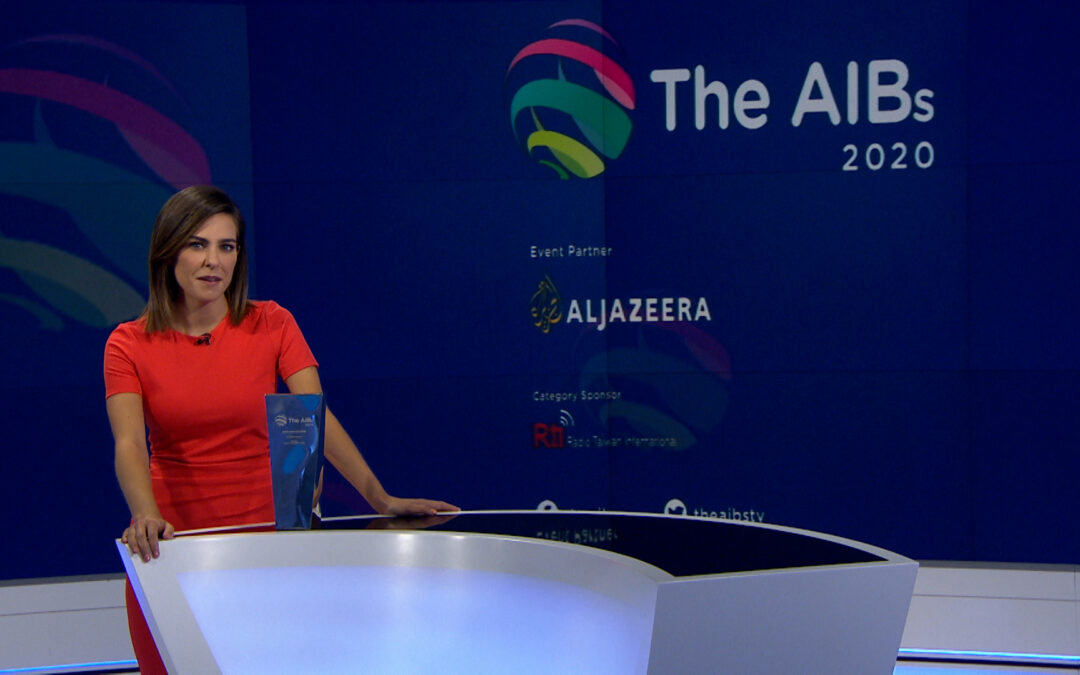
The results of the AIBs 2020 will be announced in a two-part programme that will be released on 13  and 16  November. The Association for International Broadcasting is currently working with event partner Al Jazeera Media Network to devise our virtual awards show that will maintain the depth and breadth of our traditional live event, and that showcases all the shortlisted entries. As usual, the absolute secrecy that surrounds who has won will be maintained until the special awards programme is released.

“Like everyone, the AIBs have had to adapt to cope with the very different environment we find ourselves in,” says Simon Spanswick. “We fervently hope that in 2021, we will return to our time-honoured live event that draws together the international media industry for an evening of celebration. Until then, we’re working to deliver the very best virtual awards for all our entrants and observers.”

The complete shortlist is available online at https://theaibs.tv/AIBs-2020/shortlist-2020/AIBs-Shortlist-2020-3.pdf and a copy appears from page 4 of this release. Highlights of the AIBs 2019 can be seen at https://vimeo.com/383583268/c425f5b9fe.

AIBs 2020 shortlist

AIBs 2020 shortlist

AIBs 2020 shortlist

​Congratulations to all the entrants to the AIBs 2020 who have reached the shortlist. You can see the full list at https://theaibs.tv/…/shortlis…/AIBs-Shortlist-2020-3.pdf.

Watch out for details of our Awards ceremony in November – despite it being somewhat different this year, it will celebrate the work of all our entrants and the entire journalism and factual production sectors.
And a special shout out to our event partner Al Jazeera Media Network and category sponsor Radio Taiwan International.
News viewership in India up 200% as a result of pandemic, says TV9 CEO

News viewership in India up 200% as a result of pandemic, says TV9 CEO

News viewership in India up 200% as a result of pandemic, says TV9 CEO

The latest guest on the AIB’s In Conversation series is Barun Das, chief executive of TV9 Network in India.

Speaking to the AIB’s Simon Spanswick, Das said that the exponential growth of audiences for TV news channels during the pandemic is positive and as lockdowns ease, advertisers are finding that news is a highly effective platform to reach consumers. There’s a shift in the TV news audience demographic. Traditionally, TV news has been skewed to a male audience, but that’s changing as more women are watching. Advertisers are recognising this with more commercials targeting women being bought.

Allied to the growth of audiences consuming channels via traditional cable and satellite distribution is the development of digital platforms including OTT, says Das. TV9 is making use of new digital platforms and the network believes that by 2027/28, advertising on digital news offers will overtake TV news advertising. It’s for this reason that TV9 Network is betting big on digital, says Das.

In the interview, Das talked about how TV9 maintained operations as the pandemic raged and some 150 staff members caught the coronavirus. Shift patterns were altered, and extensive safety guidelines implemented in all the company’s broadcast centres. Das also believes that as a result of the pandemic, India as a country has actually become more disciplined, despite that size and diversity that exists within the population of 1.3 billion.

Watch the full interview here.

TV9 Network has recently become a Member of the AIB.

Final few days to enter the AIBs 2020

Final few days to enter the AIBs 2020

Final few days to enter the AIBs 2020

We are into the final seven days to enter the AIBs – the annual international competition for journalism and factual productions.

The AIBs cover TV, radio and digital platforms and are open to work in any language.

There are 20 categories in this year’s competition, ranging from daily journalism to investigative documentary, natural world to human interest, science to politics.

We recognise that the past few months have been challenging for everyone, and that’s why we only launched the AIBs after discussions with a wide range of producers and journalists. Everyone we spoke with agreed that despite the global pandemic, recognising the work of teams and individuals across the world involved in factual story telling remains important.

The closing date is fast approaching – Friday 24 July – so do not delay in getting your entries together to join colleagues from Singapore, Qatar, the UK, the US, Hong Kong, Germany, Belgium, Bangladesh, Taiwan, Australia and Japan who have already submitted their work for our international panel of judges to consider.

Full information about this year’s AIBs is on our special website at http://theaibs.tv, and you can see the full entry book in page-turning format at https://theaibs.tv/AIBs-2020/Entry-book/index.html.

The AIB team is also available to answer any questions that you may have and to help solve any problems you encounter in entering your work. Full contact information appears below.

We look forward to seeing your work and that of your colleagues showcased to the world in this year’s AIBs.

Good luck!

Últimos días para ingresar

Letzte Tage, um einzutreten

Derniers jours pour participer

Giriş için son birkaç gün

Sista några dagar för att komma in

Huling ilang araw upang makapasok

Fewan kwanakin ƙarshe don shiga

Последние несколько дней, чтобы войти

Laatste paar dagen om binnen te komen

Cúpla lá deiridh le dul isteach

#HoldTheLine campaign supporting Maria Ressa launched

#HoldTheLine campaign supporting Maria Ressa launched

#HoldTheLine campaign supporting Maria Ressa launched

Sixty press freedom groups and civil society organisations, journalism institutions, filmmakers, and other supporters have formed a coalition in support of Maria Ressa and independent media in the Philippines, united around the call to #HoldTheLine.

Today the Committee to Protect Journalists (CPJ), the International Center for Journalists (ICFJ), and Reporters Without Borders (RSF) announced the launch of the #HoldTheLine campaign in support of journalist Maria Ressa and independent media under attack in the Philippines. Acting in coordination with Ressa and her legal team, representatives from the three groups form the steering committee, working alongside dozens of partners on the global campaign and reporting initiatives. The campaign takes its name from Ressa’s commitment to ‘hold the line’ in response to sustained state harassment and prolific online violence.

An internationally celebrated Filipino-American journalist, Ressa is best known for two decades covering South East Asia for CNN and founding the multi-award winning Philippines news website Rappler. On 15 June 2020, she was convicted of “cyber-libel,” alongside former Rappler colleague Reynaldo Santos Jr — a criminal charge for which they face up to six years in prison. The conviction relates to a story about corruption from 2012 – before the law was even enacted – and hung on the correction of a typo.

Ressa and Santos both posted bail, but could be imprisoned if the case is not overturned on appeal. Ressa is facing at least six other cases and charges. Guilty verdicts in all of them could result in her spending nearly a century in jail. Rappler is also implicated in most of these cases, with several involving criminal charges related to libel, foreign ownership, and taxes. The convictions are the latest offense in the Duterte government’s wider campaign to stifle independent reporting, including the recent shutdown of the main national broadcaster ABS-CBN.

“I am moved by the incredible outpouring of support we’ve received from around the globe for our campaign to #HoldTheLine against tyranny – even as President Duterte continues his public attacks on me, the legal harassment escalates, and the state-licenced and Facebook-fuelled online violence rages on. We can’t stay silent because silence is consent,” Ressa said. “We need to be outraged, to fight back with journalism. If we don’t use our rights, we will lose them. Please stand with us!”

Those interested in showing support and helping to #HoldTheLine can take two immediate steps in the run-up to Ressa’s next hearing scheduled on 22 July:

  1. Join the #HoldTheLine coalition by getting in touch via the contacts
  2. Sign and share this petition calling for the Philippine government to drop all charges and cases against Ressa, Santos and Rappler, and end pressure on independent media in the

The 60 founding members of the #HoldTheLine Coalition are:

The Committee to Protect Journalists (CPJ), the International Center for Journalists (ICFJ) and Reporters Without Borders (RSF), which form the steering committee; African Media Initiative; Association for International Broadcasting (AIB); Alliance for Journalists’ Freedom; Amnesty International; ARTICLE 19; Association of Caribbean Media Workers; Canadian Journalism Forum on Violence and Trauma; Centre for Freedom of the Media (CFOM); Centre for Law and Democracy; CineDiaz; The Coalition For Women In Journalism; Community Media Forum Europe (CMFE); The Daphne Caruana Galizia Foundation; DART Asia Pacific; Dart Center; Doc Society; English PEN; European Journalism Centre; First Look Media; Free Press Unlimited; Global Alliance on Media and Gender (GAMAG); Global Forum for Media Development (GFMD); Global Voices;  Graduate School of Journalism, Columbia University; Index on Censorship; Institute for Regional Media and Information (IRMI); International Media Support (IMS); International Association of Women in Radio  and Television (IAWRT); International News Safety Institute (INSI); International Press Institute (IPI); International Women’s Media Foundation (IWMF); James W. Foley Legacy Foundation; Judith Neilson Institute; Justice for Journalists Foundation; Media Association for Peace (MAP); Media Development Investment Fund (MDIF); Namibia Media Trust (NMT); National Union of Journalists of the Philippines (NUJP); Pakistan Press Foundation; Panos Institute Southern Africa; PEN America; Philippine Center for Investigative Journalism (PCIJ); Press Freedom Defence Fund; Project Syndicate; Public Media Alliance; Pulitzer Center on Crisis Reporting; Rappler; Rory Peck Trust; Rural Media Network Pakistan; South African National Editors’ Forum (SANEF); Storyhunter; The Signals Network; Tanzania Media Practitioners Association; Union of Journalists in Finland; World Association of Newspapers and News Publishers (WAN-IFRA); and World Editors Forum.