7 January 2019
French international radio broadcaster Radio France Internationale (RFI) had a difficult start to 2019 in two African countries, with its FM broadcasts cut off in the Democratic Republic of Congo (DRC) and its correspondent saw her accreditation withdrawn. In Madagascar, an RFI journalist was singled out as liar by a supporter of defeated presidential candidate Marc Ravalomanana.
Democratic Republic of Congo
DRC government spokesman Lambert Mende announced on 2 January that the accreditation of RFI correspondent Florence Morice had been withdrawn.
He also said that RFI FM broadcasts were blocked in all DRC cities.
Mende accused Morice of violating electoral law and “the code of good conduct for foreign journalists covering the elections”.
He also alleged that RFI was stirring controversy and said: “we are not going to let a radio station throw petrol on the flames at a time when we are waiting for the compilation of the provisional results.”
RFI, which has been closely covering elections in the DRC, issued a statement saying its coverage had been impartial and expressing full support for Morice.
She had been “merely working as a professional journalist,” the statement said, RFI urged the authorities to reverse their decision to withdraw her accreditation. RFI announced that Morice had left for France on 3 January.
Madagascar RFI journalist branded a liar by presidential challenger supporter
In Madagascar a supporter of defeated presidential candidate Marc Ravalomanana attacked an RFI journalist, showing her face on a giant screen and wrongly accusing her of lying.
Speaking to RFI French service, the chair of the International Press Correspondents Association Lova Rabary said that these methods by political parties were unacceptable and dangerous.
“They need to think about what they say and what they publish, because they cannot control the reaction of their supporters. The danger is obviously, people know the face of the journalist who is presented as a liar, the fact that her photo was shown is to make the journalist, who according to them, was not doing her job well, open to public scrutiny,” Rabary said. “Each time a protest occurs in Madagascar, local media often take a position in favour of the parties present and during a crisis, the people and even the media do not accept that a journalist can be neutral and not take a position in a crisis,” Rabary added.
20 December 2018
On 18 December, the World Trade Organisation (WTO) announced that it would investigate Qatar’s allegations of intellectual property breaches against Saudi Arabia. A WTO official said that the organisation had agreed “to establish a panel to rule on Saudi Arabia’s alleged failure to provide adequate protection of intellectual property rights.”
As reported by the AIB last June the Qatari pay-tv operator beIN, which owned exclusive rights to the FIFA World Cup 2018, had been the target of what it said was a widespread Saudi-backed piracy operation carried out through the beoutQ TV platform, an operation aimed at harming its services, commercial interests and Qatar’s reputation.
All signs point to the fact that beoutQ, which is broadcast from Arabsat, was started soon after Saudi Arabia and other Gulf States (and Egypt) cut off diplomatic and economic relations with Qatar in June 2017.
In August 2017 beIN, together with leading sporting organisations and broadcasters, called for beoutQ to be shut down. Broadcasters, such as the BBC and Sky highlighting the threat from pirated content broadcast on beoutQ piracy called on the European Union to take action.
Qatari request for consultation rejected by Saudi Arabia
An October request by Qatar for consultations with Saudi Arabia to resolve this matter concerning the protection of intellectual property rights, was turned down by the Saudis, who claimed that the matter had no legitimate connection to the WTO or to compliance with WTO rules, but was the result of national security concern.
Qatar is seeking one billion dollars in compensation from Saudi Arabia.
WTO agreed to the Qatari request, sets up a panel
Following the Saudi refusal to engage in talks to resolve this dispute, Qatar sent a communication to the WTO, asking for a panel to be established to consider the issue.
On 18 December the WTO announced that it would establish a panel to look into the matter.
The Geneva-based WTO deals with the global rules of trade between nations. Its main function is to ensure that trade flows as smoothly, predictably and freely as possible.
However, arbitration procedures may take a long time to reach conclusions that are not always accepted by the party found to be in breach of WTO rules.

7 December 2018
Directors of the British Broadcasting Corporation, ABC (Australia), Deutsche Welle, France Médias Monde, NHK (Japan) and United States Agency for Global Media today said public service broadcasting faces ‘increasing threats’ and expressed concern about ‘troubling attacks‘ on journalists around the world.
In a joint communique the broadcasters said: “Public service broadcasters are among the most trusted sources of news and information. The role of public service broadcasters has never been so important but we face increasing threats. Media organisations are subject to widespread censorship and jamming of services. Furthermore, we have seen deeply troubling attacks on journalists around the world and the recent killing of Jamal Khashoggi sent a chilling message to all of us who believe in freedom of expression. Journalists should have the right to work without fear of intimidation and violence and we call on all countries to respect media freedom and safety. We are committed to working together to do everything in our power to help protect journalists around the world.”
The annual meeting of the world’s leading public service broadcasters convened at the BBC in London on 3-4 December to discuss a variety of issues facing international public service broadcasters including trust in journalism, media freedom, interference with broadcasts and current diversity initiatives in the media industry.
17 September 2018
At the International Broadcasting Convention (IBC) held every year in Amsterdam, news was the focus of some of the conferences at a time when news media organisations, broadcasters in particular, face a number of challenges from new players, social media platforms and questions about their perceived lack of credibility and balance in some countries.
AIB leads debate with industry senior representatives
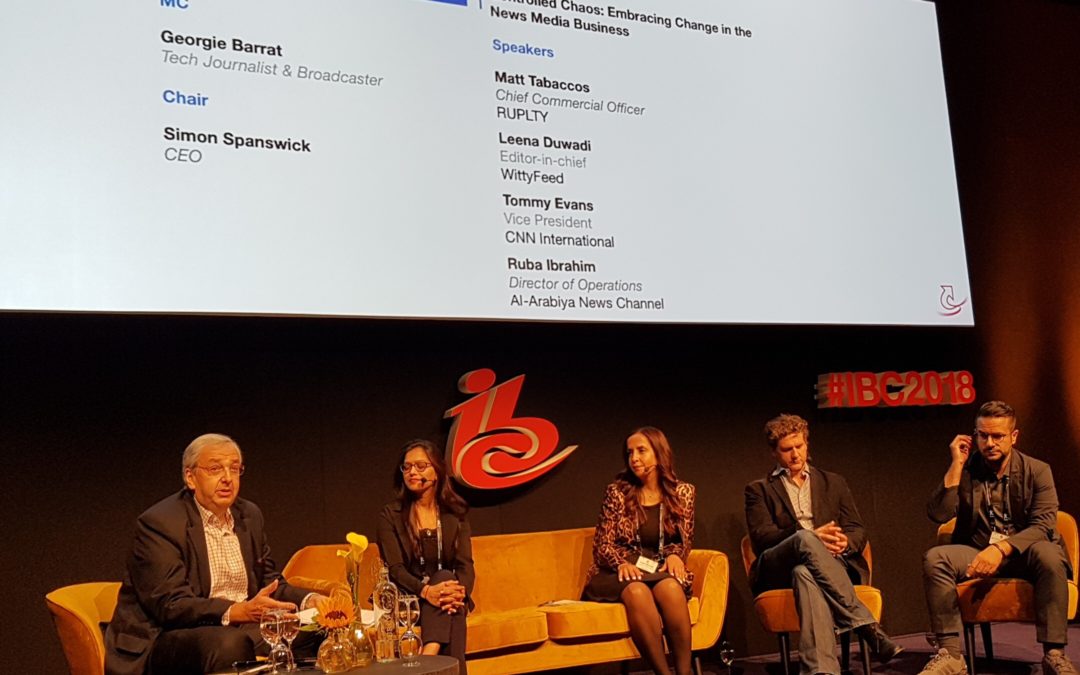
The AIB was at the centre of one of these conferences with its CEO, Simon Spanswick, chairing a session, entitled “Controlled chaos: Embracing change in the news media business”.
In this meeting, senior representatives from well-established broadcast organisations as well as from relatively new players, discussed the issues they faced and how they worked to best deal with these.
Panellists explained how their respective organisations were embracing media changes, both as regards the use of technological innovations, and the need to meet audience expectations.
The panellists, Leena Duwadi, Editor in Chief, WittyFeed, Ruba Ibrahim, Director of Operations, Al-Arabiya News Channel, Tommy Evans, VP CNN International and Matt Tabaccos, Chief Commercial Officer, of the Ruptly video news agency, described how their organisations addressed the various issues.
Shifting content, audience expectations
WittyFeed understood that the whole concept of content on the Internet was shifting, and WittyFeed idea from its creation in 2014, was to offer “content for the Millenials, produced by Millenials,” Duwadi said. From its beginning, WittyFeed proposed “vivid formats, ranging from stories to videos which differentiate it from other large Indian media companies that have hundreds of millions of users, listeners and viewers.”
Reaching a diverse Arab world audience
Ruba Ibrahim, director of operations of the Dubai-based Saudi-owned 24/7 free-to-air Al-Arabiya pan Arab News Channel launched in 2003, described the main channel and its younger “sister”, Al-Hadath, launched in 2012, which offers more in-depth, extensive coverage of political news.
Al-Arabiya has an English website also and is present and very active on digital platforms and social media.
Ibrahim explained how different content was tailored in content and length to meet the diverse requirements of the multiple platforms, showing examples of reports for online and mobile devices.
Spanswick asked how the channels were tackling the issue of addressing audiences across the entire Arab world. Ibrahim said that Al-Arabiya was primarily targeting audiences in the Gulf area, where audiences share the same language, issues and challenges, covering news, business and sports, and offering documentaries. Following the “Arab Spring”, Al-Arabiya’s extensive, but still limited resources didn’t allow it to cover all the news across the entire Arab world, so Al-Hadath was tasked with covering more specifically news and issues about Yemen, Iraq, the Levant and North Africa.
CNN: Golden age of news, healthy mix of news needed
Tommy Evans, VP of CNN International and CNN London bureau chief, said that “it was the golden age of news. US President Trump makes a lot of news and news is good for CNN and other news organisations.”
The key to success, he added, was “good content”, but he also advised for a varied and balanced mix between hard and soft news. “You can’t expect the audience to be brutalised by bad news constantly. You have to have a healthy mix of stories,” Evans warned.
CNN was established as a cable news network in 1980, but gained international recognition when it was the only channel broadcasting from inside Iraq from the beginning of the first Gulf War in January 1991. CNN launched its website, CNN.com in August 1995. It is now one of the most popular news websites in the world.
CNN has a wide offer of different programmes and online services that cover travel, style (arts, design fashion, architecture), health (food, health, wellness, fitness, etc.), features (freedom project, Impact your world, Inside Africa, climate / environment issues, etc) and even a virtual reality (VR) service, CNNVR.
Ruptly introduced flexible model, imaginative approach
Matt Tabaccos, Chief Commercial Officer, of the Berlin-based Ruptly video news agency, created in 2013 and owned by Russia’s RT television network, detailed the services offered by Ruptly.
These include an offer of real-time and archive visual news content to all media, from broadcast networks large and small to online content providers, including broadcast, digital and mobile platforms.
Ruptly value proposition, Tabaccos said, was “to try to be first, to pioneer new ways of telling stories.” Ruptly was one of the first news organisations to fly drones over war zones, which was the kind of content that resonated over the different platforms, online and broadcast, he said.
“Technology has been one of our main selling points,” Tabaccos added pointing out that Ruptly now gets some 500 million views across platforms every month. The idea is to service broadcasting organisations, start-ups and ordinary users, through flexible models, he said.
Tabaccos announced that Ruptly had just expanded its offer with Ruptly Pass, a “disrupting” subscription-based model “for individuals and growing media entities”, which gives users unlimited access to video and live events on the service for €12.50 a month.
The “Controlled chaos” conference provided a comprehensive overview of the diverse and imaginative approaches adopted by just four media organisations with different audiences to address some of the many challenges faced by the whole broadcast news media industry today.