4 March 2019

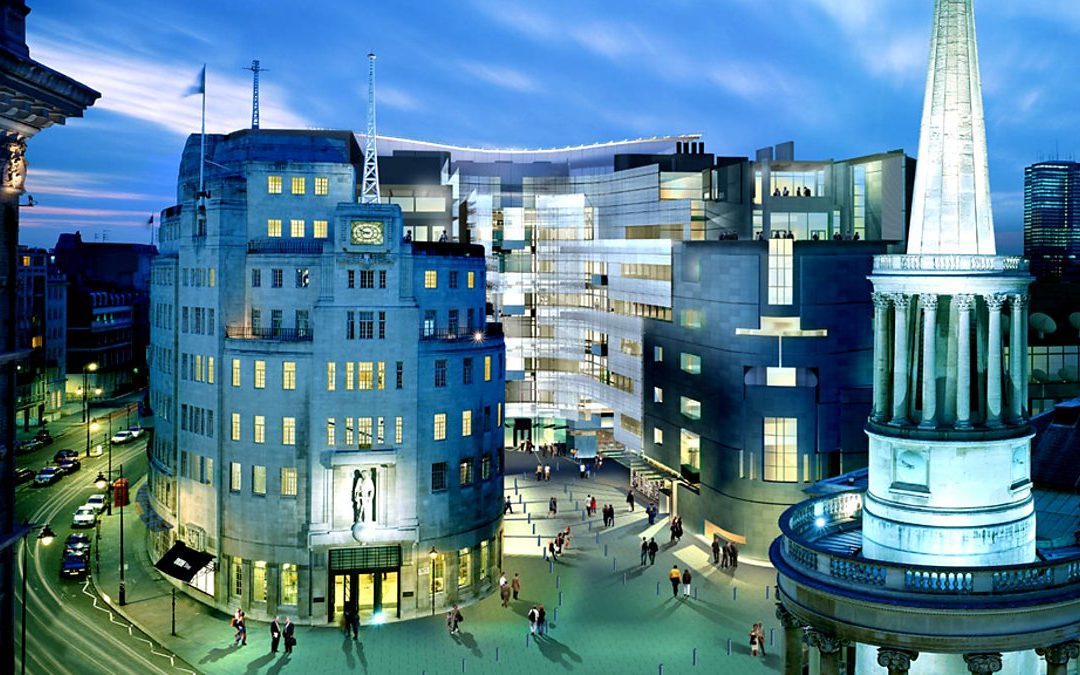
The BBC has launched an ambitious season of output that will be seen, heard and touched across all the Corporation’s channels, stations and platforms – and it all came from an elevator pitch, according to Director-General Tony Hall (pictured at the season launch in London).
It was in a lift (elevator) in Broadcasting House that season editor Emily Kasriel seized the opportunity to buttonhole the DG with the concept of what has become Crossing Divides, a multi-platform, multimedia season that explores how people can be brought together across lines that divide them in a fragmented world. And Hall says that it’s unlike anything the BBC has done before.
Crossing Divides will run across the year on TV, news, radio – national and local – and online starting on 4 March and it will bring people from conflicting sides together despite their differences – whether social, ethnic, political, religious, geographical or generational. The season will feature a broad range of programming, special reports and innovative events across the year, designed to reach audiences of all ages and create opportunities for new conversations.
 Emily Kasriel (pictured) has written a blog on the BBC website that we reproduce here:
Crossing Divides is an ambitious season. Throughout the BBC in 2019 we are exploring the power and possibilities of encountering people with conflicting opinions, across divisions of race, class, faith, politics and generation.
We’re tackling one of the biggest challenges of our age – polarisation and fragmentation – to support one of the BBC’s public purposes, contributing to social cohesion.
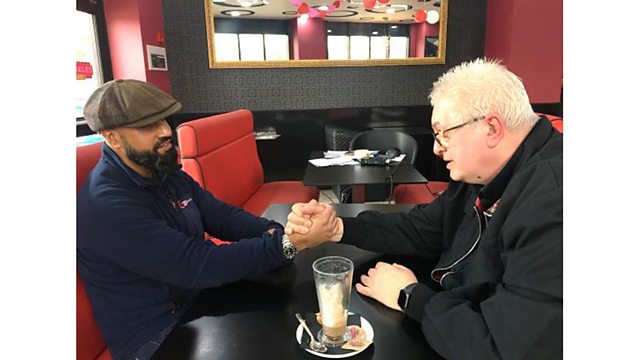
Recently, I was in Coventry with the BBC local radio team, who brought together Faisal, who drives a black cab, and Uber driver Barry. Before they met, the two drivers spoke of anger and fear about their livelihoods, the future and each other. It was moving to witness the moment Barry and Faisal began to recognise the common humanity across the table. There were even tears and a hug as Faisal left to take his next fare.
How will it work?
Psychologists have long known we harbour a deep need to be understood. Once we feel acknowledged, we may be more willing to lower our defensive walls, even by an inch, creating the space for us to hear, perhaps for the first time, an alternative perspective.
Faisal and Barry’s encounter for BBC Coventry & Warwickshire is part of a ground-breaking Crossing Divides project across all 39 BBC Local Radio stations. Each has identified three poignant and passionate local divisions, and will bring together individuals from either side. These 100-plus encounters will kick-start conversations and phone-ins across England.
It’s not just about talking
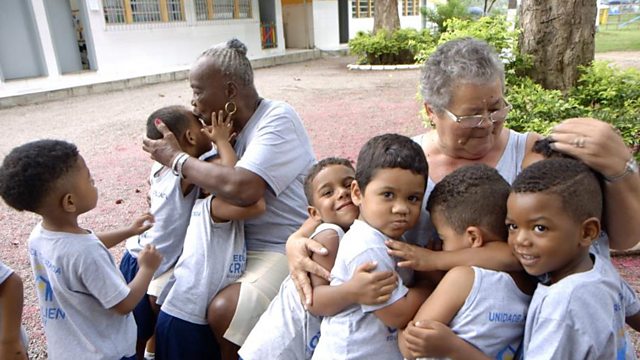
There are many ways to engage with people across the divide. Our Brazilian Service tells a story from the City of God, the violent Brazilian favela, where the very young and the very old lack affection and attention. They are crossing the generational divide by sharing capoeira lessons, acting classes, and hugs.
Our series on BBC Two, Pilgrimage, follows eight personalities with wildly different beliefs and faiths as they travel together on a demanding pilgrimage to see if they can understand each other better. BBC Monitoring discovers a dictionary enabling North and South Koreans to communicate, after decades of conflict caused their languages to grow apart.
Credit: BBC
Solutions-focused journalism
Crossing Divides has grown out of the BBC News Solutions-focused journalism project. Alongside reporting problems, journalists are encouraged to explore solutions – looking at limitations, seeing whether a solution can scale, and asking rigorous questions.
Crossing Divides isn’t all hugs and love-ins. We don’t expect people with vastly different outlooks to agree, or even get on. When they don’t, we tell that story too, like the encounter between an anti-fascist activist from Portland, Oregon, and a member of the all-male far right Proud Boys group. The men agree to sit across a table for an Our World Crossing Divides documentary, and there’s a tangible sense of danger, fury and contempt.
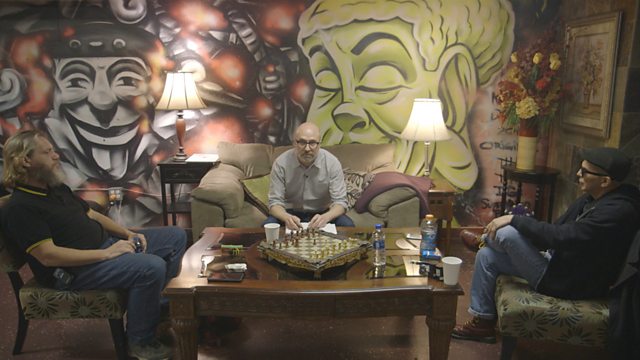
BBC’s Mike Wendling (centre) sits down with a Proud Boy (on the left) and an anti-facist activist. Credit: BBC.
Our Stories
We were encouraged to create this season across the BBC after the success of our week-long News pilot in 2018. Our Stories attracted more than 5m page views, and in excess of 300,000 comments, shares and likes on social media.
We broadcast the moving tale of Indonesian ex-child soldiers on opposite sides of a bloody conflict. Ronald Regang, a Christian, and Iskander Slameth, a Muslim, met after the end of the conflict at a trauma healing centre for child soldiers .
Once sent out to mutilate and murder others of a different faith, today they help keep a fragile peace on their island, Ambon. Following the BBC report, the two friends became national heroes, and a larger-than-life mural of the pair appeared in Ambon City, inspiring the community.
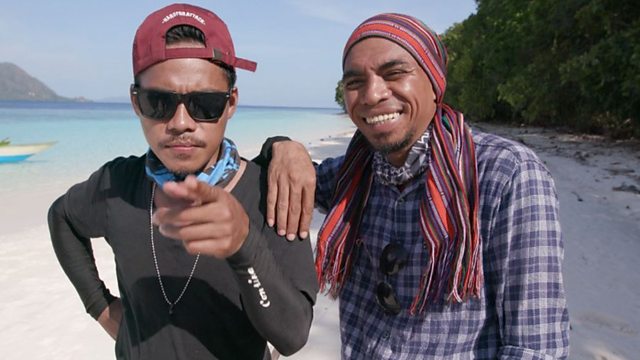
Ronald Regang and Iskander Slameth
Crossing Divides aims to spark a huge amount of conversations across divides. BBC News Labs and BBC World Service build on a successful pilot to create an interactive comic in which you can have a conversation with a virtual character who has different ideas about controversial topics such as Brexit, immigration or gun control.
One of the challenges of Crossing Divides is finding ways to help individuals and communities who share common spaces but rarely interact. We’re partnering with public transport companies across the UK for a Crossing Divides on the Move day in the summer, encouraging passengers to have conversations with strangers. Meanwhile, our BBC Radio 5 Live and BBC News Common Groundproject will pair up thousands of people with opposing political perspectives for face-to-face conversations.
We’re not endorsing particular solutions to fragmentation or implying that power relations can be equalised through an encounter. The ambition is to create more understanding. For each one of us, exposing ourselves to ideas which may challenge our core beliefs and the sense of who we are can feel like a risky endeavour – especially if we feel our community is under threat. But in doing so, we may discover our identities are more complex than we thought, with contradictions previously kept hidden, even from ourselves. We may realise we share beliefs, experiences and even values with enemies we feared or strangers we dismissed.
For this season, we have drawn on the work of Miles Hewstone, Julie Van de Vyvert, Libby Drury, the Behavioural Insights Team, British Future, More in Common, Conciliation Resources Jonathan Haidt as well as the Hedrodox Academy, Douglas Stone, Amanda Ripley, Solutions Journalism Network and Better Angels, who have a track record in negotiating successful conversations between Republicans and Democrats.
22 January 2019
It had been thought that there would by now be clarity on the issue of Britain’s withdrawal from the EU at the end of March. However, the political debate in the UK has been mired in discord and confusion resulting in no one knowing what will happen after 29 March.
This continuing uncertainty presents a challenge for many businesses, including those operating pan-European TV channels.
This month, we have seen an announcement that Discovery Networks has applied for licences in the Netherlands, taking advantage of its existing large office in Amsterdam. Others are waiting to see what may develop over the coming weeks – and the AIB’s advice continues to be “don’t panic” as we think that whatever the outcome of UK political deliberations, there won’t be a sudden channel switch-off on 30 March – which would be contrary to the Council of Europe’s Transfrontier Television Directive and the EU’s commitment to freedom of expression.
The AIB will continue to meet with broadcasters, regulators and governments as the date Britain leaves the EU draws closer.
18 January 2019
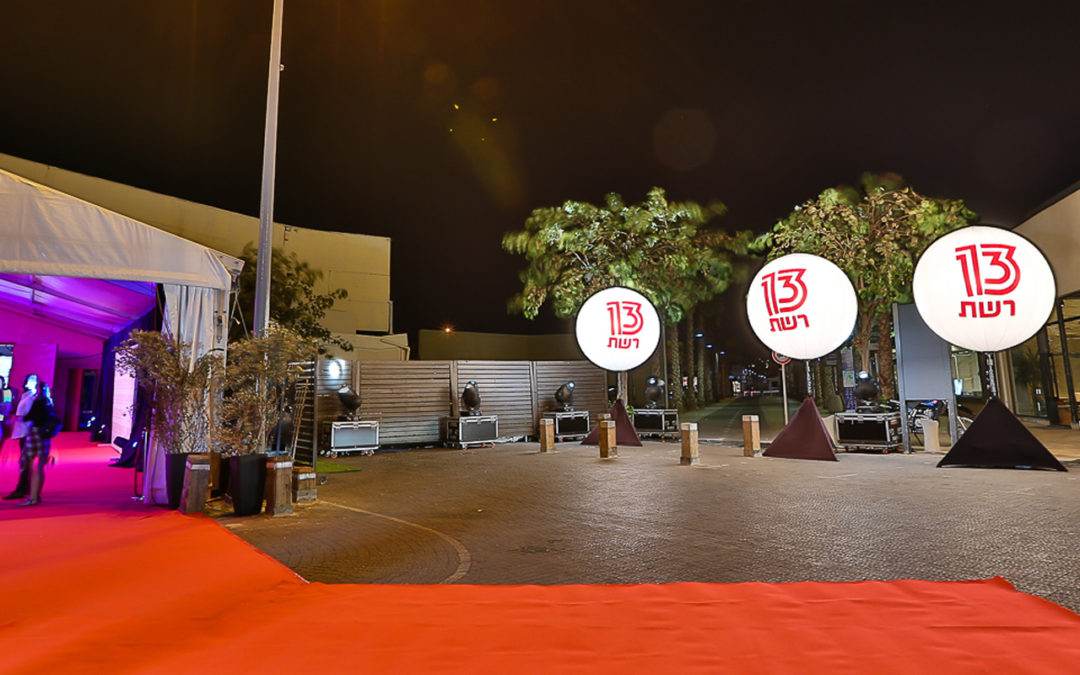
This week saw the conclusion of the merger of Israel’s Reshet commercial TV network with Channel 14 (until 2017 known as Channel 10). The newly merged channel is called – perhaps just a little confusingly – Channel 13. The merger had been approved in November last year by Israel’s broadcasting authority. At the time, the owners of Reshet and Channel Ten said: “The approval this evening [8 November 2018] is an important and critical step toward regulating the television market in Israel. Merging the activities of Reshet and Channel Ten will allow the merged company to hold on to the majority of its employees and to offer the Israeli viewer better television, based on investing in quality and original content.”

The new channel was launched at a gala event in Tel Aviv attended by 1,500 celebrities and guests.
The merger reduces the number of commercial channels in Israel to two – Keshet Channel 12 and Reshet Channel 13.
18 January 2019
Following a ruling by UK media regulator Ofcom about programming on the English-language international broadcaster RT, the Moscow-based channel is to seek a judicial review. A statement by the broadcaster said: “Ofcom investigated ten RT programmes, and decided that seven were in breach; we firmly believe that none were [sic] in breach. RT is left with no choice other than to seek judicial review of the matter.”
Ofcom published the findings of its investigations on 20 December 2018, covering programmes broadcast in the aftermath of the attack on Sergei Skripal and his daughter in early 2018. Ofcom’s report said:
This document sets out Ofcom’s Decisions in relation to the above ten programmes, which were broadcast on RT over a period of approximately seven weeks between 17 March 2018 and 4 May 2018, in the wake of the poisoning of Sergei Skripal and his daughter Yulia in Salisbury on 4 March 2018.
The licence for the RT service is held by Autonomous Non-profit Organisation TV-Novosti (“TV Novosti” or “the Licensee”). Ofcom was alerted to these programmes by a combination of complaints from viewers and Ofcom’s own monitoring.
Ofcom considered that the programmes raised issues warranting investigation under the due impartiality rules set out in Section Five of the Ofcom Broadcasting Code (“the Code”). As required under our published procedures, we wrote to the Licensee on 18 April 2018 and 14 May 2018, requesting its comments under the relevant rules of the Code.
TV Novosti provided its written representations on 6 and 20 June 2018. Ofcom prepared Preliminary Views in relation to each of the ten programmes, which we sent to the Licensee on 13 September 2018. The Licensee provided its written representations on 22 November 2018 and its oral representations on 5 December 2018.
In accordance with our published procedures, having watched all the programmes and taken careful account of all the relevant information, including the individual facts of each case and the various representations made by TV Novosti, Ofcom has decided that the following programmes are in breach of the Code for the reasons set out in full in each corresponding decision:
• Sputnik, RT, 17 March 2018, 19:30;
• Sputnik, RT, 7 April 2018, 19:30;
• Crosstalk, RT, 13 April 2018, 20:30;
• Crosstalk, RT, 16 April 2018, 20:30;
• Crosstalk, RT, 20 April 2018, 08:30;
• News, RT, 18 March 2018, 08:00; and
• News, RT, 26 April 2018, 08:00.
In addition, and for the reasons set out in full in each case, we have decided that the following three programmes are not in breach of the Code:
• Worlds Apart, RT, 1 April 2018, 23:30;
• News, RT, 30 March 2018, 18:00; and
• News, RT, 4 May 2018, 08:00.
At the Preliminary View stage, Ofcom considered that one (News, 30 March 2018) of the ten programmes was not in breach of Section Five of the Code. However, following careful consideration of the Licensee’s written and oral representations, we decided that a further two programmes (Worlds Apart, 1 April 2018 and News, 4 May 2018) were also not in breach of Section Five of the Code.
RT’s statement continues:
“Ofcom required that RT devote yet more of its time to presenting the same mainstream viewpoints of other broadcasters, instead of delivering the alternative perspectives our viewers have come to rely on. These alternative viewpoints are essential to a well-informed public debate.
“In doing so, the regulator breached a key right of broadcasters, and more importantly of audiences. We are now placing the matter in the hands of the courts.”
18 January 2019
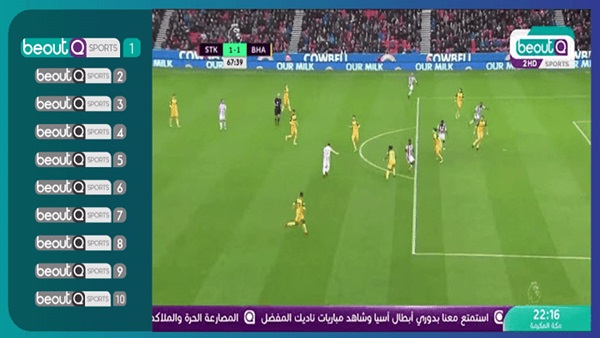
As the AIB has reported over the past year, the satellite network BeoutQ is broadcasting sport and entertainment programmes from across the world in what can only be described as industrial-scale piracy. Now Qatar’s beIN Media – the broadcaster most affected by the piracy operation – is ramping up its international efforts to hold the pirates to account.
It is widely believed that Saudi Arabia is behind the piracy operation, borne out by the fact that an operation on the scale that beoutQ operates requires immense resources of the type that only a nation state or a huge, long-established commercial organisation would have.
Now beIN has launched a website giving details of what it says is the evidence it has gathered about the beoutQ operation. It provides a time-line from before the launch of beoutQ through to the present, including beIN’s US$1bn compensation claim against Saudi Arabia.
16 January 2019
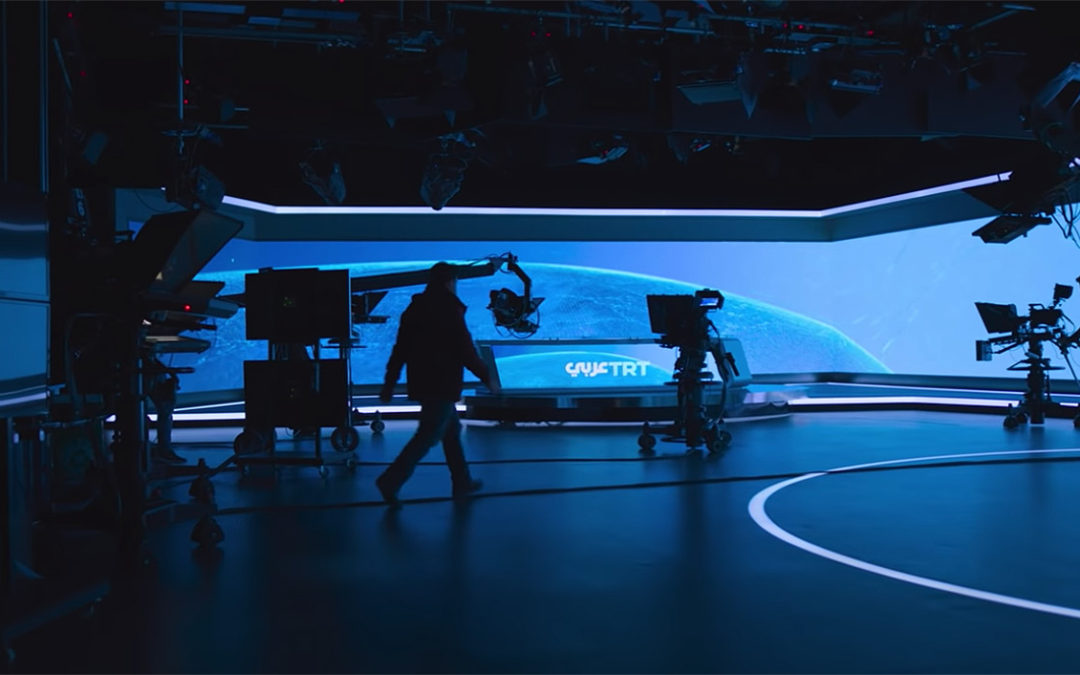
TRT, Turkey’s public broadcaster, has relaunched its Arabic-language TV channel. TRT Arabi takes many cues from TRT WORLD, the English-language TV channel that went on air in 2015. Indeed, its director of news and programmes is Resul Serdar Atas, formerly director of TRT WORLD. On launch day [7 January], Atas tweeted: “This is a big day for TRT family by launching TRT Arabi to cover the world’s news and current affairs, especially the Arab world. Today’s launch of TRT Arabi is the result of days of hard work from our dedicated journalists and experts, to be with you.”
Watch the channel promotion:
The launch of TRT Arabi appears to be part of a modernisation strategy across TRT networks, with the new TRT international logo – first seen on TRT WORLD – being used on Arabi, Haber [News], Turk, Kurdi, Spor, and Avaz, and TRT’s main national channel, TRT1.
The revamped Arabic service (previously known as TRT Arabic) has a similar look and feel both on air and in its online presence to TRT WORLD. It has bureaux in Baghdad, Jerusalem, Tehran, Cairo, London, Moscow, Washington, Beirut and Oman.
