
23 April 2019
Airing at 9pm, the studio based show focuses on the stories behind the news, with original storytelling and audience interaction via @GistNigeriaTV and its studio in Lagos.
Made by Channels Television and the BBC in Nigeria, this programme will be a weekly half hour for viewers in Nigeria, and is also screened on partner stations in Sierra Leone and Liberia.
Gist Nigeria offers in-depth reporting, focusing on the stories behind the news, its impact and how it affects the audience. It features analysis, studio discussions and hard-hitting interviews around the key issues that matter to Nigerians and West Africa. The programme will also feature stories covered by a selection of the BBC’s African services.
Broadcast from Channels Television’s new studios in Lagos, the programme will be produced to the same high standards of journalism and production that audiences around the world expect from the BBC and Channels Television.
Coverage of news will never be the same as the show’s talented duo, Wale Fakile and Ajoke Lijadu-Ulohotse aim to bring a new perspective to a younger audience.
Kingsley Uranta, Channels Television Assistant General Manager, Operations, says: “We look forward to our viewers enjoying the best of television programme production, crafted in the cherished tradition of Channels Television which is anchored on truth, balance, fairness and integrity. Of equal importance is showcasing the giant strides of our people around the world as well as highlighting those issues that demand attention on our journey to a better society.”
Nisha Kapur, BBC Commissioning Editor, Africa, says: “This partnership between the BBC and Nigeria’s leading TV channel goes beyond news coverage. It will tap into conversations going on in the country and track successful Nigerians living abroad. As we report and analyse regional and global news stories, Gist Nigeria wants to be free of clichés often associated with the news coverage of Africa. The programme will deliver BBC journalism in a dynamic and engaging style, based on our long-standing principles of independence, accuracy and unbiased reporting.”
Gist Nigeria will feature the following segments each week:
- Social Story
Exploring and showcasing what is trending on social media
- *360*
Comparing and examining how the issues raised are resolved in other countries
- Check Me Out
Featuring successful and inspirational stories of Nigerians in the diaspora.
The new co-production will air live on Channels Television in Nigeria and will also be available on Channels24 in the UK via Freesat and Sky.

5 April 2019
British Foreign Secretary Jeremy Hunt and his newly-appointed Special Envoy on Media Freedom Amal Clooney (pictured) will establish a panel of legal experts to counter draconian laws that hinder journalists from going about their work.
After a meeting with the Canadian Foreign Minister and Amal Clooney at a G7 event in France, Mr Hunt set out the next stages of the UK’s campaign to defend free media around the world.
The High Level Panel of Legal Experts will examine legal and policy initiatives that states can adopt to improve media freedom including by:
- Offering advice to governments who want to strengthen legal mechanisms to improve media freedom;
- Supporting the repeal of outdated and draconian laws;
- Encouraging and supporting governments to help ensure existing laws and international obligations are enforced;
- Promoting best practice and model legislation to protect a vibrant free press.
Foreign Secretary Jeremy Hunt said: “Violence against journalists has reached alarming levels globally and we cannot turn a blind eye. The media has a crucial role to play in holding the powerful to account. There is no escaping the fact that draconian and outdated laws around the world are being used to restrict the ability of the media to report the truth. Amal Clooney’s leading work on human rights means she is ideally placed to ensure this campaign has real impact for journalists and the free societies who depend on their work. She will use her expertise to chair a panel comprising the world’s best legal minds to develop and promote legal mechanisms to prevent and reverse media abuses.”
International human rights lawyer Amal Clooney said: “I am honoured to have been appointed as the Foreign Secretary’s Special Envoy on Media Freedom and to have been invited to chair the High Level Panel of Legal Experts. Through my legal work defending journalists I have seen first-hand the ways in which reporters are being targeted and imprisoned in an effort to silence them and prevent a free media. I welcome the UK Government’s focus on this issue at a time when journalists are being killed and imprisoned at record levels all over the world and I look forward to working on new legal initiatives that can help to ensure a more effective international response.”
The global campaign on media freedom aims to shine a spotlight on media abuses and reverse the trend of violence against journalists.
The announcement on 5 April comes ahead of the International Conference on Media Freedom to be held in the UK on 10-11 July, co-hosted with the Canadian Government. The Association for International Broadcasting is collaborating with the UK Foreign and Commonwealth Office on the planning of this important event.
The conference will bring together leaders from around the world to share good practice on media freedom, and seek consensus behind the measures that can be taken to improve the protection of journalists.
3 April 2019
The AIBs celebrate factual programming across TV, radio and online platforms
The 15th annual AIBs have opened for entry, helping programme makers across the world share and showcase their best work of the year. Launched in 2005, the AIBs have become established as the major international competition for factual productions. The AIBs are highly valued and respected by producers, editors and journalists across every continent, demonstrated by the ever-increasing number of entries from broadcasters and independent producers in almost 50 countries.
The AIBs 2019 have 21 categories ranging from daily journalism through to human interest, sport to children’s. The complete list is:
TV/video
- Children’s
- Science, technology, nature – sponsored by Radio Taiwan International
- Sport event coverage
- Arts and culture
- Human interest
- Short documentary
- Daily journalism: single report
- Daily journalism: ongoing reporting
- Politics and business
- Investigative
- Domestic affairs
- International affairs
Radio/audio
- Arts and culture
- Human interest
- Daily journalism: single report
- Daily journalism: ongoing reporting
- Investigative
- Factual podcast
Specialist
- International channel of the year
- Breakthrough talent
- Impact
Demonstrating the truly international dimension of the AIBs, all categories are open to work in every language. Winners in the past have submitted work in Arabic, Cantonese, Czech, French, German, Hindi, Mandarin, Spanish and Swedish, among other languages.
“The AIBs are one of the highlights of the Association for International Broadcasting’s work each year,” says Simon Spanswick, chief executive of the Association for International Broadcasting. “Each year we are truly privileged to see so much of the world’s best factual programmes entered into the competition. Many programmes deal with really tough, challenging subjects but they provide an extraordinary snapshot of the contemporary world. We work to ensure that that the entries are shared as widely as possible, helping to share best practice among programme makers around the world.”
Judging of the AIBs is undertaken by an international panel of experts, who bring global perspective and extensive industry experience to the competition. The judging takes place in September using the AIB digital voting system which provides online access to all shortlisted entries.
“We have more than 50 judges who give their time voluntarily to make the AIBs a success,” says Clare Dance, co-ordinator of the AIBs. “Every year our judges tell us that they are astounded by the range of content they see and hear, much of it material that they would not normally be able to view or listen to. Judges have gone on to commission programmes from producers who have been shortlisted, so the AIBs help develop international collaboration.”
The AIBs are open for entry until 28 June 2019. See the entry book online at http://theaibs.tv/Assets/AIBs-2019-books/AIBs-2019.html and more information at http://theaibs.tv.
18 March 2019
Reporters Without Borders (RSF) has condemned repeated attacks by the Chinese embassy against Swedish journalists and insists that diplomatic missions have no say in the editorial content of media in their host country.
“But why is he so harsh?” This is a question that Swedish journalists keep asking in reference to Chinese ambassador to Sweden, Gui Congyou, who has embarked on a “truth” crusade against the country’s media since taking office in August 2017. The ambassador, who developed his career between the Chinese Embassy in Russia and the Department of European-Central Asian Affairs of the Chinese Ministry of Foreign Affairs, seems to have trouble understanding that in Sweden, a country ranked second in the RSF’s 2018 World Press Freedom Index, journalists are not subject to censorship.
On the embassy’s website, the ambassador recently posted a long, unsigned attack against SVT Nyheter, a major Swedish news outlet. The diplomat castigates the site for giving a platform to David Liao, Representative to the Taipei Mission in Sweden, on February 27. Liao published an opinion piece calling support for Taiwanese democracy against Chinese threat. According to Gui Congyou, the article “challenges the one China principle” and “amounts to serious political provocation.” Beijing is very aggressive in claiming sovereignty over the island of Taiwan, despite it having an independent government since 1949.
“Diplomatic missions have no say in the editorial content of media in their host country,” says Erik Halkjaer, the president of Reporters Without Borders (RSF) Sweden. Cédric Alviani, the head of RSF East Asia bureau, considers that these attacks “reveal the unrestrained attitude with which Beijing is now trying to impose its censorship outside its borders.”
The attack on SVT Nyheter is indeed not an isolated incident. Since July of 2018, the Chinese Embassy in Stockholm has attacked multiple Swedish news sources, including Dagens Nyheter (DN), Tidningarnas Telegrambyrå (TT), 8 Sidor, Upsala Nya Tidning, Dagens Samhälle, Nya Wermlands-Tidningen, and Svenska Dagbladet (SvD).
The ambassador was particularly harsh towards Swedish journalist Jojje Olsson, author of a book on the Swedish publisher Gui Minhai, who was kidnapped in Thailand in 2015 and is still detained in China with no scheduled sentencing. Last December, he also attacked Swedish journalist and commentator Kurdo Baksi, accusing him of “instigating hatred against China.”
China is the world’s biggest jailers of journalists, with more than 60 currently detained. In the 2018 World Press Freedom Index published by RSF, the country rank stagnates at 176th out of 180.
13 March 2019
In his address, Professor Rehman raised with concern the ongoing persecution and harassment of BBC News Persian staff and their families by Iran.
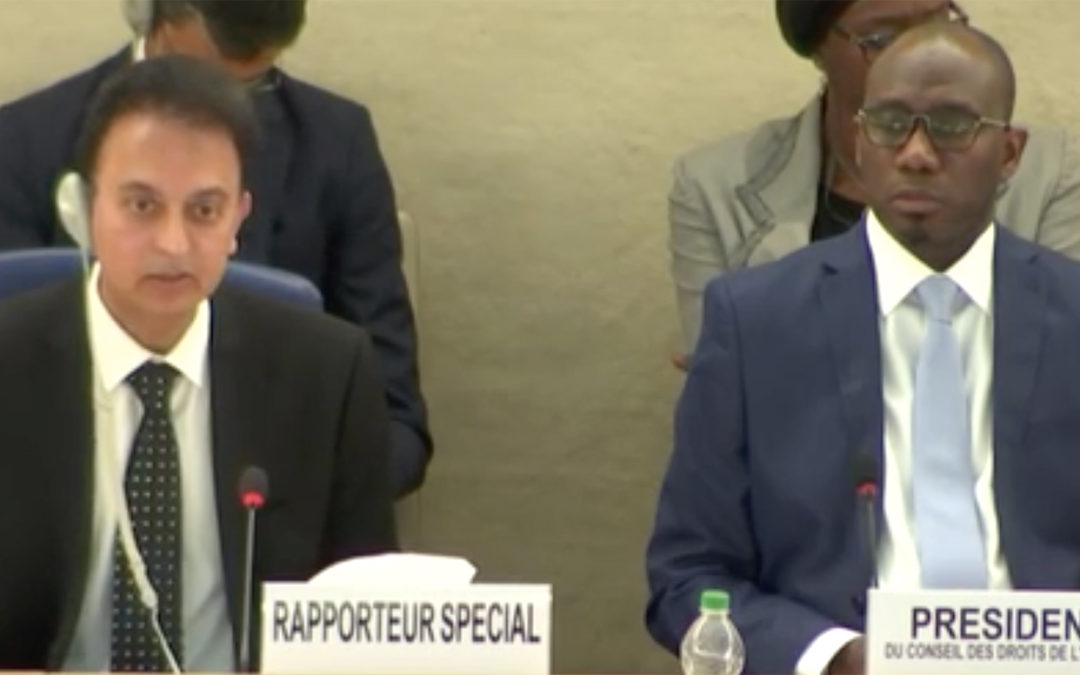
Professor Rehman (pictured addressing the UN Human Rights Council in Geneva on 11 March 2019) said he “deplores” the harassment of BBC Persian staff. His remarks raised concern about the ongoing, collective criminal investigation of BBC Persian staff and the asset-freeze which affects them and their families in Iran. He reiterated the seriousness of the persecution, which was also raised by his predecessor Asma Jahangir, including arbitrary detention and interrogation of family members in Iran. Professor Rehman also raised concern about the attacks on BBC Persian journalists in Iranian state media, in particular with fake and defamatory news being published to undermine their reputations.
The BBC made its unprecedented urgent appeal to the UN in late 2017. It is the first time in BBC history that the BBC has engaged with the UN over the protection of its journalists. Both the UN Special Rapporteur and the UN Secretary-General Antonio Guterres raised concern about the persecution of BBC Persian in their reports to the 40th session of the Human Rights Council.
The UK government mission to the United Nations raised concern with the “deteriorating” situation for freedom of expression in Iran. The UK highlighted that the “judicial harassment of BBC Persian staff and their families continues” and called upon Iran to cease the criminal investigation into BBC journalists and the harassment of their families.
 Rana Rahimpour, a BBC Persian presenter (pictured in Geneva with AIB CEO Simon Spanswick), addressed the Council about her personal experience of the persecution, explaining how her father was subjected to a travel ban to prevent him from visiting her after her first child was born. She thanked the UN Secretary General for raising the case and raised concern about the reprisals against BBC Persian staff, explaining that “my colleagues have been warned against participating in our UN advocacy work by the Iranian authorities.”
International counsel for the BBC World Service, Caoilfhionn Gallagher QC and Jennifer Robinson, have filed a further UN complaint over the reprisals BBC Persian journalists have faced for engaging with the UN. They said, “Reprisals against BBC Persian journalists and their families for engaging with the UN is not just an attack on freedom of expression, but an attack on the integrity of the UN system. Such reprisals must be condemned in the strongest possible terms.”
Michelle Stanistreet of the National Union of Journalists said: “The Iranian authorities have been systematically targeting BBC Persian journalists in the UK, and their families in Iran, since the service launched satellite television in 2009. Our campaign to stop the harassment will persist until the authorities stop targeting NUJ members for simply for doing their jobs. Both the asset freeze and criminal investigations into the activities of journalists and other staff working for BBC Persian should be dropped.”
An event was held today at the Human Rights Council co-hosted by the BBC, the International Federation of Journalists and Doughty Street International to discuss the broader implications of the persecution of BBC Persian.
Simon Spanswick from the Association for International Broadcasting – a network of broadcasters that reach one billion viewers and listeners each week – explained how the persecution of BBC Persian is “among the worst cases globally” and is indicative of a worrying trend of harassment of journalists and broadcasters in their network.
At the event, the UK Permanent Representative to the UN in Geneva, Julian Braithwaite, said “UK calls on Iran to cease the harassment of BBC Persian staff and their families – and the persecution of all independent journalists whether affiliated with the BBC or not”. He condemned the reprisals faced by BBC Persian staff.
Referring to the recent media freedom initiative announced by Foreign Secretary Jeremy Hunt, Ambassador Braithwaite said: “This case is one of the reasons we are making press freedom a particular focus for the UK. Iran’s treatment of BBC journalists will be a key part of our upcoming media freedom summit.”
The UN Special Rapporteur Professor Rehman reiterated at the event in Geneva on 12 March: “I will continue to urge Iran to cease its harassment of BBC Persian staff and their families.”
6 March 2019
RT has expanded its distribution partnership with Yahlive, a joint venture between SES and Yahsat, an Emirati satellite operator based in Abu Dhabi. RT France, the French-language news channel of the RT group based in the Paris media district of Boulogne-Billancourt, completes Yahlive’s bouquet of television channels. RT France will be available in HD for more than 10 million households in Algeria, Tunisia and Morocco for the next three years.
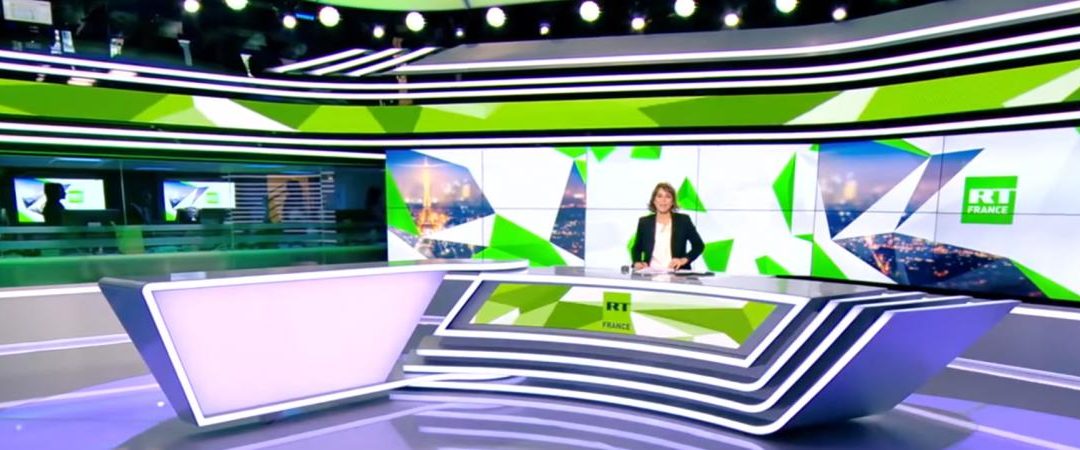
 “We are happy to be featured on Yahlive and contribute to the diversity of their offering,” said Xenia Fedorova, President of RT France (pictured). “This expanded distribution positions us even more as the reference information channel that offers the region’s Francophone audience a wide range of stories and different perspectives on the news. Our audiences in Algeria, Morocco and Tunisia, in particular, have an appetite for the diversity of sources of information, and that’s what we want to bring them.”
A long-time partner of Yahlive, the RT group has also renewed in 2018 its partnership with the satellite transmission company to continue broadcasting RT International HD and RT Arabic HD originally signed in 2012.
Ammar Baranbo, Chief Operating Officer at Yahlive, commented: “We are excited to extend our long-term partnership and cooperation with RT and look forward to continuing to bring key regional and international stories to our audiences in the Middle East and North Africa. This partnership is a reflection of the technical excellence provided by Yahsat’s Al Yah1 satellite which allows us to deliver high-quality content based on our customers transmission needs, with the best possible signal quality.”
