TRT WORLD expands global reach via Azerbaijan’s Azerspace-1 satellite

TRT WORLD expands global reach via Azerbaijan’s Azerspace-1 satellite

TRT WORLD expands global reach via Azerbaijan’s Azerspace-1 satellite

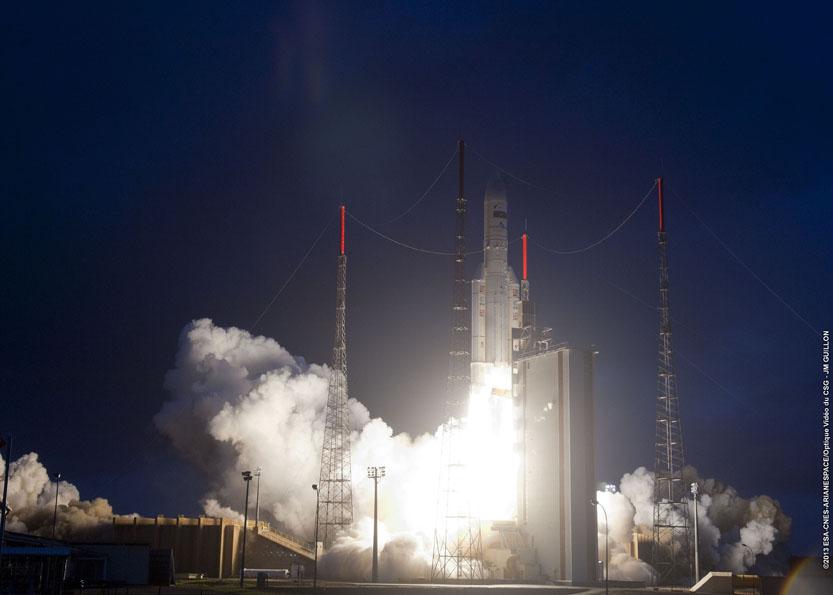
The Turkish public broadcaster TRT’s international news platform TRT WORLD is now available on Azercosmos Azerspace-1 satellite located at 46.0 °E. Azercosmos which operates Azerspace-1, Azerspace-2 and Azersky satellites provides video and data services and solutions to its customers across more than 50 countries in Central Asia, Europe, Africa and Middle East. Through this partnership, both companies aim at better serving global viewers who look for a reliable source of information.

Founded in 2015 with studios in Istanbul, London and Washington D.C., TRT WORLD broadcasts in English language to communicate a Turkish perspective on current affairs to global audience. As the international face of Turkish Radio and Television Corporation (TRT) – a European Broadcasting Union founding member – TRT WORLD hopes to encourage dialogue between viewers by offering a different viewpoint on current affairs.

Furkan Han, TRT WORLD’s Head of Global Digital & Satellite Distribution & Partnership, stated that “We are glad to launch TRT WORLD on Azerspace-1 46.0°E satellite. TRT WORLD’s satellite expansion in strategic regions is quite important for us. This partnership with Azercosmos will bring TRT WORLD’s rich and humanitarian content to more viewers in the region.”

“Working with the TRT WORLD has become a well-established practice, and we are looking forward to our continued good cooperation. Thanks to the  TRT WORLD,  our firm and principled position on the occupied territories of Azerbaijan has steadily communicated to the global community. Our fruitful cooperation enables us to attract potential new customers and further expand our services,” said Yolchu Hasanov, Head of Azerspace Commercial Team at Azercosmos.

[Source: TRT WORLD press release]

Global audience for USAGM programming hits record high

Global audience for USAGM programming hits record high

Global audience for USAGM programming hits record high

The U.S. Agency for Global Media’s five networks together reached 354 million people in a typical week during fiscal 2020, the biggest audience ever.


That total is an increase of 4 million from last year’s record audience, according to the 2020 Performance and Accountability Report, which USAGM recently presented to Congress.


“People around the world crave independent, unbiased news and I’m so proud that USAGM’s federal networks and grantees were able to deliver it, especially during COVID-19 when there was so much disinformation,” said USAGM CEO Michael Pack.


USAGM’s networks — Voice of America (VOA), Radio Free Europe/Radio Liberty, the Office of Cuba Broadcasting (OCB), Radio Free Asia (RFA), and the Middle East Broadcasting Networks (MBN) — deliver news and programming via radio, television, and internet in 62 languages.


As people worldwide struggled with COVID-19 and other events of 2020, they increasingly turned to USAGM digital platforms. USAGM networks registered upticks in digital activities beginning in January 2020, which resulted in an overall 32 percent growth in web visits and 83 percent growth in social media engagement actions over the previous year.


For example, RFA Mandarin saw a nearly 400 percent rise in audience engagement and an 800 percent increase in video views on Facebook in FY 2020 as a result of its coverage of COVID-19 and the Hong Kong political crisis.


USAGM networks also are using creative ways to distribute content to audiences digitally. For example, VOA Spanish uses WhatsApp to distribute programs, video, audio, and text content to subscribers in Venezuela. RFE/RL uses Telegram in Iran, Russia, and Central Asia to push news updates as well as to solicit user-generated content.


Overall audience growth occurred in several key markets, including in Iraq, by 2.9 million for MBN content, and in northern Iraq, where the weekly audience for VOA content increased 1.4 million. In Venezuela, the audience for USAGM content increased 0.8 million, a 44 percent increase from 2016.


Of note was the 3.3 million increase in the Democratic Republic of Congo’s weekly audience, where VOA launched Lingala-language programming in 2019. VOA is the first international broadcaster to have a service in Lingala, which is understood by 80 percent of the DRC population.


USAGM also continued to reach large audiences in countries of key U.S. national security and foreign affairs interest, notably China, which ranks first in USAGM weekly audiences with 65.4 million. Iran and Russia also make the top 10.


The growth came in the middle of a global pandemic when it was a challenge to not only report the news, but also to collect data to see how many people were getting information from USAGM. Travel restrictions implemented by foreign governments to limit the spread of COVID-19 resulted in delaying in-person survey research planned for FY 2020 to FY 2021.


Also in 2019 and 2020, USAGM launched new digital-only services in Bulgaria, Hungary, and Romania and those services will be measured in future reports.


The gains more than offset audience declines due to the loss of key affiliates in Turkey and Cambodia because of government crackdowns in those countries. The shift from radio to digital-only transmission for Radio Sawa outside of the Levant also reduced the total audience but USAGM anticipates that future surveys will show audience gains in those markets through increased usage of new digital offerings.

[Source: USAGM press release; Image: Adobe Stock/Jo Panuwat D]

Significant increase in usage figures on DW websites during U.S. election week

Significant increase in usage figures on DW websites during U.S. election week

Significant increase in usage figures on DW websites during U.S. election week

Last week, news and background information on the U.S. election on the DW websites accounted for about a quarter of the total usage. From November 3 to 8, DW provided comprehensive multimedia programs in 30 languages.

DW’s coverage of the U.S. elections featured interviews and live talks with more than 30 German and international politicians and renowned political, legal and human rights experts. DW correspondents shared perspectives from Moscow, Brussels and other locations around the world.

The usage figures are proof of the worldwide interest in DW’s reporting. DW Managing Director of Programming Gerda Meuer: “We benefit from our high credibility values. The audience trusts our journalism, which is tailored to the respective markets and media channels in our target regions. That is our strategy and it is successful.”

DW Editor-in-chief Manuela Kasper-Claridge: “With the coverage of the U.S. election, DW was able to make full use of its strengths through its diverse language and regional departments. Live ticker and analytical articles as well as continuous fact-checking were requested by users around the world in different languages. The interest in the social media offerings was also very high.”

One highlight was the more than nine-hour live TV broadcast on election night. “We followed two goals: First, to provide our audience with all the correct and necessary information quickly and reliably,” says DW Head of News Max Hofmann. “And second, to provide the context for a better understanding of what was happening. In the U.S., it’s often only about domestic political aspects, but we wanted to show what this election means for Germany, Europe and the whole world. Looking at the usage figures and the feedback from our audience, we have definitely achieved these goals.”

DW’s fact-checking team researched, evaluated facts and figures and explained its findings on complex issues on TV and online. “Never before has an election been influenced by so much disinformation as this one – probably also because President Trump himself disseminated countless fake news,” says DW Head of Fact-checking Joscha Weber. “We countered the rumors and false statements with facts.”

Washington Bureau Chief Ines Pohl, whose team of reporters traveled through numerous U.S. states in the six weeks leading up to the election and talked to people from all groups of voters, on DW’s election coverage: “After 7,000 miles from California back to Washington, our ‘Road Trip to the White House’ came to an end shortly before the election on November 3. Owing to the experiences we gained on our trip, we were not only able to convey the euphoric mood on the streets on this historic day, but also to explain to our international audience, with analyses and assessments on all channels, the problems that the divided American society and its future president Joe Biden and his vice president Kamala Harris now face.”

DW websites

From November 3 to 8, coverage of the U.S. election on the DW websites generated an average of 770,000 visits per day. On November 4 and 8, there were even more than one million visits per day.
The following languages services accounted for most of the traffic: English (26 percent), Russian (18 percent) and Arabic (16 percent). Live updates in these three languages as well as in Chinese were particularly popular.

[Source: DW press release]

NHK WORLD November programme highlights

NHK WORLD November programme highlights

NHK WORLD November programme highlights

The Ryukyu Kingdom (15C-19C) flourished in present-day Okinawa through international trade and developed a unique culture known for its beautifully dyed and woven textiles. While craftspeople made painstaking efforts to revive some of these traditions after they were lost in World War II, one particularly exquisite type of fabric called “ton-byan” remains a mystery. Join Japan’s leading textile designer Sudo Reiko as she travels around Okinawa, searching for the secrets of this lost craft.

People around the world grieved when fire ravaged Shuri Castle in Okinawa, a World Heritage Site. Six months later, just as reconstruction was to begin, the COVID-19 pandemic complicated the plans. Now, a year after the fire, performers with ties to Okinawa are singing songs of solidarity and encouragement. Experience the lavish scenery of Okinawa and listen to the music, performed from the heart.

Japan Railway Journal

Thursdays
15:30 / 21:30 / 3:30 / 9:30

Go behind the scenes of Japan’s amazing railways. Interesting facts, new technologies, expert tips, plus where to go, how to get there and more!


Seasoning the Seasons

Sundays
23:30 / 5:30 / 12:30 / 17:30

Beautiful Japan. Explore the four seasons across Japan, through its long history, ancient traditions,local festivals, food and daily life.

[Source: NHK WORLD press release]


DW usage at record high

DW usage at record high

DW usage at record high

In 2020, DW‘s journalistic offerings are reaching 249 million weekly user contacts and have thus significantly exceeded the company’s target for 2021. In comparison with the previous year, the number of user contacts increased by 52 million (plus 26 percent) which is the highest growth rate to date.  

Online offerings once again show the most considerable increase with a 46 percent rise.
More than three-quarters of online usage can be attributed to videos, and a similarly high proportion of users are interacting with DW content on their smartphones or tablets.

DW also grew significantly on TV and radio. With 111 million users a week, TV remains the strongest broadcasting platform.

The use of DW radio services, which has remained stable in recent years, is now showing a strong increase with 12 million more radio users per week compared to last year. Especially in DW’s broadcasting languages Hausa, Kiswahili and French, radio usage has again increased considerably. 

Online usage increased, especially in the spring of this year, due to the strong demand for information on the coronavirus. However, the figures have stabilized on a sustained basis at this high level.

Director General Peter Limbourg: “The continuous increase in our usage figures for several years is proof of the relevance of DW’s offerings. The fact that we have been able to consolidate our strong growth besides our reporting on the pandemic speaks for our journalistic quality.”

Cooperation between editorial departments and the Audience Development team further enhanced the profiles of DW’s social media accounts and aligned them even more to the individual needs of users in different target regions. This has led to strong growth, especially on Facebook and YouTube.

The demand for DW content continues to be particularly strong in sub-Saharan Africa. This year, it rose primarily due to higher usage of radio services and the expansion of regionalized TV services. In Europe and the Middle East as well as North Africa, the use of DW services increased most significantly, especially through regular interview segments on TV (in the Balkans and Greece, as well as in Iraq and Algeria), but also across all online platforms.

(Source: DW press release)