UN launches Pause campaign to halt disinformation

UN launches Pause campaign to halt disinformation

UN launches Pause campaign to halt disinformation

The United Nations has launched a new initiative to foster behaviour change and counter the growing threat of misinformation online. The campaign, called Pause, asks digital users to take the time to think about what they share before posting it online.

“Misinformation is spreading faster than the virus itself, and is seriously disrupting public health efforts by dangerously distorting sound scientific guidance. It is designed to exploit our emotions and biases at a time of heightened fear,” said UN Secretary-General António Guterres. “But there are ways users can learn to recognize bad information and slow the spread. We are aiming to have the phrase, ‘Pause, take care before you share,’ become a new public norm.”

A range of media companies around the world, including AIB Members Al Jazeera, Deutsche Welle and France Médias Monde, are distributing Pause content on TV channels, online and via SMS.
Major social media platforms, including Facebook, Twitter, Google (YouTube) and TikTok, have also committed to promoting Pause, while indicating a willingness to scale up their ongoing efforts to suppress the circulation of misinformation.

“It is encouraging to see steps already taken by social media platforms, such as swiftly removing misinformation surrounding COVID-19, flagging harmful content, questioning  sharing intentions and also promoting sound health advice, including from the World Health Organization (WHO),” said Melissa Fleming, UN Under-Secretary-General for Global Communications.

“Just as social distancing slows the spread of the virus, behaviour changes around sharing will go a long way to slow the spread of misinformation. But it can only be meaningfully halted if there is no place for misinformation on social media platforms.”

Pause draws on research from psychologists, neuroscientists and behavioural scientists whose studies indicate that pausing to reflect before sharing can significantly help reduce the spread of unverified and misleading information. The campaign will challenge people to break the habit of sharing shocking or emotive content impulsively and without questioning its accuracy.

The campaign, launched on World Social Media Day (30 June), is part of a larger UN initiative called Verified aimed at increasing the volume and reach of trusted, engaging and accurate information, including with the help of more than 10,000 information volunteers who have already signed on to the effort.

Following its launch in May, Verified has received strong support from governments. In mid-June, more than 130 UN Member States issued a statement on the need to address the “infodemic” related to COVID-19, while welcoming the UN’s pandemic response and the Verified initiative.

Verified is a collaboration between the UN Department of Global Communications and Purpose, one of the world’s leading social mobilisation organisations, in partnership with UN agencies and country teams as well as influencers, civil society and businesses.
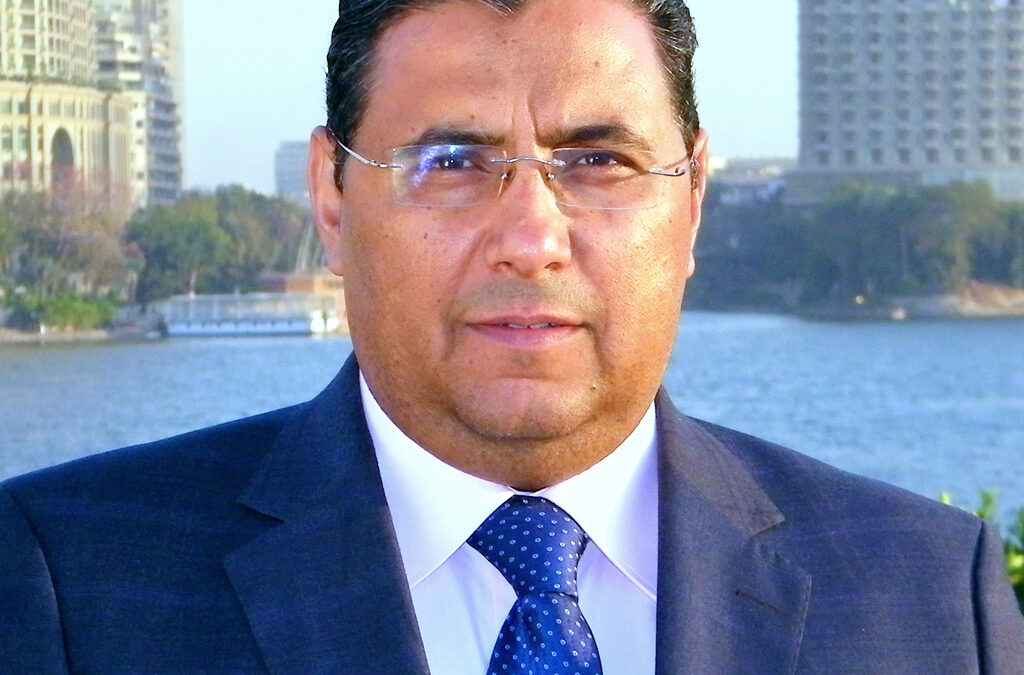
Release Mahmoud Hussein says Al Jazeera as coronavirus pandemic gathers pace

Release Mahmoud Hussein says Al Jazeera as coronavirus pandemic gathers pace

Release Mahmoud Hussein says Al Jazeera as coronavirus pandemic gathers pace

In light of grave threat posed by current pandemic, Al Jazeera calls on Egyptian Government to release Mahmoud Hussein and other detained journalists

Al Jazeera Media Network has said that is deeply concerned about the health condition of its detained journalist Mahmoud Hussein and has called on the Egyptian government to immediately release Mahmoud and other unjustly detained journalists. Overcrowded Egyptian prisons are known for notoriously unhygienic conditions, which can potentially lead to rapid spread of novel Coronavirus amongst prisoners.

“It is unacceptable that Mahmoud has been held by the Egyptian authorities for nearly 1200 days for merely being a journalist with baseless accusations and trumped up charges. Under current circumstances, with the spread of Coronavirus and the health hazards associated with it, Mahmoud and other journalists are exposed to extreme risks;” said Dr. Mostefa Souag, the Acting Director General of Al Jazeera Media Network.

He added “It’s scandalous that these detained journalists are subjected to such inhumane conditions! Consequently, we hold the Egyptian government fully responsible for their wellbeing, safety and security. We strongly urge the Egyptian authorities release Mahmoud and all other imprisoned journalists immediately.”

Al Jazeera has asked all journalists, human rights advocates and people of conscience to stand with Mahmoud and other imprisoned journalists; to express their solidarity through all available means and demand their immediate freedom; allowing them to reunite with their families and loved ones at this critical juncture. Al Jazeera says that it cannot and will not remain silent in the face of this abhorrent injustice that its colleagues continue to endure.

The AIB, as a member of the international Media Freedom Coalition Advisory Network, will raise the continuing detention of Mahmoud Hussein at its meeting on 18 March 2020.

#JournalismIsNotACrime

Al Jazeera English revamp

Al Jazeera English revamp

Al Jazeera English revamp

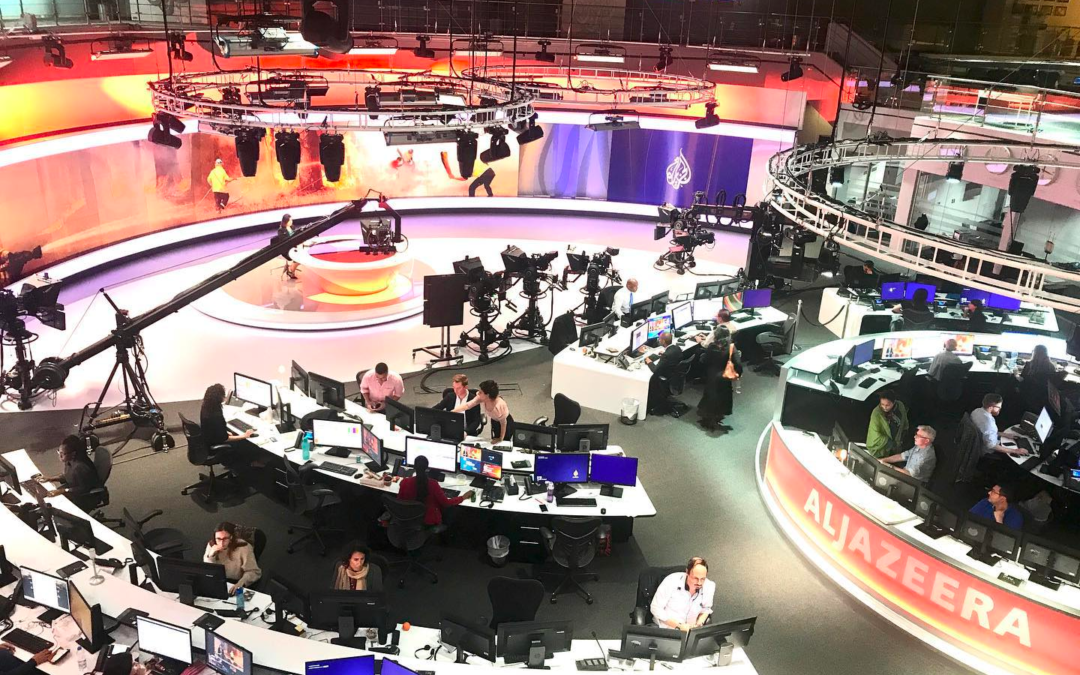
Al Jazeera English has launched its new and refreshed on-air branding and studio. The refresh project enhances news, programmes, broadcasting, and operational features.
The channel’s  renovated newsroom incorporates a state-of-the-art studio set, décor, an expanded video wall and a presenter desk that rotates through 270 degrees with enhanced lighting capabilities. This setup allows for camera positions to be utilised with reverse shots into the newsroom. In addition, revised on-screen graphics feature creative elements with new colour themes.
“We are excited to be starting the new decade with a refreshed look,” said Giles Trendle, Managing Director of Al Jazeera English. “This has involved the renovation of our studio and news room in Doha and the creation of some new on-screen features based on internal consultation as well as employee and audience feedback.”
Commenting on the refresh, Duncan Preston, Head of Global Creative, said, “This has been an amazing project, a huge effort has been made by all departments, coming together with one vision; the aim of creating a more dynamic, modern and fresh on-screen presence that will really enhance and promote the Al Jazeera brand as we move into a new decade”.
Reflecting on the project, Russell Maguire, Programs Manager for the Projects Directorate under Technology and Network Operations Division, said: “This has been a complex project to implement as maintaining on-air continuity is of paramount importance combined with the need to push on and deliver against an aggressive time constraint”.
The refresh project is the result of an initiative to enhance Al Jazeera English’s studio and newsroom to bring it up to the modern look and feel of Al Jazeera Media Network. 

Sudan PM says international broadcasters welcome back in country

Sudan PM says international broadcasters welcome back in country

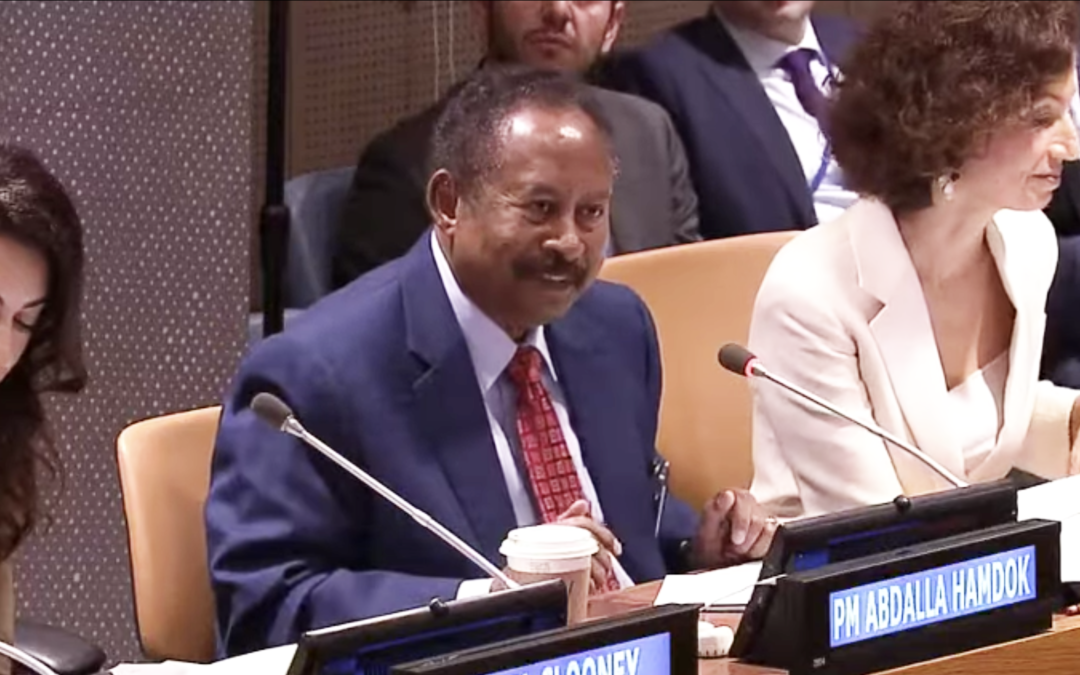
Sudan‘s newly appointed Prime Minister, Abdalla Hamdok, has told a meeting at the United Nations that international broadcasters are welcome back in the country to help build a democratic and free society.

At a UK-organised ministerial meeting on media freedom held at the UN headquarters in New York on 25 September, Hamdok said that he “grew up in Sudan in the 60s and 70s, where the BBC radio was probably the only source of international information for people. And the paradox, years after that, [is that the] BBC was prohibited from broadcasting from Sudan and people were not having access to it.”

He confirmed that the BBC was now allowed back onto FM in the country after an absence of a number of years. He also said that Monte Carlo Doualiya has been restored and that Al Jazeera which had also been banned was now back in the country. Not only were the broadcasters back on the air, but the country’s government is “very determined to create an environment that is open and allow journalists unfettered access to information but also to reporting, anywhere.

“This is actually not giving them any kind of privilege. It is good for our people. Free society, free people can only be productive, can be useful in their own lives but also for society. So I’m doing it precisely because of that.”

“The announcement by Sudan’s Prime Minister confirming the opening up of the country’s airwaves is highly positive,” said AIB Chief Executive Simon Spanswick. “It is good that AIB Members including the BBC, Al Jazeera and Monte Carlo Doualiya are now permitted to broadcast across the nation. The additional commitment to allowing journalists to report from the entire country is an immense step forward for the country and we look forward to supporting the Sudanese government and the international media community to develop Sudan’s media industry.”

The UN meeting, chaired by the UK’s special envoy on media freedom, Amal Clooney, also heard from Lord Ahmad, Foreign Office Minister, and Audrey Azoulay, UNESCO Director-General, all of whom spoke about the increasing need for media freedom globally and the Media Freedom Coalition to which 32 governments have agreed to join.

AIB moves ahead with media freedom initiative

AIB moves ahead with media freedom initiative

In November 2018, the AIB convened a meeting of senior representatives of major national and international broadcasters to discuss ways to work together on issues around media freedom. The meeting in London was chaired by Peter Greste, who was imprisoned while reporting for Al Jazeera in Egypt, and Simon Spanswick, AIB CEO.

Broadcasters are constantly being tested and harassed by authorities that seek to restrict citizens’ access to free, fair and impartial information. Journalists are constantly being intimidated in countries across the world. At the same time, the UN’s Sustainable Development Goals, signed by many of these countries, include media freedom as one of the key objectives.

There’s a clear disconnect, and broadcasters made a commitment at the November meeting to work together, share intelligence and devote resources to tackling this issue, with the Association for International Broadcasting leading the collaborative efforts between broadcasters.

It is important that this initiative does not duplicate existing work being carried out by NGOs and others, and that’s why the AIB invited a range of key organisations to the November meeting and will be sharing the work programme and other intelligence with those organisations that are carrying out important work in media freedom internationally.

At its meeting in January, the AIB Executive Committee agreed that the Association can now start work on developing a collaborative work programme. The Secretariat is in discussion with broadcasters to establish a steering group and to decide on the mechanisms to develop this crucial initiative.

The AIB is grateful to Al Jazeera Media Network for providing support for the initiative which now moves into a wider, global arena.