New appointments to RNZ board

New appointments to RNZ board

New appointments to RNZ board

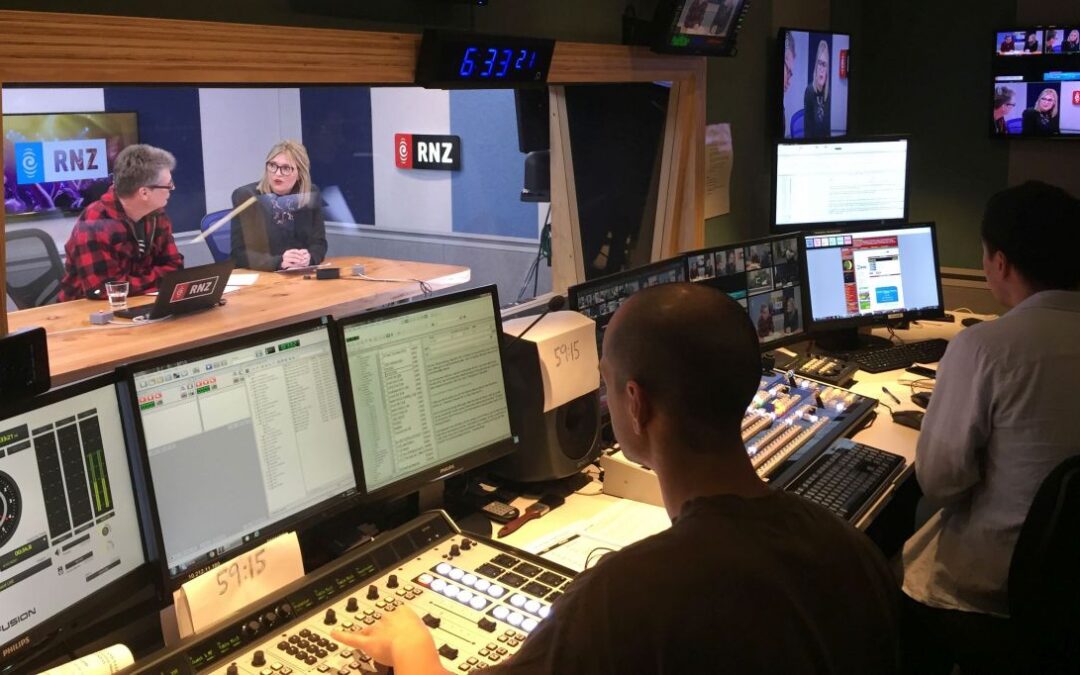
RNZ‘s Chairman Dr. Jim Mather has welcomed the appointment of former NZ On Air CEO, Jane Wrightson, as a Governor on the Board of Radio New Zealand and the involvement of Mihimaraea Parata Gardiner as an observer on the Board under the State Services Commission Future Directors programme.

“The RNZ Board and wider whānau of Te Reo Irirangi o Aotearoa are excited to be welcoming both Jane and Mihimaraea. Jane brings a vast wealth of industry knowledge and expertise, whilst the appointment of Mihimaraea recognises our commitment to leadership development and ensuring we have a wider range of perspectives at the governance level”.

Jane Wrightson took up the role of Retirement Commissioner in February 2020 after a long career in media. She came to the role from her position as the longstanding chief executive of NZ On Air, the public media funding agency. Prior to that, she was the chief executive of the Broadcasting Standards Authority, chief executive of the Screen Producers Association, and was NZ’s first woman Chief Censor. She began her career with a 10-year stint at TVNZ. She’s held various governance positions, currently as a director of Experience Wellington, a CCO. She holds an MBA with Distinction, a BA in literature, and is a chartered member of the Institute of Directors.

“I’m delighted to take up this opportunity” said Jane Wrightson. “I’m a longstanding RNZ listener: the opportunities and challenges for public media in a highly disrupted media landscape are intense and I’m looking forward to joining the RNZ governance team to help address them”.

Jane Wrightson takes up her position on the RNZ Board from 1st September.

Also joining the RNZ Board in September as part of the State Services Commission’s Future Directors programme is Mihimaraea Parata Gardiner (Ngāti Porou).

Shure continues to support broadcast and production, and more, during the pandemic

Shure continues to support broadcast and production, and more, during the pandemic

Shure continues to support broadcast and production, and more, during the pandemic

COVID-19 has required a significant shift in plans in the broadcast industry and Shure is no exception.

With a long history of helping bring the news to a mass audience through our microphones, the company understands that its role with broadcasters is as important as ever as the industry responds to this pandemic. Shure explains its priorities and how it has been responding to the challenges of the pandemic.

Our first priority is our Associates. As a global company, we initiated plans to take care of our Associates early in the outbreak. In accordance with local and national guidelines, we implemented work-from-home policies for our global Associates where appropriate and established social distancing and sanitisation protocols to keep essential areas of our business running on location.

We have witnessed the evolving impact of the pandemic across our facilities. As it first appeared in China, we have manufacturing and market support functions in that country where we needed to move quickly. We responded fast, enacting new policies and processes in accordance with health and government officials.

Our goal is to safely take care of our Associates while they take care of customers. Customer service and order fulfilment were two focus areas for us to ensure customers would continue to have communication tools during this crisis.

As Shure sells microphones and other broadcast equipment, including wireless systems, headphones, earphones, software, conferencing tools and podcasting accessories in 140 countries, serving those broadcasters during this important time is essential. We are committed to maintaining a supply of goods and still provide customer support.

As with most businesses, we pivoted to a work-from-home scenario for most office-based Associates. With today’s technology, we are still able to collaborate as teams. In some cases – because our Associates work together globally – much of this virtual collaboration is normal. However, we do miss the camaraderie of our fellow Associates, meeting with customers, attending trade shows and industry events, and other hands-on experiences. The key for us is determining how to support our customers during this difficult time. We always want to provide the right level of support, but we recognise that product needs may be different right now.

We expanded our customer webinar schedule to provide more frequent content. While the Shure Audio Institute (SAI) typically provided monthly training sessions, programming is now being delivered weekly. Demand for the sessions has been higher than normal, with three times the audience tuning in for recent training offerings versus previous webinars.

Supply chain issues are affecting many businesses in the electronics industry, and our Operations team has worked diligently to maintain the pipeline of components and continue to manufacture and ship our products to customers who order them. The need for audio products during this period is actually critical for many customers, which has helped enable Shure’s operations to be deemed essential in many locations.
Shure is also supporting our communities where we can. We have donated to Direct Relief, an organisation working with authorities to provide personal protective equipment (PPE) to health care workers in affected regions of the world. We’ve also been able to supply needed equipment directly to organisations such as hospitals and schools. In the backyard of our headquarters, Shure is supporting Chicago Independent Venue League (CIVL); in addition to a monetary donation, Shure has recruited some partners in the industry to encourage others to support local live performance venues in the Chicago area and around the world.

As live events and performances have been cancelled or severely reduced, demand for stage microphones and monitoring systems have also declined. With more people working and performing from home, Shure’s home recording, conferencing and headphones products have become more popular. For professional audio, products that can be controlled from a distance over a network or wireless connection has increased in demand. These fluctuations have impacted our supply chain, led to an inconsistent component supply and reduced global freight capacity. This has made transporting goods difficult – adding more cost and delivery times to our typical plans.

Regardless, we’ve ramped up support for the higher demand for home broadcasting equipment. We have always taken pride in exhaustive testing processes that ensure our products are as reliable and dependable as possible, especially as we understand the long-term impact of more robust cleaning regimes on our products. We’ve also worked to ensure consistent customer support during this time to make sure our customers receive the proper attention.

However, COVID-19 changes the broadcast industry, we know that we are all in this together. The industry has always adapted to change – and we’ll have to adapt again. We just celebrated our 95th anniversary, so this Company has been through a lot of challenging times. What has always helped us get through difficult periods is the strength of our Associates and the collaboration of the industry to lean on each other. We’re committed to supporting our broadcast customers throughout this difficult time.

Shure is a Member of the AIB.

News viewership in India up 200% as a result of pandemic, says TV9 CEO

News viewership in India up 200% as a result of pandemic, says TV9 CEO

News viewership in India up 200% as a result of pandemic, says TV9 CEO

The latest guest on the AIB’s In Conversation series is Barun Das, chief executive of TV9 Network in India.

Speaking to the AIB’s Simon Spanswick, Das said that the exponential growth of audiences for TV news channels during the pandemic is positive and as lockdowns ease, advertisers are finding that news is a highly effective platform to reach consumers. There’s a shift in the TV news audience demographic. Traditionally, TV news has been skewed to a male audience, but that’s changing as more women are watching. Advertisers are recognising this with more commercials targeting women being bought.

Allied to the growth of audiences consuming channels via traditional cable and satellite distribution is the development of digital platforms including OTT, says Das. TV9 is making use of new digital platforms and the network believes that by 2027/28, advertising on digital news offers will overtake TV news advertising. It’s for this reason that TV9 Network is betting big on digital, says Das.

In the interview, Das talked about how TV9 maintained operations as the pandemic raged and some 150 staff members caught the coronavirus. Shift patterns were altered, and extensive safety guidelines implemented in all the company’s broadcast centres. Das also believes that as a result of the pandemic, India as a country has actually become more disciplined, despite that size and diversity that exists within the population of 1.3 billion.

Watch the full interview here.

TV9 Network has recently become a Member of the AIB.

NHK WORLD August programme highlights

NHK WORLD August programme highlights

NHK WORLD August programme highlights

​

What if social media had existed in 1945, when the atomic bomb dropped on Hiroshima? This program constructs a timeline of imaginary tweets, based on actual diaries written by three Hiroshima citizens during  World War II. One was by a 13-year-old. Another was written by a 26-year-old newly wed, who prayed for her husband in the battlefield. The third was by a journalist. None of them had an inkling of the fate that awaited their city

A young boy carried the lifeless body of his even younger brother in Nagasaki, after the devastation that the atomic bomb brought. An American army photographer, Joe O’Donnell, took a picture of him waiting in line at a crematory. No one knows the boy’s name, but the photo has been seen around the world. This program shows the array of approaches being used to try to determine his identity. It also examines the struggles of other children who lost their parents to the bomb

Document 72 Hours

Tuesdays

1:30 / 7:30 / 10:30 / 19:30

Three days in the life of…Stay in one location for 72 hours, catching glimpses into people’s lives as they open up and share

Arqiva develops cloud-based support for Freeview Play’s metadata migration

Arqiva develops cloud-based support for Freeview Play’s metadata migration

Arqiva develops cloud-based support for Freeview Play’s metadata migration

Leading UK communications infrastructure and media services company, Arqiva, has created a cloud-based metadata management system for Digital UK, the organisation that leads the development of the UK’s biggest TV platform, Freeview. This system supports the migration of the Freeview Play service information platform to a highly scalable public cloud infrastructure. The solution aggregates, manages and delivers service and programme metadata from multiple sources for Freeview Play guides on connected TVs and set-top boxes, meaning viewers can seamlessly navigate between live TV and on-demand content.


Broadcasters are demanding increased service and commercial flexibility to keep up with a rapidly changing broadcast landscape, and Arqiva’s cloud-orchestrated technology will enable Freeview to quickly trial, adopt and integrate new services in line with market demands. Designed to be reliable and scalable, the virtual metadata system will support Freeview Play’s growth as it becomes a leading player in connected TV offerings.


The original metadata management system, which Arqiva built and operated for Digital UK,  has been at the heart of Freeview Play since its launch in 2015. Arqiva was chosen to support the transition to cloud because of its knowledge and understanding of the Freeview Play service and expertise in public cloud-based solutions. Since 2019 Arqiva has been working with Digital UK on designing, developing and testing the new cloud-based platform, with the full migration process completed on 20th July 2020.


James Jackson, technology director at Digital UK, said: “Providing an enjoyable, flexible and intuitive viewer experience is central to what we do. This Metadata Management system now allows Digital UK to adapt to future changes quicker and allows us to efficiently scale up as the platform grows rapidly over the coming years. Arqiva’s experience and depth of understanding of Freeview’s requirements has ensured that these systems can fully meet the expectations of viewers, broadcasters and our manufacturer partners.”


Laurie Patten, director of products and strategy at Arqiva, said: “As Freeview Play continues to grow in popularity, it’s more important than ever that Freeview has the right support in evolving its hybrid service towards a virtual environment. The new cloud-based metadata management system will mean Freeview can offer all its new and existing users a seamless viewing experience. Enhancing the viewing experience is always front of mind for our customers, and this highly-scalable and flexible system will allow them to bring new ideas to market sooner.” The design and build of the metadata management system that we built for Digital UK, fits within our growing cloud-based and software capabilities.

[Source: Arqiva press release]

BBC announces new all time record global audience

BBC announces new all time record global audience

BBC announces new all time record global audience

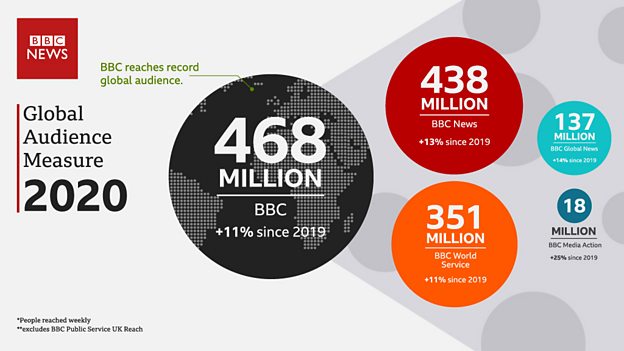
The BBC’s global reach increased by 11% year on year in 2020 to 468.2m people a week – the highest number ever.

BBC News accounts for 438.4m of the total with an annual increase of 13%. Digital platforms are key to the success, with an increase of 53% in BBC News users. A total of 151m users now access BBC News digitally according the annual Global Audience Measure which measures how many individuals the BBC reached weekly with its news and entertainment content in the year 2019/20.

Tony Hall, BBC Director-General, says: “We are without question one of Britain’s strongest and best-known brands, synonymous with quality and accuracy worldwide. Our international news services rank first for trust and reliability and the World Service remains a beacon of democratic values. Independent research shows that there is an exceptionally high correlation between places where people are aware of the BBC and places where people think positively about the UK. More than that, the BBC helps UK trade. This has perhaps never been more important. The UK will forge a new relationship with the world in the decade ahead, built on an ambitious vision of ‘Global Britain’. Success will mean drawing on all our considerable international assets, and that means unleashing the full global potential of the BBC.”

In late March 2020, as the Covid-19 virus spread and trusted sources of information were in demand, BBC News recorded the highest reach of any international media organisation in the world with 310m people accessing coverage across 42 languages.

BBC global content is increasingly popular on global platforms like Youtube with a 129% increase in audiences to 47m a week – overtaking Facebook with a 31% increase to 43m. Twitter reach has doubled to 6m and Instagram also reaches 6m weekly.

Other highlights of the 2020 Global Audience Measure:

  • BBC World News channel made significant gains to reach 112m – with growth in the Americas at 50%.
  • BBC World Service languages up 13% to 292.1m with a big uptick in digital engagement among audiences aged 15-24 who now make up a third of the total. BBC News Hindi is now the second most popular service with 25m – behind Arabic with 42m (+67%). BBC Chinese saw an increase of 141%, Russian is up 32% and BBC Mundo 40%. Other big percentage increases include Serbian (+327%), Yoruba (+166%) and Afaan Oromoo (+143%).
  • BBC Studios increased reach by 5.8m to 49.1m up 13%.
  • BBC World Service English audiences up by 8% to 97m. The Global News Podcast remains the BBC’s most popular with audiences approaching 1m a week. Italy contributed 1.4m new listeners on DAB radio.
  • BBC Media Action – the BBC’s international charity that helps to strengthen governance, improve people’s health and humanitarian response – saw an increase in audience of 4m to 18m.

New content funded by the UK government’s World 2020 initiative attracted new audiences, with Sport Africa – including extensive Premier League coverage; Africa Eye with groundbreaking investigative journalism; and What’s New for young African audiences performing particularly well.

The top 10 countries by BBC News audience are:

India

60,400,000

United States

49,500,000

Nigeria

37,200,000

Kenya

14,600,000

Tanzania

14,000,000

Bangladesh

11,900,000

Afghanistan

11,400,000

Iran

11,300,000

Canada

9,700,000

Pakistan

9,700,000

The Global Audience Measure is an annual update of how many people are consuming the BBC weekly for all services in all countries across all platforms (television, radio, website and social media). Key to this is de-duplication i.e. ensuring that a person who consumes multiple BBC services or platforms or on multiple devices is not counted many times in the top level totals, which means those totals are often not the sums of their constituent parts.


The BBC’s Director-General, Lord Hall, has published a blog about the BBC’s global role. Read it here.