News viewership in India up 200% as a result of pandemic, says TV9 CEO

News viewership in India up 200% as a result of pandemic, says TV9 CEO

News viewership in India up 200% as a result of pandemic, says TV9 CEO

The latest guest on the AIB’s In Conversation series is Barun Das, chief executive of TV9 Network in India.

Speaking to the AIB’s Simon Spanswick, Das said that the exponential growth of audiences for TV news channels during the pandemic is positive and as lockdowns ease, advertisers are finding that news is a highly effective platform to reach consumers. There’s a shift in the TV news audience demographic. Traditionally, TV news has been skewed to a male audience, but that’s changing as more women are watching. Advertisers are recognising this with more commercials targeting women being bought.

Allied to the growth of audiences consuming channels via traditional cable and satellite distribution is the development of digital platforms including OTT, says Das. TV9 is making use of new digital platforms and the network believes that by 2027/28, advertising on digital news offers will overtake TV news advertising. It’s for this reason that TV9 Network is betting big on digital, says Das.

In the interview, Das talked about how TV9 maintained operations as the pandemic raged and some 150 staff members caught the coronavirus. Shift patterns were altered, and extensive safety guidelines implemented in all the company’s broadcast centres. Das also believes that as a result of the pandemic, India as a country has actually become more disciplined, despite that size and diversity that exists within the population of 1.3 billion.

Watch the full interview here.

TV9 Network has recently become a Member of the AIB.

NHK WORLD August programme highlights

NHK WORLD August programme highlights

NHK WORLD August programme highlights

​

What if social media had existed in 1945, when the atomic bomb dropped on Hiroshima? This program constructs a timeline of imaginary tweets, based on actual diaries written by three Hiroshima citizens during  World War II. One was by a 13-year-old. Another was written by a 26-year-old newly wed, who prayed for her husband in the battlefield. The third was by a journalist. None of them had an inkling of the fate that awaited their city

A young boy carried the lifeless body of his even younger brother in Nagasaki, after the devastation that the atomic bomb brought. An American army photographer, Joe O’Donnell, took a picture of him waiting in line at a crematory. No one knows the boy’s name, but the photo has been seen around the world. This program shows the array of approaches being used to try to determine his identity. It also examines the struggles of other children who lost their parents to the bomb

Document 72 Hours

Tuesdays

1:30 / 7:30 / 10:30 / 19:30

Three days in the life of…Stay in one location for 72 hours, catching glimpses into people’s lives as they open up and share

Arqiva develops cloud-based support for Freeview Play’s metadata migration

Arqiva develops cloud-based support for Freeview Play’s metadata migration

Arqiva develops cloud-based support for Freeview Play’s metadata migration

Leading UK communications infrastructure and media services company, Arqiva, has created a cloud-based metadata management system for Digital UK, the organisation that leads the development of the UK’s biggest TV platform, Freeview. This system supports the migration of the Freeview Play service information platform to a highly scalable public cloud infrastructure. The solution aggregates, manages and delivers service and programme metadata from multiple sources for Freeview Play guides on connected TVs and set-top boxes, meaning viewers can seamlessly navigate between live TV and on-demand content.


Broadcasters are demanding increased service and commercial flexibility to keep up with a rapidly changing broadcast landscape, and Arqiva’s cloud-orchestrated technology will enable Freeview to quickly trial, adopt and integrate new services in line with market demands. Designed to be reliable and scalable, the virtual metadata system will support Freeview Play’s growth as it becomes a leading player in connected TV offerings.


The original metadata management system, which Arqiva built and operated for Digital UK,  has been at the heart of Freeview Play since its launch in 2015. Arqiva was chosen to support the transition to cloud because of its knowledge and understanding of the Freeview Play service and expertise in public cloud-based solutions. Since 2019 Arqiva has been working with Digital UK on designing, developing and testing the new cloud-based platform, with the full migration process completed on 20th July 2020.


James Jackson, technology director at Digital UK, said: “Providing an enjoyable, flexible and intuitive viewer experience is central to what we do. This Metadata Management system now allows Digital UK to adapt to future changes quicker and allows us to efficiently scale up as the platform grows rapidly over the coming years. Arqiva’s experience and depth of understanding of Freeview’s requirements has ensured that these systems can fully meet the expectations of viewers, broadcasters and our manufacturer partners.”


Laurie Patten, director of products and strategy at Arqiva, said: “As Freeview Play continues to grow in popularity, it’s more important than ever that Freeview has the right support in evolving its hybrid service towards a virtual environment. The new cloud-based metadata management system will mean Freeview can offer all its new and existing users a seamless viewing experience. Enhancing the viewing experience is always front of mind for our customers, and this highly-scalable and flexible system will allow them to bring new ideas to market sooner.” The design and build of the metadata management system that we built for Digital UK, fits within our growing cloud-based and software capabilities.

[Source: Arqiva press release]

BBC announces new all time record global audience

BBC announces new all time record global audience

BBC announces new all time record global audience

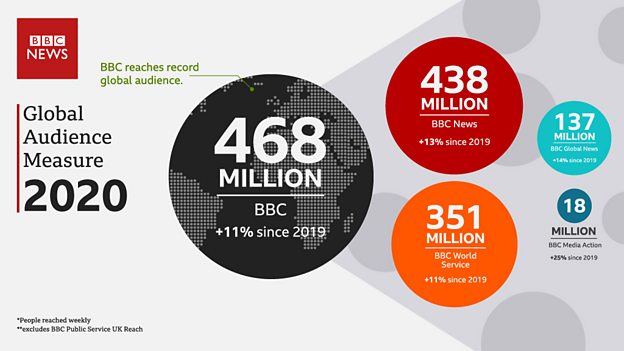
The BBC’s global reach increased by 11% year on year in 2020 to 468.2m people a week – the highest number ever.

BBC News accounts for 438.4m of the total with an annual increase of 13%. Digital platforms are key to the success, with an increase of 53% in BBC News users. A total of 151m users now access BBC News digitally according the annual Global Audience Measure which measures how many individuals the BBC reached weekly with its news and entertainment content in the year 2019/20.

Tony Hall, BBC Director-General, says: “We are without question one of Britain’s strongest and best-known brands, synonymous with quality and accuracy worldwide. Our international news services rank first for trust and reliability and the World Service remains a beacon of democratic values. Independent research shows that there is an exceptionally high correlation between places where people are aware of the BBC and places where people think positively about the UK. More than that, the BBC helps UK trade. This has perhaps never been more important. The UK will forge a new relationship with the world in the decade ahead, built on an ambitious vision of ‘Global Britain’. Success will mean drawing on all our considerable international assets, and that means unleashing the full global potential of the BBC.”

In late March 2020, as the Covid-19 virus spread and trusted sources of information were in demand, BBC News recorded the highest reach of any international media organisation in the world with 310m people accessing coverage across 42 languages.

BBC global content is increasingly popular on global platforms like Youtube with a 129% increase in audiences to 47m a week – overtaking Facebook with a 31% increase to 43m. Twitter reach has doubled to 6m and Instagram also reaches 6m weekly.

Other highlights of the 2020 Global Audience Measure:

  • BBC World News channel made significant gains to reach 112m – with growth in the Americas at 50%.
  • BBC World Service languages up 13% to 292.1m with a big uptick in digital engagement among audiences aged 15-24 who now make up a third of the total. BBC News Hindi is now the second most popular service with 25m – behind Arabic with 42m (+67%). BBC Chinese saw an increase of 141%, Russian is up 32% and BBC Mundo 40%. Other big percentage increases include Serbian (+327%), Yoruba (+166%) and Afaan Oromoo (+143%).
  • BBC Studios increased reach by 5.8m to 49.1m up 13%.
  • BBC World Service English audiences up by 8% to 97m. The Global News Podcast remains the BBC’s most popular with audiences approaching 1m a week. Italy contributed 1.4m new listeners on DAB radio.
  • BBC Media Action – the BBC’s international charity that helps to strengthen governance, improve people’s health and humanitarian response – saw an increase in audience of 4m to 18m.

New content funded by the UK government’s World 2020 initiative attracted new audiences, with Sport Africa – including extensive Premier League coverage; Africa Eye with groundbreaking investigative journalism; and What’s New for young African audiences performing particularly well.

The top 10 countries by BBC News audience are:

India

60,400,000

United States

49,500,000

Nigeria

37,200,000

Kenya

14,600,000

Tanzania

14,000,000

Bangladesh

11,900,000

Afghanistan

11,400,000

Iran

11,300,000

Canada

9,700,000

Pakistan

9,700,000

The Global Audience Measure is an annual update of how many people are consuming the BBC weekly for all services in all countries across all platforms (television, radio, website and social media). Key to this is de-duplication i.e. ensuring that a person who consumes multiple BBC services or platforms or on multiple devices is not counted many times in the top level totals, which means those totals are often not the sums of their constituent parts.


The BBC’s Director-General, Lord Hall, has published a blog about the BBC’s global role. Read it here.

Final few days to enter the AIBs 2020

Final few days to enter the AIBs 2020

Final few days to enter the AIBs 2020

We are into the final seven days to enter the AIBs – the annual international competition for journalism and factual productions.

The AIBs cover TV, radio and digital platforms and are open to work in any language.

There are 20 categories in this year’s competition, ranging from daily journalism to investigative documentary, natural world to human interest, science to politics.

We recognise that the past few months have been challenging for everyone, and that’s why we only launched the AIBs after discussions with a wide range of producers and journalists. Everyone we spoke with agreed that despite the global pandemic, recognising the work of teams and individuals across the world involved in factual story telling remains important.

The closing date is fast approaching – Friday 24 July – so do not delay in getting your entries together to join colleagues from Singapore, Qatar, the UK, the US, Hong Kong, Germany, Belgium, Bangladesh, Taiwan, Australia and Japan who have already submitted their work for our international panel of judges to consider.

Full information about this year’s AIBs is on our special website at http://theaibs.tv, and you can see the full entry book in page-turning format at https://theaibs.tv/AIBs-2020/Entry-book/index.html.

The AIB team is also available to answer any questions that you may have and to help solve any problems you encounter in entering your work. Full contact information appears below.

We look forward to seeing your work and that of your colleagues showcased to the world in this year’s AIBs.

Good luck!

Últimos días para ingresar

Letzte Tage, um einzutreten

Derniers jours pour participer

Giriş için son birkaç gün

Sista några dagar för att komma in

Huling ilang araw upang makapasok

Fewan kwanakin ƙarshe don shiga

Последние несколько дней, чтобы войти

Laatste paar dagen om binnen te komen

​Cúpla lá deiridh le dul isteach​

BBC sets out modernisation plans

BBC sets out modernisation plans

BBC sets out modernisation plans

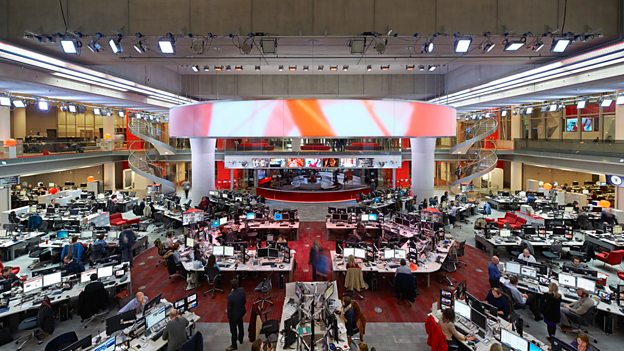
BBC News has set out an update on the plans it announced earlier this year to respond to changing audience needs.

The update addresses the BBC’s worsening financial position and draws on the experiences of operating during the Covid-19 crisis.

In January BBC News announced a series of modernisation proposals. Since then, faced with the Covid-19 crisis, BBC News has made huge operational changes to keep vital news services on air. During this time the proposals were paused, and will now be implemented in stages.

Director of BBC News and Current Affairs, Fran Unsworth, says: “Covid-19 has changed all of our lives. We are still covering the most challenging story of our lifetimes. During this crisis audiences have turned to BBC News in their millions and I’m incredibly proud of what we, as a team, have been able to achieve.

“But if we don’t make changes, we won’t be sustainable. This crisis has led us to re-evaluate exactly how we operate as an organisation.  And our operation has been underpinned by the principles we set out earlier this year – fewer stories, more targeted and with more impact. We’re aiming to reach everyone, every day. For BBC News to thrive, and for us to continue to serve all our audiences, we have to change.”

Alongside structural changes in some departments, updated plans set out today include:

  • Commissioning: the changes to working caused by the Covid-19 crisis mean it is not possible to go straight to the new way of working announced in January, but we will move towards it with a new commissioning group (made up of existing editors) to co-ordinate the biggest planned stories, avoid duplication and make BBC content go further
  • Newsgathering: BBC News will have fewer reporters overall; more correspondents will increasingly be asked to work across a range of content rather than be ‘owned’ by individual programmes. We will invest in new community affairs roles around the country, while reducing numbers in London
  • Digital: We want to ensure digital is at the heart of our journalism. A number of skilled digital journalists will move into the Newsgathering team and be deployed on stories. We will refocus the ‘rollout’ of our stories, so we break more stories in the morning when our digital audiences are highest
  • Original journalism: a new team, bringing together expertise from areas such as the Victoria Derbyshire programme and BBC Stories, will focus on under-reported ‘off diary’ stories, producing content for daily news programmes and online
  • TV political programming: Politics Live, currently airing on Wednesdays only, will return four days a week, Monday to Thursday
    BBC Parliament will focus on live and as-live coverage of the elected chambers across the UK and produce daily and weekly highlights programmes. We will no longer commission most of the other bespoke programmes we currently make for BBC Parliament, although we will continue to draw on our archive to broadcast our popular historical election coverage
  • News channels: We will preserve two clearly branded news channels (the BBC News channel in the UK and BBC World News globally) with a focus on live, breaking and developing stories but will retain some elements of shared output in the mornings and evenings
  • World Service English: we will make some of the current streamlined schedule changes permanent, including reductions in the duration of Newsday and The World This Week will be decommissioned. We will launch a new Africa-focused podcast
  • Business output: To increase the impact of business coverage we will integrate it more closely with the rest of the output, and will no longer run the Business Online live page. We will reduce separate business bulletins on the News channel and BBC World Service English
  • Radio: We will close In Business on BBC Radio 4 but continue long-form business content with The Bottom Line

Building on the lessons of operating during Covid-19, we will use fewer studios and make significant reductions to our operations staff.

The reduction in output means we will also reduce our pool of presenters.

The increased financial pressure on the BBC as a result of Covid-19 means the number of job losses in BBC News will rise to around 520, which is 70 more than the 450 announced in January. This will include senior management posts.

There will be a further update on plans later in the year.

Source: BBC Press Release