
Margaret Hoover and Kristin Lord join RFE/RL’s Board of Directors

Margaret Hoover and Kristin Lord join RFE/RL’s Board of Directors

Margaret Hoover and Kristin Lord join RFE/RL’s Board of Directors

The Board of Directors of Radio Free Europe/Radio Liberty (RFE/RL) welcomes journalist and commentator Margaret Hoover and nonprofit executive Kristin Lord as new Board Members, effective April 26, 2022.

Amb. Karen Kornbluh, the Chair of the RFE/RL Board, said, “I am thrilled to welcome Margaret and Kristin to the Board at this pivotal moment for RFE/RL and the 23-country region we serve. They bring years of journalism, foreign policy, and regional expertise to the Board, and perfectly complement the exceptional breadth of talent already supporting and serving RFE/RL’s mission.”

Margaret Hoover is the host of the PBS program “Firing Line with Margaret Hoover,” a revival of the iconic television series hosted by William F. Buckley Jr. for 33 years. A CNN political commentator, Ms. Hoover served in The White House under President George W. Bush, in the Department of Homeland Security, on Capitol Hill, and on two presidential campaigns. She is the President of American Unity Fund, a political organization focused on achieving full freedom and equality for LGBT Americans, as well as the bestselling author of American Individualism: How a New Generation of Conservatives Can Save the Republican Party. Her writing has appeared in The New York Times, The Wall Street Journal, The New York Daily News, The Daily Beast, CNN.com, and FoxNews.com. Ms. Hoover serves on the boards of Stanford University’s Hoover Institution, the Hoover Presidential Foundation, and the Belgian American Educational Foundation.

Kristin Lord is the President and CEO of IREX, a global education and development non-profit organization that promotes more just, prosperous, and inclusive societies by investing in people and the conditions that help them to thrive. She brings more than 25 years of experience in the fields of education, foreign policy, global development, and security and peacebuilding to this role. Prior to joining IREX in 2014, Kristin served in leadership roles at the United States Institute of Peace (USIP), Center for a New American Security (CNAS), Brookings Institution, and George Washington University’s Elliott School of International Affairs. She has also served in a senior advisory role at the U.S. Department of State and recently completed a term as a Trustee of the American University in Cairo. Kristin currently serves as a board member of the United States Global Leadership Coalition (USGLC) and Interaction, an alliance of international NGOs and partners that serve the world’s poor and vulnerable.

Hoover and Lord join an RFE/RL Board that, in addition to Chairman Kornbluh, includes former U.S. Ambassador Ryan Crocker, “American Purpose” editor in chief and former RFE/RL President Jeff Gedmin, public relations executive Michael Kempner, and current RFE/RL President Jamie Fly.

RFE/RL, Inc. is a private nonprofit corporation incorporated in the State of Delaware. Its Board of Directors makes all major policy determinations governing RFE/RL’s operations. Each member of the RFE/RL Board of Directors is required by federal law to have “requisite expertise in journalism, technology, broadcasting, or diplomacy, or appropriate language or cultural understanding” relevant to RFE/RL’s mission. Employees of U.S. government agencies are prohibited by law from serving on the RFE/RL Board.

[Source: RFE/RL press release]

UK launch for Current Time on Freeview

UK launch for Current Time on Freeview

UK launch for Current Time on Freeview

Current Time, a Russian-language 24/7 TV  channel broadcasting from Prague, has launched on Freeview UK, channel 271, via the Channelbox platform.

Current Time is a Russian-language TV channel headquartered in Prague and produced by Radio Free Europe/Radio Liberty (RFE/RL) in cooperation with Voice of America. The channel was established as an alternative to Kremlin-controlled media and brings real news, robust debate, and fact-based, unbiased, balanced reporting on local, regional, and international issues to Russian-speaking audiences everywhere.

Current Time has been under attack from the Kremlin since the channel began. It was designated as a foreign agent in December 2017, less than one year after its formal launch.

Following the launch of the Ukraina24 news channel last month, Current Time will further bolster Channelbox’s extensive news lineup, which includes Euronews, France24 and many others.

Channelbox is a multi-channel platform available on Freeview channel 271 and accessible via TV sets  connected to the aerial and the internet. Channelbox is also available via its mobile applications worldwide.

 “Current Time is happy to welcome its new viewers in the United Kingdom. The partnership with Channelbox is particularly important now as Current Time continues to provide its Russian-speaking audiences worldwide with uncensored news and information about Russia’s war on Ukraine,” said Pavel Butorin, Director, Current Time.

“We are very excited to have Current Time on the platform and to expand its distribution in the UK and worldwide. It is more important than ever for Russian speakers to have access to independent media, which is not controlled by the Kremlin”, said Tanya Kronfli, Channelbox Head of content and business development.

About Current Time

Current Time is a 24/7 TV and digital network for Russian speakers, led by Radio Free Europe/Radio Liberty in cooperation with Voice of America. The Current Time network’s roots reach back to August 2014 and the debut of the currenttime.tvwebsite, soon followed by its YouTube and Facebook channels and, in October 2014, the launch of its first, 30-minute news program. This was followed in February 2017 by the launch of Current Time’s 24/7 TV channel. In addition to reporting uncensored news and debunking disinformation through its Smotri v Oba (“Footage vs. Footage”) program, Current Time is the largest provider of independent, Russian-language films to its audiences. A sampling of Current Time’s best content can be found on the channel’s English portal.

About Channelbox

A free-to-air multi-channel platform available on Freeview devices connected to the Internet. Channelbox is accessible via Freeview channel 271 and mobile applications.

RFE/RL Journalist Dies In Russian Air Strikes On Kyiv

RFE/RL Journalist Dies In Russian Air Strikes On Kyiv

RFE/RL Journalist Dies In Russian Air Strikes On Kyiv

​RFE/RL journalist Vira Hyrych has died in Kyiv after a Russian air strike hit the residential building where she lived in the Ukrainian capital.

Hyrych’s body was found early in the morning on April 29 amid the wreckage of the building, which was hit by a Russian missile the night before, RFE/RL’s Ukrainian Service said.

UN Secretary-General Antonio Guterres was visiting Kyiv on April 28 as air strikes hit the capital, including the apartment block.


“We are deeply saddened by the death of our Ukrainian Service staffer Vira Hyrych in Kyiv overnight. We have lost a dear colleague who will be remembered for her professionalism and dedication to our mission,” RFE/RL President Jamie Fly said in a statement.

“We are shocked and angered by the senseless nature of her death at home in a country and city she loved. Her memory will inspire our work in Ukraine and beyond for years to come,” he added.

Videos and pictures from the site showed the lower floors of the building heavily damaged. Cars in the area had their windows blown out.

Russian Defence Ministry spokesman Igor Konashenkov claimed “long-range, high-precision” missiles had hit factory buildings in Kyiv of Ukrainian rocket manufacturer Artem on April 28.

Ukrainian officials have not commented on whether the factory had been hit during the attack.

Kyiv Mayor Vitali Klitschko said on Telegram on April 29 that one body had been retrieved from the rubble and another 10 people had been injured in the strikes. He gave no further details.

Hyrych, born in 1967, began working for RFE/RL in February 2018. Before that she worked at a leading television channel in Ukraine.

Source: RFE/RL; main photo: Facebook; Kyiv bomb damage photo: Aleksandr Sinitsa/UNIAN

As war transforms media landscape in Europe, RFE/RL opens offices in Latvia, Lithuania

As war transforms media landscape in Europe, RFE/RL opens offices in Latvia, Lithuania

As war transforms media landscape in Europe, RFE/RL opens offices in Latvia, Lithuania

Following the forced suspension of RFE/RL operations in Russia on March 6, RFE/RL is opening news bureaus in Riga, Latvia and Vilnius, Lithuania. These offices will house teams from RFE/RL’s Russia and Belarus services and the 24/7 Current Time global digital and TV network, and also provide a base for new investigative journalism projects and digital innovation hubs.

Said RFE/RL President Jamie Fly, “These new bureaus will allow RFE/RL to continue to engage with our audiences in Russia and Belarus, despite those government’s best efforts to silence independent journalism. RFE/RL will expand its already-successful efforts to reach Russian and Belarusian audiences with the relevant news they seek, and desperately need. We are grateful to the Latvian and Lithuanian governments for their commitment to press freedom and their support for vulnerable journalists who have had to seek safe haven outside their home countries.”

In Riga, RFE/RL plans to establish a multimedia hub that will host Russian Service and Current Time staff displaced from Russia. The Latvian capital will also house a new, Russian-language investigative journalism unit and a digital innovation hub designed to counter disinformation and develop strategies to circumvent online censorship across delivery platforms. The Vilnius news bureau will primarily host displaced Belarus Service journalists forced to flee after the flawed 2020 elections, as well as a new reporting team being set up by Current Time to serve the needs of the network’s Russian-speaking audiences in Belarus.

RFE/RL’s impact during the first two weeks of Russia’s war on Ukraine demonstrates the appetite within Russia and Belarus for a credible, uncensored alternative to Kremlin media about the full scope of the conflict. Between February 24 and March 16, the number of views of RFE/RL videos on YouTube from Russia tripled to nearly 238 million, while the number of visits, page views, and unique visitors to its websites from Russia rose by 34 percent, 51 percent, and 53 percent respectively. As for Belarus, the number of RFE/RL videos viewed via YouTube from inside the country quadrupled (to 22.4 million), and the number of visits (+158%), page views (+148%), and unique visitors (+110) to RFE/RL websites from Belarus has also increased dramatically.

RFE/RL says it deeply appreciates the support of the governments of Latvia and Lithuania for RFE/RL’s mission and for the establishment of these new bureaus. The people of Latvia and Lithuania have for decades been enthusiastic consumers of RFE/RL programming—both of RFE/RL’s Latvian and Lithuanian services that operated from 1975 to 2004, and more recently of Current Time programming. RFE/RL President Fly visited Vilnius and Riga this past January, in part to attend the Lithuanian premiere of the award-winning, Current Time-commissioned film “Mr. Landsbergis,” about Lithuania’s struggle to restore its independence.

RFE/RL’s Russian Service is a multiplatform alternative to Russian state-controlled media, providing audiences in the Russian Federation with informed and accurate news, analysis, and opinion. The Russian Service’s websites, including its regional reporting units Siberia.Realities and North.Realities, earned a monthly average of 12.7 million visits and 20.6 million page views in 2021, while 297 million Russian Service videos were viewed on YouTube, Facebook, and Instagram.

Current Time is a 24/7 Russian-language digital and TV network led by RFE/RL in cooperation with VOA, that caters to Russian-speakers worldwide. In addition to reporting uncensored news, it is the largest provider of independent, Russian-language films to its audiences. Despite rising pressure on Current Time from the Russian government, Current Time videos were viewed over 1.3 billion times on YouTube, Facebook, and Instagram/IGTV in FY2021.

Labeled an “extremist organization” by the Belarus government, RFE/RL’s Belarus Service provides independent news and analysis to Belarusian audiences in their own language, relying on social media platforms such as Telegram, Instagram, and YouTube, as well as mirror sites and an updated news app to circumvent pervasive Internet blockages and access disruptions.

[Source: RFE/RL press release]

RFE/RL suspends operations in Russia

RFE/RL suspends operations in Russia

RFE/RL suspends operations in Russia

Radio Free Europe/Radio Liberty (RFE/RL) has suspended its operations in Russia after local tax authorities initiated bankruptcy proceedings against RFE/RL’s Russian entity on March 4 and police intensified pressure on its journalists. These Kremlin attacks on RFE/RL’s ability to operate in Russia are the culmination of a years-long pressure campaign against RFE/RL, which has maintained a physical presence in Russia since 1991 when it established its Moscow bureau at the invitation of then-President Boris Yeltsin.

Also on March 4, Russian President Vladimir Putin signed a law that could subject any journalist who deviates from the Kremlin’s talking points on the Ukraine war to a 15-year prison sentence. Because RFE/RL journalists continue to tell the truth about Russia’s catastrophic invasion of its neighbour, the company plans to report about these developments from outside of Russia.

Said RFE/RL President & CEO Jamie Fly, “It is with the deepest regret that I announce the suspension of our physical operations in Moscow today. This is not a decision that RFE/RL has taken of its own accord, but one that has been forced upon us by the Putin regime’s assault on the truth. Following years of threats, intimidation and harassment of our journalists, the Kremlin, desperate to prevent Russian citizens from knowing the truth about its illegal war in Ukraine, is now branding honest journalists as traitors to the Russian state. We will continue to expand our reporting for Russian audiences and will use every platform possible to reach them at a time when they need our journalism more than ever. Despite this bleak moment, we know from our organisation’s 70-year history that one day, perhaps sooner than many think, we will be able to reopen a bureau in Russia. Time is on the side of liberty, even in Vladimir Putin’s Russia.”

Over the last week, nine of RFE/RL’s Russian language websites were blocked after RFE/RL refused to comply with the Russian government’s demands to delete information about Russia’s invasion of Ukraine. Overnight on March 3-4, Russian authorities blocked access within Russia to websites run by RFE/RL’s Russian, Tatar-Bashkir, and North Caucasus services, including the Russian-language North.Realities, Siberia.Realities, Idel.Realities, and Caucasus.Realities sites. On February 28, Russia blocked access to two other RFE/RL websites, including Current Time, the 24/7 digital and TV network led by RFE/RL in cooperation with VOA.

Since invading Ukraine, Russia has blocked a number of Russian-language websites producing news content from abroad, including Meduza, BBC, Deutsche Welle and Voice of America. The Kremlin has also blocked access to Facebook and Twitter.

The technical cause of the bankruptcy of RFE/RL’s Russian entity is its longstanding refusal to comply with Russia’s unlawful demand that every piece of RFE/RL’s Russian-language content—every video, every article, every tweet—be accompanied by a state-mandated warning that RFE/RL is a “foreign agent.” In the past year, Russia’s media regulator Roskomnadzor has issued 1,040 violations against RFE/RL that will result in fines of more than $13.4 million for its refusal to submit to this content-labeling regime. In addition, 18 RFE/RL journalists have been designated as individual “foreign agents.” On February 9, RFE/RL filed its final written submission with the European Court of Human Rights (ECtHR), asking for a hearing to consider the merits of the legal case it filed in May 2021 challenging Russia’s “foreign agent” laws.

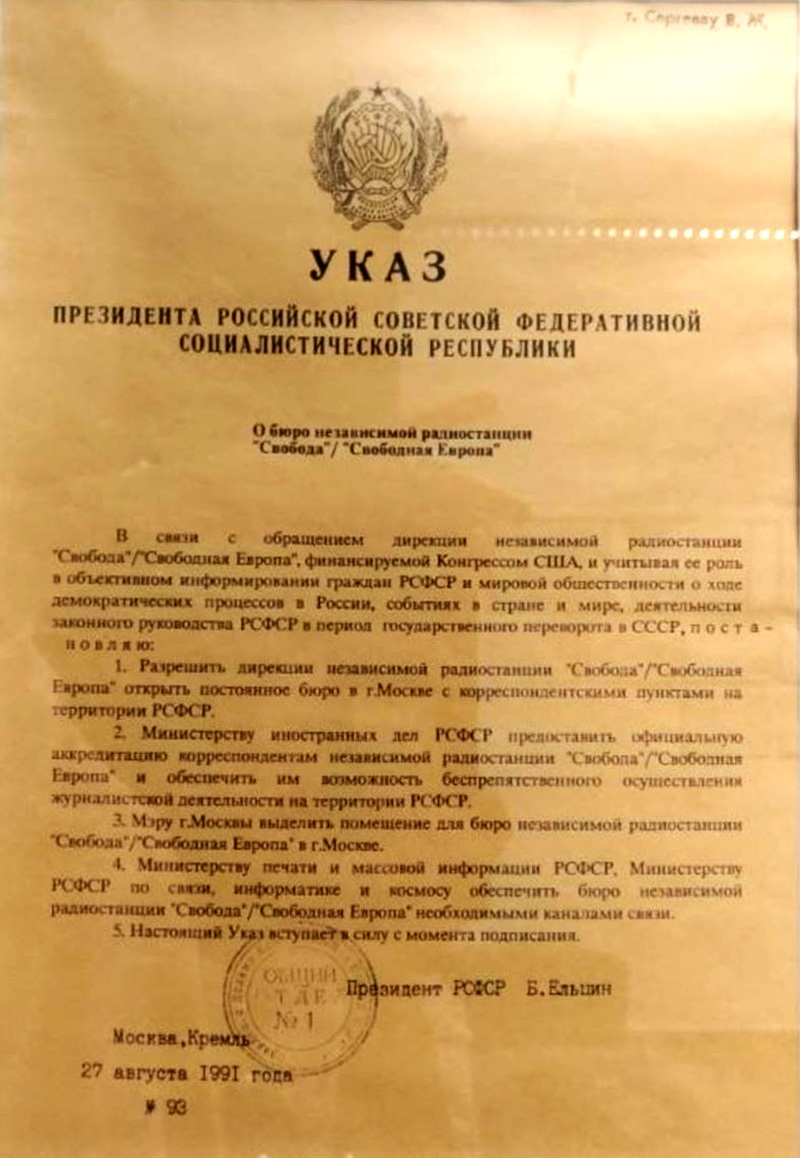
RFE/RL has been broadcasting to Russian audiences since March 1, 1953, when the first programs of “Radio Liberation” were directed at audiences in the Soviet Union. Between November 1988 and August 1991, as Soviet leader Mikhail Gorbachev’s “glasnost” policies took hold, the Russian Service built up a network of as many as 400 people across the U.S.S.R. and over 40 people in Moscow. On August 27, 1991, Russian Federation President Boris Yeltsin issued a decree giving RFE/RL accreditation and allowing it to open a bureau in Moscow; the decree was revoked by Russian President Vladimir Putin in 2002.

RFE/RL’s Russian Service is a multi-platform alternative to Russian state-controlled media, providing audiences in the Russian Federation with informed and accurate news, analysis, and opinion. The Russian Service’s websites, including its regional reporting units Siberia.Realities and Northern.Realities, earned a monthly average of 12.7 million visits and 20.6 million page views in 2021, while 297 million Russian Service videos were viewed on YouTube, Facebook, and Instagram.

RFE/RL’s Tatar-Bashkir Service is the only major international news provider reporting in the Tatar and Bashkir languages to audiences in the Russian Federation’s multiethnic, Muslim-majority Volga-Ural region. Since 1953, the Service, known locally as Radio Azatliq, and its Russian-language reporting unit Idel.Realities, have provided an important and innovative alternative to government-controlled media.

RFE/RL’s North Caucasus Service is one of the few independent media outlets reporting in this predominantly Muslim region of the Russian Federation. Producing content in Chechen and Russian via its Caucasus.Realities unit, the service reports the news in one of the most violent and dangerous regions in the world.

Current Time is a 24/7 Russian-language digital and TV network led by RFE/RL in cooperation with VOA. In addition to reporting uncensored news, it is the largest provider of independent, Russian-language films to its audiences. Despite rising pressure on Current Time from the Russian government, Current Time videos were viewed over 1.3 billion times on YouTube, Facebook, and Instagram/IGTV in FY2021.