Taliban murder relative of DW journalist, injure another

Taliban murder relative of DW journalist, injure another
Taliban murder relative of DW journalist, injure another

Taliban fighters hunting a DW journalist have shot dead one member of his family and seriously injured another. The Taliban were conducting a house-to-house search to try and find the journalist, who now works in Germany.

Other relatives were able to escape at the last moment and are now on the run. DW Director General Peter Limbourg issued a strong condemnation and called on the German government to take action.

“The killing of a close relative of one of our editors by the Taliban yesterday is inconceivably tragic, and testifies to the acute danger in which all our employees and their families in Afghanistan find themselves,” Limbourg said. “It is evident that the Taliban are already carrying out organised searches for journalists, both in Kabul and in the provinces. We are running out of time!”

Taliban hunting journalists

The Taliban have raided the homes of at least three DW journalists. Nematullah Hemat of the private television station Ghargasht TV is believed to have been kidnapped by the Taliban, and Toofan Omar, the head of the private radio station Paktia Ghag Radio, was, according to government officials, targeted and shot dead by Taliban fighters.

Two men, also presumably Taliban, shot and killed the translator Amdadullah Hamdard, a frequent contributor to Germany’s Die Zeit newspaper, on August 2 in the eastern Afghan city of Jalalabad, right there on the street. And a month ago, the world-renowned Indian photographer and Pulitzer Prize winner Danish Siddiqui died in Kandahar, presumably killed by Taliban militants.

Media alliance calls on German government for help

Consequently, DW has joined the Federal Association of German Newspaper Publishers (BDZV), Die ZeitDer Spiegel, Deutschlandradio, dpa, Reporters Without Borders, stern, the Süddeutsche Zeitung, the Frankfurter Allgemeine Zeitungtaz, RTL, n-tv and Arte in publishing an open letter calling on the German government to set up an emergency visa program for Afghan staff.

The German Journalists’ Association (DJV) is also calling on the German government to take swift action, given that stringers who worked for Western media are now being hunted down. “Germany must not stand idly by while our colleagues are persecuted and even murdered,” said Frank Überall, the DJV chairman. He said that saving these journalists right now and offering them refuge in Germany was absolutely essential.

DW is not revealing the name of the journalist or the location of his family as their lives are still at risk.

The Media Freedom Coalition [MFC] is meeting to explore ways this alliance of 49 nations can assist in protecting and supporting journalists and others employed by media companies in Afghanistan. It is not expected that Afghanistan, which under the elected government became a member of the Media Freedom Coalition, will take part in the meeting. The Association for International Broadcasting is a member of the Consultative Network to the MFC and will be taking part in the meeting.

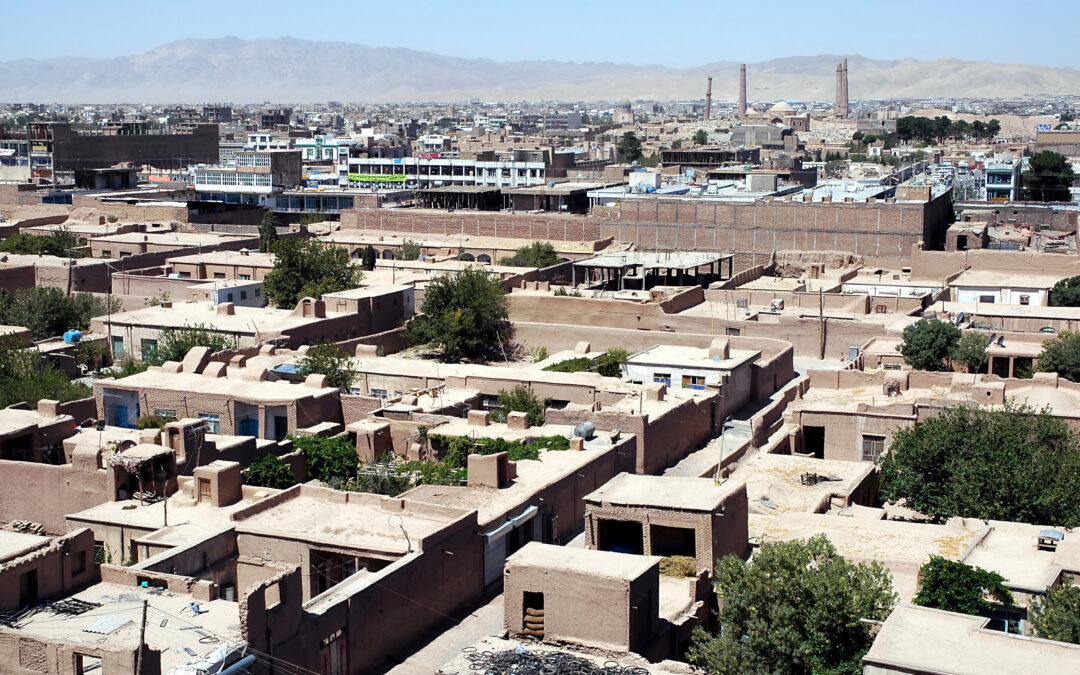
Photo: A view across the city of Herat in Afghanistan from Herat Citadel. Jonathan Wilson/Adobe Stock
Deutsche Welle Global Media Forum 2021 14/15 June

Deutsche Welle Global Media Forum 2021 14/15 June

Deutsche Welle Global Media Forum 2021 14/15 June

DW’s mainly virtual Global Media Forum (GMF) on June 14 and 15 will feature high-profile speakers, guests and participants from more than 160 countries. They will discuss aspects of this year’s theme “Disruption and innovation” in panel discussions and workshops. Registration on the website gmf.dw.com is free of charge. The live stream from the DW headquarters in Bonn can also be accessed via that website.


The media conference will be opened by German Chancellor Angela Merkel on Monday morning, 10 a.m. (CEST). Minister-President of the State of North Rhine-Westphalia Armin Laschet (CDU party) and Minister of State for International Cultural Policy at Germany’s Federal Foreign Office Michelle Müntefering will also address the audience, as well as Annalena Baerbock, Chairwoman of the Green party of Germany, and the Mayor of Bonn, Katja Dörner.


German media experts at the GMF 2021 include


Julia Becker, Chairwoman of the Supervisory Board, Funke Mediengruppe

Ellen Ehni, Editor-in-Chief Television, Westdeutscher Rundfunk (WDR)

Tobias Schmid, Director Media Authority in the German state of North-Rhine Westphalia


International experts from the fields of politics, journalism, human rights and academia include


Anne Applebaum, Pulitzer Prize-winning journalist and historian, USA

Audrey Tang, Digital Minister of Taiwan

Elif Shafak, British-Turkish novelist

Felipe Neto, YouTube star and influencer, Brazil

Irene Khan, UN Special Rapporteur for Freedom of Expression and Opinion, Bangladesh

Kenneth Roth, Executive Director, Human Rights Watch (HRW), USA

Jesper Doub, Director of News Partnerships, Facebook, Germany

Leymah Roberta Gbowee, Noble Peace laureate, Gbowee Peace Foundation Africa, Liberia

Maria Ressa, journalist and CEO of Rappler, Indonesia

Nuseir Yassin, founder & CEO of Nas Daily, Israel

Noel Curran, Director General, European Broadcasting Union (EBU), Ireland

Philipp Justus, Vice President Central Europe, Google, Germany

Steven Pinker, cognitive scientist, Harvard University, USA

Svetlana Tikhanovskaya, opposition politician, Belarus

Timothy Snyder, author and Richard C. Levin Professor of History, Yale University, USA

Vĕra Jourová, Vice-President for Values and Transparency, European Commission, Czech Republic


The two-day-conference will offer discussions and insights on topics such as digitalization, democracy, cyber security, constructive journalism and countering misinformation – and how these topics are interconnected. Here are a few highlights:


Digital platforms are increasingly becoming gatekeepers in the battle for users’ attention. How can media benefit from the innovative power of these intermediaries? How can they support each other with innovation while strengthening journalism? These topics will be discussed by Vĕra Jourová, Vice-President of the European Commission, Philipp Justus, Vice President Central Europe at Google, Naja Nielsen, Digital Director BBC News, and Julia Becker, Chairwoman of the Supervisory Board of the Funke Mediengruppe: “Looking into the future – A fruitful endeavor? Social media and journalism” on Monday, June 14,10:30 a.m. (CEST).


Entr.net is a new multilingual social media offer for young EU citizens, initiated by DW and France Médias Monde in partnership with media outlets in six European countries. On June 14 at 2:40 p.m. (CEST), the editors will present the unique project. In an additional session at 3:15 p.m., attendees will discuss “Breaking up national media bubbles – cross-border collaborative journalism initiatives.”


Constructive journalism can be easily confused with feel-good journalism or positive news as a recent internal study conducted by DW’s Trends and Knowledge team shows. So what exactly is constructive journalism? On June 14, 2:00 p.m. (CEST), the GMF session “Beyond who, what, when, where, and how – Exploring constructive journalism” will provide some answers, with experts Ruona Meyer (Solutions Journalism Network), Ulrik Haagerup (Constructive Institute) and Ellen Heinrichs (DW).


Timothy Snyder, professor of history at Yale University, will explore disruption in western societies in his impulse: “What went wrong?- Disrupted democracies and the media” on June 15, 11.20 a.m. (CEST)


Limited access to reliable information, misinformation on social media and restrictions on press freedom: journalists worldwide are under constant pressure in the pandemic. How are local and community media functioning in the pandemic? And how can newsrooms survive and come out of the crisis stronger? Media experts Teresa Chirwa-Ndanga (Media Institute of Southern Africa), Belén Pardo Herrero (Vokaribe Radio 89.6 FM) and Dina Aboughazala (EGAB.co) will explore in the session “Information saves lives – The role of local media in fighting the infodemic,” hosted by DW Akademie on June 15, 3:00 p.m. (CEST).


DW Freedom of Speech Award 2021


The annual DW Freedom of Speech Award ceremony on June 14, 5:20 p.m. (CEST) is one of the highlights of the GMF. Nigerian journalist Tobore Ovuorie is the seventh and second female laureate. Her undercover investigation into human trafficking and sex work helped her shed light on the mafia networks which operate between Nigeria and Europe. Since 2015, the DW Freedom of Speech Award has been honoring journalists’ outstanding commitment to human rights and particularly, freedom of expression.


Partner sessions


This year, numerous partner organizations from all over the world will be contributing their topics to the Deutsche Welle media conference by hosting and joining several sessions – including the Friedrich Naumann Foundation (based in Istanbul), the Association of German Newspaper Publishers (Berlin), the WDR and the Goethe Institute (Munich).


The DW Global Media Forum is Germany’s only international conference for representatives of the media from all over the world. Together with its main partners, the German Federal Foreign Office, the State of North Rhine-Westphalia, the Foundation for International Dialogue of the Savings Bank in Bonn, the Federal ministry for Economic Cooperation and Development and the City of Bonn, DW offers media professionals a unique opportunity for interdisciplinary discussions with opinion-leaders from different fields around the pressing issues of our time.

[Source: DW press release]

DW launches DW Magyar

DW launches DW Magyar

DW launches DW Magyar

In November 2020, DW announced an expansion of its journalistic offerings to include Hungarian as its 31st broadcast language, with the first reports to be published at the end of April. Hungarian was previously part of the German foreign broadcaster’s programming from 1962 to 1977 and from 1993 to 1999. DW believes that time has come to once again produce journalistically independent content for a primarily young target group under the title ‘DW Magyar’ and to initiate diverse debates on European issues. The program, which is distributed by several partner broadcasters in Hungary, is aimed primarily at users between the ages of 20 and 35.

Director General Peter Limbourg: “Now is the time for DW Magyar. Many media in Central and Eastern Europe that have reported critically on their governments are facing various obstacles to their work or have had to give up. With our programming which will soon be available in 32 broadcast languages, we are responding to the growing demand for information among the general public, as well as to the increasing restrictions on media freedom and the risks faced by journalists around the world.”

“We offer our audience true-to-life video reports from Hungary, Germany and other European countries, focusing on stories about current political, social, cultural and economic issues,” said DW Managing Director of Programming Gerda Meuer.  

“With our new offering in Hungarian, we want to enter into conversation with young people in an uninhibited and cosmopolitan manner and thus promote critical discourse about common values and challenges in Europe,” adds Adelheid Feilcke, Head of Programs for Europe.

On Wednesday April 28, DW will first launch a YouTube channel in Hungarian with around 15 video reports and features, including several editions of the formats Europeo and Untold Stories. The magazine Europeo features 4 to 5 reports per episode on one topic from different European perspectives. In Untold Stories, reporters of the same age as the target group meet interesting people from Hungary and tell their touching stories. TV magazines, reports and (web) video formats will follow in the medium term.

Initially ten reporters and editors work for the team in Germany and Hungary.
DW has been recording very high usage figures for months. Since the summer of 2020, monthly access to its digital offerings has remained constant at a level of more than one billion.  

[Source: DW press release]

DW Global Media Forum kicks off, virtually

DW Global Media Forum kicks off, virtually

DW Global Media Forum kicks off, virtually

As restrictions on international travel continue, a range of conferences have migrated to the cloud, including Deutsche Welle’s Global Media Forum. It will launch the first in a series of online events on 24 June with a digital session on the responsibility of the media in times of the coronavirus pandemic. It is the first of a series of digital talks and will be hosted by DW journalist Jaafar Abdul Karim. A discussion titled “The blame game: What is the media’s responsibility in the corona crisis?” will take place on June 24, at 1500 CET (GMT/UTC +2) with speakers from Africa, Latin America and Europe and will be streamed on Facebook.  

The session will take a close look at how populists have hijacked the COVID-19 pandemic for their own gain. It will examine the trustworthiness of news outlets on which journalists are relying during the pandemic. It will also explore how journalists can combat misinformation and disinformation – tactics constantly employed by populists and demagogues.

The host is Jaafar Abdul Kari, an award-winning journalist and host of DW’s show Jaafartalk, which reaches an audience of millions in the Arab world.

The speakers:

John-Allan Namu, CEO of Africa Uncensored, Kenya

Africa Uncensored is an investigative and in-depth journalism production house in Nairobi, Kenya. Its aim is to be the premier source of unique, important and incisive journalism.

María Esperanza Casullo, Associate Professor at the University of Río Negro, Argentina

Casullo’s work focuses on populism, democratic theory and Latin American politics, with an emphasis on comparative studies and discourse analysis.

Guido Bülow, Head of News Partnerships Central Europe at Facebook, Germany 

Bülow is responsible for the strategic initiatives and programs to promote quality journalism and an informed society in the Europe, the Middle East and Africa (EMEA) region. These include cooperation with independent fact-checkers and Facebook’s accelerator program for local media.

More information on this session: https://p.dw.com/p/3dUfy 

Join the session here: https://www.facebook.com/events/281481139639894/

Manuela Kasper-Claridge is Deutsche Welle’s new editor-in-chief

Manuela Kasper-Claridge is Deutsche Welle’s new editor-in-chief

Manuela Kasper-Claridge is Deutsche Welle’s new editor-in-chief

Manuela Kasper-Claridge, former deputy editor-in-chief and head of the economics, science and environment editorial department at Deutsche Welle, is the new editor-in-chief of Germany’s international media organization. After three years in this position, Ines Pohl will become DW bureau chief in Washington.

DW Director of Programming Gerda Meuer: “I am very pleased that the excellent journalist and program manager Manuela Kasper-Claridge will set new trends as editor-in-chief. She has always kept a close eye on the successful digitization and regionalization of our programming. Together with her team, she will provide fresh impetus. Manuela Kasper-Claridge is an experienced manager, who is committed to strengthening the journalistic profile of the brand DW. Her energy and journalistic judgement will be of particular benefit to us, not only in these times when our audiences are increasingly relying on us to provide reliable information as a result of the coronavirus crisis.”

For the first time, in March, content from all channels and platforms in DW’s 30 broadcasting languages reached more than one billion viewings worldwide. The main driver of the increase is the coverage of COVID-19, but longer documentary formats are also popular.

Manuela Kasper Claridge: “It is exciting to see how DW’s services are in demand worldwide, especially in these times. As editor-in-chief, I will work together with my colleagues to continue building on the strengths of our journalistic reporting,” said Manuela Kasper-Claridge. “Digital and diverse, innovative and clear, explanatory and reliable. We want exclusive stories that stimulate debate; we want to create added value for the users in all our target regions. And we aim to achieve all this with editorial teams, who are experts for the continents and know exactly what moves and inspires people.”

Kasper-Claridge joined Deutsche Welle 28 years ago and has reported from all parts of the world. She has developed award-winning international TV and multimedia formats, including Global Ideas, Founders’ Valley, Eco Africa and Eco India.

The outgoing Editor-in-chief Ines Pohl will take over as DW bureau chief in Washington in July. Pohl previously reported from the U.S. from 2016 to 2017, primarily on the first presidential election campaign and the inauguration of Donald Trump. “From a journalistic point of view, with the upcoming presidential elections and the impact of the Corona pandemic on the U.S., this year is an enormously exciting time for the move back to Washington,” said Pohl. “I am interested in questions of democratic legitimacy and the shaping of social transitions – and my passion is human rights.”

(Source: DW press release)