Nobel Peace Prize laureate Maria Ressa to open DW Global Media Forum 2022

Nobel Peace Prize laureate Maria Ressa to open DW Global Media Forum 2022
Nobel Peace Prize laureate Maria Ressa to open DW Global Media Forum 2022

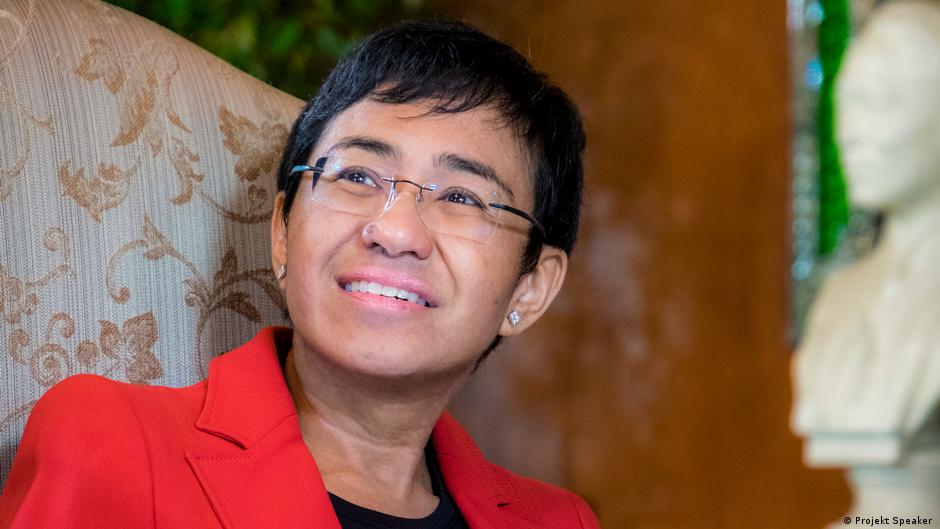
Philippine journalist and 2021 Nobel Peace Prize laureate Maria Ressa is set to open DW’s Global Media Forum (GMF) in Bonn, Germany on June 20 with the keynote speech, “What are you willing to sacrifice for the truth?”

Under the motto “Shaping tomorrow, now,” journalists, media professionals, politicians and scientists will meet for two days at the hybrid event held at the World Conference Center Bonn (WCCB).

For information on registration and conference program, please visit the GMF website.

Hundreds of media professionals, politicians, tech experts and activists from across the globe will once again convene in the former German Bundestag in Bonn to debate pressing media issues. Topics on the agenda include panels and workshops on press freedom, war reporting, constructive journalism and social resilience.

GMF 2022 participants

Among the guests are German Minister of State for Culture Claudia Roth and her G7 counterparts, Taiwanese Digital Minister Audrey Tang, Ulrik Haagerup, founder and CEO of the Constructive Institute in Aarhus/Denmark, Gerrit Rabenstein, head of DACH News Partnerships Google, Brazilian investigative journalist Patricia Toledo de Campos Mello, Russian opposition politician and digital expert Leonid Volkov, Ukrainian journalist Angelina Kariakina, Minister President of the state of North Rhine-Westphalia (NRW) Hendrik Wüst, and Jodie Ginsberg, president of the Committee to Protect Journalists (CPJ).

For the expected 1,200 participants workshops will also be held by numerous DW partners, including media companies and universities from NRW. This year, the heads of Germany’s journalism schools have chosen the Global Media Forum (GMF) for their annual meeting.

For the virtual audience, the GMF offers exclusive online sessions by renowned experts who share their knowledge on topics such as censorship detection, fact-checking and storytelling. For this purpose, DW has collaborated with intermediary organizations such as the Konrad Adenauer Foundation and the Goethe Institute, as well as international institutions such as the Nas Academy or Teyit from Turkey.

Verica Spasovska, DW Head of Events: “With this year’s hybrid event format, we have created a forum that brings people together in person while allowing the global community to participate virtually.”

Award ceremonies

Another highlight will be the award ceremony for this year’s DW Freedom of Speech Award presented to Ukrainian journalists Mstyslav Chernov and Evgeniy Maloletka. To find out more, click here.

At the @GMF start-up competition, entrepreneurial minds present their business ideas to an international audience. The concepts focus on new technologies to promote resilient journalism and a stable civil society in times of rapid change. The application is open until May 15.

For the first time, the ARD and ZDF Media Academy’s “Women and Media Technology Award” will also be presented as part of the GMF. This award honors successful female graduates from German, Austrian and Swiss universities in the fields of technology and engineering, media studies and other subjects related to media technology. More information could be found at: www.ard-zdf-foerderpreis.de

The Global Media Forum is sponsored by the German Federal Foreign Office, the State of North Rhine-Westphalia, the Stiftung Internationale Begegnung der Sparkasse in Bonn, the German Federal Ministry for Economic Cooperation and Development, and the City of Bonn.

[Source: DW press release]
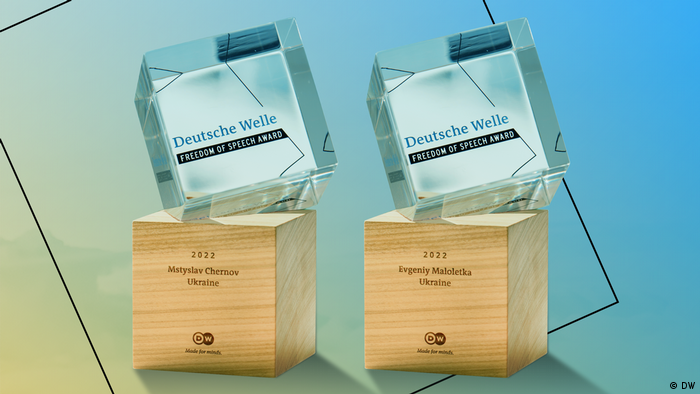
DW Freedom of Speech Award 2022 goes to Ukrainian journalists Mstyslav Chernov and Evgeniy Maloletka

DW Freedom of Speech Award 2022 goes to Ukrainian journalists Mstyslav Chernov and Evgeniy Maloletka

DW Freedom of Speech Award 2022 goes to Ukrainian journalists Mstyslav Chernov and Evgeniy Maloletka

Ukrainian visual journalist and novelist Mstyslav Chernov and photojournalist Evgeniy Maloletka are this year’s DW Freedom of Speech Award laureates. For the eighth consecutive year, Germany’s international broadcaster is awarding the prize. It recognizes outstanding promotion of human rights and freedom of expression.

“Mstyslav Chernov and Evgeniy Maloletka have a way of reporting that is painful to read and watch, but what really hurts is the truth that their reporting conveys: Russia brutally attacking Ukraine, and thereby Ukrainian civilians, under a fabricated pretence. While there are nuances to every story, there is no way facts can be negotiated. This is exactly what the Kremlin is doing: Distorting facts, spreading misinformation,” said DW Director General Peter Limbourg. “The Freedom of Speech Award for Mstyslav Chernov and Evgeniy Maloletka is to recognize their exceptional courage in standing up against propaganda and misinformation. It is to recognize that their fight for human rights and for the truth is a fight for democracy and free societies, for all of us, and it comes at a high price.”

The journalists, who both remain in Ukraine to continue their coverage of the war, welcomed the news about receiving the DW Freedom of Speech Award as an acknowledgment of their work.

The award ceremony will be held on June 20 as part of the DW Global Media Forum. 


Bringing atrocities in Mariupol to the world’s attention

AP journalist and novelist Mstyslav Chernov and freelance photojournalist Evgeniy Maloletka are both from eastern Ukraine. Previously, their reports and footage from the conflicts in Crimea and eastern Ukraine have been published in various international media, including BBC, Deutsche Welle, The New York Times, Washington Post, Der Spiegel and others. As a war reporter in several conflict zones such as Iraq or Syria, Chernov has been wounded multiple times. Before the war, Maloletka had also been working on a project about the Hutsul community in western Ukraine, their traditions and daily life, and on the impact of the conflict in Donbass.

The Freedom of Speech Award now honours the reporters’ coverage of the war in Ukraine started by Russia on February 24, 2022. The report “20 days in Mariupol: The team that documented city’s agony” offers a unique account of Mariupol under Russian siege, with Chernov and Maloletka being the last journalists in the city before their evacuation. They documented the city’s first deaths at the city hospital of Mariupol and the attack on the maternity ward with pregnant women and children in it, as well as numerous bombings. During this work, the journalists themselves were under constant attack and took great risks only to find a steady connection to upload their footage of the siege, bringing it to the attention of the international community. They were evacuated by Ukrainian soldiers to avoid them falling into the hands of Russians, who had been hunting them down.

AP Senior Vice President and Executive Editor Julie Pace: “Mstyslav and Evgeniy were the world’s eyes and ears in Mariupol, producing courageous and compelling reporting as the only international journalists inside the besieged city. The harrowing realities of Russia’s war would have remained unseen without their bravery. We are extremely proud of their work.”

Limbourg: “The war in Ukraine is a war on human rights and European values, but also a war on truth and facts. Our laureates this year have documented the atrocities committed in Mariupol and have themselves become eyewitnesses. It is thanks to them, and other journalists working in war zones, that the world gets to see what is happening on the ground. It is only then that crimes can be prosecuted, and perpetrators be held responsible. The kind of commitment and strength shown by war journalists is extremely valuable, the work is demanding and dangerous, and it is too seldomly given credit.” 


DW Freedom of Speech Award

Deutsche Welle provides independent news and information to people worldwide in 32 languages. DW promotes democratic values, human rights and the dialogue between different cultures. Since 2015, DW has been honoring individuals and organizations with the Freedom of Speech Award. The first laureate was Saudi blogger Raif Badawi, who had been jailed for ten years and was released in March this year. Other recipients include Mexican investigative journalist Annabel Hernández (2019), whose work focuses on corruption, impunity and drug cartels, and Nigerian investigative journalist Tobore Ovuorie (2021), who uncovered an international human trafficking ring.


Global Media Forum 2022: Hybrid event

The DW Freedom of Speech Award ceremony is the annual highlight of the Global Media Forum, Deutsche Welle’s international media conference. On June 20 and 21, 2022, media experts and politicians from around the world will convene at the World Conference Center Bonn in Germany to discuss this year’s theme “Shaping tomorrow, now.” Participants from all parts of the world can join in and be part of the numerous inclusive discussions, debates and workshops – in Bonn or online.

[Source: DW press release]

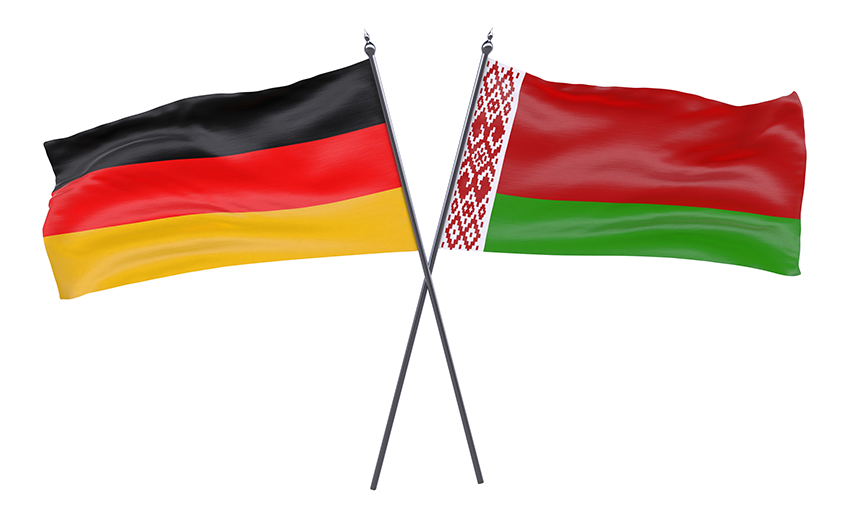
Belarus: Director General Limbourg denounces classification of DW as ‘extremist’

Belarus: Director General Limbourg denounces classification of DW as ‘extremist’

Belarus: Director General Limbourg denounces classification of DW as ‘extremist’

On Wednesday 9 March, Belarusian authorities classified the Telegram channel of DW Belarus, information services and Deutsche Welle (DW) as “extremist.”

DW Director General Peter Limbourg denounced the decision, saying, “The blocking of our websites in Belarus in October 2021 was already an unbelievable encroachment on press freedom. The recent announcement of the criminalisation of the DW logo proves how nervous the regime there is.”

“DW is still informing many people in Belarus via tools for bypassing censors. Especially following the attack on Ukraine, the numbers have significantly increased. Now they want to use cheap tricks to create pseudo-legal grounds to take action against people who make use of their right to free speech.”

The Ministry of Internal Affairs of Belarus released a statement on March 9: “The Minsk Central District Court, based on material from the Main Directorate for Combating Organised Crime and Corruption of the Ministry of Internal Affairs of the Republic of Belarus, has classified the information products of the Telegram channel and the DW Belarus chat as extremist material.”

Germany and Russia go head to head over broadcasters

Germany and Russia go head to head over broadcasters

Germany and Russia go head to head over broadcasters

Germany and Russia have traded blows over the two countries’ international broadcasters.

 
On Wednesday 2 February 2022, the German Commission on Licensing and Supervision (ZAK) decreed that RT must cease broadcasting German-language programmes saying it “does not have the necessary broadcasting licence”.
 
RT DE – the Berlin-based German-language division of RT (formerly Russia Today) acquired a licence from the Serbian media regulator on 17 December 2021. Both Germany and Serbia are signatories to the European Convention on Transfrontier Television. Licences granted by one ECTT member state provide the legal grounds for transmission and reception of a licensed service in another ECTT-ratified state. However, Germany says that since the programmes are produced in Germany and not Serbia, the licence does not provide the right for the channel to be received in the country. RT has said that it will challenge this in the German courts.
 
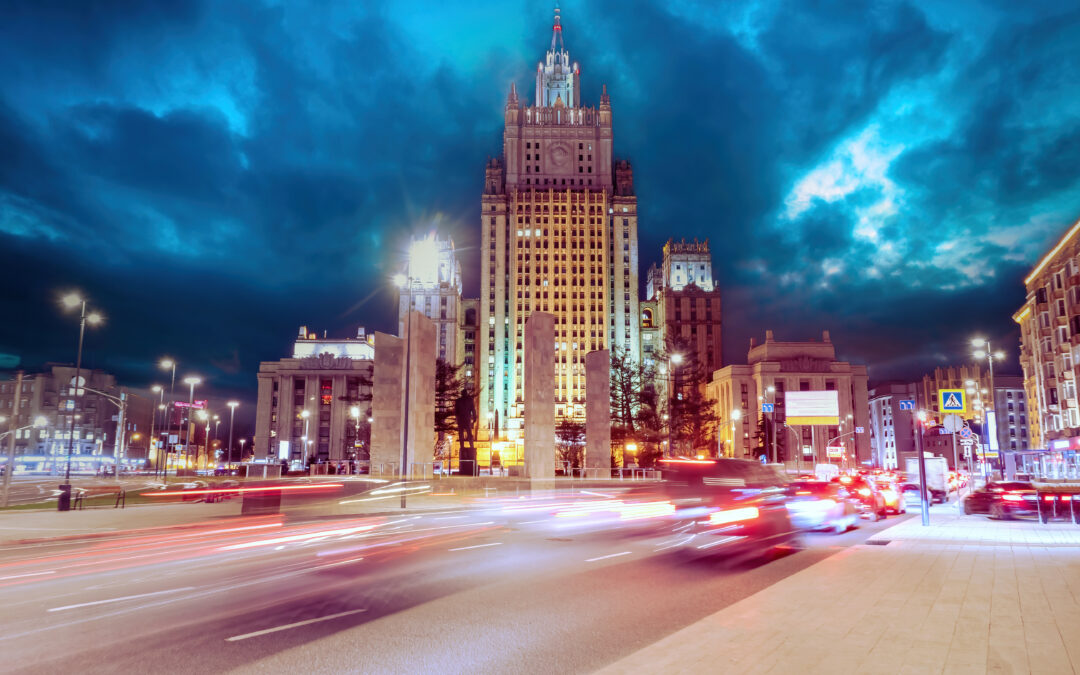
The following day, 3 February, the Ministry of Foreign Affairs of the Russian Federation issued a statement announcing that it is closing the operations of Germany’s international broadcaster DW in the country (headquarters in Bonn pictured).
 
The statement reads:
As part of the response measures announced on February 2 in response to the unfriendly actions of the Federal Republic of Germany to ban satellite and other broadcasting of the German-language television channel RT DE, the Russian side intends to implement the first stage of response measures:
– closure of the correspondent office of the German television and radio company Deutsche Welle in the Russian Federation;
– cancellation of accreditation of all employees of the Russian Bureau of Deutsche Welle;
– termination of satellite and other broadcasting of the Deutsche Welle television and radio company on the territory of the Russian Federation;
– initiation by the competent authorities of the Russian Federation of the procedure for considering the issue of recognising Deutsche Welle as a foreign mass media outlet acting as a foreign agent;
– launching the process of forming a list of representatives of state and public structures of Germany involved in restricting the broadcasting of RT DE and otherwise putting pressure on the Russian media operator, who will be banned from entering the territory of the Russian Federation. The list is not expected to be published.
Information on the next steps in the response will be published in a timely manner.”
 

DW has issued a press statement about the Russian move. It quotes DW Director-General Peter Limbourg as saying: “The measures by the authorities in Russia are completely incomprehensible and a total overreaction,

“We have been made into a kind of pawn, which the media must often endure in autocracies. We formally protest against this absurd reaction by the Russian government and we will take legal action against the announced measures. Until we are officially presented with the measures, we will continue reporting from our office in Moscow. Even if we ultimately do have to close it, our reporting about Russia will remain unchanged. In fact, we would increase our coverage.”

According to the press statement, Deutsche Welle has held a broadcast license in Russia since 2005 for its DW English and DW German TV channels. The current licenses issued by Russia’s media authorities are valid until 2025 for DW English and until 2027 for DW German.

DW English is broadcast in Russia via the ASTRA-5B satellite. DW German is broadcast using the ASTRA-4A satellite. In line with the binding conditions of the license, the DW German TV channel has a window for Russian-language programming in its schedule. This programming consists of DW magazines adapted into Russian (a total of 18 hours per week: 2 hours per day, Mon.-Fri. and 4 hours per day, Sat.-Sun.). Several cable TV distributors in Russia also run the Russian-language programming of DW German. They are Rostelecom, Tricolor, Beeline, ER-Telecom, MTS and NetByNet.


Picture: The Foreign Ministry in Moscow

ENTR has over 13 million video views in four months

ENTR has over 13 million video views in four months

ENTR has over 13 million video views in four months

Last spring, international broadcasters DW and France Médias Monde, in a joint venture with multiple media organizations, launched the digital media project ENTR in six EU countries. With a target group aged 18 to 34 and diverse social media content in six languages, ENTR has been a success story right from the start. In just four months, its videos have garnered more than 13 million views on partners’ websites and social media platforms.

Users have responded favorably to the range of topics that closely align to the interest of young EU citizens. ENTR produces a wide net of content exploring topics such as climate change, education and work, culture, new technologies, health, migration, and social issues such as solidarity and justice. Young, diverse editorial teams from six participating countries produce videos in English, French, German, Romanian, Polish and Portuguese. They subsequently adapt them for multilingual audiences, giving users access to stories from across Europe in multiple languages.

Since May 2021, video views have been evaluated across all platforms and in all six languages. The content is particularly successful on ENTR’s Facebook channels, which account for nearly half of all views. Around a third of views are generated via the partners’ websites and around ten percent each on YouTube and Instagram.

Polish-language content has proven the most popular to date. Primarily viewed on a partner website, it has received the biggest share of views, about one third of the total usage since mid-May. French language videos on Facebook rank second, accounting for 25 to 30 percent of all views per month. In third and fourth place are the English and German posts, generating traffic mostly on Instagram.

Relevant content and positive prospects

“We have seen that cross-linguistic content which deals with strong views and controversial topics such as gender equality or self-identity does particularly well,” says Gönna Ketels, ENTR Head of Content. “The editorial teams work together to set a content focus each week. This is always exciting because we look at topics differently in all ENTR countries, often resulting in completely new approaches. Our editorial teams tailor all content to their target groups. Jointly produced formats such as topic maps, voxpops and explainer galleries always provide a European context across languages. And we adapt videos from the other languages each week that are relevant to the entire ENTR community.”

ENTR media initiative aims at promoting European youth exchange and heightening awareness around a common identity. It is funded by the European Union and the German Foreign Office.

On the future of ENTR, Patrick Leusch, DW Head of European Affairs and ENTR Project Director, says: “The project’s great success from the outset confirms that we have struck a chord with our audience and created an attractive offer for young Europeans. In the medium term, we want to expand ENTR to include other languages and media partners. We hope that the German Foreign Office and MEPs from various parties and member states, as well as the EU Commission, will continue to support us in the coming years.”

ENTR at EYE 2021

On October 8 and 9, ENTR will participate as a partner at the European Youth Event (EYE) of the European Parliament in Strasbourg. The hybrid event is part of the European Parliament’s week-long youth consultation process for the Conference on the Future of Europe. Thousands of young EU citizens between the ages of 16 and 30 join in to exchange views with experts, activists, influencers, and decision-makers. Further information can be found at: https://european-youth-event.europarl.europa.eu/de/.

ENTR partners

Alongside Deutsche Welle (GERMANY), which coordinates the project, and France Médias Monde (FRANCE) are the following ENTR partners:

GERMANY: Zeit Online, Genshagen Stiftung, and Good Conversations

PORTUGAL: RTP (Rádio e Televisão de Portugal)

POLAND: RASP (Ringier Axel Springer Polska)

ROMANIA: RFI România (France Médias Monde Group) and G4 Media (Group 4 Media Freedom and Democracy)

IRELAND: Tailored Films

ENTR in English

https://entr.net/en/

https://www.instagram.com/en.entr/

https://www.youtube.com/c/enentr/videos

https://www.facebook.com/en.entr

ENTR in German

https://entr.net/de/

https://www.instagram.com/de.entr/

https://www.youtube.com/c/deentr

https://www.facebook.com/deu.entr

[Source: DW press release]