DW launches English language vodcast Global Eyes

DW launches English language vodcast Global Eyes
DW launches English language vodcast Global Eyes

‘Will the war in Ukraine make your Chapatis cheaper?’ – DW vodcast looks at security policy issues from the Western and Asian perspective

Global Eyes, the latest English-language DW vodcast, is launching on November 26. Two hosts get to the bottom of global security policy issues. With their guests, they explore how these issues affect people’s daily lives.

The creators of Global Eyes are dedicated to the idea that security policy and geopolitics are important for everyone, everywhere. The two hosts examine the very real effects security policy issues have on every individual person – from food prices to health, all the way to armed conflicts.

The vodcast not only deals with security policy issues from a western point of view, but also opens Asian perspectives. Global Eyes offers a broad range of information, expertise and personal stories from their guests, who come predominantly from the global South.

Getting out of the ivory tower

“The Global Eyes vodcast aims to draw the discussions about security policy issues out of government buildings, think tanks and academic institutions,” said Nadja Scholz, Acting Managing Director of Programming. “The hosts break down complex, global subject matters into comprehensible facts while exploring connections with their guests that are often forgotten.”

Host Isha Bhatia, from DW Programs for Asia, wants to prove with the vodcast that young people are interested in more than just TikTok and Instagram. Her goal is to discuss serious, complex topics so that they are interesting and do not sound like intellectual lectures. “From the G7 to the G20, from BRICS to OPEC, from Quad to SCO. What do these groups really mean? What implications do their decisions have? Global Eyes endeavors to answer these questions,” says Bhatia.

Host Kate Brady, from DW’s Analysis and Reports department: “It is easy to get bogged down in details when you are dealing with complicated security policy issues. We want to change that and, with support by experts, decipher how the big global topics affect our daily lives.”

Controversial core questions to guide the debate

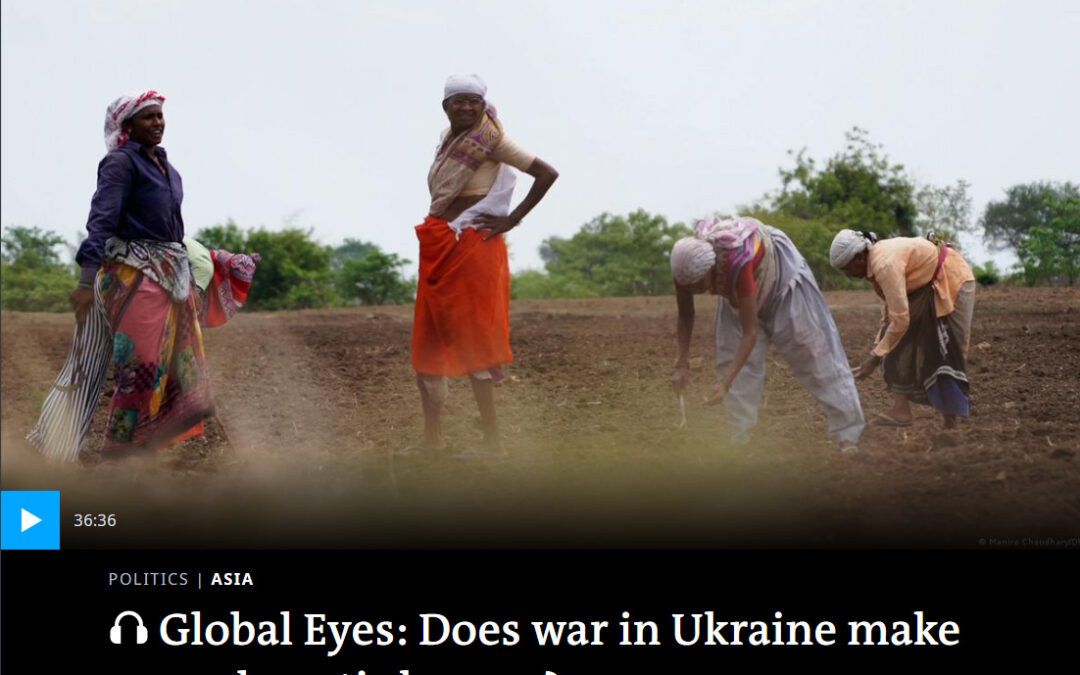
Each episode is centered on a provocative question that connects a security policy issue and the lives of users. The first episode examines the how the war in Ukraine and the Western sanctions on Russia are affecting the lives of people in India. The opening question is “Will the war in Ukraine make your Chapatis cheaper?”

Energy expert Nandikesh Sivalingam, from Bangalore and foreign policy expert Seema Sirohi, from Washington, help answer that question. By the end of the episode, it’s not only Kate Brady and Isha Bhatia who will better understand the question, but also the listeners.

They are already planning further questions such as “Will the conflict in Taiwan create IT jobs in India?” or “What does India’s G20 presidency have to do with antibiotic-resistant bacteria strains?”

Video and Audio, YouTube and Spotify

The format was developed by editors working together with Digital Format Development at DW. The English-language vodcast is produced by DW and will appear monthly as both an audio and video production. The first season consists of ten episodes with a run time of between 40 and 45 minutes. The video versions will appear on a monthly basis on YouTube and Facebook with the audio versions on all major podcast platforms including Spotify and iTunes as well as on the India-based platform Jiosaavn.

Global Eyes will premiere on November 26 on the DW News YouTube channel, on the DW Asia Facebook account and on various podcast platforms.

Global Eyes website:

https://www.dw.com/en/global-eyes-security-policy-and-what-it-means-for-you/program-63538048

YouTube:

https://youtu.be/xBSSGjUeEmM

iTunes:

https://podcasts.apple.com/de/podcast/global-eyes-security-policy-and-what-it-means-for-you/id1653609075

Spotify:

https://open.spotify.com/episode/22RwqvNOHRaV48cfxcZj9L?si=7a8b7687d3124c73

[Source: DW press release]
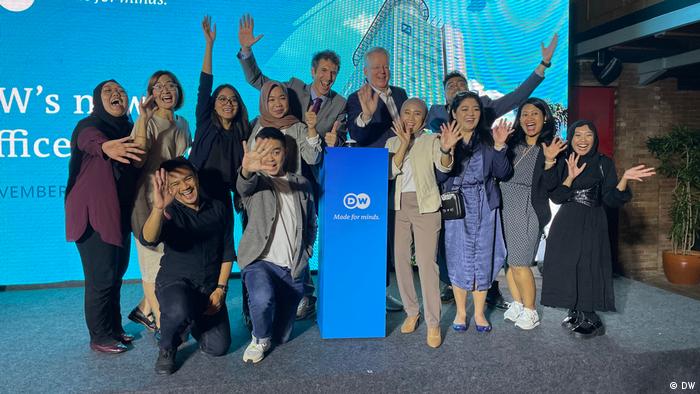
DW opens Asia Pacific Bureau in Jakarta

DW opens Asia Pacific Bureau in Jakarta

DW opens Asia Pacific Bureau in Jakarta

DW Director General Peter Limbourg: “The opening of our office in Jakarta is an important step for DW to get closer to our target groups in one of the most important regions of the world. We have a motivated and highly qualified team here. It is important that we also increasingly produce our digital offerings worldwide.”

For many people in South East Asia DW already is a trusted source for news and information. With Indonesia being the region’s largest economy and a key political player the new bureau is in a strategic location to cover events across several countries.

DW is building a team of correspondents in the region who will contribute to the Indonesian language service as well as the network’s global journalistic output. In depth coverage of events in South East Asia and Australia will be just as important as speed in covering breaking news. With a network of reporters and video journalists across the region, all coordinated from the Asia Pacific Bureau in Jakarta, DW will be able to boost its output of exclusive stories. Reports will not only come in faster but crucially contain the local perspective of journalists who know their surroundings.

DW Jakarta Bureau Chief Georg Matthes: “Reporting from the Asia-Pacific region is not nearly as comprehensive as it should be given the geopolitical importance of this part of the world. Our team does not just report on Indonesia, but on a large region facing economic and environmental changes that will have a global impact. The editorial team provides news and background to all of DW’s linear and especially digital channels in multiple languages.”

[Source: DW press release]

DW Russian marks 60th anniversary

DW Russian marks 60th anniversary

DW Russian marks 60th anniversary

From radio jamming to partnerships and back again

As DW’s Russian service celebrates its 60th anniversary, its news offer remains blocked in Russia. First introduced during the Cold War, Russia’s renewed attempt at censorship has so far failed.

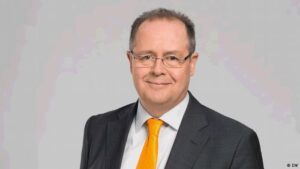
February and March 2022 saw Moscow bureau shuttered, staff accreditations annulled, website blocked and DW declared a “foreign agent”: the 60th anniversary of DW’s Russian Service marks the return to the Cold War era. “Without our studio in Moscow work has become more difficult for us. There’ s no way to sugarcoat it either. But we have found a way to continue to provide our audiences in Russia with authentic information from and about their country,” says Christian F. Trippe, Director of Programs for Russia, Ukraine and Eastern Europe (pictured).
In response to censorship, the team relocated to Riga, under the direction of Juri Rescheto, and reinforced DW’s Russian-language content, recently offering two new podcasts, DW Novosti Show and Geofaktor. Both multiplatform broadcasts are available online and on medium-wave frequencies (MW). In a way, DW’s Russian Service is back to its roots, having set up its first radio broadcast in August 1962 and its last in 2011.

From the Cuban missile crisis to the war in Ukraine

Operating amid rising East-West tensions is not new to the journalists of “Nemezkaja wolna” (Deutsche Welle), as DW has been known in Russian for decades.

A year into the construction of the Berlin Wall and shortly before the Cuban missile crisis in the fall of 1962, the then Cologne-based DW produced its first broadcasts in Russian. The recent turning point in relations between Russia and the West, caused by the Russian invasion of Ukraine on February 24, 2022, is sometimes compared to the Cuban missile crisis.

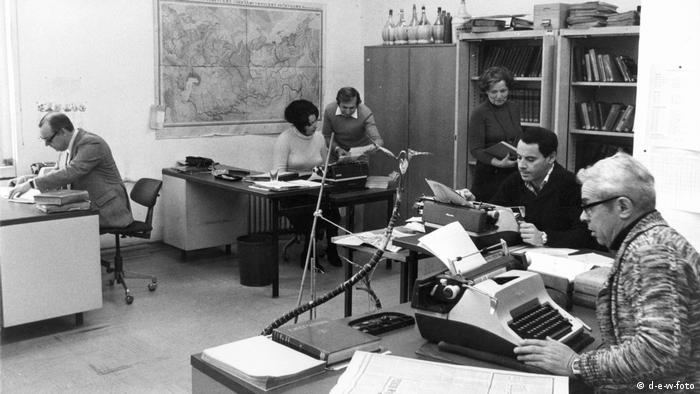
DW Russian editorial team pictured in 1978

Soviet emigrants worked in the Russian service, reporting to listeners across the Soviet Union on life in the Federal Republic of Germany and the German view of current affairs. In 1974, DW was the first Western radio station to broadcast chapter after chapter of Alexander Solzhenitsyn’s “The Gulag Archipelago,” a three-volume book banned in the USSR.

“Not emigrants, but bridge builders”

DW’s Russian Service as well as other western broadcasters were varyingly jammed in the Soviet Union. The jamming of the signal, which were used until the late 1980s, was never totally effective and could often be circumvented by changing the frequencies.

After the collapse of the USSR, new staff joined DW. Radio programming became broader, more compact and dynamic, and the advent of the Internet offered audiences a fuller multimedia online content. In post-Soviet Russia and other republics, distribution partnerships were gradually established with regional FM networks.

“I have fond memories working at the Welle in the ’90s. The newsroom was changing rapidly: reading before a microphone gave way to live reports and live broadcasts, with the fresh arrival of relatively young journalists from the new Russia,” says economist Andrey Gurkov, one of the “veterans” of the newsroom. “We didn’t think of ourselves as emigrants; rather, we saw ourselves as bridge-builders, contributing to the rapprochement between Russia, the post-Soviet region, and Europe, the West, through in-depth reporting on the epochal scale of change in politics that was underway.”

“Exemplary editorial response to major journalistic situations”

With the onset of the Russian war on Ukraine, the bridges that DW staff tried to build collapsed, Gurkov said. His colleague Anastasia Arinushkina, who joined the service in 2017, says, “In Germany, we are safe: no one will come to my house at six in the morning with a search warrant. They won’t throw me in jail either, just because I refer to the war against Ukraine as war and not as a ‘special military operation,’ as they have to do in Russia.” The journalist sees this as a special responsibility: “Since we are in such a privileged position and can work according to journalistic standards, we have to do this even better and more thoroughly,” she adds.

Christian Trippe: “Blocking our website in Russia has not resulted in a loss of reach. Quite the opposite: we have gained more users on all our Russian-language platforms. In short, the attempt to silence us has not been successful. This technical censorship doesn’t work in Russia any more than it does in other unfree countries.”

The viewing records has shown that from January to June 2022, DW Russian’s online output has reached roughly 125 million monthly multiplatform users in Russia (having beaten the 49 million monthly record set in the previous six months) – an uptick of more than 250 percent. On Facebook alone, DW Russian reached more than 34 million monthly video views in the first half of 2022, mainly by users in Ukraine. On YouTube, according to MAI, there were roughly 48 million monthly views, with the largest share coming from Russia.

Given the balance of six months of work since the start of the war, Trippe is optimistic: “In my eyes, it is exemplary how quickly and competently the entire editorial team for online, video and social media is able to react to major journalistic situations and expand the program offerings on the spot. We have demonstrated that most recently on February 24.” His core message on the 60th anniversary of the DW Russian: “If a new curtain, this time in terms of media and not iron, were to seal off Russia from the rest of the continent, we know how to breach it: with unbiased information.”

Nobel Peace Prize laureate Maria Ressa opens DW’s Global Media Forum in Bonn

Nobel Peace Prize laureate Maria Ressa opens DW’s Global Media Forum in Bonn

Nobel Peace Prize laureate Maria Ressa opens DW’s Global Media Forum in Bonn

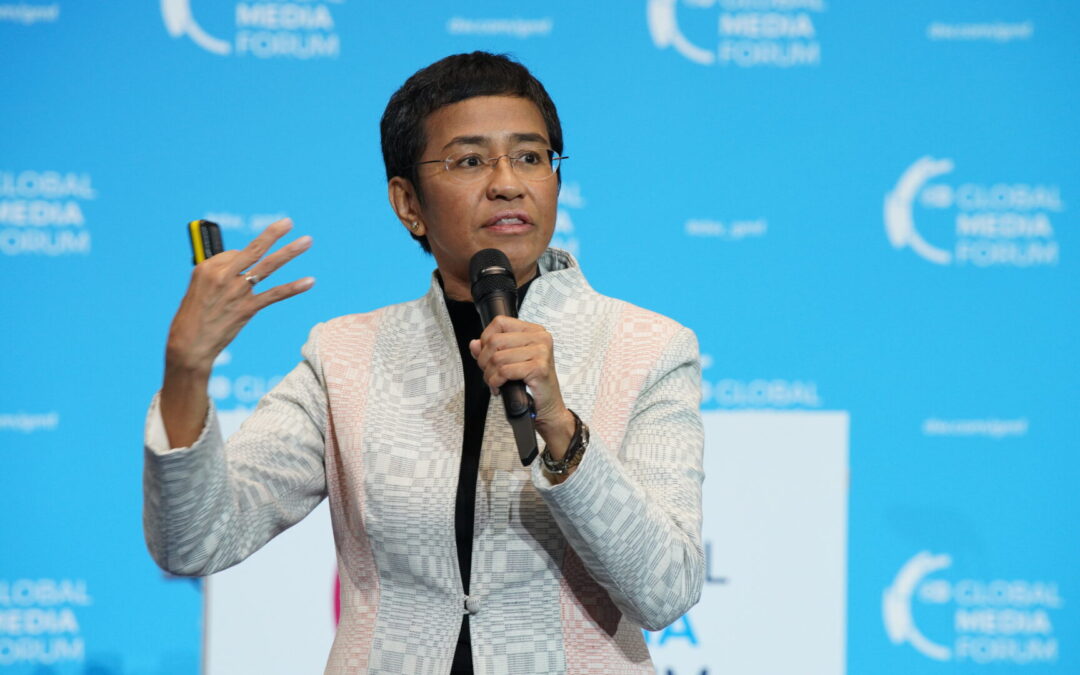
Global Media Forum in Bonn: Nobel Peace Prize laureate Maria Ressa opens DW‘s international media conference

“If you don’t have facts, you don’t have truth; if you don’t have truth, you don’t have trust,” said Philippine journalist and Nobel Peace Prize laureate Maria Ressa at the opening of Deutsche Welle’s Global Media Forum (GMF).

Nobel Prize laureate Maria Ressa opened her keynote with the questions: “How do we rebuild trust? Because that is what illiberal governments have destroyed. If you don’t have integrity of facts, how can you have integrity of elections?” adding: “The three pillars of technology, journalism and the community will help rebuild trust in journalism.”

In his opening speech, DW Director General Peter Limbourg emphasized the challenges of reporting the war in Ukraine: “This is one of the times in history when journalism can definitely prove its relevance. We cannot stop the war, but we can contribute to decisive political action by keeping the fate of hundreds of thousands of people in the headlines,” he said.

Limbourg: “We are facing a storm of disinformation, propaganda and censorship. When the free and independent voices work together, we can withstand this storm and make a difference.”

In a video statement, German Federal Minister for Foreign Affairs Annalena Baerbock commended this year’s DW Freedom of Speech Award laureates Mstyslav Chernov and Evgeniy Maloletka: “I’m delighted that the Global Media Forum is honouring them with the Freedom of Speech Award today. They stand for the courage of hundreds of journalists reporting from Ukraine.”

Baerbock: “I firmly believe that free and democratic societies need free media to inform citizens and hold those in power accountable. DW’s Global Media Forum is making a vital contribution to achieving this goal. People throughout the world rely on Deutsche Welle as a source for factual, objective and balanced reporting. Because truth is indispensable – in Mariupol and in Moscow, in Brussels and in Bonn.”

North Rhine-Westphalia’s Minister-President Hendrik Wüst stated in a video message that “freedom of expression and freedom of the press” are the “foundations of a liberal democratic society.”

Under this year’s theme “Shaping tomorrow, now,” GMF panel discussions and partner sessions will address how to promote resilient journalism and strengthen civil societies in times of crisis.

Guests from the world of politics joining the GMF today and tomorrow include Claudia Roth, Minister of State for Culture and the Media; Věra Jourová, Vice President for Values and Transparency at the European Commission; Audrey Tang, Taiwan’s Digital Minister; Laura Braam, Deputy Head of Law and Supervision of the Media Authority of the state of North Rhine-Westphalia; and Katja Dörner, Mayor of the City of Bonn.

Speakers from the fields of media, business and academia include Ukrainian UA:PBC journalist Angelina Kariakin; Timothy Snyder, Levin Professor of History at Yale University; Brazilian investigative journalist Patricia Toledo de Campos Mello; Guido Bülow, Head of News Partnerships for Central Europa at Meta; and Ulrik Haagerup, founder and CEO of the Danish Constructive Institute.

Against a backdrop of the war in Ukraine, the GMF will spotlight the challenges of reporting from the front lines by hosting war correspondents from war zones across the globe. Journalists from Germany, Ukraine and Russia such as Paul Ronzheimer, Angelina Kariakina, Tetjana Kyselchuk, Mikhail Zygar and Maria Makeeva will share how they cope with reporting on the war.

Later in the afternoon, DW will honor Ukrainian AP journalists Mstyslav Chernov and Evgeniy Maloletka with its Freedom of Speech Award in recognition of their courageous reporting from the besieged Ukrainian city of Mariupol. Ensaf Haidar, Saudi-Canadian human rights activist and president of the Raif Badawi Foundation for Freedom will attend the ceremony. Jodie Ginsberg, president of the Committee to Protect Journalists, will give a laudatory speech.

The DW Global Media Forum is Germany’s only international conference for representatives of the media from all over the world. Together with its main partners, the German Federal Foreign Office, the State of North Rhine-Westphalia, the Foundation for International Dialogue of the Savings Bank in Bonn, the Federal ministry for Economic Cooperation and Development and the City of Bonn, DW offers media professionals a unique opportunity for interdisciplinary discussions with opinion-leaders from different fields around the pressing issues of our time. 

[Source: DW press release]

DW Global Media Forum 2022 kicks off in Bonn on June 20

DW Global Media Forum 2022 kicks off in Bonn on June 20

DW Global Media Forum 2022 kicks off in Bonn on June 20

More than 100 experts from all over the world will be “shaping the future of journalism in times of crisis and war” at the Deutsche Welle Global Media Forum 2022. DW’s annual media convention will open its doors from June 20 to 21 at the World Conference Center Bonn (WCCB) in Bonn, Germany and bring together global leaders as well as professionals from media, government, technology, and civil society.

Among those who will tackle global media challenges and advance solutions for resilient societies are Nobel Peace laureate Maria Ressa from the Philippines, German Minister of State for Culture and Media Claudia Roth, Ukrainian journalist Angelina Kariakina, Brazilian investigative journalist Patricia Toledo de Campos Mello.

Taiwan’s Digital Minister Audrey Tang, Lutz Güllner, Head of Strategic Communications and Information Analysis European External Action Service, as well as Head of News Partnerships for Central Europe at Meta, Guido Bülow, will discuss the current role of technology in media and civil societies. Editors-in-chief from leading news outlets as well as scholars and media professionals from newspapers such as the Guardian and Süddeutsche Zeitung or broadcasters such as WDR, NDR and DW will share their extensive knowledge of the challenges and opportunities for journalism.

A list of confirmed speakers can be found here.

Discussion topics range from climate crisis and digital activism to war and pandemic journalism. Artificial Intelligence, fact-checking, political agenda-setting and representation in media also take center stage. The start-up contest @GMF focusses on new tech designed to foster resilient journalism and civil societies in times of rapid change. Start-ups, entrepreneurs and talent in media technology and innovation will showcase their work as a central feature of the DW Global Media Forum.

Learn more about the program and view sessions here.

Against a backdrop of the war in Ukraine, the GMF will spotlight the challenges of reporting from the front lines by hosting award-winning war correspondents who covered stories first-hand from war zones in Ukraine, Afghanistan, Myanmar, and beyond. Journalists from Germany, Ukraine and Russia, such as Paul Ronzheimer, Angelina Kariakina, Tetiana Kyselchuk, Mikhail Zygar and Maria Makeeva will share how they cope with reporting on the war.

Participants will also join DW in honoring Ukrainian AP journalists Mstyslav Chernov and Evgeniy Maloletka with its Freedom of Speech Award in recognition of their courageous reporting from the besieged Ukrainian city of Mariupol. The award ceremony will be co-hosted by Jodie Ginsberg, president of the Committee to Protect Journalists, and Ensaf Haidar, Saudi-Canadian human rights activist and president of the Raif Badawi Foundation for Freedom.

Learn more about the Freedom of Speech Award here.

The annual meeting will also bring together younger generations of journalists, with a tribute to the honorees of the ARD.ZDF Media Academy’s “Women and Media Technology” award comprising successful female graduates from German, Austrian and Swiss universities in the fields of technology, engineering, and media studies.

About GMF

The DW Global Media Forum offers a unique interdisciplinary platform for media professionals as well as decision-makers from politics, civil society, culture, education, business, and science from all over the world to get together and to learn from each other as part of an intercultural exchange since 2008. The Global Media Forum is sponsored by the German Federal Foreign Office, the State of North Rhine-Westphalia, the Stiftung Internationale Begegnung der Sparkasse in Bonn, the German Federal Ministry for Economic Cooperation and Development, and the City of Bonn.

[Source: DW]