4 March 2018
Swiss voters reject initiative to scrap the country’s licence fee-funded broadcasting model
British licence fee payers have to pay £147 a year (and soon £150.50) for access to a rich and diverse offer of public broadcasting services. What would they decide if they were asked (by popular vote) to continue paying not £150, but £345 a year for such services?
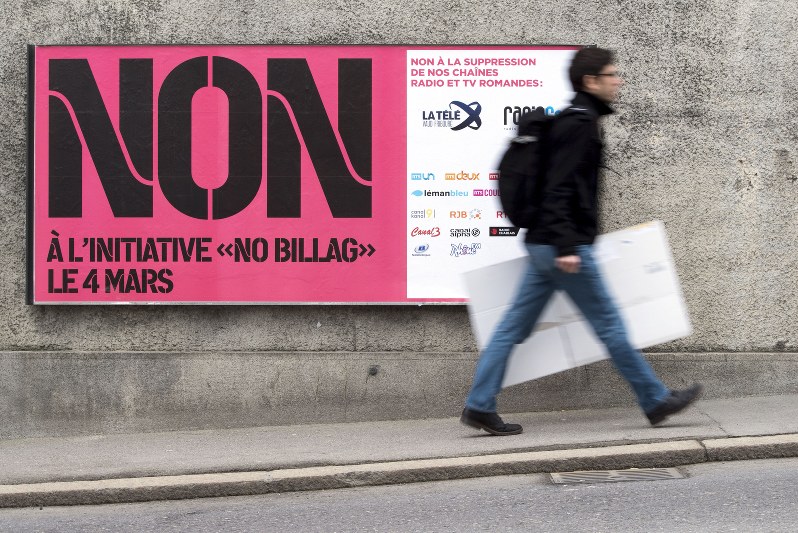
This was the choice facing Swiss voters on 4 March, following a popular initiative aimed at scrapping the licence fee and replacing it with more advertising revenues, a subscription-based, a pay-per-view, or another undefined funding system. A clear majority, 71.6%, rejected the initiative, reports Morand Fachot.
Opponents had no clear system in mind
The aim of the “No Billag” initiative (named after the licence fee collecting institution) was to change Article 93 of the Swiss constitution on “Radio and Television” to prevent the government from collecting a licence fee and from providing subsidies to radio and television stations.
Those behind the initiative claimed that it would allow citizens “who prefer to buy newspapers, books, pay for their studies or make a donation to an NGO”, to do so rather than pay a licence fee.
Swiss public, and to a significant degree also private local and regional, broadcasting relies on the licence fee.
Complex and diverse media landscape
The Swiss broadcasting (and media) landscape is complex owing to the country’s regional and linguistic diversity (with four national languages), and its proximity to three very large broadcasting markets (Germany, France and Italy – in addition to Austria), which share three of these same languages.
The latest available survey of national languages shows that German is the main language for 63% of the population, followed by French (22.7%), Italian (8.1%) and Romansch (0.5%), Non-national languages (mainly Portuguese and English) are used by some 21% of the population.
Ensuring similar levels of access to public broadcast services in four national languages for all citizens is a complex and costly undertaking in a country of barely 8.5 million. This task falls mainly on SRG SSR, the Swiss Broadcasting Corporation (SBC), which is funded by a compulsory contribution (licence fee) of 451 Swiss francs (CHF) a year (around £345) per household for radio and TV.
However, this licence fee doesn’t fund SBC only but also 34 local TV and radio stations, which complement public and commercial broadcasting, operate on a non-profit basis and offer access to media training and production facilities.
Some 13,000 jobs depend directly and indirectly on SBC.
The licence fee provides nearly 75% of SBC’s total budget of some £1.25bn, advertising and sponsoring making up about 17% of the overall budget.
A solidarity-based distribution of this budget is aimed at making “an important contribution to national cohesion, mutual understanding and dialogue between the language regions.”
Although the German-speaking part of the country collects some 73% of the licence fee, it receives only 43% of it to fund its German-language radio and TV broadcaster, SRF.
The French-speaking region, which collects 23% of the total fee, receives 33% of the total for its RTS service. The Italian-speaking part, which collects 4% of the total, is allocated a 22% share. As for the Romansch-speaking region service it collects 0.5% of the overall licence fee for a share of 2% of SBC’s budget.
SBC Director General Gilles Marchand stressed that this budget-sharing system, based on solidarity, allows the three main linguistic regions to benefit from similar levels of services irrespective of their economic or demographic weight.
Multiple services – wide audience
SBC broadcasts seven TV channels: a news channel in German and two general interest channels in each of the three main national languages.
It also operates 18 radio stations and a rich online offer in the national languages.
SBC’s reach extends beyond the country’s borders thanks to its online international service in 10 languages Swissinfo (funded equally by SBC and the confederation) and to its participation in international services.
SBC programmes are also broadcast on the global Francophone TV5Monde network, of which SBC is a shareholder, and on 3sat, the German-language network set up by German, Austrian and Swiss public broadcasters.
Taking into account unlimited access to hundreds of TV channels and radio stations from neighbouring countries that share languages with Switzerland, audience figures (share and reach) for the radio and TV services of the three main language SBC networks are very respectable and show them as clear leaders in their respective markets.
For instance, 93 out of the 100 most-viewed programmes on RTS in 2017, were RTS productions.
Meeting the challenge
According to the latest opinion polls, a clear majority emerged against the initiative after the opposite trend was recorded in late 2017. People realized that, in the words of Marchand, there was no “Plan B” from the No Billag supporters, just a “Plan D” for a complete and final dismantling of the public broadcaster and of the 34 radio and TV stations that depend on the licence fee.
In addition to SBC and dozens of private radios and TV channels that benefit from the licence fee, other organisations and public opinion in general increasingly moved against the initiative.
Other public broadcasters in Europe and beyond viewed this initiative with concern. The European Broadcasting Union (EBU), together with other media organisations, expressed support for the Swiss public broadcasting system. EBU Director General Noel Curran said: “We should do all we can to ensure that public service broadcasting in Switzerland continues to provide an independent, diverse voice in an increasingly complex and divisive world.”
Lack of credible arguments
The arguments put forward by the No Billag supporters lacked credibility, it would have been unconceivable to fund public broadcasting services in three [four] languages through advertising only in a relatively small market like Switzerland.
According to PwC SBC netted 48.6% of the revenues of Swiss advertising market for radio and TV in 2015. The share of foreign broadcasters was just over 42% and “continued to limit the potential of private Swiss channels” (9% in 2015).
SBC has a positive economic impact in the country. It will invest more than CHF 900m in the country in the next 10 years, according to Marchand.
A report by BAK Economic Intelligence, shows that each franc from the licence fee generates CHF 1.42 in added value, and each million CHF collected results in the creation of 10 jobs in the country.
 Communication Minister Doris Leuthard (pictured) said that the licence fee would be lowered from its CHF 451 a year per household to CHF 365 (CHF 1 a day) from 2019 onwards.
As its funding will come under pressure SBC put forward a series of measures.
These include a CHF 100m francs (£77m) efficiency plan, with CHF 80m coming from reinvesting CHF 20m of savings internally.
The advertising ban for SBC online services will continue and SBC decided also not to offer targeted advertising in the regions.
A representative of private radio and TV stations has called for increasing the share of the licence fee allocated to these stations from the current 5% to 10%.
Beyond the economic impact, always difficult to convey to any public anywhere, what seems to have moved a clear majority in favour of keeping the current licence fee-based funding model was the wish to preserve a system that faces tough challenges from international operators, but has always managed to provide high-quality programmes, is well-liked by listeners and viewers and contributes also to social and national cohesion.
A very small price to pay for the equivalent of 95 pence a day per household, less than the price of a cup of coffee…
1 March 2018
Members of the Association for International Broadcasting have elected a new Executive Committee for the two years from 1 March 2018. The AIB Executive Committee provides governance and oversight of the activities of the Association and helps to define the strategic direction of the not-for-profit organisation.
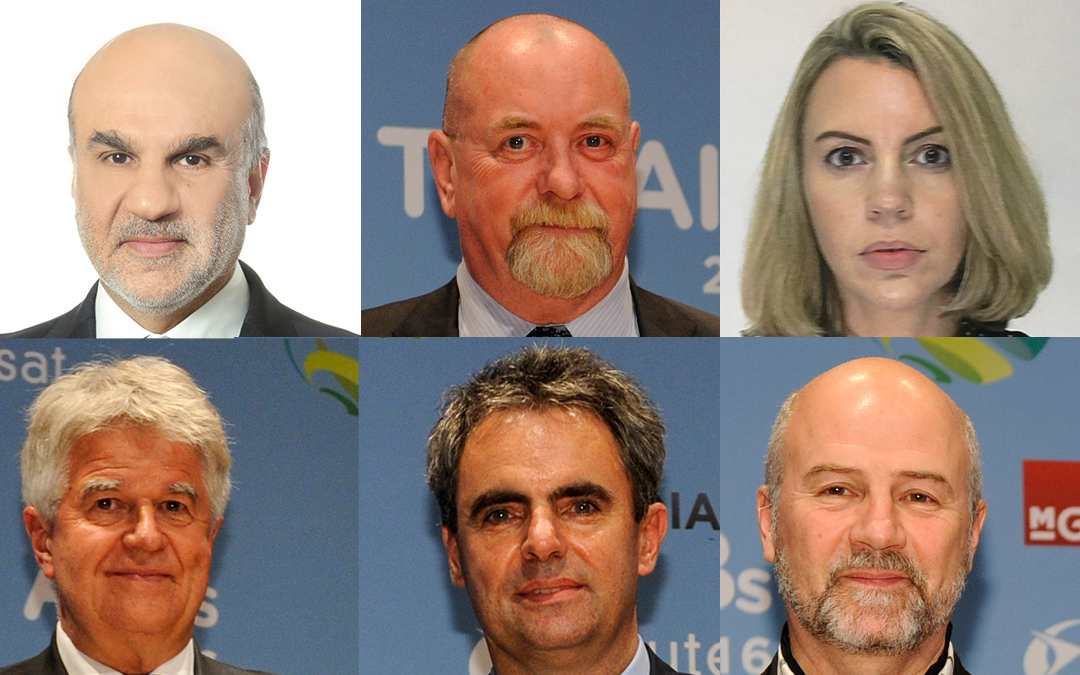
11 senior executives of AIB Member companies stood for election, of which six were existing Executive Committee members who offered themselves for re-election. After votes were counted from the 48% turnout of AIB Members eligible to vote, those elected to the Executive Committee are (pictured above from top left):
- Abdulla Al-Najjar, Al Jazeera Media Network
- John Maguire, FMM
- Anastasia Ellis, Bloomberg
- Klaus Bergmann, DW
- Simon Kendall, BBC World Service
- Alexey Nikolov, RT
“The field of candidates in this year’s election for the AIB’s Executive Committee was immensely strong,”says AIB chief executive Simon Spanswick. “I’m delighted that the Association for International Broadcasting’s Members have elected such a strong Executive Committee, and one that brings together a range of expertise and knowledge from major global broadcasters that will help steer the Association in the rapidly-changing media marketplace. My colleagues and I at the AIB Secretariat look forward to working closely with the Executive Committee as the Association continues to expand both its work and its membership.”
The AIB Executive Committee holds office for a two-year period. Members of this new Committee will hold office from 1 March 2018 until 29 February 2020.
24 February 2018
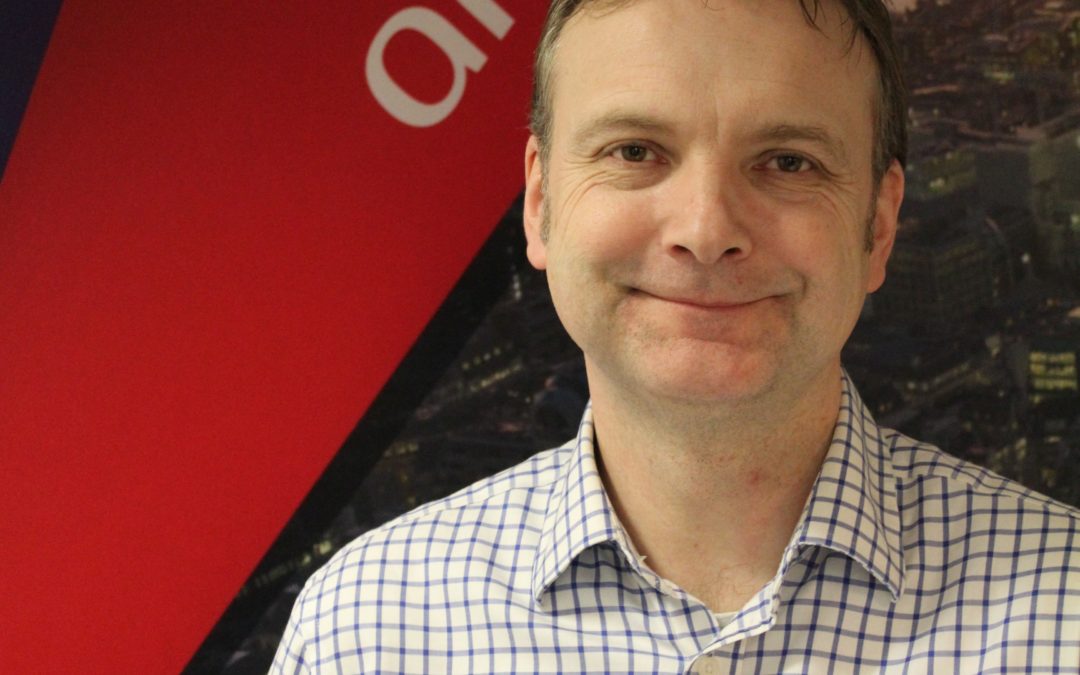
Nick Moreno, Director of Strategy, Satellite & Media, at Arqiva anticipates the following broadcasting trends at this year’s Mobile World Congress:
“The biggest broadcasting trend we are going to see at this year’s Mobile World Congress is around the shift to new ways of viewing.
“Consumer viewing habits are changing at a significant rate, and we’re already seeing the mobile device becoming the first-screen for younger, millennial audiences watching video content. In the near future, vast amounts of video will be viewed on mobile devices, and to enable that the industry needs much more efficient delivery mechanisms.
“This is pushing new technologies such as 5G into implementation phase, as companies attempt to meet the demands of the modern viewer. 5G offers significant benefits for delivering video at scale to millions of customers, and many will be exploring this at MWC.
“Another trend that will be interesting for broadcasters is the use of blockchain technology.
“We are already starting to see blockchain looked at as a ledger of video rights, so that various industry players can easily view the rights for monetising a certain piece of video content in different territories.
“Blockchain could also have a longer term use case as the enabling technology for ultra-local peer-to-peer distribution of content, allowing content to be distributed closer to the consumer (i.e. local servers, personal PCs) whilst still having legitimately tracked usage rights.”