Killing the Messenger | 2019

Killing the Messenger | 2019

Killing the Messenger | 2019

Sharp decline in 2019 media deaths as reporters retreat from deadly conflicts

A total of 48 journalists died in incidents, and accidents, directly related to their job in 2019. That was the lowest number of media workers killed in 16 years, according to the ‘Killing The Messenger’ report of journalism casualties from around the world, published annually by the International News Safety Institute (INSI).

It was also a year of apparent breakthroughs in investigations into the murder of high profile journalists, with significant legal developments in the killings of Ján Kuciak from Slovakia; Saudi Arabia’s Jamal Kashoggi; and Daphne Caruana Galizia in Malta.

There was a big reduction in casualties in war zones, where deaths more than halved in 2019 compared to the previous year and were a fraction of the average tally for the previous two decades.

INSI director Elena Cosentino said that explanations behind the drop in the number of media casualties are multiple but a reduction of hostility towards the media is not one of them.

“Our industry was spared the mass killings that blighted previous years when dozens of media workers lost their lives in targeted attacks,” said Cosentino.

“There was also a big reduction in casualties in war zones. That’s not because war reporting got any safer. The decline in casualties was simply because fewer journalists reported from conflict zones in the first place. Syria, Yemen and Afghanistan were deemed simply too dangerous for either local or international media to cover and were dropped from many outlets’ news agenda.”

Mexico, where 12 journalists died, was the deadliest country for media workers in 2019, according to ‘Killing The Messenger’, which is compiled for INSI by the Cardiff School of Journalism. Tanzania was the second deadliest country on the INSI list, simply because a car accident claimed the lives of five media workers going about their jobs. Four journalists died in Afghanistan and also in Syria and three in Honduras and in Somalia.

Last year also marked the first time in 21 years that no journalist was killed on foreign soil. As international correspondents withdrew from the world’s most dangerous places, all 48 casualties that INSI recorded last year were local journalists reporting from their home countries. The majority died in places supposedly at peace, killed by unknown assailants while reporting on crime, politics and corruption.

Though in 80 percent of the cases impunity prevailed, legal developments on previous killings, particularly in Daphne Caruana Galizia’s case, provided some hope. However, progress only came after a relentless campaign waged by Daphne’s family, huge international pressure and intense media scrutiny from all over the world. Most murdered journalists don’t generate headlines when they are killed and the institutions that should protect them are often the biggest threats.

“Daphne’s case proves that with enough time and pressure even the most powerful could one day be held to account. As happened in Malta, raising the cost of killing a journalist is the ultimate aim for everyone in the news industry. Despite the progress made in 2019, that still feels like a long way off,” said Cosentino.

Read the full Killing the Messenger report.

 

Main image: AFP via INSI

Sony Pictures takes stake in Whisper

Sony Pictures takes stake in Whisper

Sony Pictures takes stake in Whisper

Sony Pictures Television has taken a stake in the UK-based production company Whisper Group. The investment comes as the UK public broadcaster Channel 4 divests itself of its start-up investment in Whisper that was made through the broadcaster’s Indie Growth Fund. 

Whisper was founded by former F1 driver David Coulthard, TV presenter Jake Humphrey and producer Sunil Patel. It secured the contract to produce Channel 4’s F1 coverage and has expanded into a range of other sports and production genres. 

“Whisper have become one of the most talked-about production companies in the U.K.,” said Wayne Garvie, president of international production at Sony Pictures Television. “Very quickly, they have established themselves as an innovative leader in sports content. We are thrilled to be joining Sunil, David, Jake and the team in helping to take Whisper to the next level.”

“Sport is at our heart and we’ll remain committed to immersive sports broadcasting,” commented Sunil Patel, Whisper co-founder and CEO. “However, we have other ambitions, which this move can help us to realise. We are keen to grow internationally and to develop formats that can help build an exciting IP catalogue.”

Whisper won the AIBs sport award in 2016. 

How broadcasters can thrive in a hyper-disrupted marketplace

How broadcasters can thrive in a hyper-disrupted marketplace

How broadcasters can thrive in a hyper-disrupted marketplace

​The proliferation of streaming video, on-demand and multiscreen viewing, and the emergence of new, born-digital content creators and aggregators, means unprecedented disruption in TV. Broadcasters face multiple challenges, the first of which is to hold on to their viewers.

It sounds easy if you say it quickly, but broadcasters must commission or acquire content that keeps us glued to our televisions and is the subject of casual conversations, and which wins awards. They must retain their pre-eminence in local content, even as global SVOD companies choose, or are forced by regulation, to invest more in ‘local’. They may need to monetise rights across more markets to help pay for increased investments in ‘originals’.

Broadcasters must also seek to dominate the digital sphere in the way they do broadcast –  which may mean longer exclusive streaming windows. They need to make potentially life-changing decisions about distribution, like whether to feed global SVODs with content or instead ‘repatriate’ it to their own streaming services. They must decide whether to build their own SVOD services – perhaps in collaboration with other broadcasters.

Commercial broadcasters have unique challenges. As viewers migrate to digital, they must monetise them as effectively as they can in broadcast linear TV, but without heavy ad-loads that deter the less committed viewer. Targeted advertising is at least part of the answer.

They will also need addressable advertising on broadcast television, which means partnering with Pay TV operators who have AdSmart-style solutions, or developing an alternative – perhaps in collaboration with free-to-air platforms (possibly using the HbbTV standard). Anyone that wants a national addressable footprint will need a solution for free and pay homes.

Commercial broadcasters must also start to unify their broadcast and digital advertising operations so advertisers benefit from holistic planning, execution, measurement and reporting. There is no point keeping viewers away from Netflix and Amazon if your advertising budgets are then picked off by Google and Facebook.

If broadcasters meet all these challenges, what else do they need to worry about? If they start offering content behind their own pay wall then piracy, and the measures to counter it, should move up the agenda. And they need to pay attention to the fate of Pay TV operators, where much of the viewing happens today.

Any broadcaster that believes in aggregation must decide who they want as long-term partners. Online, Amazon and Apple are among those who might one day gather up content providers and give consumers a single place to view streamed programming. There is no guarantee that Pay TV will be the dominant aggregator, outside of free-to-air platforms, forever.

If broadcasters need Pay TV to thrive, they should pay attention to whether today’s operators can become the Aggregator Primus – the first and principal aggregator – in the 2020s. Is Pay TV the place where consumers will find most of the content they want? Can Pay TV operators be the trusted content discovery agent that knows what we love, and feeds it to us every hour of every day?

If Pay TV operators cannot do this, then what is the point of them, beyond the provision of exclusive content like sports, and bundled discounting?

(The jury is out on whether serious direct-to-consumer (D2C) efforts, from the likes of Disney {with Disney+} , will hurt Pay TV operators or global SVODs more, due to content repatriations. Pay TV operators need to keep hold of more ‘must-have’ content than SVOD rivals can, even if they cannot have it all. And subscription channels must carefully balance the long-term D2C opportunity against the Pay TV revenues they receive today. The channel owner decisions on whether to give or remove content will have an immediate bearing on how attractive Pay TV remains.)

The role of Aggregator Primus requires more than access to the best content, anyway. It is underpinned by a generational upgrade to the user experience, with popular apps onboarded, intelligent recommendation and content promotion, visually rich programme guides and catalogues, and voice-powered content discovery.

This upgraded UX needs to be available in as many homes as possible, which means ‘legacy’ set-top boxes as well as new ones should support new features. Small and medium Pay TV operators must be able to upgrade too, and quickly, regardless of engineering resources.

If broadcasters do make it through the current disruption, they can look ahead to the open road that leads, eventually, to all-streaming. Now is a good time, therefore, to consider what a post-broadcast world looks like, from both a technical and commercial viewpoint. How will people find content, and how will broadcasters find people?

One thing is certain: to understand the future of broadcasting you need to understand the future of everything – SVOD, D2C, Pay TV, pay, free, aggregation, content discovery, and the operations transformations that can boost agility and cut costs and so ensure profit. Connected TV World Summit takes a holistic view of television to help every stakeholder understand what comes next. This thought-leadership conference touches upon all the issues outlined above, and will be time well spent for any broadcast executive.

AIB Members receive a 20% discount to Connected TV World Summit by quoting AIB20

30 years of broadcasting to the Pacific

30 years of broadcasting to the Pacific

30 years of broadcasting to the Pacific

On 24 January 1990, Radio New Zealand International beamed into the Pacific, on a new 100 kilowatt transmitter.

New Zealand has had a short-wave service to the Pacific since 1948. The station broadcast on two 7.5kw transmitters from Titahi Bay, which had been left behind by the US military after the Second World War.

In the late 1980s, following growing political pressure to take a more active role in the Pacific area, the New Zealand government upgraded the service.

A new 100kw transmitter was installed and, on the same day the Commonwealth Games opened in Auckland, the service was re-launched as Radio New Zealand International.

“What we were able to understand was how important radio was and still is in the Pacific, where as here radio had become a second cousin to television… different thing in most of the countries we worked with,” said RNZ International’s first manager Ian Johnstone, from 1990 to ’93.

Mr Johnstone said news of a dedicated Pacific service into the region was welcomed by Pacific communities.

He also said it was important for New Zealanders to remember that New Zealand was part of the Pacific.

“One of the nice things is we say we are part of the Pacific, we are the southern corner of Polynesia, and let’s remember that.”

Linden Clark was manager from 1994 to 2016. She said the strength of the service had been its connection with Pacific people in New Zealand and the region.

“The history of of RNZI – RNZ Pacific – is absolutely marked by fantastic contributions from a whole range of people – not only employed people – but those who have given their time in all sorts of ways – both of the Pacific region and the Pacific communities here in New Zealand.

“That is the history of the station and I think that’s partly why it means so much to everybody who has had something to do with it.”

She said RNZ Pacific had built strong relationships over the years.

“We have always been about trying to support and partner with those Pacific media, radio stations, individuals and journalists, rather than broadcast and talk to them.

“We want to talk with them and use their expertise and develop that and that’s been really satisfying.”

Adrian Sainsbury, who’s RNZ Pacific’s frequency manager, said in the early days, it was difficult to get Pacific stations to take bulletins as the Australian Broadcasting Corporation’s Radio Australia was the dominant broadcaster in the Pacific.

“And we built up, over time an extensive network. And as I say, from a handful, of possibly two or three, we are now right up to 20 now, across the Pacific, stretching right up to Micronesia,” he said.

Sainsbury said RNZ Pacific was now the only dedicated Pacific broadcast service on short-wave across the region.

The signal can sometimes be heard as far away as Japan, North America, the Middle East and Europe.

Changing media landscape in the region

“In many ways, the development seen in the Pacific this century has been much faster than elsewhere – television has made a late entry to be quickly followed by an explosion of social media – just like everywhere else,” according to Walter Zweifel, former News Editor for over 20 years.

He said the internet has built information bridges in the region that were simply not there two decades ago. Gone are the days of the fax but distances are still a challenge.

Given the geography and the cost of running a media outlet, he said radio had remained resilient and vital.

“Small countries, for example in Micronesia, are still struggling to develop their local media and technological change has brought little benefit,” he said.

“In more populous countries, multi-media output has flourished. Like elsewhere, the printed press has faced steep challenges. Fiji lost one of its daily papers as did French Polynesia, which now only has one daily left.”

 And challenges remain for journalists in the region.

“There has been a professionalisation in my view. There seem to be more and better trained journalists in the field and at the same time more gatekeepers and communicators around decision-makers.”

“Depending on the country, access is now more difficult while there is more information in terms of releases and statements. Also depending on the country, journalism can be frustrated. While places like the US-affiliated territories and countries accept free media, others have clamped down on liberties known earlier. Fiji is an example of the latter,” he said.

“Pressure on individual journalists has continued, with cases of overt and covert threats popping up in many places.

“Variations throughout the region are however huge. Restrictions are still widely in place for outsiders wanting to report from Indonesia’s Papua region, and Nauru nowadays all but bans foreign reporters. In the French Pacific, there has been an improvement as the media lost some of the timidity of the Lafleur and Flosse era.”

Thirty years later the service has developed and established itself as the region’s most comprehensive and reliable source of regional news and is relayed daily by over twenty Pacific radio stations.

It broadcasts on a range of platforms including analogue and digital short-wave, satellite, and online and has an estimated audience of 1.8 million people in the Pacific.

The RNZ Pacific website attracted nearly eight million page views in 2019.

Koro Vaka’uta has been RNZ Pacific’s News Editor for the past year. He said it was awe-inspiring looking back at what had been achieved over the past 30 years and in some way it just added to the responsibility of what the current team was doing.

“With so much of the media landscape changing there is also an onus on RNZ Pacific to be dynamic and progressive in its approach now and in the coming years, while maintaining its core news role with integrity,” he said.

“While that’s probably one of the biggest challenges, there is also an increasing awareness of the importance of telling Pacific stories through culturally appropriate lenses and we will seek to do that through our growing Pasifika staff numbers and through being a vehicle for people on the ground or whenua itself to have a voice.”

Top image: (L-R) Linden Clark, Elma Maua and Ian Johnstone preparing for the launch of RNZ International – now RNZ Pacific – in 1990. Photo: RNZ Pacific


AIB Annual Review 2019 published

AIB Annual Review 2019 published

AIB Annual Review 2019 published

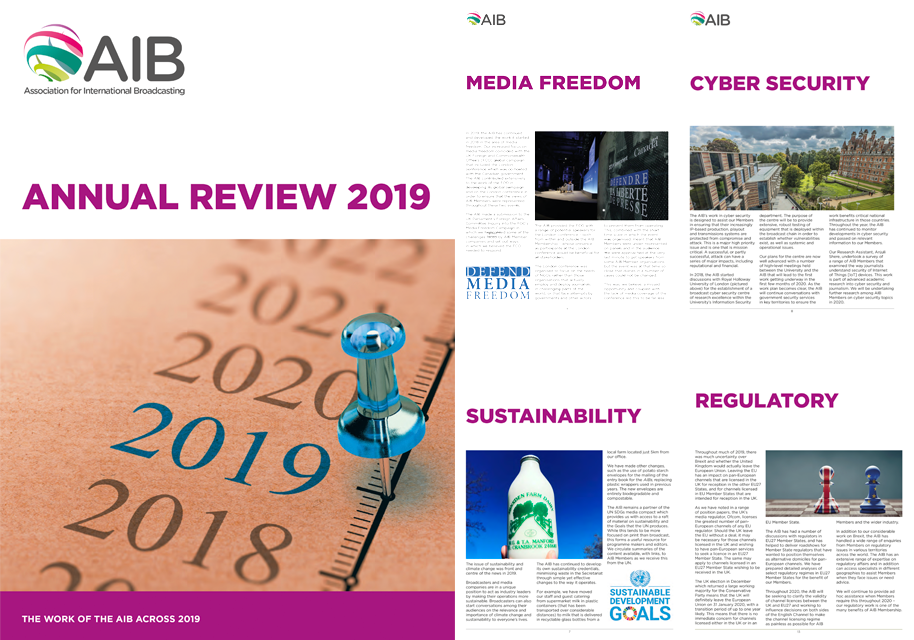
The Association for International Broadcasting has published its review of 2019. The document summarises the key activities that the AIB has undertaken through the year, ranging from work on cyber security to sustainability, media freedom to regulatory, advocacy to research. 

“The AIB’s work is varied and extensive,” commented AIB Chief Executive Simon Spanswick. “Because of our global membership, we tackle issues across the world and support our Members across a wide range of subjects. In 2019, media freedom was a particularly important focus for us and, sadly, it is likely that we will have to continue to fight for media freedom through 2020 and beyond. in addition, the AIB’s day-to-day activities helps our Members across an ever-increasing number of subjects, some of them mission-critical. The Annual Review provides a snapshot of our most visible work. Much more goes on in addition.”

The AIB Annual Review 2019 is available online here.


AIB publishes first industry briefing of 2020

AIB publishes first industry briefing of 2020

AIB publishes first industry briefing of 2020

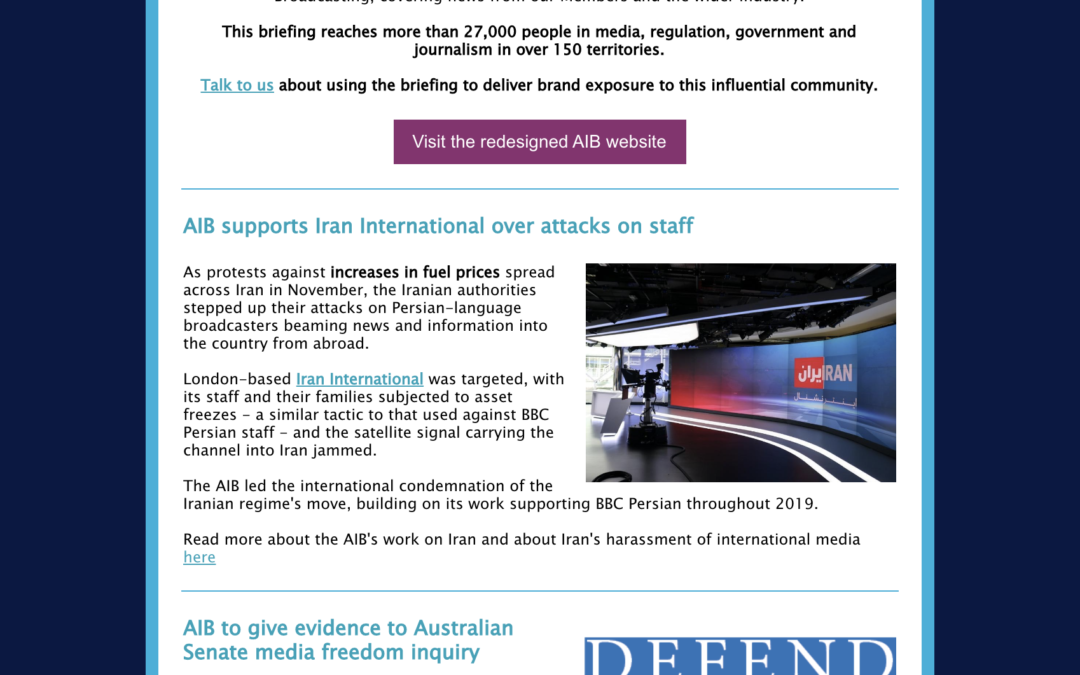
The AIB has published its first global industry briefing of 2020. Reaching more than 27,000 media leaders in over 110 countries, this edition of the industry briefing reports on some of the media freedom work that the AIB is undertaking, as well as the BBC’s newly set out goals for the decade.

To join the subscription list, click here.

With its unrivalled reach, the AIB industry briefing is the ideal platform for key messages to be communicated and brand awareness raised. Talk to Tom Wragg about how you can leverage the AIB’s global reach to help your goals.