The Tunisian Broadcasting Corporation (ONT) has signed a multi-year contract with Eutelsat Communications to broadcast its new subscription-free TV platform across North and West Africa. ONT has selected the powerful Eutelsat 7 West A satellite to reach viewers across the region.
ONT is consolidating around ten Tunisian channels in a single package at 7/8° West, North Africa’s leading satellite broadcasting neighbourhood. Eutelsat 7 West A’s footprint also enables the ONT to extend reach to West Africa. Homes equipped with a satellite dish pointing to 7/8° West will be able to enjoy improved image quality and easier navigation of the channels in the platform.
Noomen Elfehri, Tunisia’s Minister of Communication Technologies and Digital Economy, stated: “The launch of this national project is a vehicle for Tunisia’s sovereignty in the field of broadcasting. Viewers will be able to enjoy a diversified and quality line-up of Tunisian content.”
Furthering the partnership between Eutelsat and the ONT Dhaker Baccouch, Chairman and CEO of the ONT, added: “In selecting the Eutelsat 7 West A satellite, we are providing viewers with improved image quality and we are equipped to scale up our new platform with further channels.”
Michel Azibert, Eutelsat’s Chief Commercial and Development Officer, concluded: “With this new contract the ONT is strengthening its portfolio of capacity on Eutelsat, adding to resources already leased on three of our satellites, Eutelsat 12 West B, Hot Bird and Eutelsat 36B, for newsgathering and broadcasting to the general public.”
The Association for International Broadcasting (AIB) has today – 12 May 2016 – condemned the leaking of the personal details of thousands of journalists and media workers who have reported from eastern Ukraine and the support for the publication by member of the Ukrainian parliament.
Above – Simon Spanswick, AIB chief executive, interviewed on RT English
On 7th May, a group of hackers claimed on the website Myrotvorets (Peacemaker) that they had breached computers used by pro-Russian separatists in eastern Ukraine to keep track of journalists they had allowed to work in the region. The hackers published a database containing the names, affiliations, and contact information of more than 7,000 individuals. The database includes over 4,500 local and international journalists and media workers who have reported from the conflict zone.
According to the US based Committee to Protect Journalists (CPJ) the separatists have been collecting journalists’ contact information as part of an accreditation process even though their authority over eastern Ukraine is not internationally recognised.
The Ukrainian Prosecutor General’s Office on Wednesday announcedthat it had opened an investigation into the publication of the journalists’ names and contact information under article 171.1 of the Ukrainian Criminal Code, which covers “obstruction to journalism.”
The hackers wrote that they did not know what the consequences of their action would be, but added, “Be certain: It is important to publish the list because these journalists collaborate with terrorist guerillas.”
“The Association for International Broadcasting and its Members condemn without equivocation the publication of these data,” said Simon Spanswick, chief executive of the AIB. “The names and contact data of many journalists and news crews working for AIB Members – and hundreds of other agencies, TV channels, radio stations and newspapers – are included in the release. There is no excuse for releasing information of this sort. The journalists working in East Ukraine were there legitimately, reporting the situation for the benefit of audiences and readers throughout the world. Accusations that the journalists ‘collaborated with terrorists’ are completely unfounded and without any substance. We call on the authorities in Ukraine to take steps to have these data removed from the Internet and to prosecute those involved in this hack.”
Oksana Romanyuk, head of the Institute for Mass Information, a press freedom group in Kiev, told the CPJ that the hackers’ actions had remained largely unnoticed until Tuesday, when Anton Geraschenko, a member of Ukraine’s parliament, praised them on the social media site Facebook. Geraschenko suggested that Ukraine’s authorities should introduce specific actions to “counter Russian propaganda.”
Geraschenko’s recommendations included: “imposing control over broadcast programming and cable networks to prevent distribution of information that could destabilize Ukraine’s sovereignty and territorial integrity;” “imposing control over accreditation of reporters, specifically those from Russia;” “deportation of reporters found in breach of national laws;” and “developing legal and technical resources to block online content that incites to violence and destabilises Ukraine’s national security.”
Ukrainian and foreign journalists have condemned the publication of personal data of reporters, including those from the Ukrainian broadcaster Hromadske TV, the Moscow-based newspaper Novaya Gazeta, Polish daily Gazeta Wyborcza, the BBC, The New York Times, The Daily Beast, The Economist, and others. In a statement signed by 37 journalists and published on Wednesday 11th May, they rejected the description of the accredited journalists as “collaborators with terrorists” and demanded that the personal data leak be investigated by law enforcers, saying it violated Ukraine’s privacy laws, the nation’s constitution, and the European Convention on Human Rights
According to the statement, journalists started receiving threats by phone and email after the list was made public. The signatories said that by obtaining accreditation from the separatists, they were able to inform the public of the crimes committed in the area, including the downing of the Malaysian Airlines plane over the region in July 2014.
The journalists also said that in 2014 alone, at least 80 journalists were detained by eastern Ukrainian separatists in connection with their work and that some of them were tortured. They urged the hackers to remove the list from the Internet.
The AIB encourages the journalists and media workers on the list to take extra precautions for securing their email accounts and digital information.
3 May marks World Press Freedom Day. The international day was proclaimed by the UN General Assembly in 1993 following a Recommendation adopted at the 26th Session of UNESCO’s General Conference in 1991. This in turn was a response to a call by African journalists who in 1991 produced the landmark Windhoek Declaration on media pluralism and independence.
Every year, 3 May is a date which celebrates the fundamental principles of press freedom; to evaluate press freedom around the world, to defend the media from attacks on their independence and to pay tribute to journalists who have lost their lives in the exercise of their profession.
The feature tells the story of a disabled teenager who relies on his friends to push him in his wheelchair everyday along the rugged path to school, and his elation when a local NGO surprises him with a four-wheel all-terrain vehicle he can operate himself to make the journey. Produced by Bishkek-based correspondent Ulanbek Egizbaev and repackaged by RFE/RL’s Current Time digital team for social media, it was viewed more than a million times globally in Russian, English, and the original Kyrgyz.
“We deeply value this recognition of the quality of RFE/RL reporting, and thank the many, many voters globally who felt the impact of this story just as powerfully as we did,” said RFE/RL Editor-in Chief Nenad Pejic.
Two other RFE/RL entries were selected as Official Honorees in the 2016 competition. Desperate Honeymoon, a documentary by Multimedia Producer Ray Furlong, follows Syrian newlyweds as they make the arduous trek across the Balkans in search of a better life in Europe. Honored in the Documentary: Individual Episode category, it won Silver and Bronze medals at the New York Festivals International Television and Film Awards earlier this month.
RFE/RL’s Pangea Digital team, which manages the company’s content management system, was recognized by The Webby Awards in the Mobile Sites & Apps: News category for RFE/RL’s new responsive design website.
The Webby Awards is the leading international award honoring excellence on the Internet. Established in 1996, The Webby Awards received nearly 13,000 entries from over 70 countries worldwide this year, and were judged by the International Academy of Digital Arts and Sciences, an organization based in New York that presents the prize. The award will be presented at an awards ceremony in New York on May 16.
On 4 January, Africanews launched from its headquarters in Congo Brazzaville. Africanews says that it is the first independent pan-African news media, initially reaching its audience through its digital community;:website, YouTube channel, Facebook and Twitter and its innovative and interactive app, “Story Hunters”.
Africanews provides news not just on Africa, but also on the rest of the world, from a purely African perspective. At our current offices in Pointe Noire, 85 media professionals, of 15 different nationalities from all over sub-Saharan Africa, work under the direction of Mame Campbell Touré, Bureau Chief, Isaac Khaguli Esipisu, Editor in Chief, and François Chignac, Director of Editorial Development. An extensive network of correspondents in every African country rounds out the team.
Michael Peters, CEO of Euronews and Africanews stated:
“This is a milestone in the history of our Group. It all began with the recognition that the rising African continent is an incredible source of news and that there is a great pool of talent that lacks a quality media environment. I want to thank all of the people at Africanews and Euronews who have been working together for months to prepare the launch of this new media whose mission is to ensure the independence and diversity of the news, as a founding principle of Africanews. Africanews is the first organisation to provide news from a pan-African point of view and it will spotlight all the talents of Africa.”
In the news stories, features and magazines, Africanews will reflect the great creative diversity, ideas and perspectives of the evolving sub-Saharan Africa. The news coverage will be immediately available on africanews.com and, in a few weeks, the TV channel will start broadcasting across the major distribution networks.
africanews.com
People in Africa and anywhere in the world can now access the africanews.com website.
Presented in four key areas – News / Economy / Sports / Culture– all the essential African and international news will be available in French and English on africanews.com.
With its responsive web design, africanews.com is suited to all mobile, tablet and computer screens and has the added feature of adapting to the quality of the available connection. Viewers may choose from three versions:
Lite version
Standard version
Advanced version
For weak connections, the day’s headlines load quickly (text format only).
Users can browse the news and magazines of Africanews, check the stock markets, get sports scores or select features in the field that interests them the most.
For a normal connection, the articles are illustrated by photos or standard resolution videos.
For high-speed connections, the complete site is displayed with texts, photos and HD videos.
The Africanews media comes with a community app known as “Story Hunters” which invites Africanews TV viewers and website users to play an active role in finding and creating news stories.
The Story Hunters app:
contribute, like, share, comment
More than just an app or a social network, Story Hunters is a news-sharing platform designed to be a forum for expression of all things important for Africa.
Available for iOS and Android devices, in French and English, the app allows users to watch video content published by Africanews, to comment on the items, rate them, send an emoticon, share or re-post them.
Africanews also invites news hunters to join the community so that they can contribute their own photos and videos, by sending them directly from their mobile phone via the app.

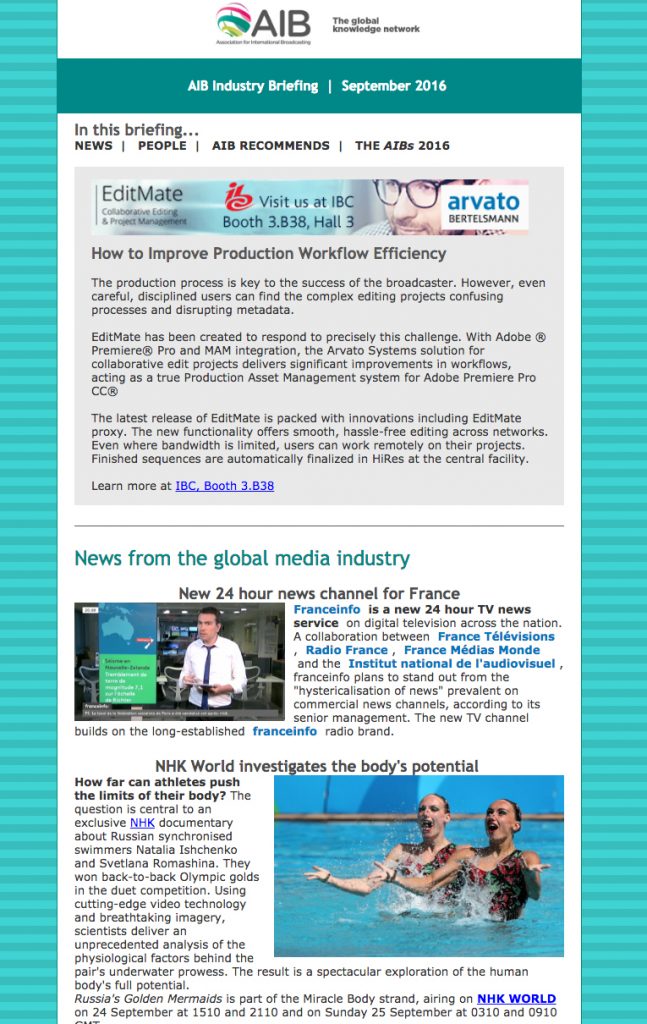 Read all about it…the latest international industry briefing from the Association for International Broadcasting has been published.