6 January 2017
RFE/RL serves a measured audience of 27 million people a week in 23 nations and territories by video, social networks, mobile apps, websites, podcasts and radio – whatever media they use most. From its Prague headquarters and 18 news bureaus, it provides local news and information in 26 languages to the nations of the former Soviet Union, the Balkans, Iran, Afghanistan and Pakistan, including a round-the-clock Russian-language television channel.
 Through last September, RFE/RL recorded one billion page views on its websites, 300 million views on YouTube and 225 million engaged users on Facebook, plus many more visits and views on other social networks and apps.
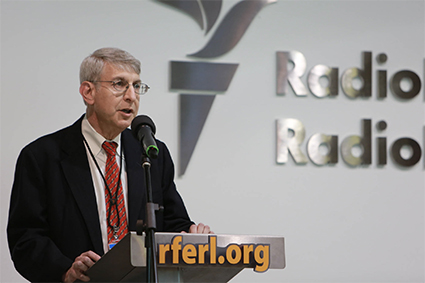
“RFE/RL’s audience is highly loyal, making their way to us despite efforts by some governments to jam us on the internet and over the air, and even to directly intimidate viewers and listeners,” said Thomas Kent, president and CEO of RFE/RL (pictured). “They find us an indispensable source of news and investigative journalism, constantly adapting to the most modern platforms to reach them.”
6 December 2016
(WASHINGTON — December 5, 2016) Turkmen authorities have arrested contributor Khudayberdy Allashov on charges of possessing chewing tobacco only days after one RFE/RL correspondent was threatened with arrest and another was physically injured in a series of violent attacks.
“We believe these charges are part of a targeted campaign intended to silence our Turkmen Service and intimidate the Turkmen people,” said RFE/RL President Thomas Kent. “Over the last 18 months our reporters have been arrested, held incommunicado, beaten, interrogated, threatened and arbitrarily jailed, and we hold the Turkmen government responsible.”
Allashov was apprehended in Turkmenistan’s northern Dashoguz province on December 3, when a group of policemen carrying weapons and video cameras entered his house, beat him, and rounded up his family, including his mother and wife. Both he and his mother were charged with possessing chewing tobacco, which, while illegal in Turkmenistan, is commonly consumed and not known to have led to arrests. Allashov’s wife was told that he had confessed to possessing 11 kilograms of the product, an outrageous claim she says was coerced, and could expect to be sentenced to seven years in prison. Both he and his mother were scheduled to appear before a court on December 5.
The dealer who sold Allashov the tobacco was also briefly detained and questioned, and later told RFE/RL that she had seen him at the police station severely bruised and unable to hold his head up or speak.
Allashov, began contributing to RFE/RL’s Turkmen Service in October this year, reporting local stories about food shortages, wage delays, salaries, and cotton-picking under the pen name Mekan Tashliyev.
While Turkmenistan has long been intolerant of any independent media, the government has escalated its repression of RFE/RL journalists recently. Correspondent Soltan Achilova was subject to three separate physical attacks in connection with her journalism in November. Correspondent Rovshen Yazmuhamedov was also threatened in November with enforcement of a suspended jail term he received in 2013. Video journalist Saparmamed Nepeskuliev is serving a three-year prison sentence on narcotics charges that rights advocates believe were fabricated and brought in retaliation for his reporting, and no fewer than six contributors quit their jobs in response to pressure during 2015.
About RFE/RL
RFE/RL is a private, independent international news organization whose programs — radio, Internet, television, and mobile — reach influential audiences in 23 countries, including Russia, Ukraine, Iran, Afghanistan, Pakistan, the republics of Central Asia and the Caucasus. It is funded by the U.S. Congress through the Broadcasting Board of Governors (BBG).
24 November 2016
Mediacorp’s Channel 5, an English mass entertainment and lifestyle channel, launches YXY: Youth by Youth this December, on the weekly current affairs magazine programme, On the Red Dot.
YXY: Youth by Youth is a four-part co-production between Mediacorp and four local institutes of higher learning – Nanyang Academy of Fine Arts, Lasalle College of the Arts, Ngee Ann Polytechnic and Nanyang Polytechnic. Each half-hour episode zooms in on a specific issue impacting the youth of today in Singapore. The series explores the lives of youths as they experience the ups and downs of living with a disability; pursuing their passions; navigating broken family relationships; and coping with social media.
“This collaboration has been exciting and meaningful,” said Ms Susanna Kulatissa, Deputy Chief Editor of English Current Affairs. “It provides a rare opportunity to peek into the world of our youth and experience their triumphs and struggles through their eyes.”
The four episodes in this series are as follows (refer to the Annex for the synopses):
1) We Are Family (in collaboration with Nanyang Academy of Fine Arts)
Telecast: Friday, 2 December 2016
2) Unstoppable (in collaboration with Lasalle College of the Arts)
Telecast: Friday, 9 December 2016
3) Passion Pursuits (in collaboration with Ngee Ann Polytechnic)
Telecast: Friday, 16 December 2016
4) Gen Soci@l (in collaboration with Nanyang Polytechnic)
Telecast: Friday, 23 December 2016
Special Screening
A special screening of YXY: Youth by Youth was organised today for invited guests and members of the media before its telecast on Channel 5.
Dr Janil Puthucheary, Minister of State, Ministry of Communications and Information (MCI) and Ministry of Education (MOE), was the special guest at the screening event.
Page 2 of 3
YXY: Youth by Youth will telecast on Channel 5 every Friday from 2 December 2016 at 9.30pm (Sin/HK/MNL time). The series is also simulcast and is available as video-on-demand on http://tv.toggle.sg/en/channel5.
About On the Red Dot
On the Red Dot is a weekly info-ed series on Channel 5. Since 31 October 2012, the half-hour current affairs programme has been examining issues important to Singaporeans, through the lives of ordinary people.
About Channel 5
Channel 5 is Singapore’s No. 1 English TV station under the MediaCorp group. It is a 24-hour general entertainment channel with a mix of local and international mass-appeal programmes. Channel 5 has a heritage of creating highly-rated and award-winning local productions featuring Asian faces and themes, such as Phua Chu Kang Pte Ltd, Incredible Tales, Red Thread, Fighting Spiders, The Noose, The Pupil, There Was A Time, Spouse For House and Keong Saik Street.
The channel is also among the first in Asia to produce formatted versions of top-rated international game shows, like Minute To Win It, Sasuke Singapore and Who Wants To Be A Millionaire. In 2004, it launched the highly successful Singapore Idol to record-high ratings and in 2011, it launched the popular game show, Million Dollar Money Drop.
As part of the channel’s continued vision to produce relatable local content for all Singaporeans, Channel 5 launched a daily topical talk show, The 5 Show, in Jan 2015 and a daily family drama Tanglin in June 2015.
Channel 5 aspires to be a respected and recognised brand in Singapore as well as in the region. It has received numerous accolades, including Asian Television Awards, New York Festival Awards and Promax International Gold Awards. It is also the Terrestrial Channel of the Year 2010 as recognised by the Asian Television Awards. MediaCorp has the widest range of media platforms in Singapore spanning digital, television, radio, print and out-of-home media. Its mission is to engage, entertain and enrich audiences by harnessing the power of creativity. MediaCorp pioneered the development of Singapore’s broadcasting industry, with the radio broadcast in 1936 and television broadcast in 1963. Today, the company has over 50 products and brands in four languages (English, Mandarin, Malay and Tamil), reaching out to virtually all adults in Singapore weekly.
MediaCorp was named Terrestrial Broadcaster of the Year for the eleventh time at the Asian Television Awards in 2014.
For more information, please visit http://tv.toggle.sg/en/channel5.
Media contact
Faith Yang
Assistant Corporate Services Manager
Corporate Communications, News Segment
Mediacorp
Tel: +65 6350 3603
Email: faithyang@mediacorp.com.sg
Page 3 of 3
ANNEX YXY: Youth by Youth Episode 1 We Are Family
What makes a family? Two young women with divorced parents share their struggles growing up in non-traditional families. Noelle Ong alternated between living with her mother and grandmother, before she finally found security and stability in a friend’s family. Tiffany Miranda once thought her friends were more important than her family, until she rebuilt the bonds with her mother and stepfather.
Episode 2
Unstoppable
Meet two young people who have not let their disability stop them. Driven, determined and unstoppable, they have accomplished achievements beyond the ordinary. But it has not been without its challenges. For Jeremiah Tan and Sheikh Muhammad Dannial Bawthan, isolation and segregation have been part of their journey. Twenty-one year old Jeremiah may suffer from Rickets and Traumatic Brain Injury, but that has not stopped him from representing Singapore in the international arena as the youngest player in the Singapore Cerebral Palsy Soccer team. Twenty-two year old Daniel has had spinal muscular dystrophy since he was born. Despite having progressive muscle wasting and being wheelchair bound, he still wins awards for the music he produces.
Episode 3
Passion Pursuits
“No time” is a common refrain we hear from our busy youth these days. But not for two young students, Jun Rui and Wei Ling who are fearlessly marching to the beat of a different drum. These talented musicians from the Singapore National Youth Orchestra have chosen to pursue classical music as part of their education, and are working night and day to hone their passion into professional musical careers. In a separate story, thirty-four year old Camellia volunteers to bring cheer to the homes for the elderly and disabled with some very special assistants. Cats! Camellia who is dealing with her own personal loss, believes her cats provide healing not only to those she visits, but to herself as well.
Episode 4
Gen Soci@l
Did you know that in 2016, Singapore recorded the highest number of active social media users among 232 countries? We find out more from our youth as we delve into the young lives of Sarrah, Sonia, and Benjamin – three avid social media users. Eighteen year-old polytechnic student, Sarrah, finds a connection to celebrities through social media. While, radio DJ and social influencer, Sonia, talks about how she manages her life on social media, the impact she has on fans, and vice versa. Lastly, we look at Ben. He may be an introvert in real life but his videos on social media application, Vine, have captured over 8 million views. How are these 6-second clips making him so popular?
18 November 2016
 The AIB is pleased to announce its first #iamabroadcaster Technology Masterclass in association with IABM.
This new event, taking place immediately before the IABM’s Annual Conference, aims to highlight the use of technology in creating, producing and delivering programming to consumers. It will also explore the mission-critical issue of cyber security in broadcasting, and look at the important work being done in digitising media archives to protect nations’ audio-visual history.
The event venue is the Radisson Blu Edwardian at London Heathrow. The half-day Masterclass is open to Members and non-members of both the AIB and IABM.

The cost for Members of either organisation is £55 per person. For non-members the charge is £80 per person.
AGENDA
0900 Registration
0930 Welcome and introduction
0940 Keeping the lights on
The threat of cyber-attacks against high value targets in the media industry has never been greater. In addition to the high profile attacks on Sony and TV5 Monde, broadcasters and other companies playing a vital role in the production and distribution of content throughout the world continue to be targeted by criminal gangs and rogue states.
The Association for International Broadcasting has been working to ensure that its Members are able to share information and expertise in a confidential forum to help minimise risk and ensure that networks remain on the air.
Taking part in a discussion that will explore the challenges and the way that technology suppliers can help ensure that programmes remain on air will be Jonathan Farrell, Head of Information Security at Arqiva and James Stubbs, Business Development Manager at Babcock MSS. Both have first-hand experience of how to make broadcast infrastructure resilient against attack and the need for all parts of the industry to act together to make sure that the attempts to take broadcasters off air, or to infiltrate their playout systems and online services, are stopped in their tracks.
1030 Coffee
1100 Content worth keeping
Preserving the past for the future – Private Engineering Office, Qatar
Although it’s a relatively young country, Qatar has an extensive analogue library of TV programming and film. In its original format, the content is inaccessible. That’s why the Qatari government has implemented what may be the world’s most concentrated and comprehensive digitisation project. It aims not only to preserve the content but also to analyse the material, employing historians to tag the programming and then to make it easily accessible for citizens and scholars, now and in the future.
In this session, we’ll learn about the project and how it has been implemented. We’ll find out whether the systems developed in Qatar can be replicated elsewhere as the world’s audio-visual history cries out for preservation against a backdrop of obsolescent formats and rapidly deteriorating archives.
Sanjay Salil, Managing Director of global media services company MediaGuru will explain the work that has gone into the Qatar project.
1140 Enabling story-telling
How is technology enabling story-telling? Is the equipment that’s available today meeting all the editorial requirements of programme makers? In an environment where consumers are always on and want content delivered anytime, anywhere, can technology companies deliver what’s demanded by journalists, editors, producers and directors? In a wide-ranging discussion involving key players working at the sharp end of live broadcasting, we’ll also hear from consumers in Europe, North America and the Middle East about the way they choose content and the means of consumption. Expect some surprises along the way.
Martin Davies, Founder of Between the Posts Productions will be in conversation with Wesley Dodd, CEO of Celebro Studios.
1240 Close
1300 Networking lunch
16 November 2016
The BBC World Service has announced its biggest expansion since the 1940s, in a move designed to bring its independent journalism to millions more people around the world, including in places where media freedom is under threat.
 The BBC World Service will also expand its digital services to offer more mobile and video content, a greater social media presence, and new ways of reaching its audience around the globe.
The BBC World Service will launch 11 new services in Afaan Oromo, Amharic, Gujarati, Igbo, Korean, Marathi, Pidgin, Punjabi, Telugu, Tigrinya, and Yoruba. This means the BBC World Service will be available in 40 languages including English. The expansion will also mean more journalists on the ground in locations across the world.
The expansion includes plans for the BBC to:
- Produce extended news bulletins in Russian, with regionalised versions for surrounding countries, a relaunched website, new digital formats and more journalists on the ground
- Enhance its television services across Africa, including over 30 new TV programmes for partner broadcasters across sub-Saharan Africa
- Enhance the BBC Arabic offer by delivering new regional programming across the Arab world
- Broadcast short-wave and medium-wave radio programmes aimed at audiences in the Korean peninsula, supplemented by digital content online and on social media
- Invest in World Service English, with new programmes, more original journalism, and a broader agenda
- Continue with the digital transformation of the BBC World Service, including new TV news bulletins, so that all 40 languages will eventually have a video offer
- Use its global presence to provide an even greater focus on analysis and explanation, or ‘slow news’, helping audiences to make sense of the world by explaining the ‘why’ as well as the ‘what’.
Tony Hall, Director-General of the BBC, said: “This is a historic day for the BBC, as we announce the biggest expansion of the World Service since the 1940s. The BBC World Service is a jewel in the crown – for the BBC and for Britain.
“As we move towards our centenary, my vision is of a confident, outward-looking BBC which brings the best of our independent, impartial journalism and world-class entertainment to half a billion people around the world. Today is a key step towards that aim.”
Francesca Unsworth, BBC World Service Director, said: “Through war, revolution and global change, people around the world have relied on the World Service for independent, trusted, impartial news. As an independent broadcaster, we remain as relevant as ever in the 21st century, when in many places there is not more free expression, but less.
“Today’s announcement is about transforming the World Service by investing for the future. We must follow our audience, who consume the news in changing ways; an increasing number of people are watching the World Service on TV, and many services are now digital-only. We will be able to speed up our digital transformation, especially for younger audiences, and we will continue to invest in video news bulletins. What will not change is our commitment to independent, impartial journalism.”
The BBC World Service will focus particularly on increasing audience reach with younger people and women.
The BBC’s Director-General has set a target for the BBC to reach 500m people worldwide by its centenary in 2022.
This expansion is a result of the funding boost for the BBC World Service announced by the UK Government last year. Further details of the new services will be announced in due course. The first new services are expected to launch in 2017.
13 October 2016

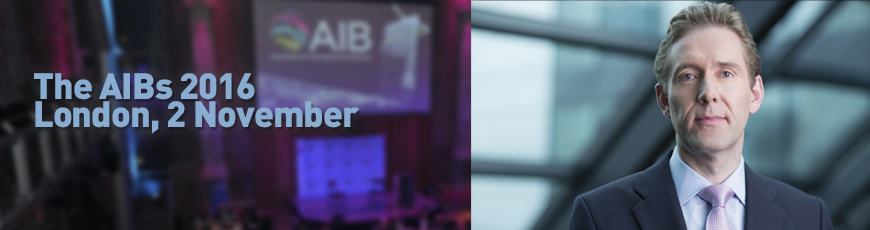
Mark Barton, Bloomberg Television’s longest serving presenter in Europe, the Middle East and Africa, is to host the AIBs – the twelfth international awards for the best factual television, radio and online productions.
Taking place in London on Wednesday 2 November 2016, the AIBs celebrate the work of producers, editors and journalists from around the world. Work from nearly 40 countries has been submitted to this year’s AIBs, and the shortlist includes work from major broadcasters, online video companies, newspapers and independent producers.
“I am delighted to have been asked to host this year’s AIBs,” said Mark Barton. “I have been amazed by the range and quality of productions that have been entered. I am looking forward to revealing who has won in this global competition and sharing in the celebrations of success.”
“It is great that Mark Barton has agreed to present this year’s AIBs,” commented Simon Spanswick, chief executive of the Association for International Broadcasting. “His experience in live journalism means he understands the realities of getting news to audiences in challenging situations. He also has consummate interviewing skills that will bring the best out of this year’s winners as they receive their prizes.”
Mark Barton played an integral role in establishing Bloomberg Television as a global financial and business news network. Mark has witnessed at first hand three global recessions and covered five UK general elections and five US elections.
Mark has travelled the world to interview more than ten thousand newsmakers. They’ve included Presidents, Princes, Prime Ministers, members of the US Federal Reserve and most of the global business elite. Among his personal career highlights are Microsoft founder Bill Gates and the late Israeli leader Shimon Peres.
The AIBs will be presented in London at LSO St Luke’s on 2 November 2016 in front of a truly global gathering of journalists, editors, producers and directors representing countries as diverse as Argentina, Denmark, India, France, Russia, the USA and the UK, among many others. Reserve places at theaibs.tv.
Eutelsat and MediaGuru are sponsors of this year’s AIBs.
