BBC to drop and combine channels, focus on digital future

BBC to drop and combine channels, focus on digital future

BBC to drop and combine channels, focus on digital future

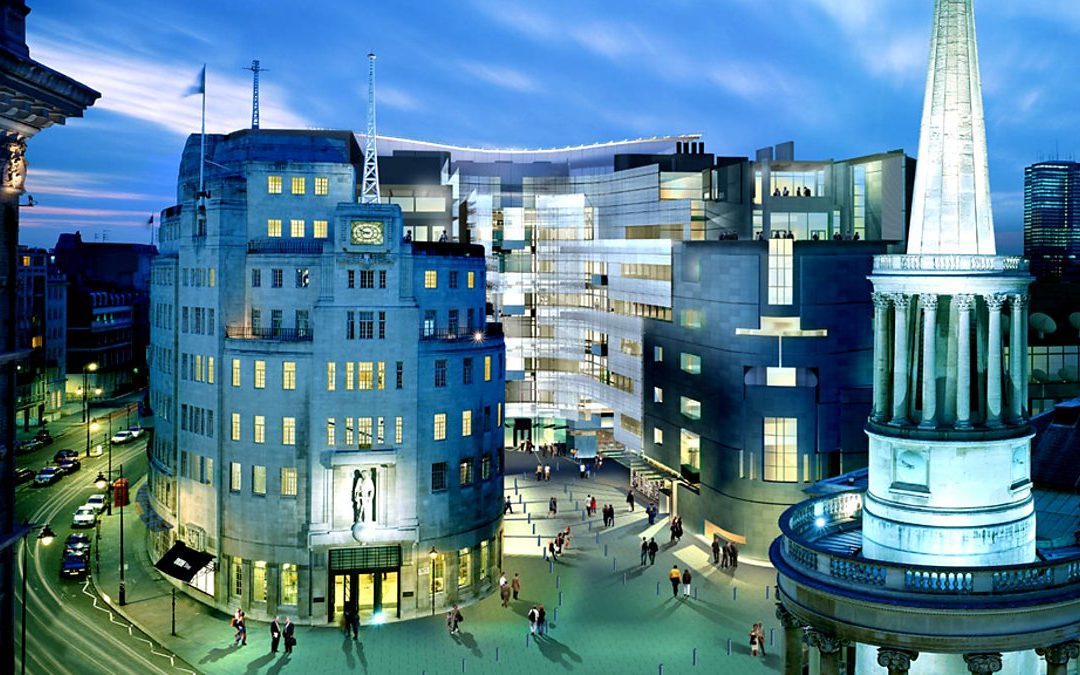
The BBC has set out the blueprint to build a digital-first public service media organisation.
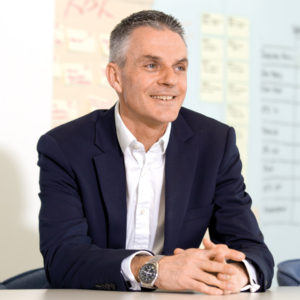
In a speech to staff on Thursday 26 May 2022, Director-General Tim Davie said the BBC must reform to stay relevant and continue to provide great value for all.

This will include changes to content and services, efficiency savings and a drive to seek new commercial investment, as the BBC manages the demands of the licence fee settlement (every UK household owning a TV set and watching live broadcasts must hold a TV licence) and looks to the future.

The broadcaster will adapt to compete and succeed in a busy, global market, while staying faithful to the values that have underpinned it for a century.

It will change in step with the modern world, giving audiences the content they want and delivering it to them in the ways they want it.

The plan focuses on creating a modern, digital-led and streamlined organisation that drives the most value from the licence fee and delivers more for audiences.

This first phase represents £500m of annual savings and reinvestment to make the BBC digital-led.

As part of this, £200m will contribute to the £285m annual funding gap by 2027/28, created by the licence fee settlement earlier this year. The remaining funding gap will be covered in the final three years of this Charter period, which is consistent with previous savings programmes.

The BBC will also reinvest £300m to drive a digital-first approach, through changes to content and output and additional commercial income. This includes:

  • Shifting significant amounts of money into new programmes for iPlayer which will also attract extra third-party investment on screen
  • Shifting resources in local output towards digital, while keeping spend flat
  • Making savings in broadcast news, reinvesting that in video and digital news
  • Investing up to £50m a year in product development.

Overall, there will be up to 1,000 fewer people employed in the public-funded part of the BBC over the next few years.

Detailed plans and budgets will be set out as normal in future Annual Plans and Annual Reports and Accounts.

Director-General Tim Davie told staff: “When I took this job I said that we needed to fight for something important: public service content and services, freely available universally, for the good of all.

“This fight is intensifying, the stakes are high.”

Examples of future changes announced today include:

  • The creation of a single, 24-hour TV news channel serving UK and international audiences, called BBC News, offering greater amounts of shared content, but maintaining the ability to offer separate broadcasts depending on what’s happening at home and abroad;
  • Plans to stop broadcasting smaller linear channels, such as CBBC and BBC Four and Radio 4 Extra, after the next few years;
  • Ongoing work to strip out any unnecessary bureaucracy, reduce running costs and simplify ways of working to free up time;
  • Plans to stop scheduling separate content for Radio 4 Long Wave, consulting with partners, including the Maritime and Coastguard Agency, ahead of the closure of the Long Wave platform itself;
  • Shifting a number of World Service languages to be digital only;
  • An ambition to reach 75% of BBC viewers through iPlayer each week;
  • Reviewing commercial options for audio production;
  • New on-demand content and formats for news and current affairs;
  • Requesting Ofcom to remove regulatory restrictions on iPlayer to expand boxsets and archive content;
  • Bigger investment in programming from the nations and regions across the UK;
  • Investment in an enhanced news and current affairs offer for iPlayer and Sounds, with new video formats, simulcasts and podcasts;
  • Changes in local radio and regional news to ensure high-quality, distinctive BBC local journalism is available every day when and where audiences want it;
  • Plans to accelerate digital growth in audio and drive listeners to BBC Sounds, simplifying schedules and cancelling shows that do not deliver;
  • Further investment in data to ensure comprehensive, real-time data that supports growth of digital products and services.

Speaking to staff, Mr Davie said: “This is our moment to build a digital-first BBC. Something genuinely new, a Reithian organisation for the digital age, a positive force for the UK and the world.

“Independent, impartial, constantly innovating and serving all. A fresh, new, global digital media organisation which has never been seen before.

“Driven by the desire to make life and society better for our licence fee payers and customers in every corner of the UK and beyond.  They want us to keep the BBC relevant and fight for something that in 2022 is more important than ever.

“To do that we need to evolve faster and embrace the huge shifts in the market around us.”

Work will start immediately, with further details to be announced in the coming months, including consultations with staff.

Mr Davie added: “I believe in a public service BBC for all, properly funded, relevant for everyone, universally available, and growing in the on-demand age. This plan sets us on that journey.”

Russia closes CBC bureau in Moscow

Russia closes CBC bureau in Moscow

Russia closes CBC bureau in Moscow

Russia cancelling visas of CBC journalists

The Russian Foreign Affairs Ministry has announced that it is to close the Moscow bureau of the Canadian Broadcasting Corporation (CBC). It will also withdraw visas for CBC journalists. The move follows the banning of Russia’s international TV channels RT English and RT France in March from being distributed in Canada. 

“With regret we continue to notice open attacks on the Russian media from the countries of the so-called collective West who call themselves civilised,” Russian Foreign Ministry spokesperson Maria Zakharova said.

“A decision has been taken to make retaliatory, I underscore retaliatory, measures in relation to the actions of Canada: the closure of the Moscow bureau of the Canadian Broadcasting Corporation, including the annulation of the accreditations and visas of their journalists.”

In April, Russia imposed sanctions against Catherine Tait, President of CBC and Michael Melling, VP News at CTV News, preventing them – and a range of politicians and business people – from visiting Russia.


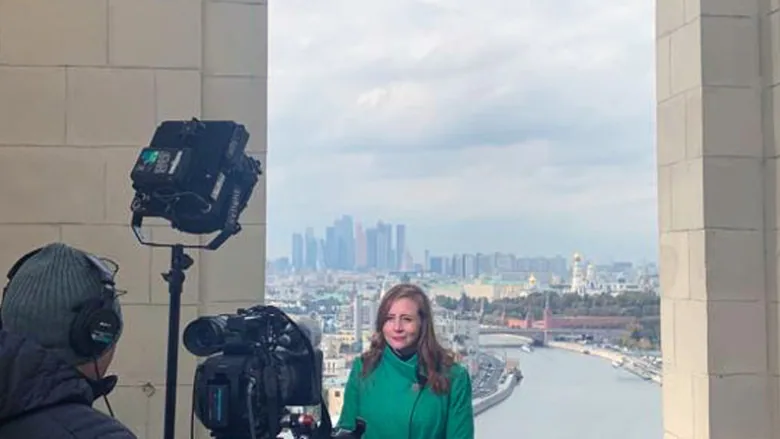
Photo: CBC correspondent Briar Stewart on the rooftop of CBC’s Moscow bureau on Oct. 5, 2021. (CBC)

UK launch for Current Time on Freeview

UK launch for Current Time on Freeview

UK launch for Current Time on Freeview

Current Time, a Russian-language 24/7 TV  channel broadcasting from Prague, has launched on Freeview UK, channel 271, via the Channelbox platform.

Current Time is a Russian-language TV channel headquartered in Prague and produced by Radio Free Europe/Radio Liberty (RFE/RL) in cooperation with Voice of America. The channel was established as an alternative to Kremlin-controlled media and brings real news, robust debate, and fact-based, unbiased, balanced reporting on local, regional, and international issues to Russian-speaking audiences everywhere.

Current Time has been under attack from the Kremlin since the channel began. It was designated as a foreign agent in December 2017, less than one year after its formal launch.

Following the launch of the Ukraina24 news channel last month, Current Time will further bolster Channelbox’s extensive news lineup, which includes Euronews, France24 and many others.

Channelbox is a multi-channel platform available on Freeview channel 271 and accessible via TV sets  connected to the aerial and the internet. Channelbox is also available via its mobile applications worldwide.

 “Current Time is happy to welcome its new viewers in the United Kingdom. The partnership with Channelbox is particularly important now as Current Time continues to provide its Russian-speaking audiences worldwide with uncensored news and information about Russia’s war on Ukraine,” said Pavel Butorin, Director, Current Time.

“We are very excited to have Current Time on the platform and to expand its distribution in the UK and worldwide. It is more important than ever for Russian speakers to have access to independent media, which is not controlled by the Kremlin”, said Tanya Kronfli, Channelbox Head of content and business development.

About Current Time

Current Time is a 24/7 TV and digital network for Russian speakers, led by Radio Free Europe/Radio Liberty in cooperation with Voice of America. The Current Time network’s roots reach back to August 2014 and the debut of the currenttime.tvwebsite, soon followed by its YouTube and Facebook channels and, in October 2014, the launch of its first, 30-minute news program. This was followed in February 2017 by the launch of Current Time’s 24/7 TV channel. In addition to reporting uncensored news and debunking disinformation through its Smotri v Oba (“Footage vs. Footage”) program, Current Time is the largest provider of independent, Russian-language films to its audiences. A sampling of Current Time’s best content can be found on the channel’s English portal.

About Channelbox

A free-to-air multi-channel platform available on Freeview devices connected to the Internet. Channelbox is accessible via Freeview channel 271 and mobile applications.

FRANCE 24 programme highlight | France/Portugal cultural season

FRANCE 24 programme highlight | France/Portugal cultural season

FRANCE 24 programme highlight | France/Portugal cultural season

FRANCE 24 programme highlight: Lisbon: How African music is breaking down racial barriers?

In February 2022, France and Portugal embarked upon a cultural season that will see nine months of arts events in both countries. To celebrate this international friendship, France 24 is exploring Portuguese culture in a special programme. The culture show Encore! is going on a musical journey to Lisbon to meet the country’s top artists.

This show zooms in on the new Afro-Portuguese scene, whose influences come from Portugal’s former colonies Angola, Cape Verde, Mozambique, Guinea-Bissau and Sao Tome and Principe.

Presenter Eve Jackson meets award-winning Dino d’Santiago, a rising star of Portuguese music who mixes traditional and contemporary sounds. And DJ Marfox is in the mix, to explain how he brings new beats to the airwaves.

France 24’s team also takes part in a concert from the Batukadeiras Orquesta, a group of female drummers and Cape Verdean singers, specialising in Batuka – a rhythmic call-and-response style created in Cape Verde during the slave trade.

Watch on France 24 on Friday 13 May at 1015 GMT.

RFE/RL Journalist Dies In Russian Air Strikes On Kyiv

RFE/RL Journalist Dies In Russian Air Strikes On Kyiv

RFE/RL Journalist Dies In Russian Air Strikes On Kyiv

​RFE/RL journalist Vira Hyrych has died in Kyiv after a Russian air strike hit the residential building where she lived in the Ukrainian capital.

Hyrych’s body was found early in the morning on April 29 amid the wreckage of the building, which was hit by a Russian missile the night before, RFE/RL’s Ukrainian Service said.

UN Secretary-General Antonio Guterres was visiting Kyiv on April 28 as air strikes hit the capital, including the apartment block.


“We are deeply saddened by the death of our Ukrainian Service staffer Vira Hyrych in Kyiv overnight. We have lost a dear colleague who will be remembered for her professionalism and dedication to our mission,” RFE/RL President Jamie Fly said in a statement.

“We are shocked and angered by the senseless nature of her death at home in a country and city she loved. Her memory will inspire our work in Ukraine and beyond for years to come,” he added.

Videos and pictures from the site showed the lower floors of the building heavily damaged. Cars in the area had their windows blown out.

Russian Defence Ministry spokesman Igor Konashenkov claimed “long-range, high-precision” missiles had hit factory buildings in Kyiv of Ukrainian rocket manufacturer Artem on April 28.

Ukrainian officials have not commented on whether the factory had been hit during the attack.

Kyiv Mayor Vitali Klitschko said on Telegram on April 29 that one body had been retrieved from the rubble and another 10 people had been injured in the strikes. He gave no further details.

Hyrych, born in 1967, began working for RFE/RL in February 2018. Before that she worked at a leading television channel in Ukraine.

Source: RFE/RL; main photo: Facebook; Kyiv bomb damage photo: Aleksandr Sinitsa/UNIAN

Mali withdraws RFI and France 24 licences

Mali withdraws RFI and France 24 licences

Mali withdraws RFI and France 24 licences

The Malian government has withdrawn the operating licences of the international radio and TV services RFI and France 24.

The country’s High Authority of Communication said: “The licence granted to France Medias Monde [FMM] to establish and operate Radio France International, RFI, services in Mali under convention No. 055/HAC-MALI/2018 of 11 June 2018 is hereby permanently withdrawn.”

The ruling means that the two services cannot be carried by any Malian TV or radio distributor, and it also means that the online services of the broadcasters cannot be carried on Mali-based mobile phone operators.

Reacting, France Médias Monde condemned the move, saying: “France Médias Monde strongly contests such a measure and intends to appeal this decision. It will use all other possible means of appeal.

“We will continue to cover the news in Mali, which is of interest to the whole of Africa as well as the rest of the world. All technical solutions will be implemented to make our media accessible to Malians who wish to continue to receive free, expert information that is open to the world. FMM stresses its commitment to the independence and freedom of information.”

Update

Media watchdog RSF unblocks RFI and France 24 in Mali

29th April 2022

Reporters Without Borders (RSF) says it has unblocked French media outlets  in Mali  a day after the country’s military rulers revoked their operating licences.

RSF said in a tweet that RFI and France 24 were back online  as part of its Operation Collateral Freedom, which was launched in 2015 and “is currently enabling 47 websites in 24 countries (including eight sites in Russia) to circumvent censorship by their governments”.