BBC publishes results of deprivation study

BBC publishes results of deprivation study

BBC publishes results of deprivation study

​The BBC has published the full findings of a “deprivation study” in which 80 homes had no access to any BBC content or services for nine days.

The results suggest many of those taking part underestimated the value their household gets from the BBC.

The study, conducted by research company MTM on behalf of the BBC, found that 70% of those who initially said they would rather do without the BBC, or would prefer to pay less for it, changed their minds and were willing to pay the full licence fee or more in order to keep BBC content and services.

Just under 200 people, based in 16 different locations in the UK and with a mix of views about the BBC, took part.

This study produced a near identical result to one conducted in 2014/2015 despite significant changes in the media market in the last seven years and a significant increase in global competition from other broadcasters, subscription services and platforms.

Since 2014 23 mainstream content streamers have launched, with a total of 38 now available to UK audiences.

BBC Director-General Tim Davie says: “It is great to see the role the BBC plays in people’s lives up and down the UK and it not only shows the importance of public service broadcasting it reinforces that we must continue the hard work to maintain that support and ensure we offer something for everyone.”

The new research focused primarily on licence-fee paying households who felt the BBC was of no or little value to them.

Of the 80 households involved, 30 initially said they wanted to pay nothing and not receive the BBC and another 30 only wanted to pay less than the full licence fee. A control group of 20 who were willing to pay the full licence fee was also included.

Households varied in size, age range and background and included singles, couples, young and older families, and shared homes.

They were unable to access any BBC services, across TV, radio, online and apps, for nine days, covering two full weekends. They were also not permitted to watch any BBC content available on other services such as Netflix or YouTube. In return they received the cost of the licence fee for those days, which works out at about £3.90.

On completing the study 42 of the 60 households, or 70%, who initially wanted to either pay nothing or less said they were willing to pay the full licence fee or more in return for the BBC.

Reasons for changing views included a realisation that they had underestimated the value their households get from the BBC and the amount of BBC content and services they consumed in their daily lives. This included missing out on high-profile dramas, event TV and live sport that brings the country together; missing CBeebies and CBBC; missing BBC iPlayer; missing the BBC radio stations/Sounds that they listened to; and missing BBC online services.

Other factors were an increased understanding of the variety of services the licence fee pays for; the high quality of content; missing content without advertising; and greater recognition of the cultural and societal role of the BBC in UK life.

In 2014 when the first study was started 21.5 million adults used the internet/social media for news, that compares to 39.2 million today, while 4.8 million UK households had access to SVOD services, compared to 20 million today.

The full report is available here.

Al Jazeera English’s Giles Trendle on media freedom

Al Jazeera English’s Giles Trendle on media freedom

Al Jazeera English’s Giles Trendle on media freedom

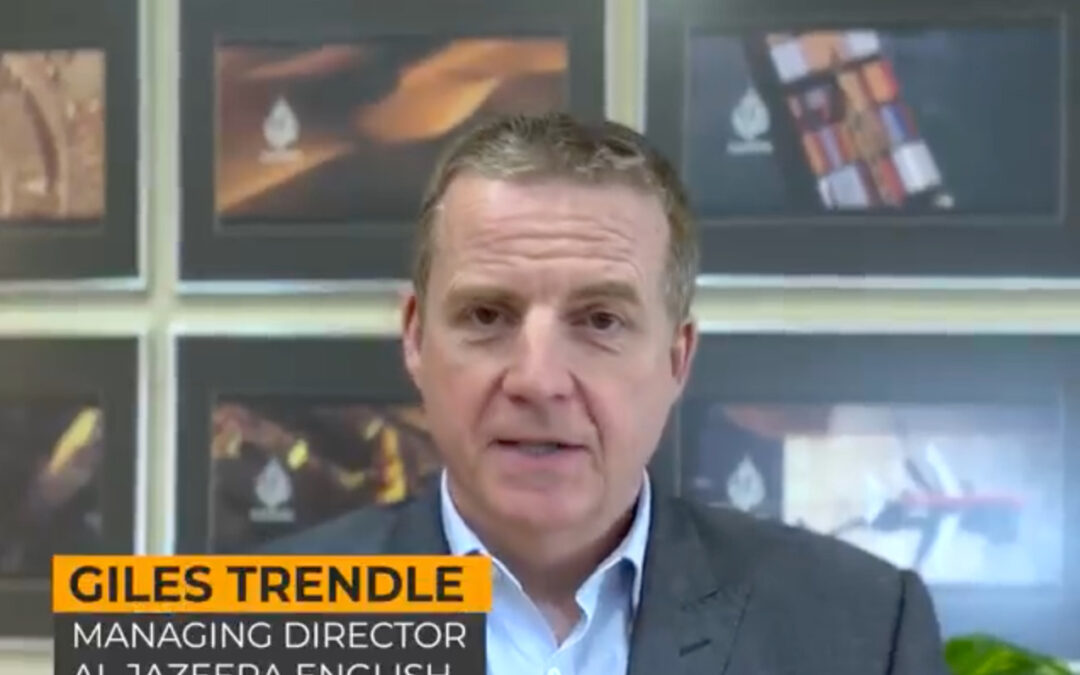
In the run-up to Earth Day on 22 April and World Press Freedom Day on 25 April, Giles Trendle, Managing Director of Al Jazeera English, has released a video talking about the vital importance of journalism.

“Journalists have a critical role to play in covering the climate emergency,” says Trendle. “Yet journalists cannot play this crucial civic role if our reporters are being killed, our offices bombed, and our freedom to publish and broadcast trampled.”

Watch the video here:


France 24: 2022 Presidential Election 2nd round coverage

France 24: 2022 Presidential Election 2nd round coverage

France 24: 2022 Presidential Election 2nd round coverage

French voters will go to the polls to choose between Emmanuel Macron and Marine Le Pen for the second round of the Presidential Election on April 24.

During the election campaign, France 24 has brought extensive, multi-platform coverage of the candidates, the race, and the issues. On election night for the second round, France 24’s English language channel and website has mobilised its journalists and resources to provide global coverage of this important event in an evening of special programming.

On Live | 1700 to 2230 GMT: special edition

From 1700 to 2000 – Presented by François Picard and Marc Perelman. For three hours, France 24 will closely follow the second round of this election with its team of reporters and political guests and go live from the two candidates’ campaign headquarters. François Picard and Marc Perelman will be joined by France 24’s correspondents on the scene and around the world to analyse, discuss and dissect the latest numbers and key issues of the election. 

From 2000 to 2230 – Presented by Genie Godula. Polls will be closed but France 24’s special coverage continues. Joined by a team of reporters from around the world and political analysts, they’ll take a deep dive into the result of the presidential election and the different consequences for France’s foreign policy for the next five years. 

France 24 will offer rolling election coverage: reports plus exclusive developments can be found on france24.com and on the channel’s mobile application.

ABC Global Affairs Editor named

ABC Global Affairs Editor named

ABC Global Affairs Editor named

John Lyons, one of Australia’s leading journalists and most experienced foreign correspondents, has been appointed ABC NEWS Global Affairs Editor. 

Lyons will contribute expert analysis and reporting across all platforms and enhance on-the-ground coverage of the biggest world stories.  

He will also help mentor the next generation of talented correspondents coming through the organisation.  

ABC NEWS currently has correspondents deployed in Bangkok, Beirut, Istanbul (from May 2022), Jakarta, Jerusalem, London, New Delhi, Port Moresby, Taipei, Tokyo and Washington. 

Director, News Justin Stevens: 

“International reporting is one of the core services the ABC provides to our audiences. Our correspondents make sense of the key overseas events and issues from an Australian perspective and analyse how they impact us at home. 

“We have an outstanding group of correspondents and John will add more than four decades of experience as a journalist. 

“He is the perfect person for the role.” 

Lyons, a former Editor of The Sydney Morning Herald, joined the ABC in August 2017 as Head Investigative and In-depth Journalism, leading ABC NEWS’s current affairs teams at 7.30, Australian Story, Four Corners, Q+A, InsidersForeign Correspondent and the Investigative Reporting Team.

Previously he has worked as a foreign correspondent based in Washington, New York and Jerusalem for a range of media outlets. 

Lyons will take up the new role in June, following the federal election. 

John Lyons: 

“For 90 years the ABC has reported and analysed events around the world for an Australian audience. It is therefore a great honour for me that, after 40 years in journalism, I have the opportunity to join the ABC’s international team. 

“Parts of the world today are as precariously poised as they’ve been since World War 2. If a year ago someone had said that in 2022 we would have another war in the heart of Europe and Vladimir Putin would order his nuclear capability be put on high alert few people would have believed that possible. 

“I would like to acknowledge the ABC’s new Director of News Justin Stevens for deciding in his first two weeks to boost the ABC’s international coverage.”  

ABOUT JOHN LYONS 

A three-time Walkley Award winner, John Lyons has reported at home and abroad across four decades.   

His first major foreign assignment was reporting on the fall of former Philippines President Ferdinand Marcos in 1986, going on to co-author a book about the dramatic fall of the corrupt regime, Marcos and Beyond 

In 1991 he was posted to New York for The Sydney Morning Herald and later to Washington for The Australian, covering the election and inauguration of Bill Clinton, the early days of the Clinton administration and the beginning of the Oslo peace accords.  

In 2009 Lyons was posted to Jerusalem as the Middle East Correspondent for The Australian. From there he covered stories including the rise and violent downfall of the Arab Spring, the end of the Gaddafi regime in Libya, the collapse of the Mubarak regime in Egypt and the attempt by ISIS to take Baghdad.

He reported on three wars between Israel and Hamas in Gaza and the “Green Revolution” in Tehran, which was brutally put down by the Iranian regime. While based in Jerusalem, he also won three United Nations human rights awards and wrote the book Balcony Over Jerusalem: A Middle East Memoir. 

From the Middle East he won the Walkley Award for investigative journalism for a report for Four Corners. His other awards include the 1999 Graham Perkin Award for Australian Journalist of the Year for his outstanding reporting on national affairs for The Bulletin 

His other previous roles include Associate Editor (Digital Content) at The Australian and Executive Producer of the Nine Network’s Sunday program.  

DW Akademie: Afghan media sector faces economic collapse

DW Akademie: Afghan media sector faces economic collapse

DW Akademie: Afghan media sector faces economic collapse

DW Akademie and its partners have just finalised a piece of research into the state of the media in Afghanistan. 175 respondents answered an online questionnaire.

The report, Afghan media sector faces an imminent economic collapse, can now be accessed on DW Akademie’s #mediadev web resource:

https://www.dw.com/en/afghan-media-sector-faces-economic-collapse/a-61327013

It focuses on the financial situation of media houses and sheds light on reporting restrictions and the situation of journalists.

Respondents shared their clear recommendations for the support of media and media professionals in Afghanistan by international actors.

The survey results were discussed in February 2022 in the Media Freedom Talk Six Months after the Fall of Kabul, organised in cooperation with Reporters Without Borders. The video of the event is available to view here:

https://www.dw.com/en/media-freedom-talks-journalism-in-afghanistan/a-60631440

Image: Flickr – The U.S. Army – Radio station gives voice to remote mountain province.jpg

CBC/Radio-Canada secures broadcast rights for Olympic Games from 2026 to 2032

CBC/Radio-Canada secures broadcast rights for Olympic Games from 2026 to 2032

CBC/Radio-Canada secures broadcast rights for Olympic Games from 2026 to 2032

The International Olympic Committee (IOC) has announced that CBC/Radio-Canada, Canada’s national public broadcaster, has secured the exclusive broadcast rights in Canada for the following Olympic Games: Olympic Winter Games Milano Cortina 2026, Los Angeles 2028, Olympic Winter Games 2030 (the host of which is yet to be selected) and Brisbane 2032. 

Including the Olympic Games Paris 2024, for which the public broadcaster has already been awarded the rights, CBC/Radio-Canada will continue to serve as Canada’s Olympic network for the next five Olympic Games.

“The Olympics are the culmination of so many athletes’ dreams. As Canada’s public broadcaster, we’re proud to share their journey, from local competitions across the country all the way through to national and world championships throughout the year. It’s an honour to be able to continue sharing these great stories with Canadians for years to come.” 

– Catherine Tait, President and CEO, CBC/Radio-Canada

“We are proud of our partnership with CBC/Radio-Canada and delighted to be able to continue working together for another decade at least. This agreement demonstrates a commitment to the Olympic values, the Olympic Games and the development of sport. This agreement will support athletes at all levels in Canada and around the world.” 

– Thomas Bach, President of the International Olympic Committee

CBC/Radio-Canada has acquired rights across all media platforms, including television and digital. The agreement includes a commitment to broadcast at least 200 hours of the Olympic Games and 100 hours of the Olympic Winter Games on free-to-air television.

 Chris Wilson, executive director of CBC Sports, said it was exciting that the Olympic partnership, which he said was in discussion for a “long time,” was finally official.

“It’s the biggest thing we do as a company. It draws the biggest audiences. It is one of the most relevant things we do that brings the country together,” Wilson said. “And so I really believe it just sort of cements, as part of our mandate, a really major programming pillar for the company as a whole.”