Iran jamming Eutelsat – again

Iran jamming Eutelsat – again

Iran jamming Eutelsat – again

Following the anti-government protests that flared up following the death of 22-year-old Mahsa Amini in Iranian police custody last month, the Iranian authorities appear to be stepping up their efforts to restrict information coming into the country.

Satellite operator Eutelsat reports that it has been suffering jamming on two of its satellites since 26 September. These attempts at causing deliberate harmful interference are affecting the transmission of a number of TV and radio channels that provide services to Farsi-speaking audiences in Iran. The jamming affects other channels that are not targeted towards Iran as well.

Eutelsat says that it has carried out research using a specially designed interference detection system. The result show that the source of the jamming transmissions is within Iran.

Eutelsat says that it has “decided to take action simultaneously along two main lines: on the diplomatic front, and using all appropriate national and international procedures, Eutelsat has immediately notified the relevant authorities in the Islamic Republic of Iran, demanding that the harmful jamming operations be immediately and permanently stopped. Eutelsat has also reminded the relevant Iranian authorities that intentional jamming is explicitly prohibited by the International Telecommunication Union (ITU) Radio Regulations.”

Broadcasters such as London-based Iran International say that their transmissions have been affected by the illegal jamming by the Iranian authorities.

Iran has employed satellite jamming for many years in the regime’s attempts to limit access to free and impartial information getting into the country. In spite of their efforts, audiences for Farsi-language channels from outside the country continue to grow as viewers and listeners find ways to circumvent their government’s efforts.

The AIB will be monitoring the situation and taking action on behalf of its Members affected by the illegal jamming of their signals.

Read more: the AIB’s brief history of jamming


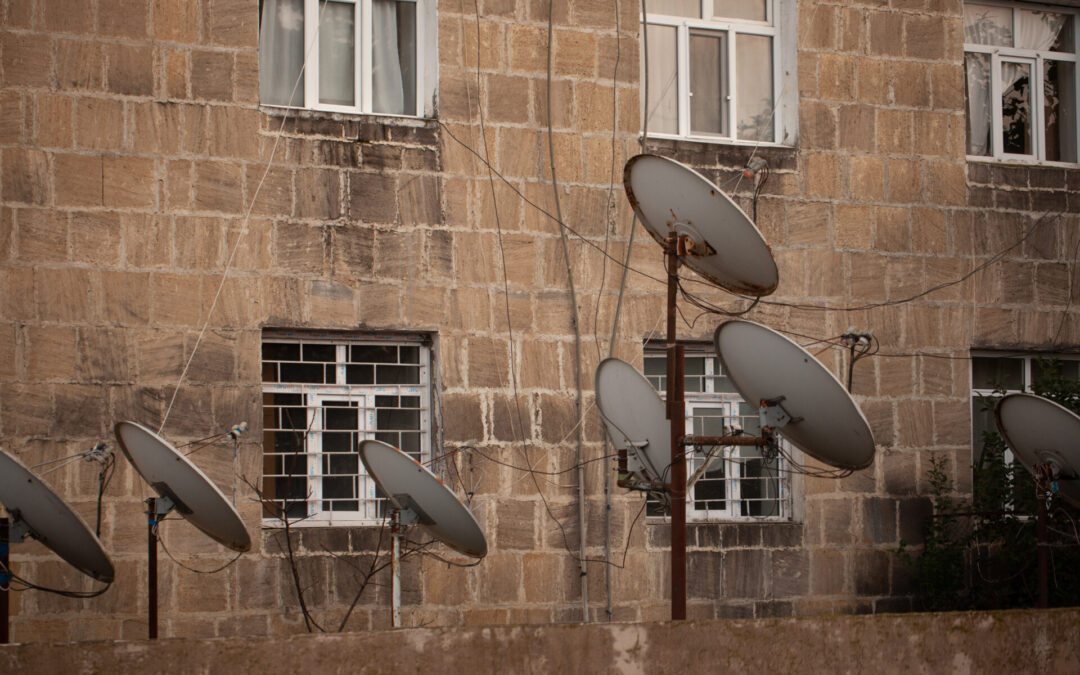
Photo: satellite antennas on roofs in Iran 

The DPP becomes an independent organisation

The DPP becomes an independent organisation

The DPP becomes an independent organisation

Building on its success as a membership organisation, the DPP has announced plans to become fully self-sufficient. The founding shareholder members, BBC, ITV and C4 will relinquish their Board positions and revert to normal DPP membership.

This change in control acknowledges the evolution of the DPP since it was founded in 2015. It has fulfilled its original purpose of helping to accelerate the transition of the media industry to file-based digital working, and has now become an international membership organisation providing strategic insight and a huge range of events, as well as facilitating technical collaboration.

To support this strategy, the Board has appointed two new Non-Executive Directors. The first is Sadie Groom, Founder and CEO of Bubble, a global PR, Events and Marketing Agency, and also the Founder of Rise – a group for gender diversity in media technology. The second is Danny Meaney, Founder and CEO of UP Ventures Group.

Other DPP Board members will be existing Non-Executive Director, Emma Springham, CMO of TSB Bank; DPP CEO Mark Harrison; DPP CTO Rowan de Pomerai; and DPP COO Kelvin Jones. The Board will continue to be Chaired by Helen Stevens, Operations Officer for Content & Delivery at ITV through the transition before a new Chair is confirmed later this year.

“The BBC, ITV and Channel 4 are proud of the contribution they have made to the media and entertainment industry by helping to found and guide the DPP” says Helen Stevens. “Now is the moment for the DPP to fully explore its potential as a global membership organisation that can deliver value to any company that works with audio visual content.”

“We feel privileged that each day we get to work with an incredible range of companies from across the whole media supply chain, and from around the world,” added Mark Harrison. “It is their input that enables us to keep evolving and refining our work so that we meet our aim of being a valued, independent, and expert resource in a constantly changing market.”

The DPP is currently delivering major insight work around the future of news production, the role of standards, innovation in localisation, and how to build more effective relationships between customers and suppliers. Its Leaders’ Briefing conference will take place in London on 16-17 November; and it will hold further conferences in Berlin in March 2023 and New York in June 2023.

[Source: The DPP press release 3 October 2022]
Arqiva and MediaKind launch Arqplex head-end service

Arqiva and MediaKind launch Arqplex head-end service

New headend-as-a-service simplifies content processing for broadcast and OTT networks

Arqiva and MediaKind have announced the next stage of their pioneering partnership with the launch of Arqplex, a new hybrid content processing service that is set to transform headend services for broadcast and OTT networks.

The fully managed headend-as-a-service has been designed and developed for a broad range of broadcasters and network or platform operators, including leading global, regional, and national broadcasters and regional cable and satellite network operators.

The Arqplex service provides secure and reliable content aggregation, encoding, multiplexing and packaging for content distribution and will unify OTT and broadcast operations, reducing complexity, increasing efficiency and delivering rapid speed to market for customers.

About Arqplex

Arqplex is underpinned by decades of experience in broadcast and broadband services for tier-one service providers. The partnership combines MediaKind’s cloud-native multiplexing, encoding, and packaging headend media processing technology delivering globally renowned content quality and distribution reliability with Arqiva’s expertise in systems integration, connectivity, and managed services. Arqiva’s operational teams fully manage and monitor the service, bringing real economies of scale to headend operations.

Through MediaKind’s cloud-native headend software, Arqplex will deliver broadcast-grade service levels to OTT operations. The service utilises Arqiva’s global content network to collect content from any source, whether satellite, fibre, cloud, or the internet.  It also includes options to manage ad insertion and catch-up functionality for customers.

The highly scalable and flexible Arqplex service is built on a cloud-based subscription model, removing the need for large capex investment in the latest technology advances. Customers can have technology upgrades and patches securely applied as soon as they are available, removing the need to source and install updates.

Media service providers can use AWS public cloud, an alternative cloud provider or Arqiva’s UK-based datacentres. Where customers opt for cloud processing, operations can be sited in the region most appropriate for their services. The Arqplex service also integrates seamlessly with other products across the Arqiva portfolio.

The existing Arqplex roadmap will be extended further, with Arqiva and MediaKind integrating a range of partners to expand the service’s capabilities. Arqiva has already begun the process of migrating existing headend customers to the new headend-as-a-service offering.

Arqplex will radically simplify the headend operations of broadcast and OTT operators, enabling them to focus on growth. The ways in which content is consumed, and the content itself, have become increasingly diverse in recent years. At Arqiva, we’re embracing cloud technology to remove hassle and empower agility for our customers, so that they can meet the needs of their consumers. We’ve already begun the process of migrating existing headend customers to the new headend-as-a-service offering. We’re excited to be leveraging our partnership with MediaKind once more, building on our cloud-migration proposition.

Shuja Khan, Chief Executive Officer, Arqiva

NHK WORLD-JAPAN debuts on Freeview UK

NHK WORLD-JAPAN debuts on Freeview UK

NHK WORLD-JAPAN debuts on Freeview UK

NHK WORLD-JAPAN launches on Freeview channel 271 via the Channelbox platform.

NHK WORLD-JAPAN, the international English-language channel from Japan’s public broadcaster NHK, delivers to the world the latest information about Japan and Asia. This channel reaches over 380 million households in 160 countries and regions via local satellite and cable TV providers.

NHK WORLD-JAPAN is available in the UK on Sky and Freesat and now became available also on Freeview, channel 271 bolstering the Channelbox news category which includes Bloomberg, Euronews, France24, TVP World and many other international news channels.

“NHK is a window to Japan and Asia and this TV channel is a perfect addition to the Channelbox and Freeview lineup of news channels”, said Tanya Kronfli, Head of Channelbox content and business development.

Channelbox is a multi-channel platform available on connected Freeview, channel 271, and Channelbox mobile applications.

Channelbox is free-to-air and has over 60 TV channels including Euronews, Fashion TV, NTD, France24, Fuel and many others.

France 24 | September programme highlights

France 24 | September programme highlights

France 24 | September programme highlights

France 24 has announced the highlights of its September output across the English-language service

Beyond the News | Reporters

Central Africa, under Russian Influence | September 10 | 1710 GMT

As the world watches the war in Ukraine, Russians are carrying out another fight, in Africa. Since 2017, the mercenaries of the Wagner Group, a Russian secret army have set up their base in the Central African Republic. They protect the regime in exchange for mineral resources and deploy aggressive propaganda to cover up the massacres, rapes and torture they are accused of. 

Taking advantage of France’s loss of influence in its former colony, torn apart by decades of a deadly civil war, Russia has turned the country into the laboratory of a new information war. Using education, cinema, and even vodka. 


France, by France 24 | 

Champollion: The Man who Cracked Hieroglyphics | 9 September |1545 GMT

On 14 September 1822, Jean-François Champollion became the first Egyptologist in the world to crack the mystery of hieroglyphics. With support from his brother, he led the way in the study of ancient Egypt, lifting the veil on 1,500 years of history. In this special edition, “France in Focus” travels to Vif, in Isère, to follow in the footsteps of the “child prodigy” who would become the first head of the Louvre’s department of Egyptian antiquities. 


Iran International leads popularity stakes

Iran International leads popularity stakes

Iran International leads popularity stakes

Foreign-based Persian-language broadcasters dominate the news and information market in Iran, according to an article in Shargh Daily, a relatively independent and reformist newspaper in Iran.

The article, published on 8 August, calls for the Iranian government to be more tolerant of media and criticism, pointing out that Iranian citizens turn to international TV news services for day-to-day information.

BBC News Persian, Iran International, Manoto and VoA Persian News Network are influential, “with Iran International getting ahead by employing anchors and journalists who left Iran and having an impact on public opinion in the country.”

The article’s author, Ghader Bastani, writing on Iran’s Journalist Day, urged the government to give freedom “as the most effective way to fight corruption and improve government efficiency.”

According to a survey carried out by the Netherlands-based Gamaan agency in 2021, Iran International had the highest audience for TV news in the country, at 33% daily audience, while Manoto TV rated at 30%. BBC News Persian ranked at 17%, Turkey-based Jam TV at 16.5% and Persian News Network operated by Voice of America at 11%. Iranian state TV ranked at 16%, according to the survey.