
18 November 2016
 The AIB is pleased to announce its first #iamabroadcaster Technology Masterclass in association with IABM.
This new event, taking place immediately before the IABM’s Annual Conference, aims to highlight the use of technology in creating, producing and delivering programming to consumers. It will also explore the mission-critical issue of cyber security in broadcasting, and look at the important work being done in digitising media archives to protect nations’ audio-visual history.
The event venue is the Radisson Blu Edwardian at London Heathrow. The half-day Masterclass is open to Members and non-members of both the AIB and IABM.

The cost for Members of either organisation is £55 per person. For non-members the charge is £80 per person.
AGENDA
0900 Registration
0930 Welcome and introduction
0940 Keeping the lights on
The threat of cyber-attacks against high value targets in the media industry has never been greater. In addition to the high profile attacks on Sony and TV5 Monde, broadcasters and other companies playing a vital role in the production and distribution of content throughout the world continue to be targeted by criminal gangs and rogue states.
The Association for International Broadcasting has been working to ensure that its Members are able to share information and expertise in a confidential forum to help minimise risk and ensure that networks remain on the air.
Taking part in a discussion that will explore the challenges and the way that technology suppliers can help ensure that programmes remain on air will be Jonathan Farrell, Head of Information Security at Arqiva and James Stubbs, Business Development Manager at Babcock MSS. Both have first-hand experience of how to make broadcast infrastructure resilient against attack and the need for all parts of the industry to act together to make sure that the attempts to take broadcasters off air, or to infiltrate their playout systems and online services, are stopped in their tracks.
1030 Coffee
1100 Content worth keeping
Preserving the past for the future – Private Engineering Office, Qatar
Although it’s a relatively young country, Qatar has an extensive analogue library of TV programming and film. In its original format, the content is inaccessible. That’s why the Qatari government has implemented what may be the world’s most concentrated and comprehensive digitisation project. It aims not only to preserve the content but also to analyse the material, employing historians to tag the programming and then to make it easily accessible for citizens and scholars, now and in the future.
In this session, we’ll learn about the project and how it has been implemented. We’ll find out whether the systems developed in Qatar can be replicated elsewhere as the world’s audio-visual history cries out for preservation against a backdrop of obsolescent formats and rapidly deteriorating archives.
Sanjay Salil, Managing Director of global media services company MediaGuru will explain the work that has gone into the Qatar project.
1140 Enabling story-telling
How is technology enabling story-telling? Is the equipment that’s available today meeting all the editorial requirements of programme makers? In an environment where consumers are always on and want content delivered anytime, anywhere, can technology companies deliver what’s demanded by journalists, editors, producers and directors? In a wide-ranging discussion involving key players working at the sharp end of live broadcasting, we’ll also hear from consumers in Europe, North America and the Middle East about the way they choose content and the means of consumption. Expect some surprises along the way.
Martin Davies, Founder of Between the Posts Productions will be in conversation with Wesley Dodd, CEO of Celebro Studios.
1240 Close
1300 Networking lunch
10 November 2016
The Association for International Broadcasting has presented its Founders Award to Abdul Rahman Ramadhan
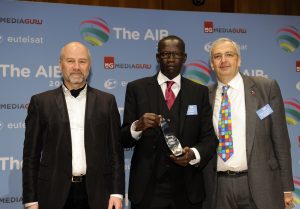
Abdul Rahman Ramadhan (centre) receives the AIB Founders Award from Alexey Nikolov, Chairman of the AIB Executive Committee and Managing Director, RT (left) and Simon Spanswick, Chief Executive, AIB (right)
Abdul Rahman Ramadhan started work in 1980. It wasn’t a typical career for someone living in Nairobi’s Kibera slum. He graduated from the local madrasa and chose the profession of sound, landing a job at the Camerapix news agency run by Mohamed Amin in the Kenyan capital.
He honed his skills on the job, working with the standard location sound kit of the time – a Nagra reel-to-reel tape recorder. Those skills, which would be developed over the following three and a half decades, have brought the world sound from across Africa.
For Abdul has recorded the sound that has accompanied TV news reports from many of Africa’s most troubled places and challenging events. His first truly dangerous assignment was the civil war in Sudan in 1992. This was the first war zone that the young sound man had experienced. Along with the other Camerapix team members, Abdul dodged bullets from soldiers and bombs dropped from Antonov planes. He slept among the dead to avoid detection – a certain route to death.
Soon after, he accompanied Mo Amin to Ethiopia which was in the grip of the worst famine to hit the country in a century. It was the pictures and sound captured by Mo Amin and Abdul for the BBC and other organisations of the plight of tens of thousands of starving people led to the establishment of Live Aid. Bob Geldof saw the report that Michael Buerk filed for the BBC and was so moved that he organised Band Aid that recorded the global hit “Do They Know It’s Christmas?”, followed in 1985 by Live Aid.
In 1994, with his wife pregnant with their second child, Abdul was sent by Mo Amin to Rwanda where the genocide had started. There Abdul and the Camerapix team witnessed many of the atrocities that occurred during the 100 days of the genocide. It was the first time that Abdul had seen tens of people being killed at the same time. In Somalia, it was just one killing a day, he recounts. In Rwanda, Abdul saw gangs killing ten people or more at a time, all in the most horrific ways.
He’s covered stories in his native Kenya, too, including the election violence in 2008. The two main tribes in the country fought running battles and up to 1,500 people died in the violence, with half a million or more displaced. Abdul was on hand, recording the sounds of battle on his own home turf.
Abdul is sanguine about the risks to his own life, saying that when his time is up, that’s just the way it is, however his life should end.
His wife supports him, despite not knowing if Abdul will come back from his latest assignment. She knows that capturing the sound that tells the most important stories is in Abdul’s blood, and that it is far more than just a job.
Sound is Abdul’s passion. Over the past 35 years, he has brought us some of the most momentous moments from Africa’s recent history.
Abdul shows no sign of hanging up his microphone. The Association for International Broadcasting is proud to recognise the work that Abdul has undertaken to help bring us the stories from Africa that need to be told. The AIB Founders Award pays tribute to a remarkable man – the Sound Man Abdul Rahman Ramadhan.
3 November 2016
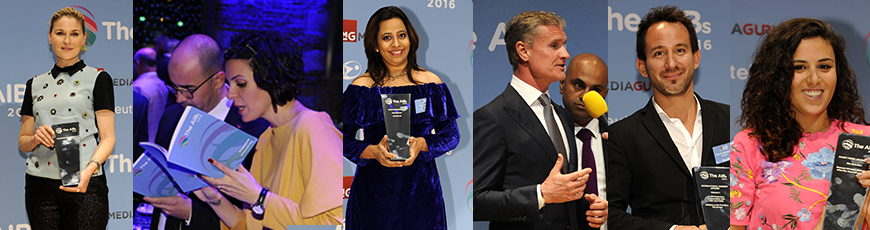
12th annual AIBs reward factual programme makers from across the world
The 12th annual awards for factual television, radio and online productions – known as the AIBs – were awarded at a glittering gala dinner in London on Wednesday 2 November hosted by Mark Barton, anchor on Bloomberg Television. Sponsors of the AIBs 2016 include global satellite communications company Eutelsat and broadcast consultants MediaGuru.
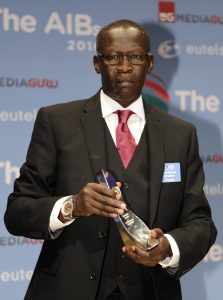 As well as rewarding programme makers, the Association for International Broadcasting presented its Founders Award to Abdul Rahman Ramadhan (right) who for more than 35 years has been an unsung hero of news and documentary-making in Africa. He is “The Sound Man” who, working for Camerapix alongside the late legendary photojournalist Mohamed Amin, captured the sounds of war, famine and genocide across Africa. Abdul was the sound recordist who worked with the BBC’s Michael Buerk, who brought news of the Ethiopian famine into homes around the world. This led to the creation of Band Aid and the global Live Aid pop concert. “We are delighted to have the opportunity to recognise the work of Abdul Rahman Ramadhan,” said Alexey Nikolov, Managing Director of RT and Chairman of the AIB’s Executive Committee. “He has worked tirelessly in the most challenging of situations to bring the sounds that illustrate the news to viewers across the world. He has put his life in danger on many occasions and yet shows no sign of hanging up his headphones. Abdul is a worthy recipient of the important AIB Founders Award.”
Alongside the presentation of the Founders Award, the global panel of judges of this year’s AIBs rewarded programme makers in 14 countries, ranging in size from an Argentinian radio station to major TV networks such as the BBC.
Key themes among the entries were the migrant crisis in Europe and in particular the effects on children. There were also a range of productions covering issues around so-called ISIS, including the radicalisation of youth in western European countries. The judges praised the work of nominees, describing productions variously as “bold”, “engaging”, “compelling” and “comprehensive”.
The Association’s Innovation award was presented to the Private Engineering Office of Qatar for its ground-breaking TV and film archiving project that is preserving Qatar’s audio-visual archives on a scale unmatched anywhere in the world.
“We had the largest crop of entries in the 12-year history of the AIBs,” commented Simon Spanswick, chief executive of the Association for International Broadcasting. “Work from broadcasters and production companies on every continent was considered by our shortlisting team. Then our experts in the international jury evaluated which work was the best of the best. Some of the decisions were immensely close as the programmes we saw and heard in the shortlist were all of the very highest standard.”
With results in 17 categories ranging from news journalism to children’s factual, sport to investigate documentary, the AIBs cover the entire range of factual TV, radio and online production genres. There is an overall winner in each category and there are also special commendations that the judges said represented excellent work.
The list of winners appears below.
The AIBs open for entry again in April 2017.
Winners list
TELEVISION JOURNALISM – sponsored by MediaGuru
Winner – The Children of War – BBC News
Highly commended – Desperate Journey – PBS NewsHour
Highly commended – Paris Terror Attacks – CNN
RADIO JOURNALISM
Winner – Burmese Election Special – BBC Burmese
DOMESTIC CURRENT AFFAIRS
Winner – My Son the Jihadi – True Vision Productions for Channel 4
Highly commended – My Jihad – VRT
Highly commended – Chemsex – Vice
RADIO CURRENT AFFAIRS
Winner – ISIS: Young, British and Radicalised – Snappin’ Turtle Productions for BBC Radio 1
Highly commended – Corruption K: Cristina in the Dock – Radio Mitre
Highly commended – Alvin Hall Goes Back to School – WNYC & Public Radio International
SHORT FEATURE
Winner – On Assignment – Vicky’s Story – ITV News and MediaZones
Highly commended – Right to Fight – The Guardian
Highly commended – Winners – BBC World Service
SPECIALIST
Winner – It Ends with Murder – The Body in the Freezer – Danish Broadcasting
Highly commended – The Sound Man – Africa24 and Camerapix
Highly commended – The Special Needs Hotel – Lambent Productions
RADIO INVESTIGATIVE
Winner – Documentary on One: The Case That Never Was – RTÉ Radio 1
Highly commended – The Unfinished Story of Fighting FGM in Egypt – BBC Arabic
Highly commended File on 4 – Tennis – Game Set and Fix? – BBC/Buzzfeed
ONLINE
Winner – 6×9: A virtual experience of solitary confinement – The Guardian
Highly commended – Back in Touch – On Our Radar in partnership with New Internationalist
Highly commended – China’s Science Revolution – BBC News
SCIENCE
Winner – Iceman Reborn – Nova – WGBH
Highly commended – Secrets of the Brain – TERN International
INNOVATION
Qatar Private Engineering Office for the Old Films Archive Project
FOUNDERS
Abdul Rahman Ramadhan
CHILDREN’S
Winner – Checker Tobi – Bayerischer Rundfunk
Highly commended – Know Zone – The Mediae Company
SPORT
Winner – Formula 1 – Whisper Films and Channel 4
Highly commended – Rugby World Cup Final – ITV Sport
RADIO CREATIVE FEATURE
Winner – The Battle of Britain at 75 – TBI Media with Snappin’ Turtle Productions for BBC Radio 2
Highly commended – Growing Up Without a Dad – BlokMedia
SHORT FORM JOURNALISM
Winner – Brussels Divided: Molenbeek after the Terrorist Attacks – The Guardian
Highly commended – Syria: Witness to an Airstrike – CNN Worldwide
Highly commended – VTM News – Train of Hope – Medialaan
TV INVESTIGATIVE
Winner – ISIS: The British Women Supporters Unveiled – Channel 4
Highly commended – 101 East: Murder in Malaysia – Al Jazeera English
Highly commended – Spotlight – Selling Northern Ireland – BBC Northern Ireland
INTERNATIONAL CURRENT AFFAIRS
Winner – Children on the Frontline: The Escape – Channel 4
Highly commended – Kaos Hatti – Kos Island – TRT
Highly commended – We Love Gaza – RT
RADIO PERSONALITY
Viny Agrawal – MyFM 94.3, Indore, India
TELEVISION PERSONALITY
Hala Gorani – CNN International
13 October 2016

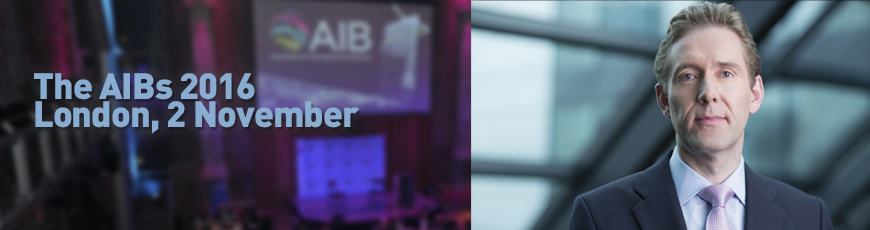
Mark Barton, Bloomberg Television’s longest serving presenter in Europe, the Middle East and Africa, is to host the AIBs – the twelfth international awards for the best factual television, radio and online productions.
Taking place in London on Wednesday 2 November 2016, the AIBs celebrate the work of producers, editors and journalists from around the world. Work from nearly 40 countries has been submitted to this year’s AIBs, and the shortlist includes work from major broadcasters, online video companies, newspapers and independent producers.
“I am delighted to have been asked to host this year’s AIBs,” said Mark Barton. “I have been amazed by the range and quality of productions that have been entered. I am looking forward to revealing who has won in this global competition and sharing in the celebrations of success.”
“It is great that Mark Barton has agreed to present this year’s AIBs,” commented Simon Spanswick, chief executive of the Association for International Broadcasting. “His experience in live journalism means he understands the realities of getting news to audiences in challenging situations. He also has consummate interviewing skills that will bring the best out of this year’s winners as they receive their prizes.”
Mark Barton played an integral role in establishing Bloomberg Television as a global financial and business news network. Mark has witnessed at first hand three global recessions and covered five UK general elections and five US elections.
Mark has travelled the world to interview more than ten thousand newsmakers. They’ve included Presidents, Princes, Prime Ministers, members of the US Federal Reserve and most of the global business elite. Among his personal career highlights are Microsoft founder Bill Gates and the late Israeli leader Shimon Peres.
The AIBs will be presented in London at LSO St Luke’s on 2 November 2016 in front of a truly global gathering of journalists, editors, producers and directors representing countries as diverse as Argentina, Denmark, India, France, Russia, the USA and the UK, among many others. Reserve places at theaibs.tv.
Eutelsat and MediaGuru are sponsors of this year’s AIBs.

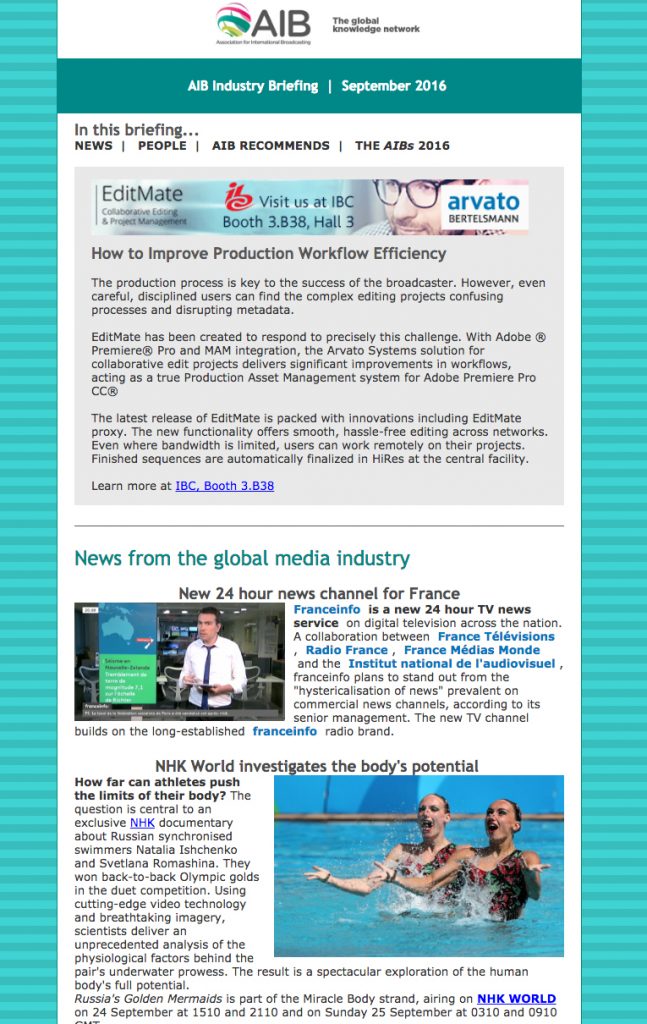 Read all about it…the latest international industry briefing from the Association for International Broadcasting has been published.