13 February 2017
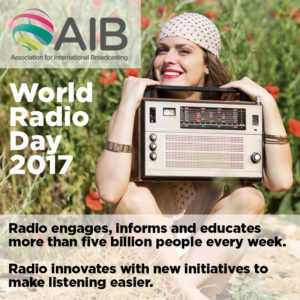 In the year since the last World Radio Day, the global radio industry has gone from strength to strength.
Some estimates suggest that today there are over 44,000 radio stations – large, medium and small – all over the world. It is believed that 75% of the planet’s population – about 5.6 billion people – listen to radio every week. That’s an impressive number and shows that radio, in all its forms, remains an important medium.
At the Association for International Broadcasting, we monitor developments in all sectors of the media industry, and the vibrancy of today’s radio industry continues to fascinate us. There continues to be remarkable innovation in the sector. New initiatives, such as radio.garden, have become viral internet sensations. Voice controlled devices, like Amazon’s Echo, place radio from around the world at the centre of people’s homes. World Radio Day 2017 marks the official launch of the dot radio top level domain that will allow radio broadcasters to harness the power of, and be more easily recognised on, the internet.
Of course, it is the engagement with listeners that is most exciting about radio, and the impact the medium has on people’s lives. Radio Free Europe/Radio Liberty, based in Prague, has collected anecdotes from some of its 13.5million listeners across Central Asia, Pakistan, Iran and Afghanistan. They talk of the impact that the broadcaster has on their lives and how RFE/RL has created a democratic space that benefits society.
“The work of radio members of the Association for International Broadcasting remains as important today as it has always been,” comments Simon Spanswick, chief executive of the AIB. “Whether it’s entertainment, news or documentaries, radio continues to engage, inform and educate listeners in every country on the planet. And we’re delighted to see exciting, relevant new initiatives that makes radio ever more accessible in today’s ‘always on’ society. Radio isn’t just important on World Radio Day – it’s on the air 365 days a year, touching people’s lives in a constantly increasing number of positive ways.”
The AIB’s Business of Radio book highlights the continuing relevance of the radio industry and showcases the work of some of the AIB’s Members around the world. Read it online here.
1 February 2017
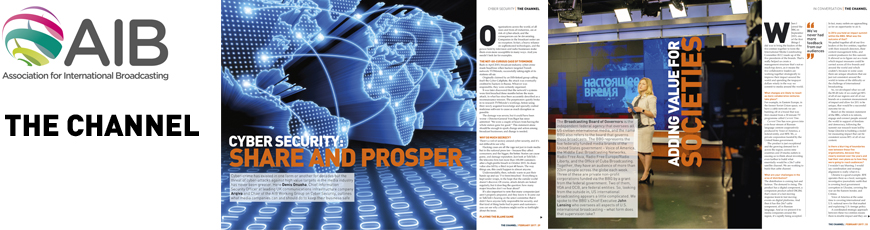
The latest articles in the AIB’s international media magazine, The Channel, are now available to read online or to download.
This month we focus on the ever more critical issue of cyber security and take a look at international broadcasting from the United States of America.
The chair of the AIB‘s Cyber Security Working Group, Denis Onuoha (CISO at Arqiva), talks about the need for all companies to focus efforts on protecting themselves from cyber attack. He also explains what is being done to ensure collaboration across the media industry.
We talk with John Lansing, CEO of the Broadcasting Board of Governors, about the way US international broadcasting is set up and how it is having an impact around the world.
Go to The Channel page of the AIB website to read these and other editions of the magazine
31 January 2017
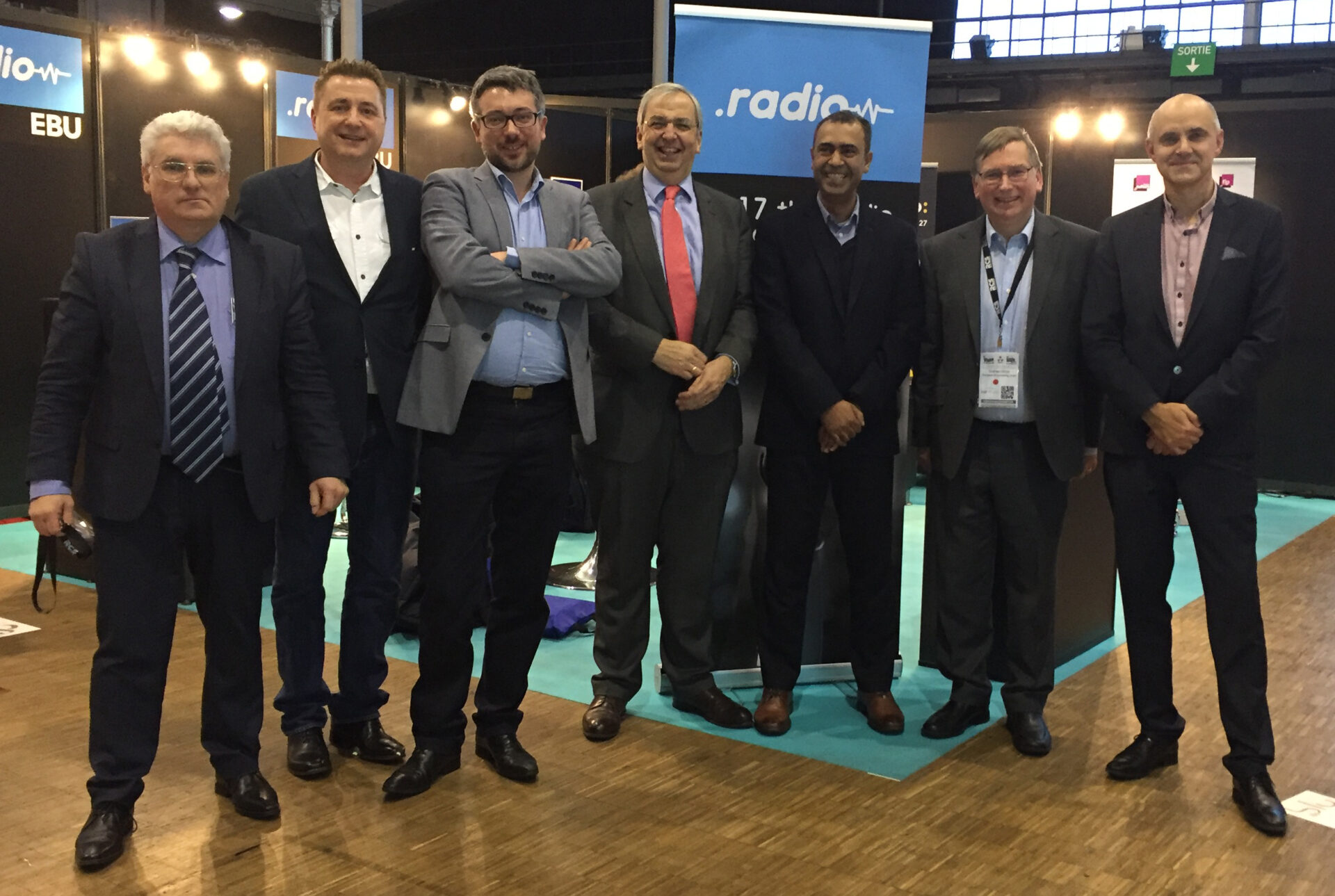
The Association for International Broadcasting has confirmed its commitment to supporting the .radio top level domain at the Salon de la Radio in Paris. The new .radio top level domain is a community-based domain that the AIB has supported throughout the application process, along with other broadcasting unions. ICANN granted the .radio domain last year, with the EBU as the principal organiser.
The first World .Radio Advisory Board meeting took place in Paris on 30 January where a range of issues concerning the launch of the top level domain were discussed. At the meeting, the President and Vice-Presidents of the Advisory Board were elected.
The AIB’s chief executive, Simon Spanswick, was elected President (centre in picture above); Nawaaz Doohkee, Head of Legal Affairs at the ABU (third from right) and Vincent Sneed, Director of Regulatory Affairs at the AER (third from left) were elected Vice Presidents.
“It is a great honour to be elected to lead the work of the World .Radio Advisory Board,” commented Simon Spanswick. “Along with my colleagues from other broadcasting unions and associations, we will be working to make the .radio top level domain a tremendous success across the radio industry. There has already been interest from broadcasters and from other organisations involved in the ever growing radio industry in making effective and creative use of this new top level domain. In the coming months as we move closer to the opening of registrations, we will be working to ensure that everyone involved in radio around the world has the opportunity to harness the power of .radio addresses on the Internet.”
For more information on the .radio top level domain, visit register.radio.
21 December 2016
 In 2017, a new top level domain (TLD) will be launched on the Internet for the global radio industry.
.radio is a Community TLD, led by a community of interest for the benefit of the entire radio community. The Association for International Broadcasting joined with other organisations around the world to support the .radio application to the Internet’s controlling body.
ICANN accepted .radio as a TLD to be administered by the world’s radio industry, administered by the EBU and supported by an advisory board. The board will convene at the end of January at which time its membership will be confirmed and the chair and deputy chair will be elected.
“The Association for International Broadcasting is delighted to be closely involved with the radio industry’s new top level domain,” says Simon Spanswick, AIB chief executive. “The Association will be working closely with the EBU and other partners involved in this exciting project that will offer radio broadcasters, web radio stations, radio amateurs and radio equipment manufacturers the ability to demonstrate their commitment to radio through their web address.”
More information for the AIB’s Members will be published over the coming weeks.
16 December 2016
If you attended the AIBs in November 2016, you might like to watch a short video with highlights from the event. And if you weren’t there, but want to know what the annual awards for factual TV, radio and online productions are like, here’s your chance!
Watch our highlights video here
We would love you to get involved in the AIBs 2017. Entries open in April, judging takes place in September, and the awards will be presented at our gala awards night on 1 November 2017 in London.
You can also sponsor the AIBs 2017. Full information in our partnership document, available here.
23 November 2016
20 years after the tragic and untimely death of Mohamed Amin, founder of Nairobi-based Camerapix, the Association for International Broadcasting pays tribute to the renowned cameraman.
Mohamed Amin was born on 29 August 1943 in Nairobi where he developed an interest in photography at school. He founded Camerapix company in 1963 in Dar es Salaam and moved the company to Nairobi three years later. During the 1970s, he became one of the most relied-upon African news photographers, reporting on wars and coups all through the continent. His pictures were often used by Western news media.
Amin’s most influential moment came when his photos, along with the reporting of the BBC’s Michael Buerk of the 1984 Ethiopian famine brought international attention to the crisis and eventually helped start the charity wave that resulted in Live Aid concerts.
Amin contributed exclusive photos of the fall of Idi Amin and of Mengistu Haile Mariam and was author of numerous books, including Journey Through Pakistan, Pilgrimage to Mecca and covered various themes such as East African wildlife and the Uganda railway.
A short film looking back on Amin’s life has been produced by A24 Media – run by Amin’s son, Salim – and Reuters. It will be screened at Newsxchange taking place in Copenhagen at the start of December.
