In the year since the last World Radio Day, the global radio industry has gone from strength to strength.
Some estimates suggest that today there are over 44,000 radio stations – large, medium and small – all over the world. It is believed that 75% of the planet’s population – about 5.6 billion people – listen to radio every week. That’s an impressive number and shows that radio, in all its forms, remains an important medium.
At the Association for International Broadcasting, we monitor developments in all sectors of the media industry, and the vibrancy of today’s radio industry continues to fascinate us. There continues to be remarkable innovation in the sector. New initiatives, such as radio.garden, have become viral internet sensations. Voice controlled devices, like Amazon’s Echo, place radio from around the world at the centre of people’s homes. World Radio Day 2017 marks the official launch of the dot radio top level domain that will allow radio broadcasters to harness the power of, and be more easily recognised on, the internet.
Of course, it is the engagement with listeners that is most exciting about radio, and the impact the medium has on people’s lives. Radio Free Europe/Radio Liberty, based in Prague, has collected anecdotes from some of its 13.5million listeners across Central Asia, Pakistan, Iran and Afghanistan. They talk of the impact that the broadcaster has on their lives and how RFE/RL has created a democratic space that benefits society.
“The work of radio members of the Association for International Broadcasting remains as important today as it has always been,” comments Simon Spanswick, chief executive of the AIB. “Whether it’s entertainment, news or documentaries, radio continues to engage, inform and educate listeners in every country on the planet. And we’re delighted to see exciting, relevant new initiatives that makes radio ever more accessible in today’s ‘always on’ society. Radio isn’t just important on World Radio Day – it’s on the air 365 days a year, touching people’s lives in a constantly increasing number of positive ways.”
The AIB’s Business of Radio book highlights the continuing relevance of the radio industry and showcases the work of some of the AIB’s Members around the world. Read it online here.
CCTV has disappeared as a brand from China’s consumer-facing international TV channels, replaced by a new name: China Global Television Network (CGTN). Overnight on 30 December, CCTV’s English, Arabic, Spanish, Russian and French channels were rebranded under the CGTN umbrella, while new mobile apps were launched.
According to the South China Morning Post, CCTV carried out the rebranding to “integrate resources and to adapt to the trend of media convergence”, with foreign language channels, video content and digital media falling under the new group.
This rebranding – and the new apps – are part of a continuing effort by China to project its soft power internationally. It is widely reported that billions of dollars are spent each year on China’s international television channels and on its cultural initiatives in markets globally.
In 2017, a new top level domain (TLD) will be launched on the Internet for the global radio industry.
.radio is a Community TLD, led by a community of interest for the benefit of the entire radio community. The Association for International Broadcasting joined with other organisations around the world to support the .radio application to the Internet’s controlling body.
ICANN accepted .radio as a TLD to be administered by the world’s radio industry, administered by the EBU and supported by an advisory board. The board will convene at the end of January at which time its membership will be confirmed and the chair and deputy chair will be elected.
“The Association for International Broadcasting is delighted to be closely involved with the radio industry’s new top level domain,” says Simon Spanswick, AIB chief executive. “The Association will be working closely with the EBU and other partners involved in this exciting project that will offer radio broadcasters, web radio stations, radio amateurs and radio equipment manufacturers the ability to demonstrate their commitment to radio through their web address.”
More information for the AIB’s Members will be published over the coming weeks.
Vietnam’s TV channels are following the lead of many Western networks with investments to produce more shows on YouTube, with most of them targeting young Vietnamese viewers, according to reports in the local press.
Vinh Long Television, which has four channels in addition to a channel on YouTube launched in 2014, is concentrating on documentaries and entertainment programmes with some success. From September 2014 to the end of this year’s first quarter, its YouTube channel attracted more than 295 million viewers, according to POPs Worldwide, a leading digital company and multi-channel network in Vietnam. Last year, THVL won the 2015 POPS Awards for its YouTube channel, which attracted the highest number of viewers.
Its biggest competitor is Vietnam Television‘s VTCTube, which launched in 2013. It offers dozens of theatre and music programmes as well as films produced by TV stations. VTCTube now attracts more than 80 million viewers, in a country of around 90 million (although individual programmes show “views” in the low hundreds on YouTube).
Today, Vietnam’s young TV producers and technicians are travelling to Singapore and South Korea to improve their skills and understand other TV and online markets.
These moves into the modern online world marks a change from a few years ago when Vietnam tried to restrict access to the TV market to foreign channels. The government’s attempts were ultimately unsuccessful, following extensive lobbying the AIB, among other organisations.
The Association for International Broadcasting (AIB) has today – 12 May 2016 – condemned the leaking of the personal details of thousands of journalists and media workers who have reported from eastern Ukraine and the support for the publication by member of the Ukrainian parliament.
Above – Simon Spanswick, AIB chief executive, interviewed on RT English
On 7th May, a group of hackers claimed on the website Myrotvorets (Peacemaker) that they had breached computers used by pro-Russian separatists in eastern Ukraine to keep track of journalists they had allowed to work in the region. The hackers published a database containing the names, affiliations, and contact information of more than 7,000 individuals. The database includes over 4,500 local and international journalists and media workers who have reported from the conflict zone.
According to the US based Committee to Protect Journalists (CPJ) the separatists have been collecting journalists’ contact information as part of an accreditation process even though their authority over eastern Ukraine is not internationally recognised.
The Ukrainian Prosecutor General’s Office on Wednesday announcedthat it had opened an investigation into the publication of the journalists’ names and contact information under article 171.1 of the Ukrainian Criminal Code, which covers “obstruction to journalism.”
The hackers wrote that they did not know what the consequences of their action would be, but added, “Be certain: It is important to publish the list because these journalists collaborate with terrorist guerillas.”
“The Association for International Broadcasting and its Members condemn without equivocation the publication of these data,” said Simon Spanswick, chief executive of the AIB. “The names and contact data of many journalists and news crews working for AIB Members – and hundreds of other agencies, TV channels, radio stations and newspapers – are included in the release. There is no excuse for releasing information of this sort. The journalists working in East Ukraine were there legitimately, reporting the situation for the benefit of audiences and readers throughout the world. Accusations that the journalists ‘collaborated with terrorists’ are completely unfounded and without any substance. We call on the authorities in Ukraine to take steps to have these data removed from the Internet and to prosecute those involved in this hack.”
Oksana Romanyuk, head of the Institute for Mass Information, a press freedom group in Kiev, told the CPJ that the hackers’ actions had remained largely unnoticed until Tuesday, when Anton Geraschenko, a member of Ukraine’s parliament, praised them on the social media site Facebook. Geraschenko suggested that Ukraine’s authorities should introduce specific actions to “counter Russian propaganda.”
Geraschenko’s recommendations included: “imposing control over broadcast programming and cable networks to prevent distribution of information that could destabilize Ukraine’s sovereignty and territorial integrity;” “imposing control over accreditation of reporters, specifically those from Russia;” “deportation of reporters found in breach of national laws;” and “developing legal and technical resources to block online content that incites to violence and destabilises Ukraine’s national security.”
Ukrainian and foreign journalists have condemned the publication of personal data of reporters, including those from the Ukrainian broadcaster Hromadske TV, the Moscow-based newspaper Novaya Gazeta, Polish daily Gazeta Wyborcza, the BBC, The New York Times, The Daily Beast, The Economist, and others. In a statement signed by 37 journalists and published on Wednesday 11th May, they rejected the description of the accredited journalists as “collaborators with terrorists” and demanded that the personal data leak be investigated by law enforcers, saying it violated Ukraine’s privacy laws, the nation’s constitution, and the European Convention on Human Rights
According to the statement, journalists started receiving threats by phone and email after the list was made public. The signatories said that by obtaining accreditation from the separatists, they were able to inform the public of the crimes committed in the area, including the downing of the Malaysian Airlines plane over the region in July 2014.
The journalists also said that in 2014 alone, at least 80 journalists were detained by eastern Ukrainian separatists in connection with their work and that some of them were tortured. They urged the hackers to remove the list from the Internet.
The AIB encourages the journalists and media workers on the list to take extra precautions for securing their email accounts and digital information.

 In the year since the last World Radio Day, the global radio industry has gone from strength to strength.
 In 2017, a new top level domain (TLD) will be launched on the Internet for the global radio industry.
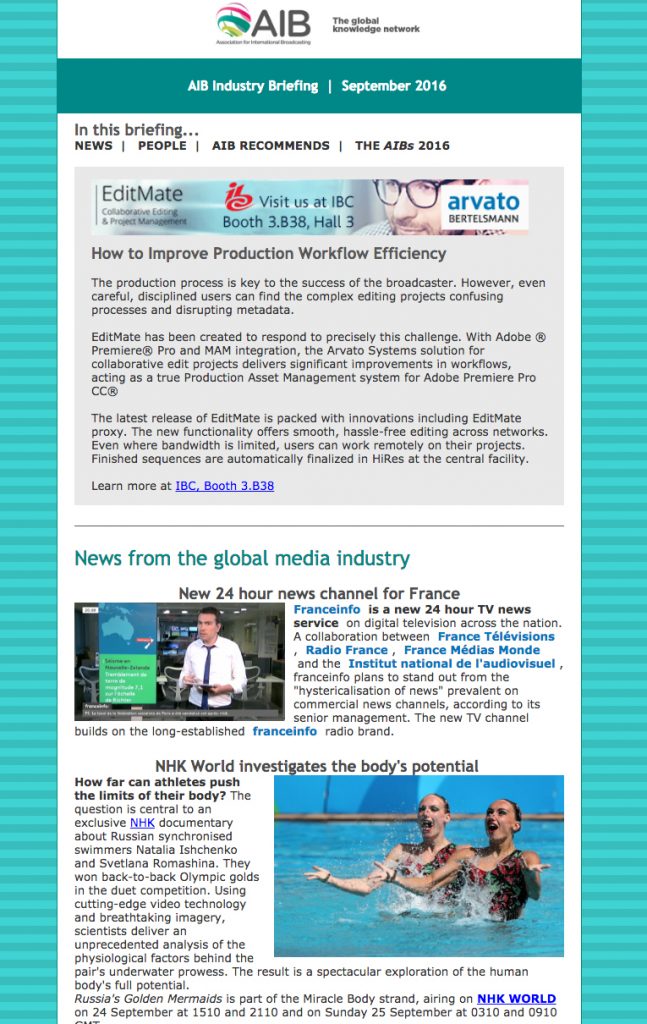 Read all about it…the latest international industry briefing from the Association for International Broadcasting has been published.