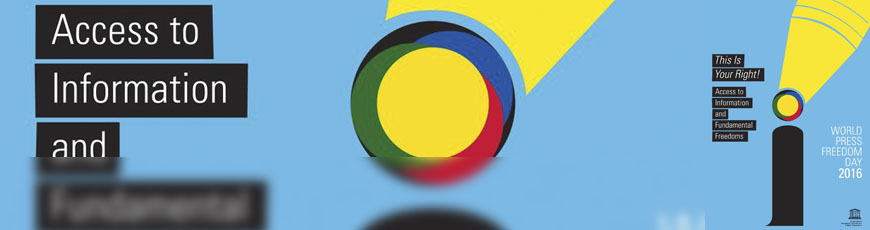
3 May marks World Press Freedom Day. The international day was proclaimed by the UN General Assembly in 1993 following a Recommendation adopted at the 26th Session of UNESCO’s General Conference in 1991. This in turn was a response to a call by African journalists who in 1991 produced the landmark Windhoek Declaration on media pluralism and independence.
Every year, 3 May is a date which celebrates the fundamental principles of press freedom; to evaluate press freedom around the world, to defend the media from attacks on their independence and to pay tribute to journalists who have lost their lives in the exercise of their profession.
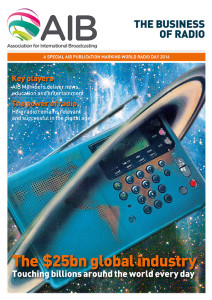
Radio, the oldest electronic mass medium, is in good health and well positioned for the future. That’s the message from the Association for International Broadcasting as World Radio Day 2016 is marked internationally.
“Radio generates revenues of well over US$25m every year,” comments Simon Spanswick, chief executive of the Association for International Broadcasting (AIB). “Radio is a major a generator of economic growth and employment – both in front of and behind the microphone. Every day, it touches the lives of billions of people, providing news, information, entertainment and education. At the AIB we’re delighted to join with our Members to celebrate the continued relevance and importance of radio on 13 February, the day designated by UNESCO as World Radio Day.”
The AIB is publishing a special souvenir book to demonstrate the value of radio internationally. ‘The Business of Radio’ provides insight into the radio industry and profiles Members of the AIB who operate radio networks and the service providers that keep radio on the air around the world.
‘The Business of Radio’ is being sent to opinion-leaders including parliamentarians and media regulators around the world to remind them of the key role that radio continues to play, even in the digital age of mobile apps and social media.
“The strength of radio is its ability to connect people in a way that other media cannot,” continues Spanswick. “At the AIB, we are delighted to see that our radio Members are reacting positively to the changes in media consumption habits. For example, they make sure that their programmes are available via multiple platforms, increasing their reach as they do. The AIB is pleased to be accompanying them on their journey into radio’s bright future.” or as a downloadable PDF at
‘The Business of Radio’ includes articles contributed by a number of the AIB’s Members, including the BBC, Broadcasting Board of Governors, RNW Media, Radio Taiwan International and DW. It is available in digital page-turning format at http://aib.org.uk/Resources/BizofRadio.html or as a downloadable PDF here.
Each year, the AIB publishes a calendar of media events around the world that we believe are worthwhile gatherings. The diverse list is constantly updated through the year, enabling you to keep on top of what’s happening in different markets globally, and where you and your colleagues should devote energy in seeing and being seen!
The British government has announced that it proposes to provide a grant of £34m [US$51.42m] between 2016 and 17, and £85m a year from 2017-18 for the expansion of BBC World Service.
The BBC currently reaches 308 million people worldwide, and its goal is to reach 500 million people by 2022. The BBC World Service reaches into some of the most remote places in the world, providing a link to the UK for individuals and societies who would otherwise not have this opportunity. We will invest £85 million each year by 2017/18 in the BBC’s digital, TV and radio services around the world to build the global reach of the World Service and increase access to news and information.
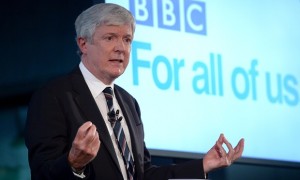
BBC Director-General Tony Hall commented on the news: “I warmly welcome today’s announcement. It’s fantastic news.
“This new funding is the single biggest increase in the World Service budget ever committed by any government.
“The millions announced today will help the BBC deliver on our commitment to uphold global democracy through accurate, impartial and independent news reporting.
“The World Service is one of the UK’s most important cultural exports and one of our best sources of global influence. We can now further build on that. The funding will also help speed us on to our target of reaching half a billion people globally.”
The new funding will allow the BBC to develop a range of services, including:
Enhanced TV services for Africa
New radio services for audiences in North Korea; radio and digital services for Ethiopia and Eritrea
Additional language offers via digital and TV in India and Nigeria
More regionalised content to better serve audiences to the BBC Arabic Service
Dedicated TV output for Somalia and a fully digital service for Thailand
Enhanced digital and TV services for Russian speakers, both in Russia and surrounding communities
A video-led digital transformation of Languages services
To expand the impact and future-proof World Service English
The BBC took over the funding of BBC World Service – including all radio services and foreign language television services, but not BBC World News – in April 2014. It had previously been funded by a “grant-in-aid” from the British Foreign Office [Ministry].
Radio Taiwan International has been broadcasting since the 1920s. Now it’s moving into the future with increased online and video activities supplementing its traditional radio offering. AIB chief executive Simon Spanswick visited RTI’s headquarters and talked with the broadcaster’s President, Weber Lai.
International Radio Serbia – or Radio Yugoslavia – has been closed down by the Serbian government. The move was first announced in April when the government published its media strategy and new law on public information which was adopted in 2014 and brought about the end of state ownership of the media or its funding.
During protests in April, a letter from the station’s staff was handed to Prime Minister Aleksandar Vucic which said: “Although the new media laws were adopted in 2014, we are certain there is a way for Radio Yugoslavia – International Radio Serbia to survive, being the only short wave radio station in the country, and whose broadcasts are reaching all continents. There is not a lot of us – less than a hundred – and before you solve our fate, check to see whether Germany has renounced on Deutsche Welle, Great Britain on BBC, the USA on the Voice of America, China on the China International, or Russia on the Voice of Russia. The situation is similar in Croatia, Bulgaria, Romania and Albania. Those are all radio stations financed form the state budget as their world service. Please consider those options and let someone speak to us before passing the decision to shut down the program in 11 languages, which offers exquisite possibilities for representing Serbia around the world. We sincerely believe you will find the way to hear our position and help us.”
The broadcaster, that had been on the air since the 1930s, had 12 language services and employed 96 staff, all of whom have lost their jobs according to reports coming out of Belgrade.
A statement on the radio station’s website says: “The Serbian government, however, believes that the closing down of Radio Yugoslavia – International Radio Serbia – is a justified move. Regardless of the fact that the state of Serbia is in an economic crisis, that each saved penny is precious, that many citizens have been rendered jobless, that new work positions should be opened, it has become unclear to the very end why the only state short-wave station has suddenly become too expensive after 80 years. We are, however, certain, that Serbian citizens, taxpayers, who have financed us for all these years, would have decided differently had they been asked to.”


 Each year, the AIB publishes a calendar of media events around the world that we believe are worthwhile gatherings. The diverse list is constantly updated through the year, enabling you to keep on top of what’s happening in different markets globally, and where you and your colleagues should devote energy in seeing and being seen!
 BBC Director-General Tony Hall commented on the news: “I warmly welcome today’s announcement. It’s fantastic news.