21 August 2017
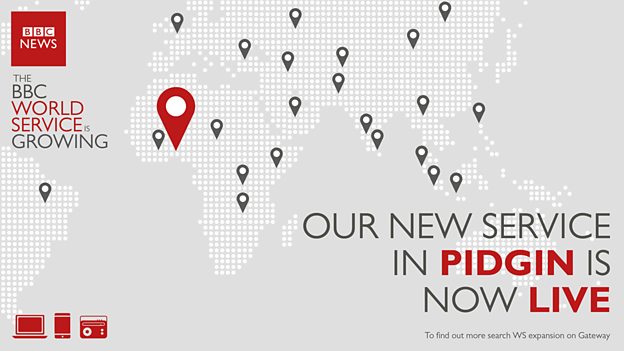
The BBC World Service launched its first new language service in its biggest expansion since the 1940s on 21 August.
A digital Pidgin service for West Africa has launched and will be followed by new online services in Amharic, Afaan Oromo and Tigrinya, aimed at Ethiopia, Eritrea and diaspora audiences around the world. Further services, including Korean, are set to launch from this autumn. This expansion means BBC News will operate in more than 40 languages.
The BBC World Service expansion comes following a funding boost of £289m from the UK Government.
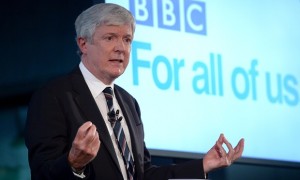 Director-General of the BBC Tony Hall (pictured left) says: “Today marks the start of a new chapter for the BBC.
“The BBC World Service is one of the UK’s most important cultural exports. In a world of anxieties about ‘fake news’, where media freedom is being curtailed rather than expanded, the role of an independent, impartial news provider is more important than ever. The new services we’re launching will reach some of the most under-served audiences in the world.”
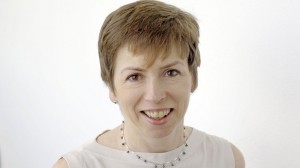 World Service Director Francesca Unsworth (right) says: “For more than 80 years the BBC World Service has brought trusted news to people across the globe. I’m delighted that millions in West and then East Africa will be able to access the BBC in the languages they speak.
“The BBC World Service expansion will also bring benefits to audiences in the UK. Having more journalists on the ground will enrich our international reporting, bringing news from areas which are often under-reported.”
Pidgin is spoken by an estimated 75m people in Nigeria alone, with additional speakers in Cameroon, Ghana, and Equatorial Guinea.
The Pidgin service is fully digital featuring six daily editions of BBC Minute – a 60-second audio news update – followed by two daily news video bulletins in November. Two further services for West Africa – Yoruba and Igbo – will launch at the beginning of next year.
The Amharic, Afaan Oromo and Tigrinya services will launch online and on dedicated Facebook pages next month. This will be followed later in the year with shortwave radio services in each language, consisting of a 15-minute news and current affairs programme, followed by a 5-minute Learning English programme, from Monday-Friday.
16 November 2016
The BBC World Service has announced its biggest expansion since the 1940s, in a move designed to bring its independent journalism to millions more people around the world, including in places where media freedom is under threat.
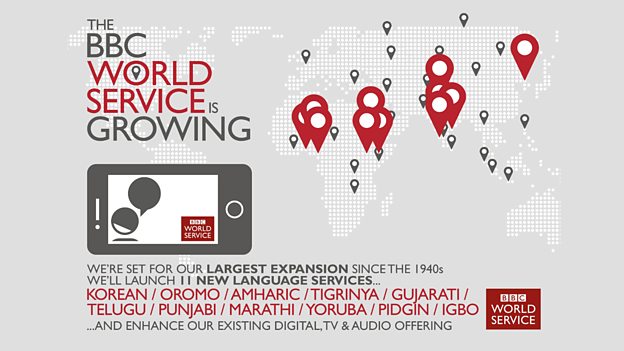 The BBC World Service will also expand its digital services to offer more mobile and video content, a greater social media presence, and new ways of reaching its audience around the globe.
The BBC World Service will launch 11 new services in Afaan Oromo, Amharic, Gujarati, Igbo, Korean, Marathi, Pidgin, Punjabi, Telugu, Tigrinya, and Yoruba. This means the BBC World Service will be available in 40 languages including English. The expansion will also mean more journalists on the ground in locations across the world.
The expansion includes plans for the BBC to:
- Produce extended news bulletins in Russian, with regionalised versions for surrounding countries, a relaunched website, new digital formats and more journalists on the ground
- Enhance its television services across Africa, including over 30 new TV programmes for partner broadcasters across sub-Saharan Africa
- Enhance the BBC Arabic offer by delivering new regional programming across the Arab world
- Broadcast short-wave and medium-wave radio programmes aimed at audiences in the Korean peninsula, supplemented by digital content online and on social media
- Invest in World Service English, with new programmes, more original journalism, and a broader agenda
- Continue with the digital transformation of the BBC World Service, including new TV news bulletins, so that all 40 languages will eventually have a video offer
- Use its global presence to provide an even greater focus on analysis and explanation, or ‘slow news’, helping audiences to make sense of the world by explaining the ‘why’ as well as the ‘what’.
Tony Hall, Director-General of the BBC, said: “This is a historic day for the BBC, as we announce the biggest expansion of the World Service since the 1940s. The BBC World Service is a jewel in the crown – for the BBC and for Britain.
“As we move towards our centenary, my vision is of a confident, outward-looking BBC which brings the best of our independent, impartial journalism and world-class entertainment to half a billion people around the world. Today is a key step towards that aim.”
Francesca Unsworth, BBC World Service Director, said: “Through war, revolution and global change, people around the world have relied on the World Service for independent, trusted, impartial news. As an independent broadcaster, we remain as relevant as ever in the 21st century, when in many places there is not more free expression, but less.
“Today’s announcement is about transforming the World Service by investing for the future. We must follow our audience, who consume the news in changing ways; an increasing number of people are watching the World Service on TV, and many services are now digital-only. We will be able to speed up our digital transformation, especially for younger audiences, and we will continue to invest in video news bulletins. What will not change is our commitment to independent, impartial journalism.”
The BBC World Service will focus particularly on increasing audience reach with younger people and women.
The BBC’s Director-General has set a target for the BBC to reach 500m people worldwide by its centenary in 2022.
This expansion is a result of the funding boost for the BBC World Service announced by the UK Government last year. Further details of the new services will be announced in due course. The first new services are expected to launch in 2017.
15 September 2016
This morning the UK Government has published the draft new BBC Charter and Agreement.
Tony Hall, Director-General of the BBC said:
“This hard won Charter is now an opportunity to write the next chapter in the BBC’s history. It will deliver the strong and creative BBC the public believes in. It provides an 11-year Charter and a licence fee guaranteed for 11 years. It endorses the remit, scale and scope of the BBC, and backs it as a great British institution.
I set out my concerns regarding the new board appointments back in May and said we would continue to make the case to the Government. The BBC is a public service broadcaster – not a state broadcaster. I am glad they have reconsidered. There will now be an equal number of board appointed non-Executive Directors alongside the ones appointed by the Government. And there will now be four Executive directors on the board too. An independent and strong BBC is what the public want and demand.
Our position on talent pay has not changed and all major broadcasters have questioned the merit of the proposal. The BBC is already incredibly transparent and we publish what we spend on talent pay – a bill which has fallen in recent years. The BBC operates in a competitive market and this will not make it easier for the BBC to retain the talent the public love. Ultimately, the BBC should be judged on the quality of its programmes.
There has been a passionate debate over the BBC’s future. Overall, we have the right outcome for the BBC and its role as a creative power for Britain. It lays the foundation for more great programmes and journalism. The BBC has always existed to inform, educate, and entertain. We will do that with renewed energy and vigour.”
(Source: BBC press office)
6 July 2016
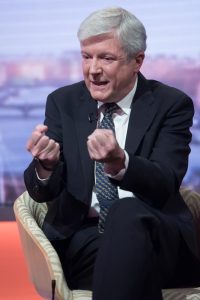 BBC Director General Tony Hall (left) has announced his reshaped senior leadership team at the Corporation.
He said: “I am proud of what we have achieved over the last few years. Together we stabilised the BBC after a difficult period in its history. We went on to create a compelling case for a new decade of the BBC and secured an eleven-year charter as a result.
“Now, as we move towards this new Charter period, I want us to turn our energy to focus on the future of public service broadcasting and what it means for our audiences. We must continue to harness the creative power of the UK. We must continue to be a creative beacon to the world and we will do this best by renewing the way we engage with our audiences as we enter our centenary year.
“The leadership changes I am making today can help ensure that the BBC is best equipped to do this. We must never stand still. We must always be looking to innovate and change. The new Executive will lead this process of creative renewal to ensure the BBC remains the most creative force in the world.
“On a practical level, these changes are also about creating a simpler BBC with fewer layers and clear lines of accountability. Much has already been achieved, but this process must now be accelerated.
“The BBC also needs to reinvigorate its offer to the public on education – something I am passionate about. That’s why its importance is now recognised at the very top of the BBC.
“The UK is changing and changing fast. The BBC needs to recognise and address that. That’s why the work of improving our news and programming offer to the nations and regions is so important. It will be a challenge in an environment where resources are tight, but it is a priority and the steps taken today recognise that.”
Below are the major changes:
• Anne Bulford becomes the BBC’s Deputy Director General. In addition to continuing to lead finance, operations, HR, legal, and design and engineering, she will take on the additional responsibilities related to the BBC’s marketing and audiences teams and create a new centralised commercial and rights group which will co-ordinate all BBC’s negotiations to deliver the best possible deals. This puts Anne in charge of the distribution of content and reaching audiences in the most effective way – something vital as audiences change viewing habits. Anne will look at what more can be done to ensure the BBC spends as much money as possible on content.
• We will have a new director of Nations and Regions. The BBC already produces around 50% of its output from outside the M25. That is a strong record, but the UK is changing and so must the BBC. The role will bring together and enhance the BBC’s offer to the nations and regions of the UK to improve our content while also looking for savings so that more money can be released for content. The role will bring together the nations and regions of the UK. The Directors in Scotland, Wales, Northern Ireland and the regional hubs in the North, Midlands and South West will report to this role. The Nations directors will continue to play a crucial role.
• Charlotte Moore will become Director of Content, and remain as Controller of BBC One. She will be responsible for all the BBC’s TV channels and iPlayer. She will also take on oversight of BBC Sport.
• James Purnell will become Director of Strategy and Education. He will lead the BBC’s work on strategy and on the delivery of the BBC’s new Ideas Service, which aims to partner the BBC with leading academic, arts and science institutions such as the British Museum, the Royal Society, the Royal Shakespeare Company, leading arts festivals and galleries to curate and commission content and offer an online resource. This is part of a renewed drive to put education at the heart of what the BBC does. The aim is to reinvigorate the BBC’s mission on education through a new education strategy for BBC Children and BBC Learning – both of which will now report to him. James will also lead on BBC’s broader partnerships work.
• Helen Boaden will continue to lead the BBC’s Radio output and will formally take responsibility for 5Live as it moves into BBC Radio.
• James Harding will continue as Director of News and Current Affairs. Tim Davie’s role as Director of Worldwide and Mark Linsey’s role as Director of Studios also remain unchanged.
• The BBC is also confirming that the Executive position representing BBC North will close. The director of BBC Children’s – Alice Webb – will lead the region on a day to day basis. As a result of these changes, the Executive Team will reduce from 16 members to 11. The BBC has already saved over 40 per cent on its senior manager pay bill and reduced its overall pay bill by £150 million a year. As a result of this reshaped top team, each area will now look at the immediate layers below to identify further headcount and post savings.
(Source: BBC press release)
23 November 2015
The British government has announced that it proposes to provide a grant of £34m [US$51.42m] between 2016 and 17, and £85m a year from 2017-18 for the expansion of BBC World Service.
In its National Security Strategy and Strategic Defence and Security Review, the government says:
The BBC currently reaches 308 million people worldwide, and its goal is to reach 500 million people by 2022. The BBC World Service reaches into some of the most remote places in the world, providing a link to the UK for individuals and societies who would otherwise not have this opportunity. We will invest £85 million each year by 2017/18 in the BBC’s digital, TV and radio services around the world to build the global reach of the World Service and increase access to news and information.
BBC Director-General Tony Hall commented on the news: “I warmly welcome today’s announcement. It’s fantastic news.
“This new funding is the single biggest increase in the World Service budget ever committed by any government.
“The millions announced today will help the BBC deliver on our commitment to uphold global democracy through accurate, impartial and independent news reporting.
“The World Service is one of the UK’s most important cultural exports and one of our best sources of global influence. We can now further build on that. The funding will also help speed us on to our target of reaching half a billion people globally.”
The new funding will allow the BBC to develop a range of services, including:
- Enhanced TV services for Africa
- New radio services for audiences in North Korea; radio and digital services for Ethiopia and Eritrea
- Additional language offers via digital and TV in India and Nigeria
- More regionalised content to better serve audiences to the BBC Arabic Service
- Dedicated TV output for Somalia and a fully digital service for Thailand
- Enhanced digital and TV services for Russian speakers, both in Russia and surrounding communities
- A video-led digital transformation of Languages services
- To expand the impact and future-proof World Service English
The BBC took over the funding of BBC World Service – including all radio services and foreign language television services, but not BBC World News – in April 2014. It had previously been funded by a “grant-in-aid” from the British Foreign Office [Ministry].
