
12 May 2017
A district court in Baku today ruled in favor of a lawsuit blocking access within Azerbaijan to the website of Radio Free Europe/Radio Liberty’s (RFE/RL) Azerbaijani Service, azadliq.org.
RFE/RL President Thomas Kent said, “Today’s ruling is another blatant attempt by Azerbaijani authorities to try to silence our reporting in Azerbaijan. It misrepresents RFE/RL’s work in Azerbaijan, and violates Azerbaijan’s international commitments to respect media freedom. We will appeal it.”
The Sabail district court in Baku ruled that the Ministry of Transport, Communications, and High Technology’s request to block access to the websites of five news outlets — RFE/RL’s Azerbaijani Service, the nongovernmental Azadliq newspaper (unrelated to azadliq.org), Meydan TV, and the online Turan TV and Azerbaycan Saati TV channels — must be carried out.
Access to the websites has been blocked since March 27 on the instructions of the Prosecutor General’s Office, which claims that the websites “pose a threat” to Azerbaijan’s national security, and accuses them of “posting content deemed to promote violence, hatred, or extremism, violate privacy, or constitute slander.”
The March blockage followed the publication of investigations by the Azerbaijani Service, in cooperation with the Sarajevo-based Organized Crime and Corruption Reporting Project, on financial activities linked to members of the president’s family and inner circle. The Service also recently published reports raising questions about costs associated with a September 2016 referendum that extended the term of presidential office from five to seven years, and created the post of Vice President, to which President Ilham Aliyev appointed his wife earlier this year.
According to Azerbaijani legislation, a guilty judgement by the court against azadliq.org could be used as grounds to prosecute the website’s correspondents. In 2014, authorities imprisoned prominent investigative reporter Khadija Ismayilova on charges of encouraging an attempted suicide and financial crimes in a case that foreign governments and rights advocates condemned as politically motivated.
Ismayilova’s arrest came just weeks before Azerbaijani state agents raided and sealed RFE/RL’s Baku bureau, forcing it to close in May, 2015. In December 2008, RFE/RL was formally banned from FM airwaves by Azerbaijan’s National TV-Radio Council, but continues to engage with its audience via satellite and online social media platforms.
(Source: RFE/RL press release)

15 March 2017
RFE/RL has published never-before-seen color images of life in the Soviet Union in the 1950s, from a trove of original video and still images that was recently discovered in cardboard boxes in a former auto body shop in the Pacific Northwest of the United States.
The archive belonged to U.S. Army Major Martin Manhoff, who spent more than two years in the Soviet Union in the early 1950s, serving as assistant army attache at the U.S. embassy. From his vantage point at the embassy, then located just off Moscow’s Red Square, he filmed what is thought to be the only independent footage of Stalin’s funeral procession, providing an unfiltered view of the event not conveyed in official Soviet reels.
CLICK TO VIEW THE MANHOFF ARCHIVE
Douglas Smith, the award-winning historian and author of five books on Russia who discovered the Manhoff Archive, has said that the photos have “a human quality that is missing from any other depiction” of Soviet life at the time.
This first installment of the Manhoff Archive, released by RFE/RL in English and Russian and featuring the Stalin funeral procession video, has been viewed more than 2 million times on Russian-language platforms and over 250,000 times in English, as has been shared 20,000 times on Facebook in Russian and English.
Part two of the series, which will be published on March 20, will feature Manhoff’s collection of photos of city life in the Soviet Union of the 1950’s. Part three, “On The Road,” to be issued on April 3, is a selection of his photos taken during his travels outside Moscow. On April 10, the final instalment, “Spy or Artist,” will focus on the discovery of the archive and the man himself.
About RFE/RL
RFE/RL is a private, independent international news organization whose programs — radio, internet, television, and mobile — reach 27 million people in 26 languages and 23 countries, including Russia, Ukraine, Iran, Afghanistan, Pakistan, the republics of Central Asia and the Caucasus, and the Baltic states. It is funded by the U.S. Congress through the Broadcasting Board of Governors (BBG).
(Source: RFE/RL press release)
13 February 2017
 In the year since the last World Radio Day, the global radio industry has gone from strength to strength.
Some estimates suggest that today there are over 44,000 radio stations – large, medium and small – all over the world. It is believed that 75% of the planet’s population – about 5.6 billion people – listen to radio every week. That’s an impressive number and shows that radio, in all its forms, remains an important medium.
At the Association for International Broadcasting, we monitor developments in all sectors of the media industry, and the vibrancy of today’s radio industry continues to fascinate us. There continues to be remarkable innovation in the sector. New initiatives, such as radio.garden, have become viral internet sensations. Voice controlled devices, like Amazon’s Echo, place radio from around the world at the centre of people’s homes. World Radio Day 2017 marks the official launch of the dot radio top level domain that will allow radio broadcasters to harness the power of, and be more easily recognised on, the internet.
Of course, it is the engagement with listeners that is most exciting about radio, and the impact the medium has on people’s lives. Radio Free Europe/Radio Liberty, based in Prague, has collected anecdotes from some of its 13.5million listeners across Central Asia, Pakistan, Iran and Afghanistan. They talk of the impact that the broadcaster has on their lives and how RFE/RL has created a democratic space that benefits society.
“The work of radio members of the Association for International Broadcasting remains as important today as it has always been,” comments Simon Spanswick, chief executive of the AIB. “Whether it’s entertainment, news or documentaries, radio continues to engage, inform and educate listeners in every country on the planet. And we’re delighted to see exciting, relevant new initiatives that makes radio ever more accessible in today’s ‘always on’ society. Radio isn’t just important on World Radio Day – it’s on the air 365 days a year, touching people’s lives in a constantly increasing number of positive ways.”
The AIB’s Business of Radio book highlights the continuing relevance of the radio industry and showcases the work of some of the AIB’s Members around the world. Read it online here.
6 February 2017
Current Time, an up-and-coming player in the Russian media market, will mark on Tuesday, Feb. 7 the formal launch of its 24/7 digital and TV stream.
With a mission to bring real news to Russian-speaking audiences everywhere, Current Time is engaging audiences from Lithuania to Kazakhstan and providing an alternative to Kremlin-sponsored media. The day-long video stream builds on the successes of individual daily news programs started in 2014 and 2015.
First and foremost a digital news and current affairs network, Current Time’s daily lineup features hourly live newscasts and sharp political debate, in addition to innovative programs covering business, entrepreneurship, civil society, and culture. It is also a leading destination for documentary films that are otherwise unavailable inside Russia.
“Led by Radio Free Europe/Radio Liberty in cooperation with the Voice of America (VOA), the Current Time digital network is a signature accomplishment of the Broadcasting Board of Governors (BBG),” said BBG CEO and Director John Lansing. “Current Time embodies all of the priorities I set forth to maximize the agility, efficiency and impact of the BBG networks and allow us to more effectively address the rapidly evolving global media environment.”
Public demand for Current Time’s content is reflected in its wide distribution network, comprising 32 cable affiliates in Ukraine, Georgia, Moldova, Latvia, Lithuania, Estonia, Kyrgyzstan, Tajikistan, Kazakhstan, Germany, and Israel. Its live video stream is available across Eurasia, to more than 7.3 million subscribers to 36 satellite, cable, and IPTV services. The stream is also hosted on the digital platforms filmon.tv and MeGoGo, with more than 100 million monthly users, and on the Eutelsat Hotbird-8 satellite, which reaches 135 million households from Iceland to Turkey.
While TV remains the dominant media platform in much of Current Time’s target region, the network’s innovative digital unit takes the network’s content direct to growing mobile and web audiences, who have viewed its clever social videos on corruption, politics, and the ordinary challenges of daily life more than 160 million times in 2016 on Facebook, YouTube, and Twitter, and Russian social networks such as VKontakte and Odnoklassniki. An average of 1 million people per month visited the network’s website and mobile news and video apps.
The network’s Russian name, “Nastoyashchee Vremya,” has a triple meaning that aptly describes Current Time’s purpose — to provide its Russian-speaking audience content that is truthful, current, and real.
RFE/RL is a private, independent international news organization whose programs — radio, internet, television, and mobile — reach 27 million people in 26 languages and 23 countries, including Russia, Ukraine, Iran, Afghanistan, Pakistan, the republics of Central Asia and the Caucasus, and the Baltic states.
VOA delivers news and information in more than 45 languages to a measured weekly audience of more than 236 million people. With 75 years of experience, VOA is a trusted source for accurate information about news events, freedom of expression, civil society, and change.
VOA and RFE/RL are two of the five networks of the Broadcasting Board of Governors, an independent federal agency supervising all U.S. government-supported, civilian international media.
6 January 2017
RFE/RL serves a measured audience of 27 million people a week in 23 nations and territories by video, social networks, mobile apps, websites, podcasts and radio – whatever media they use most. From its Prague headquarters and 18 news bureaus, it provides local news and information in 26 languages to the nations of the former Soviet Union, the Balkans, Iran, Afghanistan and Pakistan, including a round-the-clock Russian-language television channel.
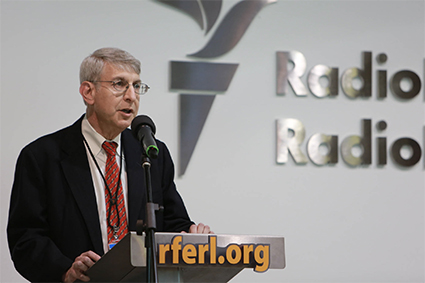 Through last September, RFE/RL recorded one billion page views on its websites, 300 million views on YouTube and 225 million engaged users on Facebook, plus many more visits and views on other social networks and apps.
“RFE/RL’s audience is highly loyal, making their way to us despite efforts by some governments to jam us on the internet and over the air, and even to directly intimidate viewers and listeners,” said Thomas Kent, president and CEO of RFE/RL (pictured). “They find us an indispensable source of news and investigative journalism, constantly adapting to the most modern platforms to reach them.”
