29 July 2016
Deutsche Welle (DW) has recorded a marked increase in its audience reach over the last year. 135 million people watch, listen to or use DW programmes and services at least once a week, compared to 118 million in 2015. The English-language TV programme and digital offerings across languages, especially in social media, are particularly successful.
DW Director General Peter Limbourg: “The positive development in the number of users of our media strengthens our conviction to focus on digital media and extensive news programming in English. The popularity of our formats, especially in the Middle East and Africa, is proof of DW’s positive image. Thanks to our multi-language editorial teams, DW is a recognized and valued source of independent, reliable journalism.”
TV programs
DW offers 24-hour TV programmes in German, English, Spanish and Arabic. TV formats in 16 languages are broadcast in cooperation with more than 2,500 partners worldwide. DW now reaches 66 million viewers, as compared to 55 million in 2015.
Among the four languages, English programming is the most popular with viewers, reaching up to 30 million people every week. The redesigned English channel was launched in June 2015. The hourly DW News shows which make up the core programming are complemented by magazines, reports, documentaries, interviews and talk shows. Interruptions due to breaking news are possible at all times.
Over the last year, the weekly number of viewers of DW’s Arabic television program in the Middle East and North Africa has increased by about 50 percent, due to many partnerships with regional TV stations. The digital offerings in Arabic are nearly as successful. The German-language programme is currently being updated and will be relaunched early next year with a clear focus on culture.
Radio programmes
For international broadcasters, radio remains a relevant media – especially in Africa, where DW programmes can be received via FM and short wave. Currently 40 million people listen to DW programmes on a regular basis, especially in Hausa and Kiswahili.
Digital offerings
29 million users choose the digital offerings of the DW App, on dw.com, social media or affiliated platforms. In 2015, the weekly figure was 22 million. The interactive app is available to download for free at dw.com/app/ios or dw.com/app/android).
Facebook likewise plays an important role. The increasing use of DW video content draws a growing number of young fans in Asia, especially in Bangladesh and Pakistan. In the Arab world, DW’s digital contents reach more than nine million users per week; in Europe it is more than six million.
July 29, 2016
The figures are the results of an extrapolation drawn from more than 90 studies with 250,000 participants from more than 60 countries. DW’s Market and Media Research department also took into account user figures regarding DW platforms including apps, Facebook and Twitter, as well as partner platforms.
(Source: DW press release)
8 June 2016
Ines Pohl (49) will become Deutsche Welle’s new editor-in-chief on March 1, 2017. She will succeed Dr. Alexander Kudascheff (65), who will enter retirement. Pohl, longtime editor-in-chief of the German daily newspaper taz, joined DW at the end of 2015 and has been a correspondent from Washington.
DW Director General Peter Limbourg: “Ines Pohl is an outstanding journalist and an experienced manager. She will further distinguish our multi-language and cross-platform offerings and support DW’s transformation into a digital media house. She has gained high esteem within the organization in a short period of time.”
Limbourg praised Alexander Kudascheff as “a journalist who has shaped DW over many decades. He has been the best editor-in-chief DW could have hoped for during a time of internal reform and change.”
Following his academic education – philosophy, history, politics and Islamic studies – as well as a traineeship with DW, Kudascheff worked on the international broadcaster’s Middle East editorial team. He later became head of domestic politics, chief reporter and finally editor-in-chief of German radio programming. He was head of DW’s studio in Brussels from 1998 and the studio in Berlin from 2007. In 2014 he was named editor-in-chief of all DW journalistic offerings.
After studying Scandinavian and German studies at the University of Göttingen, Ines Pohl began her career in journalism as a freelancer with Radio ffn and local newspapers. She later became head of politics of the Hessische/Niedersächsische Allgemeine (HNA) newspaper and served as a correspondent in Berlin for the media group Ippen. Pohl has been a member of the board of trustees of “Reporters without Borders” since 2010 and the International Journalists’ Programmes (IJP) since 2013. Before joining DW she was editor-in-chief of the national daily newspaper taz from 2009 to 2015. (Source: DW press release)
24 February 2016
Two days before the parliamentary elections in Iran, DW Director General has urged the government in Tehran to grant people access to information. “Internet censorship remains very common in Iran,” Limbourg said.
Access to the DW webpage in Farsi has been blocked since 2009. The circumvention software provided by DW has been accessible only irregularly since mid-January.
“Obviously the drastic encroachment on the freedom of the Internet is linked to the upcoming elections and DW’s extensive and balanced reporting,” Limbourg said.
On a special page in Farsi, DW offers information, analysis and opinions on the elections scheduled for next Friday.
Limbourg: “Blocking access to our Farsi website has led to a clear decrease in the number of page impressions in January in comparison to the month before. The Iranian government should become more transparent and end censorship.”
In the meantime DW would try to create alternative opportunities for entering the Internet, the director general said. Limbourg added that Iran would only thrive if people were allowed to speak out without fear of state repression.
“Young people especially depend on the Internet and social media as instruments for social dialogue and individual formation of opinion,” Limbourg said. (Source: DW press release)
11 February 2016
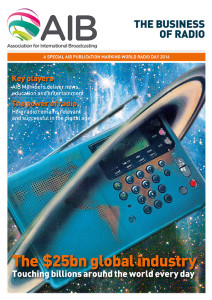 Radio, the oldest electronic mass medium, is in good health and well positioned for the future. That’s the message from the Association for International Broadcasting as World Radio Day 2016 is marked internationally.
“Radio generates revenues of well over US$25m every year,” comments Simon Spanswick, chief executive of the Association for International Broadcasting (AIB). “Radio is a major a generator of economic growth and employment – both in front of and behind the microphone. Every day, it touches the lives of billions of people, providing news, information, entertainment and education. At the AIB we’re delighted to join with our Members to celebrate the continued relevance and importance of radio on 13 February, the day designated by UNESCO as World Radio Day.”
The AIB is publishing a special souvenir book to demonstrate the value of radio internationally. ‘The Business of Radio’ provides insight into the radio industry and profiles Members of the AIB who operate radio networks and the service providers that keep radio on the air around the world.
‘The Business of Radio’ is being sent to opinion-leaders including parliamentarians and media regulators around the world to remind them of the key role that radio continues to play, even in the digital age of mobile apps and social media.
“The strength of radio is its ability to connect people in a way that other media cannot,” continues Spanswick. “At the AIB, we are delighted to see that our radio Members are reacting positively to the changes in media consumption habits. For example, they make sure that their programmes are available via multiple platforms, increasing their reach as they do. The AIB is pleased to be accompanying them on their journey into radio’s bright future.” or as a downloadable PDF at
‘The Business of Radio’ includes articles contributed by a number of the AIB’s Members, including the BBC, Broadcasting Board of Governors, RNW Media, Radio Taiwan International and DW. It is available in digital page-turning format at http://aib.org.uk/Resources/BizofRadio.html or as a downloadable PDF here.
13 December 2015
Starting Tuesday, December 15, 2015, West European viewers can receive Deutsche Welle’s Arabic-language television program via Astra satellite. DW and satellite-operator SES arranged the partner project with the aim of reaching refugees who come from the Middle East. Plans are made to expand the program in the coming months into a conduit of information and an aid to integration. Politicians are welcoming the initiative.
The Arabic-language TV program of the German foreign broadcaster will be transmitted in Europe via Astra 1M. DW (Arabia) offers round-the-clock news and information about Germany. Until now it was available in Germany exclusively via Internet livestream at dw.com/arabic.
Norbert Hölzle, Senior Vice President Commercial Europe of SES, pledged to DW Director General Peter Limbourg to transmit the channel at no cost for twelve months.
Limbourg: “Thanks to SES, we are in the position to make available a high-value TV-program for refugees and all interested parties from the Arab region. It is an important goal of ours to convey European values and to provide access to reliable information from a German perspective, initially in their native language. In that way, Deutsche Welle contributes to the refugees’ participation in German society.”
Hölzle outlined the motive behind the pro-bono project: “We are a market leader in Europe, and we see it as our duty to provide good, additional offerings. At the same time, we want to show how important social engagement is to us.”
The charitable project is not the company’s first, Hölzle said. For example, SES was engaged in Haiti and Nepal after devastating earthquakes there, as well as in the Philippines after the typhoon. In the midst of the Ebola crisis, SES used its satellite fleet to broadcast an educational channel throughout West Africa.
Hölzle: “With this project we want to contribute towards providing better information and integration for the refugees. Deutsche Welle is an ideal partner, because as an internationally-oriented media company it has a good reputation as a fair and neutral intermediary.”
DW (Arabia) offers a diverse program with an emphasis on providing information, understanding, and cultural exchange.
Politicians respond
Peter Altmaier, chief of staff of the German Chancellery in charge of coordinating the country’s refugee policy, welcomed the initiative. “This mission of democracy, freedom of opinion and cultural exchange can provide a valuable contribution to the integration of Arab refugees fleeing from war,” Altmaier said.
Minister of Culture Monika Grütters said: “The media, especially international broadcasters like Deutsche Welle, assume a special responsibility in times marked by war and terror. People from war-torn areas seeking safety, not only in Germany, are reliant on it for trustworthy and objective information about the situation in their homeland as well as that in their places of refuge. The continuing dialogue with the Arab world about values and ideologies as well as about the worth of respecting universal human rights is more important than ever.”
Deutsche Welle acts as a symbol for democracy and freedom of opinion and against intolerance and terror, the culture minister said. “Shows like Shababtalk also contribute to that, in addressing topics that are critical of society and are often taboo in the Arab-speaking world. I thank SES for making this possible,” Grütters added.
Germany’s commissioner for migration, refugees and integration, Aydan Özoğuz, said: “Information knows no boundaries. I therefore greatly appreciate that Deutsche Welle’s Arabic TV program can now be received via satellite in West Europe. DW stands for democracy, freedom of opinion and cultural exchange – now it does in our country as well.”
Step-by-step expansion planned
Initially, the full extent of the Arabic channel will be adopted as it is currently received in Arab countries. Adjustments are planned to match the needs of the target group in Germany – including, for instance, a German-language course crafted for television and bought-in features from German and European partners.
A satellite-receiver is all that is necessary to receive the new channel. The service can therefore be easily accessed at refugee accommodation facilities.
A publically traded company, SES has its headquarters in Luxembourg. By its own account, it operates over 50 geostationary satellites worldwide. SES offers services for broadcasters, content and Internet providers, mobile and stationary network providers, business associations, and governmental organizations. (Source: DW press release)
