
BBC’s global news coverage drives audience growth

BBC’s global news coverage drives audience growth

BBC’s global news coverage drives audience growth

BBC News grew its global audience by 4 million people in 2024/25

The BBC’s coverage of international conflicts, crises and elections has boosted its international audience year-on-year to reach 418m people on average every week. The total BBC audience, including content made and distributed by BBC Studios, grew by 3m to 453m.

Audiences went to BBC News for the latest news and developments as elections, global conflicts and political unrest dominated the past year. The majority of the BBC’s international audience came to the BBC World Service (World Service English, World Service Languages) with content reaching 313m people on average every week.

In the Middle East, BBC News Arabic grew its weekly audience reach to 39.5m – up nearly 13% – with growth across Arabic TV and digital programming as well as 1.2m listeners tuning into the Gaza and Syrian lifeline radio services. The fall of former Syrian President Bashar al-Assad and the Israel-Gaza conflict both contributed to significant boosts in audiences seeking trusted news and information.

BBC News Persian saw audiences rise a staggering 38% to 24m as Persian-speakers in Iran and around the world sought out the latest news amid unrest in the region. Despite the challenges of reaching audiences across Iran, the service’s TV channel – the largest international news channel in Iran – is viewed by a record audience of 14m. The BBC now reaches one in four people in Iran every week.

In the United States, the November election and subsequent news around President Trump saw spikes in the number of people coming to BBC News. Audiences increased on digital platforms with the country accounting for 55% of growth on BBC.com

With BBC World Service language services BBC News Brasil and BBC News Mundo also both experiencing audience boosts, the BBC now reaches 83m people across the Americas every week.

Other services which saw a spike in audiences include BBC News Bangla following the protests and unrest in Bangladesh, and BBC News Korean as the service reported on political upheaval in the country.

The BBC remains the most trusted international news provider.

Jonathan Munro, Global Director and Deputy CEO, BBC News, said: “In the past year, the heightened global news agenda has seen audiences come to the BBC for news they can trust in times of instability and insecurity. Despite the decrease in press freedom and increased competition, the BBC has stepped up when audiences need our services the most – from elections and conflict, to the upheaval in Syria and unrest in Bangladesh.

“Alongside this, record numbers are coming to BBC News Persian despite the service being banned in Iran, and BBC News Arabic has once again demonstrated the importance of having an accurate and impartial news service in the region.”

The BBC’s news in English across World Service English, BBC.com and the BBC News channel grew its audience to 198m people weekly, an increase of 7m year-on-year. The BBC News channel built on its success last year to grow its audience in the UK and around the world to 102m.

Press freedom continues on a downward trend globally, with 112 countries reporting a decline in press freedom in 2024. 74% of the BBC World Service audience is now in countries with the lowest press freedom (up 1% on last year).

The BBC’s biggest international market is India, followed by the United States, Nigeria, Iran, and Tanzania.
BBC announces subscription service for USA

BBC announces subscription service for USA

BBC announces subscription service for USA

BBC Studios and BBC News has launched the first phase of a pay model for BBC.com visitors in the U.S., offering its most loyal users a premium experience and a new way to enjoy even more of the BBC’s acclaimed journalism and storytelling.

In the initial phase of the launch, for less than $1 a week ($49.99/year) or $8.99/month, users who join will get unlimited access to the BBC’s news articles, feature stories and the 24/7 livestream of the BBC News channel. In the coming months as we test and learn from audience consumption, ad-free documentary series and films (including the full BBC Select documentary catalogue), ad-free and early release podcasts, and exclusive newsletters and content will be included in the offer. This pay model launch supports BBC Studios’ ongoing effort to grow international commercial revenue that helps fund the BBC’s journalism and storytelling and delivers greater value for the licence fee.

Following a period of significant investment in technology and journalism, BBC.com relaunched last year and has seen double-digit year-on-year growth. Today, BBC.com reaches 139 million visitors globally, including nearly 60 million in the U.S. alone.

Rebecca Glashow, CEO BBC Studios Global Media & Streaming said: “Over three years ago, we set out on a bold mission: to completely reimagine how we deliver the BBC’s world-class news and factual content to consumers in the U.S.. Our goal? To serve our audiences better than ever before—and unlock new opportunities for growth. Today, the next phase of that vision becomes reality. We’re bringing more of the BBC’s trusted, high-quality content together in one powerful, easy-to-access destination. Over the next few months, as we test and learn more about audience needs and habits, additional long-form factual content will be added to the offer for paying users. This is a major milestone and just the beginning of an exciting new chapter.”

Deborah Turness, CEO, BBC News said: “Through our partnership with BBC Studios we are growing our audiences in North America – providing more people with news they can trust at a time of dramatic global uncertainty.”

BBC.com is employing a dynamic pay model—an intelligent, engagement-based pay model trusted by leading news publishers globally. All users visiting the site from within the U.S. will be assessed based on how they interact with our content, including how much they read and how long they stay.

This approach allows casual readers to explore freely, while offering our most engaged users the opportunity to unlock even more. By opting to pay, readers gain unlimited access to all the site’s content. It’s a premium experience designed to keep visitors informed and connected—while directly supporting the future of independent, fact-based reporting.

Visitors who choose not to pay will still have access to select global breaking news stories, BBC Radio 4 and BBC World Service radio livestreams, BBC World Service Languages sites, and a variety of free newsletters and podcasts.

The site will remain ad-supported, providing global brand partners with continued opportunities to connect with the BBC.com audience in impactful and meaningful ways.

The website, which is commercially funded and operates separately from other BBC platforms in the UK, identifies users based on their device’s geolocation, an industry standard practice to ensure compliance with the laws and content rights restrictions in each country. UK Licence Fee payers travelling to the U.S. for holiday or work can access their usual content via the BBC News app, as long as they’ve downloaded the latest versions from the UK app stores before travelling.

There will be no change to the services that people in the UK will receive and have access to. All the content that’s available on BBC.com is also available to UK audiences through the BBC’s various channels and services. There are no current plans to introduce a pay model outside of North America.

About BBC Studios

The main commercial arm of BBC Commercial Ltd, BBC Studios generated revenues in the last year of £1.8 billion and a third consecutive year of profits of over £200 million. Able to take an idea seamlessly from thought to screen and beyond, the business is built on two operating areas: the Content Studio, which produces, invests and distributes content globally and Media & Streaming, with BBC branded channels, services including bbc.com and Britbox International and joint ventures in the UK and internationally. The business made more than 2,800 hours of award-winning British programmes last year for a wide selection of public service and commercial broadcasters and platforms, both in the UK and across the globe. Its content is internationally recognised across a broad range of genres and specialisms, and includes world-famous brands like Strictly Come Dancing/Dancing with the Stars, the Planet series, Bluey and Doctor Who.

BBC relaunches global apps

BBC relaunches global apps

BBC relaunches global apps

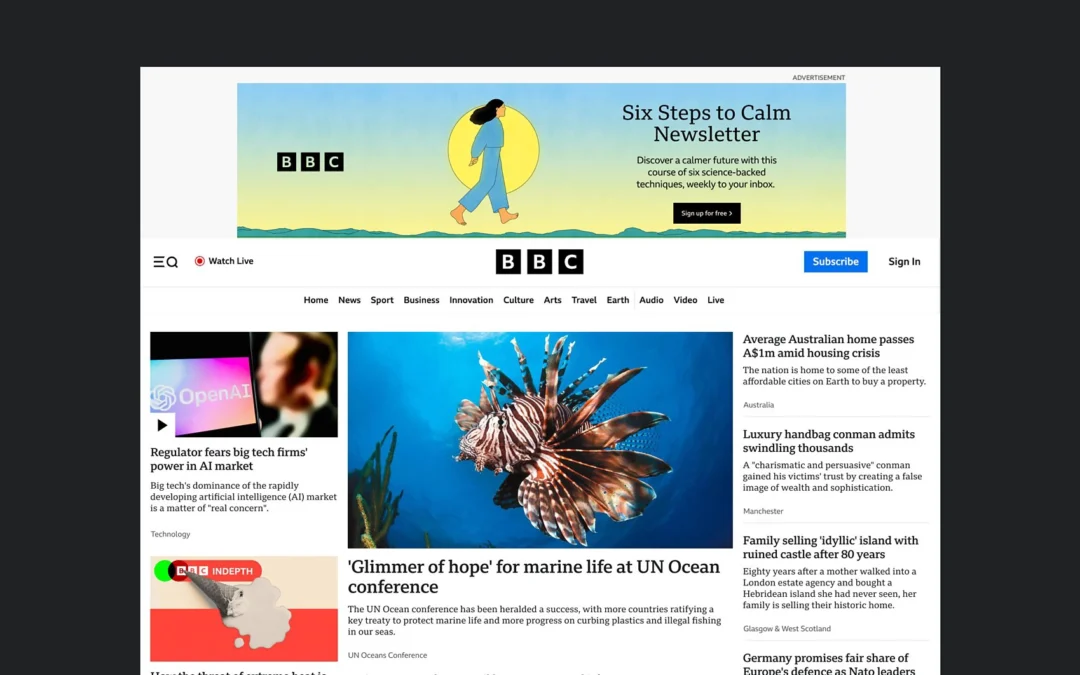
Redesigned website and app offer a new contemporary look and more BBC content for digital audiences outside of the UK, alongside enhanced advertising capabilities.

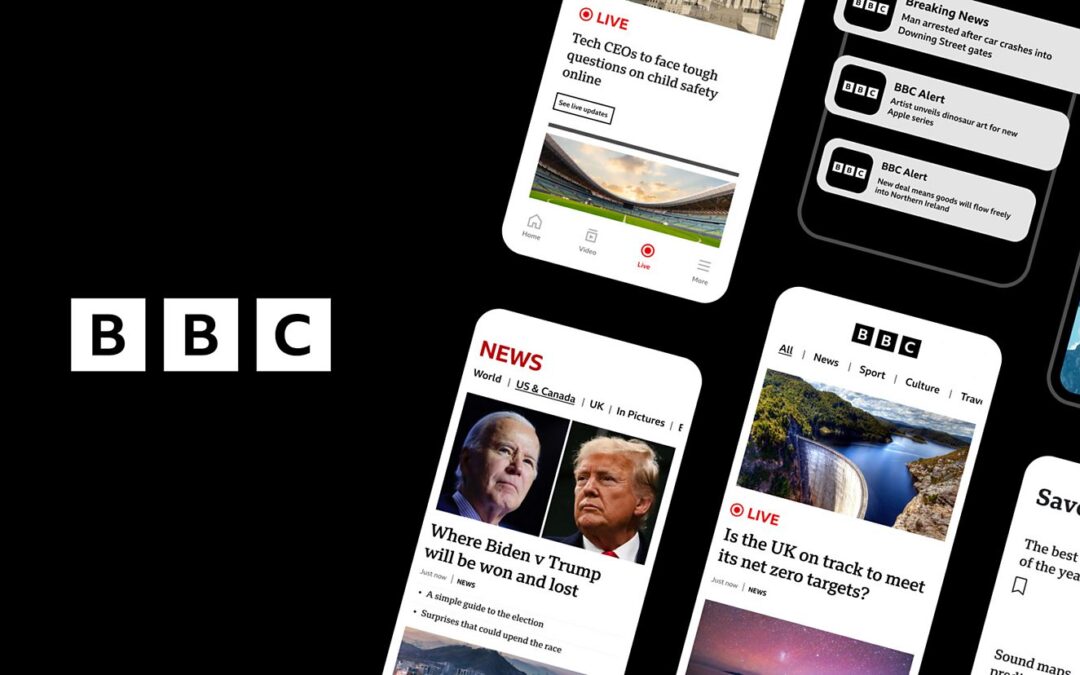
BBC Studios, the commercial arm of the BBC, and BBC News has announced the global launch of the all-new BBC.com and BBC app, transforming the way digital audiences read, watch, and find the BBC’s renowned journalism and storytelling outside of the UK. Available to users worldwide, the new website and app boast an updated design and navigation along with more of the trusted, impartial journalism that consumers rely on the BBC for across the world. The new BBC.com and BBC app also allow for a more premium and sustainable commercial offering with ad tech enhancements that unlock new opportunities for advertisers.

The BBC app, which replaces the International BBC News app, brings together content from across the BBC, for the first time ever. The app mirrors the refreshed BBC.com experience, offering stories and videos across Business, Innovation, Culture, Travel, Earth and more, alongside News, Sport, and live coverage. The BBC app is available for download today in the App Store for Apple users and for Android devices via Google Play.

Tara Maitra, Chief Commercial Officer, BBC Global Media & Streaming, BBC Studios, said: “We are excited to bring the new website and brand-new BBC app to audiences and partners around the globe, following a successful first introduction to consumers in North America,” said “These new digital products deliver an experience as premium as our news and storytelling and offers us the opportunity for future growth as we remain focused on finding new and innovative ways to make BBC content more easily accessible across the globe.”

Naja Nielsen, Digital Director for BBC News, said: “We know there is huge appetite for impartial BBC News journalism as we report – without an agenda – on the burning issues of our time. Thanks to our independent journalism, the BBC is the world’s most trusted international news media organisation, reaching more than 400 million people each week. As we expand and develop our global digital newsroom, I am thrilled our new global app and website will provide an excellent experience and much better showcase our world-beating journalism”.

BBC.com, which re-launched in North America last December, and the BBC app allow users to engage with the BBC’s content in a more cohesive experience. Some of the changes to the website and app include:

  • New Homepage: The new BBC.com homepage and home screen now include a mix of the biggest global news stories of the moment plus a selection of timely and relevant features, curated by BBC editors.
  • New Look, Same Trusted News: Visitors looking to dig deeper into what’s happening around the globe can navigate to News to find articles, videos, and live coverage. Those looking for news from Africa, Asia, Australia, Europe, Latin America, and Middle East can find it in the World section under News.
  • New Sections: BBC’s arts and entertainment coverage in Culture, technology, health and science in Innovation, and sustainability and environment in Earth. Sport, Business and Travel continue to offer agenda-setting stories from around the world, as well as the thought-provoking features readers have come to love from the BBC.
  • More BBC Videos: New Video section offers an extensive library of BBC videos and multimedia storytelling featuring content ranging from news and sport updates to captivating stories on climate, sustainability, science, health, entertainment, and history.
  • More Live Coverage: New Live section makes it easier to find live news updates and live global sport coverage as they unfold.
  • Up-to-the-Minute Breaking News Alerts: Audiences can sign up to receive the same breaking news notifications they always have.
  • The BBC Direct to your Inbox: Discover our newsletters, including The News Briefing, US Election Unspun, Tech Decoded, Future Earth, The Essential List and the brand-new In History

The new website and app, together, create a streamlined digital ecosystem that makes it easier than ever for audiences worldwide to discover a wider array of BBC content. The consistent, unified layout across web and app results not only in an improved user experience, but the unified, single product suite also allows for more opportunities and flexibility for advertising and sponsorship across both web and app.

Advertising partners can now take advantage of more premium high impact ad units that live seamlessly alongside the BBC’s content, making for a more effective consumer journey. Marketers will also benefit from advanced targeting capabilities featuring more sophisticated audience intelligence, segmentation, and attribution that connects campaigns across web and app products, delivering enhanced measurable results for partners.

These new digital platforms and features, coupled with research that shows advertising within news can drive business results, together bolster the opportunity for marketers to reach the coveted BBC.com audience of engaged and informed news consumers. In fact, according to the IAB1, advertising in news creates a halo effect, with consumers more likely to consider making a purchase after being exposed to a brand’s advertisement within their preferred news sources. Findings show that 90% of consumers have either a positive or neutral response to brands that advertise within news, while nearly half of consumers find brands that advertise in the news to be more customer-focused and engaging, more innovative, and relevant to them. The study from the IAB reinforces internal findings into the aggregated performance of advertising on BBC.com, which show an 80%+ average lift in likelihood to recommend and consideration across key categories.2

BBC.com and the BBC app are the latest step in the company’s ongoing digital transformation, and is supported by its investment in North America, which includes an expanded newsroom that facilitates deeper analysis and local expertise of the regional stories affecting the world. Recently, the company also launched the BBC News FAST channel in the U.S. across leading services, more than doubling the channel’s reach in the region. Ranked as the most trusted news broadcaster in the world, the BBC is driven by its public service mission and editorial guidelines and standards for which the organization is known.

The development and operation of BBC.com and the BBC app is driven by BBC Studios Global Media & Streaming division, which leverages the power of the BBC to reach and engage audiences worldwide. GM&S is responsible for the distribution and advertising of BBC News globally outside of the U.K. GM&S is a division of BBC Studios, the BBC Group’s commercial arm that helps to fund innovation, internationally recognized programming, and the organization’s public service mission.


BBC staff launch new company to serve audiences with BBC Indian language services

BBC staff launch new company to serve audiences with BBC Indian language services

BBC staff launch new company to serve audiences with BBC Indian language services

Four BBC staff members have announced plans to leave the organisation and form a new entity in India which will provide audiences with a breadth of services across India, as commissioned by the BBC.

The establishment of Collective Newsroom Private Limited ensures the BBC and Collective Newsroom can meet their shared commitment to Indian audiences and cover stories on India that matter to global audiences. It is in compliance with the Indian Foreign Direct Investment law.

Collective Newsroom has been established as an Indian company, wholly owned by Indian citizens, with four existing staff members leaving the BBC to lead Collective Newsroom. These senior leaders have a wealth of editorial and programme-making experience. The BBC will commission Collective Newsroom to produce its six Indian language services as well as Indian digital output and Indian YouTube channel in English for audiences globally.

The BBC has a long-held and deep-rooted place in India’s media landscape, having first launched the Hindi language service in 1940. Since then it has developed a range of BBC output, expanding the number of Indian language services and growing audience figures from decade-to-decade with its agenda-setting and high impact journalism.

Rupa Jha, Senior News Editor, BBC India, and founding shareholder of Collective Newsroom, says: “Audiences in India can be assured that the BBC’s Indian language services and unique range of quality output will inform, educate and entertain audiences across our diverse and highly engaged country under the agreement between the BBC and Collective Newsroom. We launch Collective Newsroom with big ambitions for audiences in India and beyond.”

Jonathan Munro, Deputy CEO, BBC News says: “The BBC’s presence in India is steeped in a rich history that has always put audiences first, so we warmly welcome the formation of Collective Newsroom which continues that progression. The BBC will get first class content from Collective Newsroom that will be rooted in India and in line with the editorial standards audiences expect from the BBC. We look forward to working with them.”

Liliane Landor, Senior Controller, BBC News International Services, says: “Two of the BBC’s critical strengths are its truly global output for audiences and our reputation as a trusted source of news. We are deeply committed to excellence in journalism for and from India, and this agreement ensures the continued production of independent, international and impartial journalism that the BBC News brand is renowned for in India and around the world.”

Activity for BBC Monitoring and the BBC’s English language newsgathering operation for global output will remain with the BBC.

  • The four staff members leaving the BBC to lead Collective Newsroom are; Rupa Jha, Mukesh Sharma, Sanjoy Majumder and Sara Hassan
  • The BBC provides content in six Indian languages (BBC News Hindi, BBC News Marathi, BBC News Gujarati, BBC News Punjabi, BBC News Tamil, BBC News Telugu) as well as in English, to 82 million people around the country on average each week
  • BBC News Hindi is the BBC’s language service with the largest audience and in 2023, across all platforms, its weekly reach figure grew 27% year-on-year
  • The BBC World Service reaches 318 million people on average every week globally and operates 42 different language services

​Earlier in 2023 it looked as if a number of international TV news channels broadcast in India would have to close after the Ministry of Information and Broadcasting announced a significant increase in the “net worth” of Indian companies holding downlink licences on behalf of global channels. After lobbying, this move was rescinded allowing the small-scale local licence holders to continue operating on behalf of international channels. 

BBC News announces savings and digital reinvestment plans

BBC News announces savings and digital reinvestment plans

BBC News announces savings and digital reinvestment plans

BBC News has set out savings and reinvestment plans to boost its digital journalism around the clock; increase its streaming offer on BBC iPlayer and the BBC News app; and bring more in-depth, analytical, and high-impact reporting to its online audiences. A new BBC News Investigations unit will be created, and areas such as BBC Verify will be boosted, with new reporting and production roles.

News consumption habits are changing, with [British] linear TV audiences declining by 11% over the last five years, and the BBC needs to invest in online news to respond to this. With the flat Licence Fee settlement and the impact of inflation, this means the BBC needs to make £500m of savings.

The announcement is the next phase of BBC News’ evolution from broadcast to digital journalism, and forms part of the BBC’s strategy to deliver value to all of its audiences, wherever they live and whichever platforms they use. This draws on research which shows audiences particularly value online breaking news, high-impact investigations, and forensic verification.

BBC News and Current Affairs CEO Deborah Turness says: “Like many businesses, we are in a tough financial climate and as our audiences shift rapidly from TV to online news consumption, we need to make choices about where we allocate our resources. While TV and radio remain crucial to BBC News, we must invest in our digital platforms to ensure they are also the home of our very best journalism, and today’s package of measures will accelerate this transformation.”

The package includes a reformatting of BBC Newsnight – a flagship late evening news programme screened on domestic channel BBC TWO – based on audience feedback which showed what consumers value most from today’s programme – high-quality, consequential, news-making interviews, discussion and debate.

Newsnight will remain as a nightly BBC Two TV programme from Mondays to Fridays, and will become a 30 minute interview, debate and discussion show which draws on the best of the BBC’s talent and news-making interviews to make sense of the day’s news.

As a result the BBC is proposing the closure of a number of roles across Newsnight’s reporting, production and operational functions.

Deborah Turness adds: “Audiences have told us how much they value Newsnight as an iconic BBC debate and discussion programme, and we’ve listened to what they’ve said – we’ve made the decision to keep the programme on air five days a week, despite the financial challenges we face.

“Newsnight has also been a source of great investigative reporting and films but we know that people are consuming the news in different ways, and it can no longer make sense to keep a bespoke reporting team for a single television programme. We will offer more to audiences by investing to ensure the best investigative journalism and reporting is produced – and consumed – across the whole of BBC News.”

As part of this, a new BBC News Investigations Unit will bring together the best investigative talent across BBC News. New roles will be created in financial and political investigations.

There will be a new drive to bring the depth and analytical strength of BBC broadcast journalism to its online audiences, creating a new in-depth digital experience which will be a destination for the best of the BBC’s analysis and thought-provoking journalism online. A dedicated team will commission “premium” analysis from editors, specialists and experts around the world, and curate daily content including the best of the BBC’s written articles, podcasts and radio moments, investigations and documentaries in one place. Followers will be able to take part in digital live events with our experts and receive extra exclusive content.

The plans will also provide more resource to guarantee the speed and quality of 24/7 digital journalism and digital streaming, building on the success of online live pages, so consumers are getting the best of BBC journalism around the clock.

As part of the BBC’s commitment to serving the whole of the UK, an extended hour-long edition of the BBC News at One will relocate to Salford, creating a daytime TV powerhouse in the city. This will be the first time a daily BBC national news bulletin will be broadcast outside London. There will be even more news content broadcast from Salford as BBC Breakfast will be extended for an extra 15 minutes daily.

There will be a restructure of BBC News’ story teams in the UK, with a focus on digital storytelling and live coverage, and a reduction in the amount of television packaging, as the BBC moves to digital-first.

The changes will involve the creation of specialist roles with OSINT (open source intelligence) and policy analysis expertise within and expanded BBC Verify, the specialist team with a range of investigative skills at its fingertips. They also include creating a UK Editor based in Salford; creating a Royal Editor; and adding new correspondent and reporter positions covering Artificial Intelligence, Financial and Political Investigations, Employment and Housing. There will also be a number of post closures within the teams. The changes to reporting positions have been designed to focus on areas which are of particular interest to today’s audiences.

The BBC’s Annual Plan sets out a reduction of 1,000 hours in content commissions. BBC News has undertaken a review of its current affairs programming and made the tough decision to close the Our World strand on the News Channel, and to make nine fewer hours of single documentaries each year for BBC Two. Panorama will continue as the flagship current affairs brand on BBC One, with no change in the number of hours.