4 March 2018
Swiss voters reject initiative to scrap the country’s licence fee-funded broadcasting model
British licence fee payers have to pay £147 a year (and soon £150.50) for access to a rich and diverse offer of public broadcasting services. What would they decide if they were asked (by popular vote) to continue paying not £150, but £345 a year for such services?
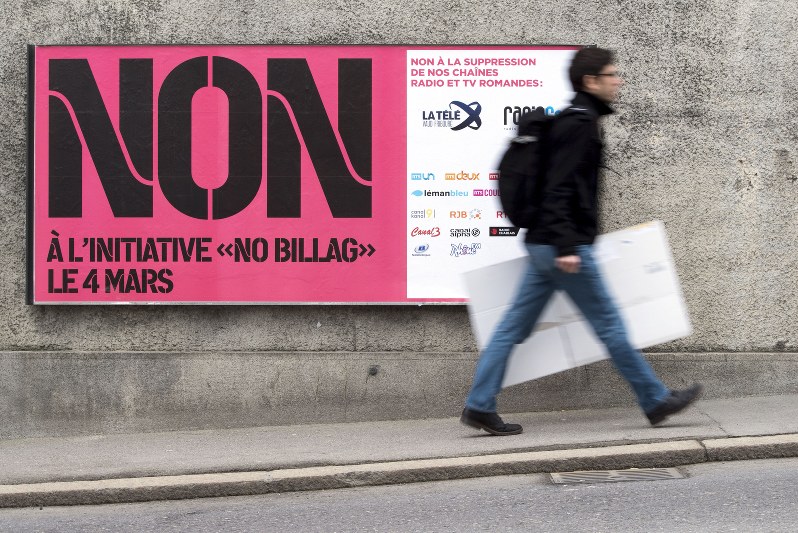
This was the choice facing Swiss voters on 4 March, following a popular initiative aimed at scrapping the licence fee and replacing it with more advertising revenues, a subscription-based, a pay-per-view, or another undefined funding system. A clear majority, 71.6%, rejected the initiative, reports Morand Fachot.
Opponents had no clear system in mind
The aim of the “No Billag” initiative (named after the licence fee collecting institution) was to change Article 93 of the Swiss constitution on “Radio and Television” to prevent the government from collecting a licence fee and from providing subsidies to radio and television stations.
Those behind the initiative claimed that it would allow citizens “who prefer to buy newspapers, books, pay for their studies or make a donation to an NGO”, to do so rather than pay a licence fee.
Swiss public, and to a significant degree also private local and regional, broadcasting relies on the licence fee.
Complex and diverse media landscape
The Swiss broadcasting (and media) landscape is complex owing to the country’s regional and linguistic diversity (with four national languages), and its proximity to three very large broadcasting markets (Germany, France and Italy – in addition to Austria), which share three of these same languages.
The latest available survey of national languages shows that German is the main language for 63% of the population, followed by French (22.7%), Italian (8.1%) and Romansch (0.5%), Non-national languages (mainly Portuguese and English) are used by some 21% of the population.
Ensuring similar levels of access to public broadcast services in four national languages for all citizens is a complex and costly undertaking in a country of barely 8.5 million. This task falls mainly on SRG SSR, the Swiss Broadcasting Corporation (SBC), which is funded by a compulsory contribution (licence fee) of 451 Swiss francs (CHF) a year (around £345) per household for radio and TV.
However, this licence fee doesn’t fund SBC only but also 34 local TV and radio stations, which complement public and commercial broadcasting, operate on a non-profit basis and offer access to media training and production facilities.
Some 13,000 jobs depend directly and indirectly on SBC.
The licence fee provides nearly 75% of SBC’s total budget of some £1.25bn, advertising and sponsoring making up about 17% of the overall budget.
A solidarity-based distribution of this budget is aimed at making “an important contribution to national cohesion, mutual understanding and dialogue between the language regions.”
Although the German-speaking part of the country collects some 73% of the licence fee, it receives only 43% of it to fund its German-language radio and TV broadcaster, SRF.
The French-speaking region, which collects 23% of the total fee, receives 33% of the total for its RTS service. The Italian-speaking part, which collects 4% of the total, is allocated a 22% share. As for the Romansch-speaking region service it collects 0.5% of the overall licence fee for a share of 2% of SBC’s budget.
SBC Director General Gilles Marchand stressed that this budget-sharing system, based on solidarity, allows the three main linguistic regions to benefit from similar levels of services irrespective of their economic or demographic weight.
Multiple services – wide audience
SBC broadcasts seven TV channels: a news channel in German and two general interest channels in each of the three main national languages.
It also operates 18 radio stations and a rich online offer in the national languages.
SBC’s reach extends beyond the country’s borders thanks to its online international service in 10 languages Swissinfo (funded equally by SBC and the confederation) and to its participation in international services.
SBC programmes are also broadcast on the global Francophone TV5Monde network, of which SBC is a shareholder, and on 3sat, the German-language network set up by German, Austrian and Swiss public broadcasters.
Taking into account unlimited access to hundreds of TV channels and radio stations from neighbouring countries that share languages with Switzerland, audience figures (share and reach) for the radio and TV services of the three main language SBC networks are very respectable and show them as clear leaders in their respective markets.
For instance, 93 out of the 100 most-viewed programmes on RTS in 2017, were RTS productions.
Meeting the challenge
According to the latest opinion polls, a clear majority emerged against the initiative after the opposite trend was recorded in late 2017. People realized that, in the words of Marchand, there was no “Plan B” from the No Billag supporters, just a “Plan D” for a complete and final dismantling of the public broadcaster and of the 34 radio and TV stations that depend on the licence fee.
In addition to SBC and dozens of private radios and TV channels that benefit from the licence fee, other organisations and public opinion in general increasingly moved against the initiative.
Other public broadcasters in Europe and beyond viewed this initiative with concern. The European Broadcasting Union (EBU), together with other media organisations, expressed support for the Swiss public broadcasting system. EBU Director General Noel Curran said: “We should do all we can to ensure that public service broadcasting in Switzerland continues to provide an independent, diverse voice in an increasingly complex and divisive world.”
Lack of credible arguments
The arguments put forward by the No Billag supporters lacked credibility, it would have been unconceivable to fund public broadcasting services in three [four] languages through advertising only in a relatively small market like Switzerland.
According to PwC SBC netted 48.6% of the revenues of Swiss advertising market for radio and TV in 2015. The share of foreign broadcasters was just over 42% and “continued to limit the potential of private Swiss channels” (9% in 2015).
SBC has a positive economic impact in the country. It will invest more than CHF 900m in the country in the next 10 years, according to Marchand.
A report by BAK Economic Intelligence, shows that each franc from the licence fee generates CHF 1.42 in added value, and each million CHF collected results in the creation of 10 jobs in the country.
 Communication Minister Doris Leuthard (pictured) said that the licence fee would be lowered from its CHF 451 a year per household to CHF 365 (CHF 1 a day) from 2019 onwards.
As its funding will come under pressure SBC put forward a series of measures.
These include a CHF 100m francs (£77m) efficiency plan, with CHF 80m coming from reinvesting CHF 20m of savings internally.
The advertising ban for SBC online services will continue and SBC decided also not to offer targeted advertising in the regions.
A representative of private radio and TV stations has called for increasing the share of the licence fee allocated to these stations from the current 5% to 10%.
Beyond the economic impact, always difficult to convey to any public anywhere, what seems to have moved a clear majority in favour of keeping the current licence fee-based funding model was the wish to preserve a system that faces tough challenges from international operators, but has always managed to provide high-quality programmes, is well-liked by listeners and viewers and contributes also to social and national cohesion.
A very small price to pay for the equivalent of 95 pence a day per household, less than the price of a cup of coffee…
10 November 2017
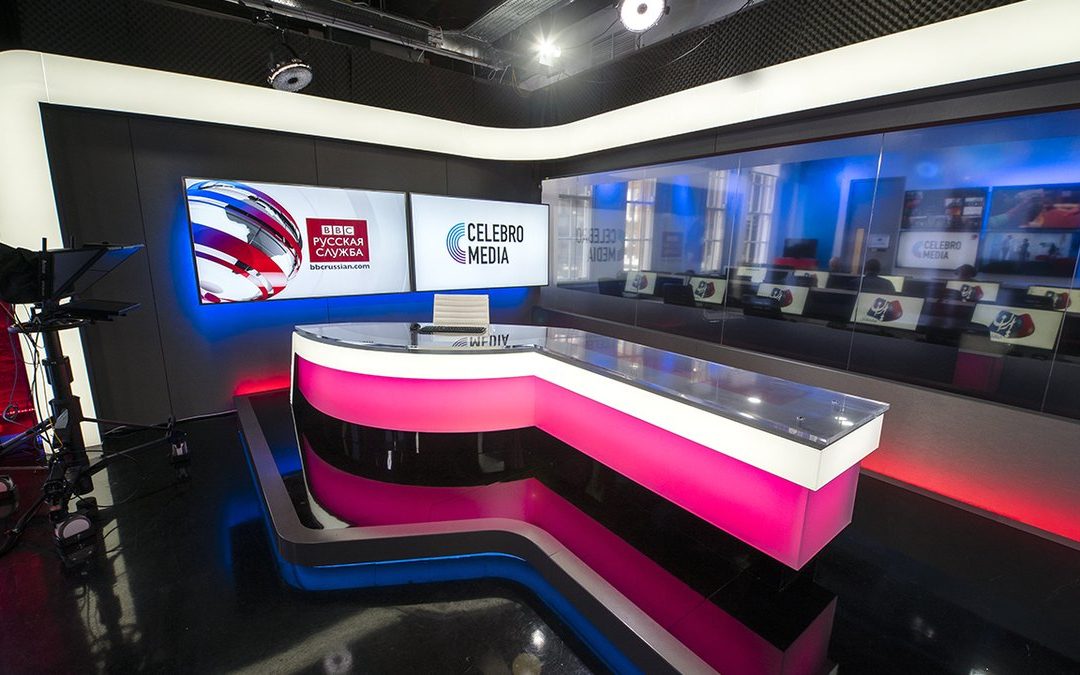
Three years ago, Celebro opened a 2,000 square foot studio close to Oxford Circus in central London. The concept was simple: to offer state-of-the-art, multi-camera news studios with the kind of automation that international broadcasters have come to expect.
Today the company has 12,000 square feet at its London complex (with more space coming on-line in 2018) and operates a number of 24/7 channels, providing a full-service solution that includes newsrooms, OBs, playout and uplinks. Celebro has a wide client base that includes traditional broadcasters such as BBC, ITV and Viacom, news agencies including Reuters and internet companies such as Yahoo! The company has also helped launch international global news channels like Iran International, provided an international bureau for TRT World and provided services for a host of other international broadcasters across Europe, the Americas and Australasia.
Celebro is now expanding operations around the world. Celebro’s Moscow studio opened in 2015 to service broadcasts for MTV. The office has recently moved to central Moscow where it offers an enviable view of Red Square. Celebro’s Head of Production, Andrew Lebentz, explains that the move is timed ahead of a busy news cycle in Russia. “The eyes of the world will be focussed on Russia in 2018. March sees fresh Presidential Elections and of course the football World Cup kicks off in the summer. We already have a renewed interest in Moscow live positions as a result of the questions over Russian involvement in Syria and the US elections. Our new facility boasts unrivalled views of Red Square and has the capacity to run six simultaneous transmissions.”
Today Celebro is about to begin the process of taking its concept global. Celebro’s chief executive, Wesley Dodd, has announced that the company is building new studio locations in Washington DC and Los Angeles. “We wanted to take the same concepts that have helped in our success in the UK and offer our international clients the same level of service in the US. Our facility will offer more than 4,500 square foot near the Capitol with an eye-catching backdrop.”
The main studio will offer a fully-automated five-camera news centre along with a state-of-the-art newsroom with MOS integrated systems, VizRT graphics systems and a combination of desktop and craft editing. They will also offer three stunning rooftop positions of Capitol Hill, the beating heart of US politics.
The Washington studio is due to open in spring 2018 and a facility in Los Angeles is due to come on-line even sooner. The new studio, near the legendary junction of Sunset and Vine, has a spectacular view of the Hollywood sign and again offers a multi-camera automated news facility for those clients who want more than a straightforward ‘down-the-line.’
But Celebro’s ambitions do not end there. Over the past year Celebro have been building an IP based OB company that has responded to some of the year’s biggest news stories: the Grenfell Tower tragedy in London; the UK General Election; Catalonia’s independence vote; and the Manchester bombing.
 Celebro’s Chairwoman, Maxine Mawhinney, is a former BBC News Channel anchor and explains the concept. “My years in rolling news means I understand how important it is to get reporters live on air and from the scene as fast as possible. Celebro Live is quick and easy to deploy and offers all the stability of a satellite truck but without the enormous cost. Also our ‘Celebro Minis’ are easier to take to the heart of the story, and have a much smaller carbon footprint.”
Over the next two years Celebro plans to add 30 new cities to its network infrastructure through a combination of new studios and Celebro Live facilities. To do so, Celebro has attracted venture capital funding in the UK and the US which is already helping the company to reach new markets.
You can see an interview with Wesley Dodd in the AIB’s In Conversation series here
17 August 2017
“We call upon the Iranian authorities to reverse this order urgently and allow BBC staff and former staff to enjoy the same financial rights as their fellow citizens.”
The BBC’s Persian Service is banned in Iran and BBC Persian staff and their families routinely face harassment and questioning from the authorities.
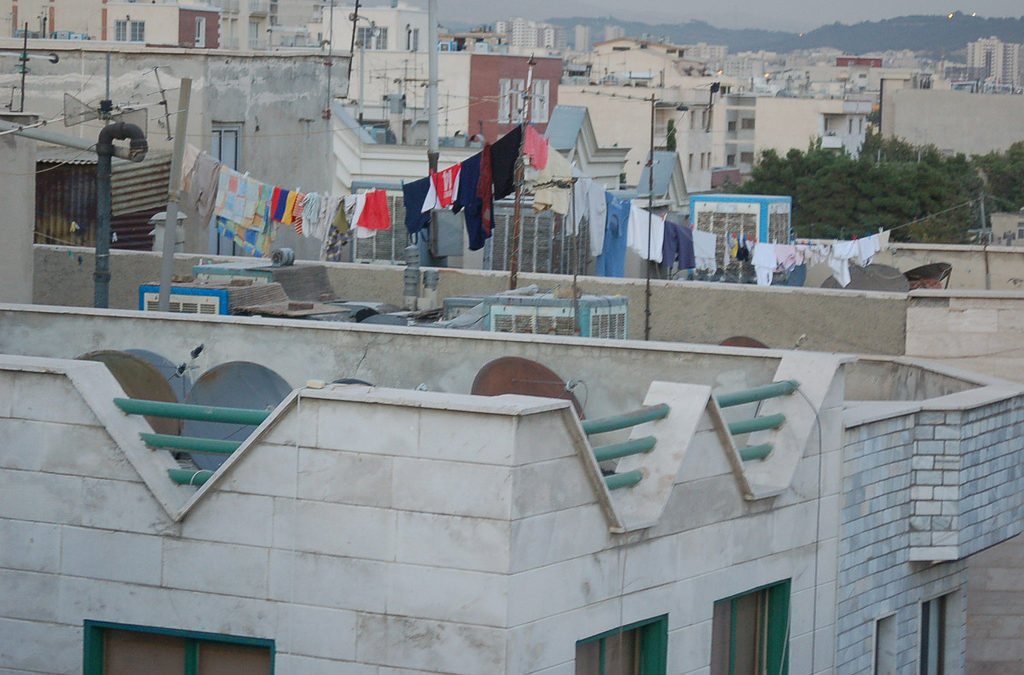
Reception of foreign TV and radio via privately-owned satellite dishes is banned in Iran, although there is widespread flouting of this rule. Dishes are often hidden on balconies and below rooftop parapets, as the image above from BBC Persian shows.

In July 2016, authorities seized and destroyed a reported 100,000 satellite dishes and receivers. According to media reports from Iran, General Mohammad Reza Naghdi, the head of Iran’s Basij militia, oversaw a destruction ceremony in Tehran after the equipment was confiscated and warned of the impact that satellite television was having in the country.
“The truth is that most satellite channels… deviate the society’s morality and culture,” AFP news agency reported him as saying. “What these televisions really achieve is increased divorce, addiction and insecurity in society.”
Naghdi claimed that a total of one million Iranians had already voluntarily handed over their satellite dishes to authorities. Iranian conservatives regularly denounce the channels as an attempt to corrupt Iranian culture and Islamic values and the police regularly raid neighbourhoods and confiscate dishes from rooftops. Under Iranian law those who distribute, use, or repair them can be fined up to $2,800.
Despite the ban on the BBC, the latest figures show the BBC World Service has an audience of 13m in Iran, making it BBC News’ seventh biggest market worldwide.

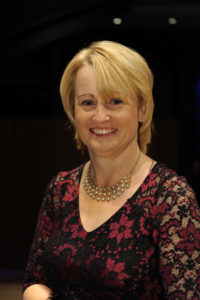 “Many people have been in touch with us asking for an extension to the closing date,” says AIB Awards Co-ordinator Clare Dance (pictured). “We’re able to push the deadline back to enable the AIBs to showcase the very best factual content from all over the world. This year’s competition has already seen fantastic work submitted and it’s being entered by broadcasters and production companies which have not entered the competition in the past. Here at the AIB, we believe this demonstrates the constantly growing influence and importance the the AIBs enjoy. In this 13th year’s competition, we’re seeing the largest number of entries ever across the 20 categories.”