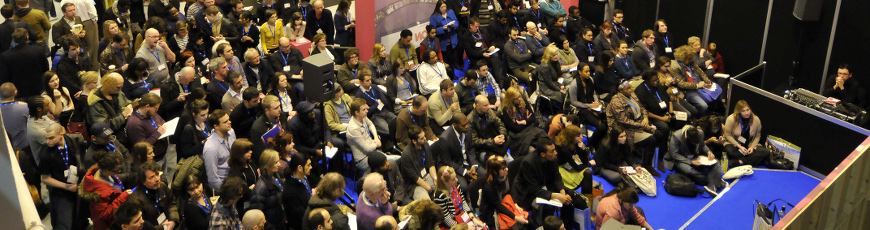
Broadcast industry conferences can fall into the trap of becoming mere forums for insiders sharing old ideas with other insiders – and at their worst, an echo chamber removed from real world concerns. One of the goals of AIB’s #iamabroadcaster Global Media Summit last month was to look outside established wisdom to the real world and real audiences the broadcast industry serves.
TIMA (The International Media Associates) partnered with AIB to provide a series of on-the-street interviews with young people in Washington DC, London, Paris, and Teheran, providing a unique insight into how the 21st century expects to consume its media.
It should surprise few that conventional, linear tv viewing was far down the list of priorities of the next generation. When asked what was their primary means of consuming news and entertainment content, most favored the computer, tablet and phone. “I watch television a little bit in the morning, but that’s all.”
“Internet. I barely use the radio and the television. I practically only use the Internet,” said one Parisian man. And in London, the responses were similar: “Online, on my phone. I really don’t watch TV at all.”
The responses were no different in Teheran: “I don’t have such a great relationship with the TV. I don’t put much time on it.”
On the face of it, this would sound like a death knell for broadcasters. And it is, if you still believe that broadcasting means linear distribution to a TV or radio. But TIMA’s vox pops revealed that the hunger for content has gone through the roof. Reliance on mobile technologies means that audiences formerly tied to viewing hours in the morning or evening can now access content any time, anywhere.
Said one Parisian “What is practical with the Internet is that you can do it whenever you want, so I do it when I want all day long.”
The trick for broadcasters – for anyone distributing content through the internet – is not the demand or lack of audience, but getting that audience to pay for the content.
When asked how willing they were to pay for content, some of the interviewed young people echoed a Parisian responder “The Internet is basically the contrary of this. We can share our information freely and as much as we want with no monitisation on it. So, no.”
Many already had subscriptions to services like Netflix and Spotify – and a few said they might be willing to pay extra for some premium content.
An American responder said, “We’re so used to having such easy and ready access to it, that for it to become a pay structure, I think that would be really upsetting. I’d find ways around paying.”
Interestingly, the young people in Teheran expressed far more willingness to pay for quality content online than their western counterparts.
The entire collection of these #iamabroadcaster Global Vox Pops can be viewed on our YouTube page:
Abubakar Jijiwa, the Director General of Voice of Nigeria, the country’s official international broadcasting network, is stepping down after over two decades of service. Jijiwa has been an active participant in the AIB and a judge of the AIB awards.
The following farewell was written by his colleague Abdul-Warees Solanke head of the VON Training Centre:
In two weeks from now, the Director-General of Voice of Nigeria, Mallam Abubakar Bobboyi Jijiwa (MFR), will be exactly 22 years in the service of the Corporation, 10 years as its director general. Statutorily therefore, he will bow out from VON, an epoch deserving some sober reflection from this quintessential public manager and a rededication or commitment to work for the greater good of the country beyond life in VON.
In December last year, he similarly relinquished the chairmanship of the Broadcasting Organizations of Nigeria which he also led since 2004. His services as DG VON and Chairman BON has yielded huge dividends in the Nigerian broadcasting industry where players are more united, new grounds broken and talents nurtured due to his visionary and managerial disposition. Whenever there is an opportunity for assessment of his predecessors, Jijiwa always give them credit for providing the platform for his own achievements. All of them excelled within the circumstances they found themselves, he would always say.
Jijiwa came to VON in March 1993 from the News Agency of Nigeria where he was the Assistant General Manager (Enterprises). His sojourn in the federal government established media actually began at the Kaduna based-New Nigerian, where although he was employed as a senior accountant, he was drafted to the editorial board as a special correspondent because of his gift of the pen which he had been wielding as a regular contributor in the New Nigerian since his university days while studying accountancy at the University of Maiduguri.
Impressed by the brilliance and lucidity of his writings, the NN management felt it would be an under-utilization of talent consigning him to merely poring over cold figures instead of giving him the platform and the space on the pages to churn words and ideas to influence opinions. Since New Nigerian in 1984, Jijiwa has not looked back in providing leadership in the mass media, returning home briefly the invitation of the Gongola state government to serve as Secretary to the Fufor Local Government. After completing the Fufore assignment he returned to NN and shortly after in 1988, he picked an appointment with the News Agency of Nigeria as Ag. Chief Accountant, a position he held until 1989 when he was invited by his home government, Gongola to lead the state-owned radio station, Gongola Broadcasting Corporation.
In less than four years of heading GBC, later Adamawa Broadcasting Corporation, Jijiwa turned around the fortunes of the local radio station to an enviable one in the north east of Nigeria. ABC which had no permanent site and transmitting station, built one under Jijiwa. Then Jijiwa as the GM had been designated Director General and sole administrator of the corporation. With this feat, he was soon back at NAN as AGM enterprises in 1992 and in March 1993, he joined Voice of Nigeria as Director Finance and Supplies. But in-between his service in VON, he had the privilege of being invited home to serve as the Adamawa State commissioner for Budget, Economic Planning and Finance.
This rich experience jijiwa placed at the service of VON when he returned from his leave of absence and assumed office as Director Administration and Finance of the Corporation under Aremo Taiwo Allimi in 1999. Being the most senior director in VON when Aremo Allimi completed his single term in 2004, this rich experience also recommended him to the post of Ag. Director General. Again, this rich experience facilitated his confirmation as the substantive DG in March 2005 and secured him a reappointment in 2010.
As DG VON since the past eight years, Jijiwa has used this experience to pilot the affairs of the Broadcasting organizations of Nigeria (BON), the umbrella of all public and private broadcasting services in the country. Four of these eight years, he also used to etch Nigeria’s name on the Commonwealth Broadcasting Association hall of fame as he was elected CBA president in 2006 in the Indian capital, New Delhi for a two-year term, securing another CBA mandate in the Caribbean nation of the Bahamas in 2008.
Since relinquishing the CBA presidency in 2010, Jijiwa has dedicated himself to providing leadership in public service broadcasting globally as he is regularly invited to public service broadcasting forum worldwide as a lead speaker, authority and resource person. He has used broadcasting to confirm Nigeria’s eminence in all regions of the world: Asia and the Pacific, the Americas, Australia, Europe and here in Africa He is enriching broadcasting for Nigeria. He is mentoring a lot of leaders and managers in the Nigerian public service broadcasting firmament. He is contributing to to the growth and development of the Nigerian public information sector.
The Greatest beneficiary of course is the Voice of Nigeria which he has provided the leverage for global network and partnership, affording the staff of the corporation tremendous learning and development opportunities in countries like Germany, France, the Netherlands, the United States, Malaysia, Singapore, south Africa, Indonesia, Egypt, Angola etc. Name the country and you are likely to find one VON staff studying or working or participating in international conference, workshop or seminar on broadcasting there. Jijiwa facilitated these. This writer is a beneficiary in winning a Commonwealth Broadcasting Association Scholarship to pursue graduate studies in Public Policy and Administration at Brunei Darussalam’s premier university in Bandar Seri Begawawan.
From Jijiwa in VON in the past 22 years are so many lessons in leadership, service, comradeship, compassion and integrity. He readily gives credit to whom it is due, acknowledging every little effort of staff, colleagues and superior. Ask his predecessors in office, Mallam Yaya Abubakar and Aremo Taiwo Allimi. They are always full of superlatives in describing Jijiwa as a team player. Ayo Sulaiman, Ben Egbuna, kabir Muhammed Ahmed, Timothy Gyang, Sola Tijani, Okey Nwachukwu, Margaret Obanya, Frank Ilogu and others who worked with him on the VON Board of Management consider him a gift in leadership and Management of human resources.
Jijiwa’s uncommon leadership qualities and humility are to be traced to his humble background in rustic Fufore, via Yola Adamawa State, the grace he has enjoyed in his growing up years, the men of eminence he had served and the challenges imposed on him by his community which find him worthy of the title of Sardaunan Ribadu, a traditional title of prime ministerial status in Ribadu District of the Adamawa Emirate. But the most eminent is the national honor he was conferred with by President Goodluck Jonathan in 2010. He was honored with Member, Federal Republic (MFR). Successive Ministers of Information since 2005 found Jijiwa an asset in the information ministry under which VON falls as a parastatal. His colleagues regards him highly just as he respects all immensely.
As he bows out of VON, Jijiwa, established as a Gamji, would be leaving behind a worthy national heritage. Jijiwa continues in service of Nigeria as he returns to the to his primary constituency, Accounting. One unique feature of Sardaunan Ribadu is his limitlessly elastic patience, confounding belief in destiny and unusual spirit of sacrifice. With these, he just waits on God for direction on every step he makes. So, 22 years in the service of Voice of Nigeria, the authoritative choice, I can only wish Abubakar Bobboyi Jijiwa more of the blessings of the light of faith, wisdom, understanding, discernment, courage, fairness and justice. These are the essentials of success in public leadership. These are implied in the Nolan Principles of public life. Every leader or aspiring public office holder can also learn from Jijiwa.
Today is opening day of Broadcast Video Expo 2015 at the ExCel in London. BVE is Europe’s second largest broadcast tradeshow (first place goes to the mighty IBC in Amsterdam) and is becoming a key event, not only in the UK production calendar, but increasingly in the international one. Whereas IBC has sometimes had difficulties incorporating its seminar programme into what has traditionally been a technology show, BVE’s seminars have gone from strength to strength and are drawing increasingly bigger names – this year’s show will feature actor/director Richard Ayoade (Submarine, The IT Crowd). And the show’s focus has expanded beyond the exhibition of kit to also incorporate knowledge sharing, education and networking.
The Association for International Broadcasting is also getting involved in BVE’s seminar programme, with AIB Chief Executive Simon Spanswick and Editorial Director Neal Romanek moderating and hosting sessions this week.
AIB had the pleasure of interviewing BVE’s Event Director, Alison Willis, about London’s biggest production event, where it came from and where it’s going:
How old is BVE and how did it start?
There has been a broadcast-based exhibition in London for over 20 years, though its name and venue have changed several times (remember The Production Show at the Business Design Centre?). London – indeed the whole UK – is a major centre for the global creative industries, boasting talent and facilities that are the envy of the world. The UK content creation industry also contributes a significant amount to the economy; according to a new BFI report on media production in 2014, 222 films started principal photography in the UK in 2014 with a UK spend of £1,471m, while 87 high-end television shows began production with a UK spend of £615m.
How has BVE changed and grown over the years?
BVE and its predecessor shows have always represented an important date in the UK broadcast industry calendar as an opportunity to learn about new technology, see the latest products and network with peers. Every year we strive to reflect the state of the industry, ask the questions that people want answered, and look ahead to the next set of challenges.
BVE took place at Earl’s Court for many years. Have people warmed up to the ExCel location?
By and large, they have. It’s very well served by public transport, and we’re finding that once visitors are here they are staying much longer than before; at Earl’s Court it was easier to pop in and out, but people are now investing a day and planning their visit to catch more seminars, plan more meetings, and have time to look around properly. ExCeL is also much more accessible for international visitors with London City Airport close by – we’ve seen a rise of 12% for international visitors since the move. The new venue is also very easy for exhibitors to set up, the catering facilities and other show services are excellent, and there is plenty of space for the show to develop and grow.
How has BVE responded to changes in the broadcast industry, with digital and online content now competing with the traditional broadcast space?
The last couple of years have seen some major changes in what ‘broadcast’ means, from cinematic broadcasts of theatrical events to the growth of streaming video for corporates, and brands becoming broadcasters in their own right, not to mention multi-platform programming. BVE is putting an umbrella across the growing ‘broadcast’ sector, working in conjunction with our advisory panel to monitor broadcast trends and note who the key players are, as well as targeting experts that can make sense of the rapid rate of change. Our free seminar programme, offering over 120 hours of sessions, is more diverse than ever this year with representatives from organisations like the Victoria & Albert Museum, the Association of British Theatre Technicians, Leo Burnett and Arsenal FC TV speaking alongside traditional broadcast and production companies.
Does BVE see itself as a show for producers or for tech-heads?
Both! Producers need to be aware of technological trends and formats, for instance understanding the data storage and post-production implications of shooting in 4K; just as engineers need to have an understanding of what producers are trying to achieve. BVE offers an amazing opportunity for these seemingly disparate worlds to come together and understand that they are working towards the same goal of producing exciting, informative, creative content.
What are some of the highlights at this year’s BVE?
4K continues to be a hot topic across the industry, and BVE is delighted to present a keynote presentation from Bruno Mahe, Head of Technology at Illumination Mac Guff on ‘The future of computer-animation and the road to 4K’. Other highlights in the 4K Theatre include Minoru Yonezawa, CEO, Sky Perfect Broadcasting Co. presenting ‘How Japanese broadcasters are leading the way in 4K broadcast’ and a case study from Sky Deutschland on ‘Taking Live Music to 4K’.
The ‘connected world’ is also high on the agenda, and in the Connected Theatre visitors can learn about issues including multi-platform content, monetisation and rights. Jonas Anschütz, Business Affairs Manager, Red Arrow Media discusses his company’s experiences of working with the likes of Netflix, Amazon and Hulu on co-productions, while Kati Price, Head of Digital Media, Victoria and Albert Museum, reveals the museum’s multiplatform strategy and its use of apps to encourage interaction and engagement. The role of the second screen in maximising audience engagement is discussed by a panel including Neil Hall, Executive Product Manager for Sport, BBC Future Media and David Gibbs, Director of Digital Media, Sky Sports.
BVE 2015 is also doing its part to ensure that the UK stays at the forefront of global production, with a dedicated afternoon for the ‘Broadcasters of the Future’ taking place on Thursday 26 February. The tailored sessions across all the theatres will educate and advise students, recent graduates and young people starting out in the industry, highlighting the skills they need and how to get them. Confirmed seminars include the BBC Academy presenting File Service Delivery sessions; Bournemouth University showcasing their graduation show reel with its top students discussing the inspiration for and production of their individual pieces; and Ravensbourne facilitating a networking session with leading industry figures who can give real-world advice.
What do attendees want to see in a tradeshow? Are there too many industry tradeshows and conferences?
It’s increasingly important to have a UK event where people from all areas can converge to discuss their experiences, share their knowledge and learn from each other. The internet is great for research, but nothing beats actually meeting vendors who can explain their products in human terms or hearing industry experts sharing their experiences and being able to ask them questions. It’s also a chance to see pieces of equipment in action – we have over 260 exhibitors this year, 70 of them new to the show, and many product launches and exciting innovations.
With people pressed for time as never before, and budgets ruling out overseas travel for many, it’s essential that we as organisers ensure that BVE is relevant, informative and inspiring enough to warrant people taking the time to attend. We’re confident that our visitors will not be disappointed.
BVE is free to attend for production professionals and runs from 24-26 February. Learn more at the BVE website.
This week, AIB is making its first visit to ISE (Integrated Systems Europe) in Amsterdam, a trade show not always at the top of the list for broadcasters. So why are we here? And what is ISE anyway?
ISE is one of the world’s biggest tradeshows serving the installation and AV market. The gear on the tradeshow floor and the seminars held are wide-ranging. Tech companies present everything from touch-screen kiosks and weatherproof 4K monitors to smart home devices and elaborate comms systems. The ISE seminars and conference topics include the smart building tech, immersive audio, home theatre design and, of course, the potential of The Internet of Things.
So what does ISE have to do with broadcast? And why is ISE worth AIB’s notice?
For one, more and more of our broadcast partners are showing at ISE. Avid, Dolby, DPA Microphones, and Sennheiser are all here – as well as the big media tech players like Panasonic.
More importantly, we realise media is no longer bound by conventional distribution channels, a theme that ISE returns to again and again.
In the past couple years, we’ve kept hearing about “The Internet Of Things” and that we have passed a tipping point in its development. Exactly what the Internet Of Things is meant to be is still vague, even to some experts, but at its core is the notion that the devices all around us in our daily lives will be able to communicate with each other and with us.
The ISE keynote address on Monday evening was given by futurist Lars Thomsen of Future Matters, who was a technical adviser on the movie Minority Report. That dystopian sci-fi film famously showed a vision of the future in which media was omnipresent, and highly personalised. As characters walked down the street, advertisements on flat-panel screens would personalise their content as they passed, and the mass manipulation of data was a matter of everyday occurrence.
In his keynote address, Thomsen painted a picture of a future world – one he thought was not too many years away – saturated in the connectivity of IP, one in which virtually everything we own has its own IP address, everything we own is a part of the internet.
We know that the bulk of web traffic in the world is dominated by video – and that percentage is only going to grow. As IP connectivity between everyday objects – phones, fridges, bathtubs, TV’s, cars, air conditioners, roofs, sidewalks – becomes more ubiquitious, the opportunity for delivering content to consumers – for broadcasting – extends beyond the “internet” to potentially every device we own. The potential reach of a piece of content in that scenario in which everything is a receiver of informations is nearly infinite. Imagine being able to transmit your content to a display (and one not necessarily confined in size and shape) that is part of your audience’s fridge, or bed, or bathroom, or car, or workplace wall, or…you name it. The Minority Report vision of hyper-hyper-targeted content seemed like a sci-fi dream when the movie was released in 2002. Looking at this year’s ISE, it’s apparent we’re not too far away from it.
Broadcasters – those who want to survive into the next century – are leaving behind the definition of broadcast as a linear one-to-many proposition. The new generation of broadcasters understands that broadcasting is no more or less than the delivery of relevant timely content – through whatever means is best suited to its audience. From the discussion at ISE, we can see that the future holds an endless variety of ways in which a broadcaster can contact its audience, where reaching the audience no longer even depends on a consumer’s access to a screen. In the ultimate vision of The Internet Of Things, every thing that a consumer owns is a connected opportunity for messaging and for communication, and a chance for the consumer to participate in a truly universal conversation that will makes today’s communications web look like 1930’s radio.
Understanding and awareness of the possibilities of this new world of hyper-broadcast is essential for both media companies and consumers alike. The latest scare that Samsung TV’s may be registering and relaying living room conversations without viewers’ consent is one issue that will have to be resolved to consumers’ satisfaction, along the way. If you thought issues of privacy, content ownership, and the borderlines between public and private life were complicated now…
Some say we still have a way to go before the full implications of an IP addressed life becomes accepted. Even many of the vendors at ISE think we’re going to be stuck with hardware and cables for a while. But the connected future will be a present reality soon, and AIB is preparing broadcasters to be a leading part of it.
TV-2, one of Russia’s first independent commercial stations, will lose its broadcasting license on 8 February, only five weeks after its terrestrial signal was cut off by the local Tomsk monopoly responsible for broadcasting transmissions. The move will silence one of the last remaining independent broadcasters in the country just months before its 25th anniversary.
Local authorities have refused to review their decision despite a demonstration of more than 4,000 people showing their support for the broadcaster on 1 February.
On November 30, TV-2 was notified by the Russian Television and Radio Broadcasting Network (RTRS), a local division of the state monopoly that owns broadcasting facilities, that it would not be renewing TV-2’s contract when it ended in December. RTRS turned off the station’s signal on 1 January 2015, leaving the company with only cable distribution.
This is not the first time that TV-2 has been involved in a conflict with RTRS. In 2014, TV-2 was not able to broadcast its signal because of repair works at RTRS’ facilities that lasted an unexpectedly long time.
“About a month after we had been switched off the air, because of the long repairs, we started to actively speak out in the press. There were rallies in support of us. Maybe, RTRS perceived that as political pressure and got offended,” Viktor Muchnik, TV-2 Editor-in-Chief told the BBC Russian Service.
Muchnik believes that politics is behind the threatened switch-off. “We can presume that some people do not like some of our reports. For example, the governor [of the Tomsk region]. But I cannot bluntly say that he is in charge of the termination of our broadcasts. I have no proof. I know that the local government often discusses our reports. And many of the reports on everyday issues are considered political. I cannot say who exactly is annoyed with our reports but certain law enforcement agencies send letters about us to the top,” Muchnik said in an interview with the BBC Russian service.
TV and Radio company TV-2 was founded in November 1990 and its first broadcast was on May 15, 1991. The company is the major asset of the Tomsk Media Group holding company which also runs cable channels, an advertising agency and a number of radio stations. Four of the TV-2 team are members of the Russian TV Academy. The company has a reputation for providing accurate and independent news reporting on important political and social issues. It has been awarded 22 TEFI awards by the Russian TV Academy.
RTRS is the Russian-government owned corporation, providing terrestrial air transmission of TV and Radio channels over the whole of the Russian Federation. RTRS was created in August 2001 by decree of Russian president Putin.
A video purporting to show the execution of Japanese journalist Kenji Goto by “IS” militants has been released.
Kenji Goto went to Syria in October, reportedly to secure the release of another Japanese man, Haruna Yukawa.
In the video, Goto is seen kneeling in an orange jumpsuit beside a black-uniformed, masked figure who addresses the Japanese government in British-accented English and wielding a knife. The speaker has been tentatively identified as “Jihadi John”, who has apparently appeared in other execution videos. The video cuts back and forth between two camera positions and care has been taken in recording the speaker. The video also contains carefully designed graphics.
Goto’s mother, Junko Ishido, read from a prepared statement from her home in Koganei, western Tokyo:
“Kenji has passed away. I am at a loss for words, facing such a regretful death. The only thing I can do now is to shed tears of deep sorrow…I strongly hope we can hand down Kenji’s wish of creating a society without war and saving children’s lives from war and poverty.”

 It should surprise few that conventional, linear tv viewing was far down the list of priorities of the next generation. When asked what was their primary means of consuming news and entertainment content, most favored the computer, tablet and phone. “I watch television a little bit in the morning, but that’s all.”
 The trick for broadcasters – for anyone distributing content through the internet – is not the demand or lack of audience, but getting that audience to pay for the content.