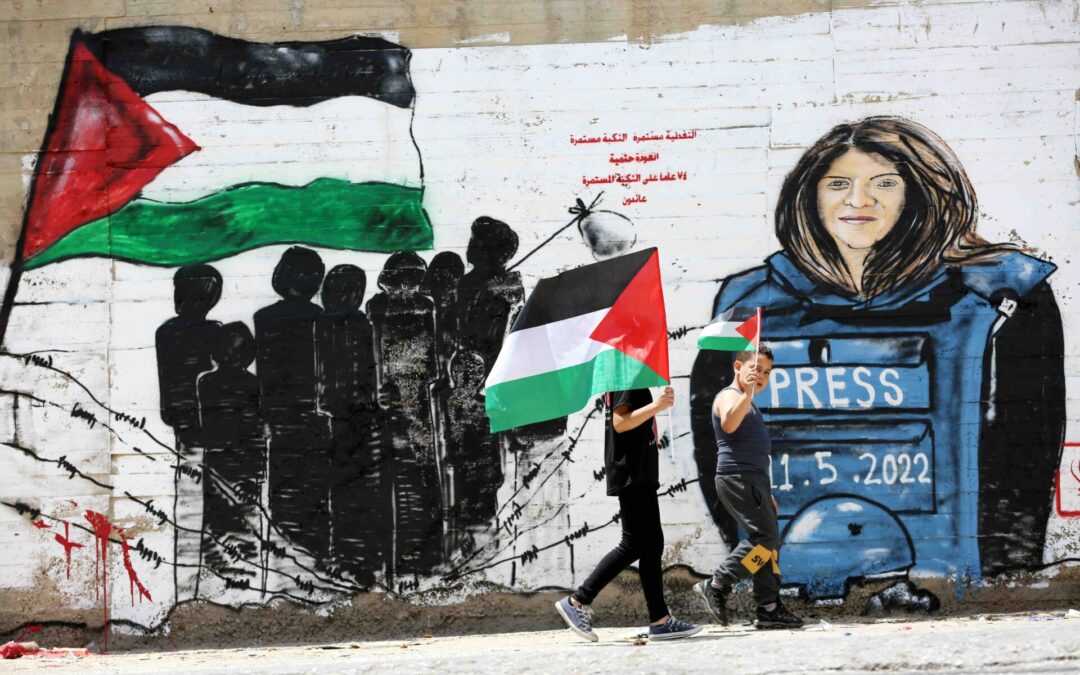
The AIB has joined a coalition of 34 press freedom and human rights groups calling for an immediate and independent investigation into the killing of Al Jazeera journalist Shireen Abu Akleh on May 11.
This is the full statement:
We, the undersigned organisations, call for an immediate, thorough, and independent investigation into the killing of veteran Al Jazeera journalist Shireen Abu Akleh in an attack in the West Bank on May 11 that also left another journalist wounded. We demand that the government of Israel and all other states fulfil their responsibility to ensure that crimes against journalists are fully investigated and prosecuted.
The killing of Abu Akleh, one of Palestine’s most widely respected journalists who had reported from the West Bank for decades, has shocked many in the region and around the world. According to Al Jazeera, Abu Akleh and three other journalists came under fire from Israeli soldiers while reporting on an Israeli military raid of a refugee camp in the city of Jenin on the West Bank. The reporters were wearing vests and helmets, clearly marked as “press.” Abu Akleh was shot in the face and Al Jazeera producer Ali Al-Samoudi was shot in the back. Al-Samoudi was treated for gunshot wounds and released from the hospital.
Eyewitness accounts, video documentation and media reports indicating that these journalists may have been deliberately targeted by Israeli soldiers have made this case all the more alarming. An analysis by independent investigative teams with Bellingcat concluded that the gunfire came from Israeli soldiers and that the shots seem to have been “both aimed and deliberate.”
We call attention to this latest case as one of a wider pattern of violence against journalists and media workers in Palestine. At least 23 journalists in Palestine have been killed since 2002, according to UNESCO data, and hundreds have been injured by or targeted with violence.
In May 2021, Israeli forces bombed the media offices of the Associated Press and Al Jazeera in Gaza Strip. That same month, an Israeli airstrike killed Voice of Al-Aqsa reporter Yousef Abu Hussein in his home. In 2018, Palestinian journalists Yaser Murtaja and Ahmed Abu Hussein were also killed while covering the Gaza border protests. Advocacy groups, including the International Federation of Journalists, have cited these cases in a recent submission to the International Criminal Court on the “systematic targeting of journalists” in the occupied Palestinian territory.
The duty to investigate: Ending impunity for crimes against journalists
States have a duty to investigate attacks on journalists promptly, thoroughly, and independently, and to prosecute those responsible. This obligation is well established in international and regional human rights instruments, as well as in numerous UN protocols and resolutions, requiring states to provide effective remedy for human rights abuses.
Israel is among the many states around the world that are failing to meet this obligation. A vast majority of murders of journalists go unresolved, which has fueled a culture of rampant impunity for violence and crimes against the press on a global level.
The obligation to investigate crimes against journalists does not disappear in a conflict zone. On the contrary, authorities are legally bound under international law and international humanitarian law to ensure the safety of journalists and media workers in situations of conflict. Moreover, a deliberate attack on a journalist during a situation of armed conflict constitutes a war crime.
The killing of Shireen Abu Akleh represents a particularly egregious attack on the press, not least because of credible reports that Abu Akleh and other journalists were intentionally targeted by Israeli forces, but also in light of growing concerns over impunity for crimes against journalists and other grave human rights abuses by Israel in the occupied Palestine territory. The Israeli government’s recent announcement that it will not investigate this killing only adds to these concerns.
We, the undersigned organisations, demand concrete action by states and other duty bearers, including international governmental organisations (IGOs) with a specific mandate in this area, to fulfil their duty to protect the safety of journalists and to ensure that attacks against the press are not carried out with impunity.
We call for:
• The government of Israel to uphold its international obligations to conduct a thorough, transparent, and independent investigation into the killing of Shireen Abu Akleh and to prosecute those responsible. This investigation must include the full involvement of independent international experts or observers and must follow UN protocols for conducting investigations into human rights abuses.
• In parallel, an international task force to investigate this attack and to ensure credibility and impartiality of procedures and outcomes. Ideally, such a task force would be led by UN special rapporteurs with mandates that include oversight over issues related to the safety of journalists or human rights abuses. This follows the precedent set by the investigation into the killing of Jamal Khashoggi initiated by Dr. Agnes Callamard, former UN Special Rapporteur on extrajudicial, summary or arbitrary executions in 2019. This investigation must include the full involvement of independent international experts, as well as participation and input by journalists and civil society.
• In the absence of an independent and impartial investigation by the government of Israel, the International Criminal Court (ICC) to conduct an investigation into the circumstances of Abu Akleh’s killing and the attack on Abu Akleh and her colleagues to determine if this incident amounts to a war crime under the Rome Statute of the ICC.
• Governments, particularly allies of Israel, to hold Israel accountable to its international obligations to protect the safety of the press and for ending impunity for crimes against journalists in Palestine. Governments must also urge Israel to fully cooperate with any international inquiries into this crime as well as with other investigations into human rights abuses by Israeli forces in the occupied Palestinian territories.
• Governments to take clear measures to end impunity for crimes against journalists at the global and local levels, including through multilateral institutions and coalitions. This includes prioritising support for the creation of a standing, international multi-stakeholder task force to investigate threats and crimes against journalists, involving the participation of UN special rapporteurs, civil society, media and journalists worldwide.
Signatories:
- Article 19
- Association for International Broadcasting
- 7amleh – The Arab Center for the Advancement of Social Media
- Afghanistan Journalists Center (AFJC)
- Bahrain Center for Human Rights
- Cartoonists Rights Network International (CRNI)
- Cambodian Center for Human Rights
- Center for Media Studies and Peacebuilding (CEMESP-Liberia)
- Centre for Independent Journalism, Malaysia (CIJ)
- Child Rights International Network (CRIN)
- Committee to Protect Journalists (CPJ)
- Freedom of Expression Institute (FXI)
- Globe International Center
- Gulf Centre for Human Rights (GCHR)
- I’lam Media Centre
- Independent Journalism Center Moldova (IJC)
- Index on Censorship
- International Federation of Journalists (IFJ)
- International Press Institute (IPI)
- Maharat Foundation – Lebanon
- Media Action Nepal
- Media Foundation for West Africa (MFWA)
- Media Watch Bangladesh
- Mediacentar Sarajevo
- Pakistan Press Foundation (PPF)
- PEN Canada
- PEN International
- PEN Norway
- Public Media Alliance
- SEENPM
- South East Europe Media Organisation (SEEMO)
- Syrian Center for Media and Freedom of Expression- SCM
- World Association of Community Radio Broadcasters (AMARC)
- World Association of News Publishers (WAN-IFRA)
Image: Palestinians walk in front of a mural for Al Jazeera journalist Shireen Abu Akleh in the West Bank city of Bethlehem, 16 May 2022. Abu Akleh was killed on May 11 2022 during a raid by Israeli forces in the West Bank town of Jenin. EPA-EFE/ABED AL HASHLAMOUN via IPI




 In a
In a