
29 January 2015
 An Azeri court has extended the pre-trial detention of independent journalist and RFE/RL contributor Khadija Ismayilova for an additional two months.
“We are devastated by this decision, which lacks any factual basis and violates the basic requirements of due process,” said Nenad Pejic, editor in chief and co-CEO of US state broadcaster RFE/RL. “The extension of her sentence can only be interpreted as an act of revenge by Azeri authorities against the country’s leading investigative reporter.”
RFE/RL’s Baku bureau was raided and sealed shut on December 26 by agents of the state’s “grave crimes investigations committee” in connection with a new law on so-called “foreign agents.” The same law was invoked to force the National Democratic Institute, IREX, and other organizations supporting civil society development to suspend their local operations.
RFE/RL sent a letter to Azeri authorities earlier this week requesting that the Baku bureau be reopened and employees resume their work without fear for their security and safety.
Ismayilova, who has reported extensively on the financial activities of family members of Azeri President Ilham Aliyev, was arrested and jailed for two months on December 5 on charges of inciting a former colleague to attempt suicide.
Azerbaijan’s crackdown on foreign journalists has been widely condemned, including by the Association for International Broadcasting.
29 January 2015

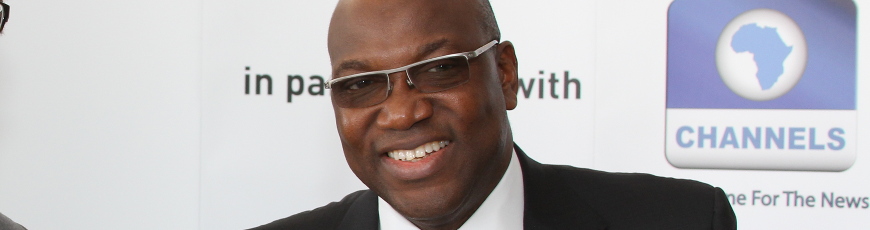
John Momoh signs an agreement with BBG at AIB’s 2014 event, “Africa’s Digital Media Future”
The story of Channels TV is in some ways the story of the modern Nigerian broadcast industry. John Momoh started it in 1992, sometimes shooting, editing and presenting all himself. Now Channels TV is Nigeria’s biggest broadcaster with aims to become a channel for Africans all over the world. John Momoh will be a speaker at AIB’s #iamabroadcaster Global Media Summit, hosted by the Assocation for International Broadcasting, on 18-19 February at London’s Royal Institute of British Architects.
What has been the reason for Channels TV’s success?
I think it’s a combination of the fact that we’re very blessed, very lucky, and that from the onset, we carved a niche for ourselves. What I did when I set up Channels was to get a new crop of broadcasters, so there would be a departure from the government-controlled organisations. We tried new ways of doing things, in modes of dressing, presentation, production. We introduced graphics for the first time, we introduced sets. We were doing a lot of things that hadn’t been done before, and that put us in the eyes of the public. It was 24/7 in those formative years, and even up to now. It’s been one long journey, with a lot of hard work and a lot of dedicated staff.
You had a wide variety of broadcast experience in your early years. How did that help in starting Channels TV?
Initially I had to take the lead. I used to go out with a camera, put it on my shoulder and shoot, go back to the studio and edit, then read the news. Sometimes the newscasters would direct. And my wife, Olusola, who was a stabilising force for me, would also do a lot work. In those formative years, I would take a lot of the equipment at hhome in my car. It was all hands-on.
Channels TV will be starting in the UK this year.
Yes. We hope to settle everything by February or March 2015. We’ve pretty much done everything. We’re waiting for Ofcom to give us a licence. Every other thing is in place. There have been some challenges. We’ve had to tweak our application, but I think now we’ve got things right. And we’re just waiting for the approval.
Tickets are still available for AIB’s #iamabroadcaster Global Media Summit. Featuring two days of conversation by top figures from the global media industry, and the inaugural David Frost Memorial Lecture, #iamabroadcaster will be held at London’s Royal Institute of British Architects on 18-19 February.
In addition to John Momoh, other speakers include, Peter Limbourg, Director General of Deutsche Welle; Tom Roope, Creative Director of The Rumpus Room, and Neeraj Arora of MSM Asia Limited/Sony Entertainment Network. Download the summit agenda here.
(read this interview in its entirety in the next issue of AIB’s print magazine, The Channel)
28 January 2015
Eurosport today announced that it has extended its partnership with the Vuelta a España, the third and last Grand Tour of the cycling season, by securing all TV and digital rights of the event until 2020.
The agreement, which was renewed through the EBU following a tender process, incorporates all 54 territories covered by Eurosport in Europe, and features exclusive rights in key markets including France, Germany, Italy, Poland and UK*.
The premier cycling event will continue to be covered live on the Eurosport channel, which is also available on PC, mobile, tablet and connected TV via Eurosport Player, Eurosport’s online subscription service.
The deal reinforces Eurosport’s status as the ”Home of Cycling” and its unrivalled coverage of over 40 events every season. Eurosport’s cycling portfolio includes the three Grand Tours and the leading one day and multi-day stage races, delivering fans a total of 1,800 hours of TV coverage on Eurosport and Eurosport 2.
Jean-Thierry Augustin, CEO, Eurosport Group commented: “As we enter the twentieth year in our broadcast of the Vuelta a España, I am delighted to extend our long-term partnership with this great property until 2020. Vuelta a España and cycling is in our DNA and, in 2014, 100 million different European viewers** enjoyed the sport on our TV channels. We are pleased to support and contribute to the growth of this premium property across Europe and look forward to bringing all the action and drama to the fans.”
*coverage is exclusive in the UK on the live broadcast only
**Sources: AGF/GfK, BARB, SKO, MMS, TNS-Gallup, Kantar Media, AGB NMR, Armadata/Kantar- Techedge

28 January 2015
 Speaking on behalf of the international satellite community, Michel de Rosen, CEO of Eutelsat, today warned African states of the consequences for the continent if C-band resources are reallocated to mobile operators.
Michel de Rosen was speaking to delegates from African countries gathered in Nigeria for a meeting organised by the African Telecommunication Union (ATU) to prepare for the World Radiocommunication Conference scheduled to take place in Geneva from 2 to 27 November 2015. During the meeting in Abuja, African states will define their position on access to the C-band that is currently allocated to satellite operators and claimed by mobile operators.
Michel de Rosen reminded delegates that the C-band is widely used to provide vital services, including air traffic control, government and enterprise communications, disaster relief, broadcasting and Internet access. The use of C-band by mobile operators would mean the total loss of these critical services, with no possible alternatives.
“Opening the C-band to mobile operators would not herald the expansion of its use for new services. It would mean the end of services, with no guarantee that new mobile services would actually be deployed using this band. It’s a lose-lose scenario and exactly the opposite of the intended goals,” he said.
“Terrestrial operators already have access to a very broad range of spectrum and should be using this first before seeking to acquire more, particularly if this process is carried out at the expense of critical applications,” he added.
27 January 2015
Euronews is the only European news media available on Clear TV’s offer for airports.
The most-watched news channel in Europe has been selected by ClearTV Media (CLTV:F) to be available on their channel produced for five major American airports that include: Dallas Love Field (Texas), New Orleans International Airport (Louisiana), Cleveland International Airport (Ohio), Grand Rapids International Airport (Michigan), and Raleigh-Durham International Airport (North Carolina).
ClearTV Media is currently adding Denver International Airport (Colorado), San Jose International Airport (California), Reno International Airport (Nevada), and Tucson International Airport (Arizona).
The ClearTV Media network will soon reach over 100 million passengers annually, and they will be able to watch Euronews’ best programmes on over 700 screens in airport waiting areas.
Euronews programmes featured in English language by ClearTV Media are:
– News: daily bulletins, Europe, Focus.
– Economics: Business, Real Economy.
– Sci-Tech: Science, Space, Futuris, Hi Tech.
– Culture: Le Mag, Cinema.
Arnaud Verlhac, Worldwide Distribution Director of Euronews said: “We are proud to be the only European news media having been selected by ClearTV Media. We are looking forward to offering our international, independent and multi-cultural programmes to a potential new audience of 100 million viewers each year. Furthermore, the fact that ClearTV Media is distributed in US airports perfectly aligns with our strategy to offer the right content, in the right place, at the right time.”
“Euronews brings something fresh and exciting to our traveling audience at airports” said Jonna Birgans, VP, Programming Strategy at ClearTV. “By providing our viewers the diverse selection of news-related content from one of the top European broadcasters makes ClearTV the premiere platform partner for all types of global broadcasters.”
Jenny Delcambre, Head of Global Travel Distribution of Euronews added: “Euronews viewers are frequent travellers who want to stay informed and connected wherever they go. We are proud of and excited by this partnership with ClearTV Media which is an excellent opportunity to make airline passengers in the US discover our diversified and original content with a European angle”.
(Source: Euronews press release)
27 January 2015
 DW’s Crossroads Generation is being offered as in-app content on Mxit – a South African mobile social network with millions of monthly active users.
Deutsche Welle has added to its portfolio of partners in Africa with Mxit – one of the largest mobile social networks on the continent. DW and Mxit worked together to develop an app for Crossroads Generation, which makes the educational audio content available to users throughout Africa. Users with any Internet-enabled mobile phone can listen to the program for free after adding “crossroadsgen” as a contact in their Mxit account.
Crossroads Generation is an educational radio novella designed to help Africa’s youth deal with everyday challenges in a fun and easy way. Listeners learn about real-life issues like drug abuse, teenage pregnancy and domestic abuse.
“The new deal with Mxit will ensure that we reach our target audience in Africa even better,” says Petra Schneider, Director of Distribution at DW. “We can definitely imagine expanding the partnership in the near future to include online and audio content in several African languages, as well as video content in English.”
Ben Carl Havemann, Marketing and Communications Manager of Mxit, called Crossroads Generation app as a format featured by the platform “especially valuable for our core target group.”
With nearly 5 million users in South Africa alone, Mxit is particularly popular among young people and rivals heavyweights like Facebook. The majority of Mxit users are located in South Africa, and other key markets include India, Nigeria and Indonesia.
Mxit compresses digital content to make it accessible on all types of handsets and over all types of networks – something that is especially important in Africa, where network speeds have remained slow in many places. Mxit users can engage in private chats, group chats, play games or read news, and most of the content is free.
Crossroads Generation is broadcast on DW radio in Amharic, English, French, Hausa, Kiswahili and Portuguese and rebroadcast by 260 DW partner stations in Africa. It is being offered initially on Mxit in English.

 An Azeri court has extended the pre-trial detention of independent journalist and RFE/RL contributor Khadija Ismayilova for an additional two months.

