11 March 2015
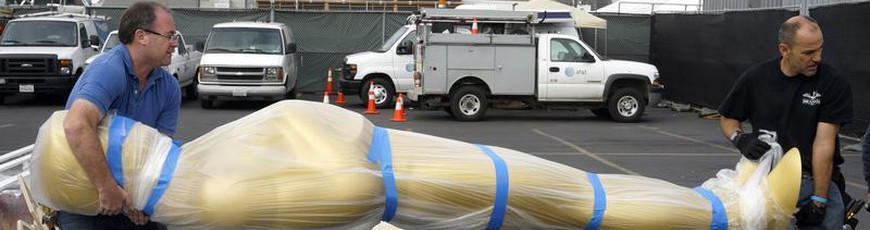
 Even before the public unveiling of their new locations services partnership, Reuters and TIMA were planning their live facilities provision for the 87th Academy Awards.
The physical set up, which commenced several days before the show, was culmination of weeks of planning and coordination between the Reuters bureau in Los Angeles, and staff in Washington DC and London from both Reuters and TIMA. The live camera was set up on a specially-constructed steel bridge over the red carpet on Hollywood Boulevard, near the entrance to the Dolby Theatre.
With Reuters-TIMA broadcasting live for clients in Europe as well as Latin America, it was essential to ensure that the transmission route’s working as planned. The substantial US fibre network meant that Reuters-TIMA didn’t need to hire its own satellite truck to broadcast from the Oscars. Clients who used the services for run-up broadcasts included a broadcaster from the Middle East and Polish Television who, with the nomination (and subsequent win) of Polish drama Ida, was closely watching the race for Foreign Language Film.
 Rain on the day of the Oscars required event organisers to construct a temporary rain cover running the length of the red carpet, which threatened to block broadcasters’ view of the arrivals, but on the day of the show, the cover was removed. During the Oscars pre-show, Reuters-TIMA broadcast transmissions for clients in the Middle East, Poland, Japan and Argentina with the Reuters Video News team editing Oscars footage and writing scripts for the news service.
“I couldn’t have hoped for a more successful launch of our new partnership. Clients from all over the world booked with us and everything went smoothly. It feels like the months of planning, hiring and buying are now beginning to pay off – despite the rain,” said Tim Santhouse, Reuters Global Head of Video Products.
Reuters’ Martin Veal kept a diary detailing the challenges of settging up and executing the Reuters-TIMA Oscar coverage. Read it here.
9 March 2015
The international news channel is now available via cable to 1.1 million Indian homes in Delhi and its region.
Broadcast in luxury hotels* in India since 2013, Euronews has made significant advances in the country, through the signing of four distribution agreements with regional leading cable networks covering Delhi and the suburb of Noida.
The English service of Euronews is now part of the basic digital line-up of the cable operators Star Broad Band, Satellite Channels Pvt Ltd, Home Cable and Neo News Network, received in 1.1 million homes.
* Euronews began its distribution in India in 2013 through agreements with the most prestigious hotels, including international chains such as Radisson, Hyatt and Crown Plaza.
Over 10,500 rooms in some 50 hotels around the country receive Euronews.
… and mobile devices
| Euronews and Samsung in India |
|
Samsung has chosen to pre-load Euronews on its new operating system, Tizen, which made its world premiere in India.
The Euronews Tizen app is available on the new Samsung Z1 smartphone, exclusively on the Indian market since 14th January 2015, and later in Bangladesh.
This development is part of a global agreement with the South Korean company.
|
| Euronews is also present in India, as elsewhere in the world, thanks to its digital distribution via all of its apps for connected devices, its website, YouTube channels and social networks. |
Arnaud Verlhac, Worldwide Distribution Director of Euronews stated: “Asia and the Indian sub-continent are a key geographic area for Euronews’ development. The obvious growth potential of India makes the country a strategic and necessary place to do business. These recent distribution agreements are the result of three years of work by the entire team and testify to the value of our objective editorial approach and the quality of our programmes and magazines.”
Sabrina Mimouni, Regional Distribution Manager Asia-Pacific added: “Launching Euronews in the Delhi area is the first visible sign of Euronews’ arrival on this market which is particularly difficult to penetrate. I am delighted by the confidence the four big cable operators have shown in us. In just a few weeks, they put Euronews in their basic line-up so that the largest number of subscribers would have access.” (Source: Euronews press release)
5 March 2015
 Find out all about the AIB’s #iamabroadcaster conference, held in London on 18 and 19 February, in the delegate book all participants received.
Delegates travelled from across Europe, the Middle East, Africa and North America to join the conversations that took place at #iamabroadcaster. Speakers from Sydney, New Delhi, New York, London, Bucharest, Tomsk and Moscow participated, either at the venue or via an ipDTL broadcast-quality video link. You can read about all the speakers in the delegate book, and learn about the conference Platinum Sponsor, Channels TV.
#iamabroadcaster is just one of AIB’s activities that support our global members, and the wider media industry. Talk to us to find out more about the Association and its work.
5 March 2015
 At the AIB’s #iamabroadcaster conference in London in February, Michael McEwen, Director-General of the North American Broadcasters Association, kindly provided an overview of the media market in the region.
McEwen (pictured left) recounted the experiences of members of NABA and talked about the challenges – and opportunities – that face his organisation’s members.
You can watch McEwen’s address here.
5 March 2015
- EditMate, the new solution for editing, provides project management extension to Adobe Premiere Pro CC.
- Features and benefits of arvato Systems’ latest innovation will be presented at Cabsat in Dubai
Broadcasters like those attending the CABSAT 2015 in Dubai face a challenge familiar to media companies across the world: Ever-increasing demands for efficiency and quality coincide with the need to move to a new non-linear editing platform, all while allowing users to benefit from the existing MAM installation. The EditMate solution is presented at Cabsat 2015 in Dubai from 10 to 12 March 2015.
EditMate was developed to dramatically increase productivity and quality control in environments where editors share networked access to projects and media files. With an optional integration to a MAM system, additional workflow control, data sharing, access control, and other advanced functions are also available.
The new tool is an elegant editing project management solution that enables collaborative editing, project sharing and easy-to-use management of all project related files within Adobe Premiere Pro CC. arvato Systems’ newest product is fully integrated as a Premiere Pro CC plugin and is an optional component for VPMS, arvato Systems’ popular MAM solution. EditMate tracks all your editing projects and also includes features for automated metadata import, housekeeping, user rights, template management and efficient import of multiple projects.
As a plugin inside Adobe Premiere Pro CC, the intuitive EditMate user interface offers easily accessible tabs for functions like Search, Create, Save, and Check In. Based on system configuration and templates, required and optional metadata are populated either by users or automatically filled in from a connected external source, such as arvato Systems’ MAM solution, VPMS.
EditMate manages all your editing projects securely, and users from any location can access projects and their related media files. To prevent disaster scenarios, EditMate manages stored AutoSaves, and users can restore their own or other projects directly through their EditMate window in Premiere. Projects that are controlled by EditMate can be locked, and, when connected for instance to a MAM system, the related media files can be flagged to prevent deletion as long as the project is active.
Administrators have the power to configure various aspects of EditMate, including metadata definitions, searchable metadata, hold-back times, templates and standard project “collections”, presets for automatically created project titles, and more.
EditMate changes the way media companies can think about and work with editing projects: From isolated “editing bays”, to networked and collaborative environments where tasks are completed by quality-focused, collaborative teams.
arvato Systems is at CABSAT 2015 in Dubai from 10 to 12 March where the company and its partner Qvest Media showcase its innovative industry-specific solutions for managing and monetizing the digital transformation at stand E3-10.
http://s4m.arvato-systems.de/com/news-events/cabsat-2015.html
2 March 2015
SES has announced that Christophe De Hauwer has been appointed by the Board of Directors of SES as Chief Development Officer (CDO) and member of the company’s Executive Committee, effective 1 August 2015.
Christophe De Hauwer will succeed Gerson Souto, the company’s current CDO, who has decided to step down from his position for personal reasons and relocate to Brazil, his home country. Gerson will continue to advise SES and work with the Executive Committee on development projects in Latin America and elsewhere.
Christophe will officially take up the position of CDO on 1 August 2015. He has been with the Company for over 10 years, holding several positions of responsibility in the areas of Strategic Marketing, Strategic and Business Planning and Corporate Development. In his current role of Senior Vice President, Fleet Development and Yield Management, Christophe oversees the overall optimization of the entire SES satellite fleet and its future development.
Christophe also played an instrumental role in the acquisition of New Skies (2005), the GE share redemption (2007) and the investment in O3b Networks (2009). Since 2010, he has served as a board member of O3b Networks. Prior to joining SES, Christophe was a consultant, first at Arthur Andersen Business Consulting and later at Deloitte & Touche. Christophe is a Belgian national and holds an Engineering Degree and a PhD in Engineering from the University of Brussels in Belgium.
Gerson Souto has been with SES for more than 16 years and has been an Executive Committee member and Chief Development Officer since 2011. Previously, he was a member of the Management Committee of SES NEW SKIES and later of SES WORLD SKIES.
Karim Michel Sabbagh, President and CEO of SES, stated: “We respect and understand Gerson’s decision and are pleased that he has agreed to continue to support SES in a strategic advisory role. Gerson has been instrumental in SES’s global expansion and integration across its various business units. Under his leadership, SES has articulated a holistic and winning strategy which is now serving as a platform to focus on go-to-market and investment efforts, as well as the capabilities development agenda. We wish Gerson all the very best for the future. In appointing Christophe De Hauwer, the Board of Directors and the Executive Committee have ensured a strong succession and a flawless transition. Christophe’s deep knowledge of the industry and of SES, as well as his management skills, will help us to further deliver on our growth potential.” (Source: SES press release)

 Even before the public unveiling of their new locations services partnership, Reuters and TIMA were planning their live facilities provision for the 87th Academy Awards.