14 June 2016
Euronews is a trusted source and leader for international news brands in the annual Ipsos Affluent Survey Europe.
Europe’s elite population, surveyed in this independent industry research study, shows that Euronews placed Second in highest reach to audiences in continental Europe with a digital usage increase of 23%.
In continental Europe, Euronews has the second highest daily, weekly and monthly reach of all international news channels.
Euronews is # 1 in Central and Eastern Europe, with the highest daily reach of any other international News brand, such as CNN, BBC World News, and CNBC. Euronews leaves other top News brands behind in the Central and Eastern European markets of Russia, Czech Republic, Hungary and Poland combined.
In total, Euronews services reach over 12 million people and among the most affluent and powerful people in Europe every month.
Euronews daily reach on digital services has increased by 23% year on year and every day digital adds an extra 32% to TV reach alone.
The survey again emphasized the desire of the elite to follow the News in their own language; this is what makes Euronews unique and why they provide an accessible platform to 97% of Europe’s most influential people. The independent news hub addresses audiences in 13 language editions, produced by its 600 journalists from 30 nationalities. The diversity of Euronews extensive content ranges from breaking News, through sports to culture. Today, Euronews is available 24/7 worldwide in 425 million homes in 158 countries.
| |
Olivier de Montchenu, Euronews Sales Managing Director |
“The Ipsos survey results confirms that Euronews is a major brand in Europe in the international news market and also perfectly fits today’s digital world. To reinforce its success with our consumers and our clients, Euronews unveiled, one month ago, its new visual identity inspired by its new strategic vision. This vision is based on a new mission that aims to empower people and their views so they can make up their own mind from a sound, reliable and trustworthy news media source. With its new positioning “All Views” Euronews clearly announces to be the source of the diversity of perspectives, based on its strong multicultural team. This new strategic approach is our solution to reinforce Euronews as a very effective media platform for our current and future advertisers.”
Ipsos Affluent Survey Europe
(formerly EMS)
In 1995, EMS was designed to expand the Pan European Media market and to allow comparative analyses on a national and multi-national basis. EMS contained significantly more detailed demographic, classification and marketing data than any other survey available at the time or indeed now.
The Affluent Survey Europe is part of the Ipsos suite of Affluent surveys which now covers Europe, The Middle East, Africa, Asia/Pacific, Latin America and the USA, spanning 51 countries and reflecting approximately 133 million adults.
Since its first launch, the Affluent Survey Europe has continually evolved and enhanced its methodology. Ipsos interviewed a sample of 27,751 Europeans representing a business elite of 52 Million audiences, across 21 countries, each of whom was screened to ensure they passed certain minimum household income thresholds established as representing the Top 13% population.
*Continental Europe: 19 countries (all countries excluding UK/Ireland)
(Source: Euronews press release)
13 June 2016
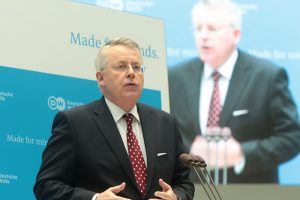 Freedom of speech and freedom of the press are increasingly facing limitations the world over; in order to counter the culture of disinformation and manipulation, “We need to rethink the way in which we perceive, demonstrate and spread our values.” With those words, DW Director General Peter Limbourg opened the Global Media Forum in Bonn on Monday, June 13, 2016.
Limbourg greeted more than 2,000 guests from over 100 countries, including representatives from a number of partner broadcasters, at the ninth annual media conference from the German international broadcaster. The topic of the three-day conference is “Media. Freedom. Values.”
“Only when people are able to communicate freely, there will be change. The possibility to share ideas and values with others and the chance to inspire those, who are still under the control of dictatorial regimes,” said the Director General.
Deutsche Welle has positioned itself on a path to digitalization – and drawn upon more than 4,000 partners from around the world. Part of this strategy includes co-productions with partners to the benefit of both parties. “This is a first in international broadcasting. And an important step in recognizing the value of the contribution of regional partners,” said Limbourg. “We truly appreciate the local expertise and perspective which our regional partners contribute.”
Limbourg lamented the state of affairs in which instead of preserving the universal prestige of the right to speak one’s mind, in increasingly more countries, limitations are being placed on laws protecting freedom of expression. He cited Turkey, where critical media personalities are being suspended by members of President Erdogan’s governing party, where unwelcome journalists are labeled terrorists, without grounds, and being thrown in prison. “In the heart of the EU, freedom of the press cannot be taken for granted,” said the Director General. With an eye cast on the national-conservative powers in Hungary and Poland, Limbourg said, “But nothing – and I stress – nothing – justifies a limitation of the freedom of expression to be rooted within a democratic constitution.”
Limbourg referred to the example of Germany. “Even here in Germany, the enemies of the freedom of the press are at work.” Right-wing populists of all shapes have problems with tolerance and with a diversity of opinion, he said.
Journalists themselves can endanger freedom of the press. “If they don’t research with due diligence, if they copy without checking the facts, or if they scandalize every harmless occurence. Because thus, they provide arguments to their enemies,” said Limbourg.
Limbourg closed with the statement, “The end of the freedom of expression is also the beginning of the end of democracy. There are simply no more excuses when this point is reached. Each and every one of us is called upon, to stand up and demand the freedom of expression loud and clear.”
10 June 2016
Intelsat S.A. (NYSE: I), operator of the world’s first Globalized Network, powered by its leading satellite backbone, announced the successful launch of the Intelsat 31 satellite, which is hosting the DLA-2 payload for DIRECTV Latin America. Intelsat 31 was launched from the Baikonur Cosmodrome, Kazakhstan aboard an ILS Proton launch vehicle. Liftoff occurred at 7:10 GMT. The Intelsat 31 satellite separated from the rocket’s upper stage at 22:41 GMT, and signal acquisition has been confirmed.
Built for Intelsat by Space Systems/Loral (SSL), Intelsat 31 is a 20-kilowatt class Ku- and C-band satellite. The Ku-band payload, known as DLA-2, is designed to provide redundancy and reliability for DIRECTV Latin America’s distribution services in South America and the Caribbean, reflecting the company’s commitment to providing their subscribers with the highest reliability in the region.
The C-band portion enhances Intelsat’s existing C-band service infrastructure serving Latin America. The satellite will be co-located with the previously launched Intelsat 30, which hosts the DLA-1 payload, at 95° West and is expected to have a service life of more than 15 years.
“Intelsat 31 will deliver additional resilience to the DIRECTV service platform, further enhancing their leadership in the region. DIRECTV Latin America is committed to providing its customers with the highest quality programming at all times,” said Intelsat CEO Stephen Spengler. “Intelsat 31 will also provide valuable C-band services for our customers and further fortifies our video neighborhoods serving Latin America.”
Resources:
(Source: Intelsat press release)
10 June 2016
Thomas Kent, a longtime Associated Press journalist, has been appointed the new President of Radio Free Europe/Radio Liberty (RFE/RL), effective June 27.
In his announcement of the appointment, Jeff Shell, the Chairman of RFE/RL’s Board of Directors, said, “Tom was chosen in a competitive selection process from a strong field of candidates. RFE/RL will benefit enormously from such an outstanding leader.” Shell, who also serves as Chairman of the Broadcasting Board of Governors (BBG), continued, “Tom’s track record in digital news expansion and his collaborative leadership style aligns with the BBG’s vision of a unified, innovative and effective U.S. International Media.”
Mr. Kent is a skilled media executive with extensive experience in management, international reporting and journalism standards development. He has worked at The Associated Press since 1972, filling roles such as Moscow Bureau Chief, International Editor, Deputy Managing Editor and, most recently, Standards Editor. In these positions, he played a leading role in the editorial and technical transformation of AP into a fully digital news organization. He has also been involved in corporate strategic planning and the development of new multimedia services.
Commenting on Kent’s appointment, BBG CEO and Director John F. Lansing said, “Our winning strategy is our talented staff. Tom joins a cadre of committed journalists around the world with the simple goal of ensuring that everyone has access to impartial, independent and professional news and information about their communities that helps citizens take more control over their lives. He brings extensive experience in developing successful digital media strategies and joins us at a highly dynamic time when BBG networks are streamlining and employing content in creative and impactful ways. I am thrilled to welcome him on board.”
“I am honored to be leading RFE/RL,” Kent said. “I look forward to joining its highly skilled team as we create great journalism across languages and geographies.”
Kent has served as a member of the advisory board of the Ethical Journalism Network, leader of the Online News Association’s Build Your Own Ethics Code project, advisor for the Society of Professional Journalists and international reporting juror for the Pulitzer Prizes. He has written and spoken extensively on journalism ethics and has a particular interest in Russian news media. Kent has taught at the Harriman Institute at Columbia University and has guest lectured at Yale University, Moscow State University, St. Petersburg University of Trade Unions, Columbia Law School, and New York University, among others. He speaks four languages and is fluent in Russian. He is a graduate of Yale University.
Shell and Lansing praised Acting RFE/RL President Nenad Pejic for his leadership and guidance since taking over after Kevin Klose stepped down in 2015.
“I am delighted to hand over the reins to Tom.” said Pejic. “I believe his passion for journalism will ensure that RFE/RL continues to deliver programs that have a positive effect on people’s lives.”
(Source: RFE/RL press release)
8 June 2016
Ines Pohl (49) will become Deutsche Welle’s new editor-in-chief on March 1, 2017. She will succeed Dr. Alexander Kudascheff (65), who will enter retirement. Pohl, longtime editor-in-chief of the German daily newspaper taz, joined DW at the end of 2015 and has been a correspondent from Washington.
DW Director General Peter Limbourg: “Ines Pohl is an outstanding journalist and an experienced manager. She will further distinguish our multi-language and cross-platform offerings and support DW’s transformation into a digital media house. She has gained high esteem within the organization in a short period of time.”
Limbourg praised Alexander Kudascheff as “a journalist who has shaped DW over many decades. He has been the best editor-in-chief DW could have hoped for during a time of internal reform and change.”
Following his academic education – philosophy, history, politics and Islamic studies – as well as a traineeship with DW, Kudascheff worked on the international broadcaster’s Middle East editorial team. He later became head of domestic politics, chief reporter and finally editor-in-chief of German radio programming. He was head of DW’s studio in Brussels from 1998 and the studio in Berlin from 2007. In 2014 he was named editor-in-chief of all DW journalistic offerings.
After studying Scandinavian and German studies at the University of Göttingen, Ines Pohl began her career in journalism as a freelancer with Radio ffn and local newspapers. She later became head of politics of the Hessische/Niedersächsische Allgemeine (HNA) newspaper and served as a correspondent in Berlin for the media group Ippen. Pohl has been a member of the board of trustees of “Reporters without Borders” since 2010 and the International Journalists’ Programmes (IJP) since 2013. Before joining DW she was editor-in-chief of the national daily newspaper taz from 2009 to 2015. (Source: DW press release)
6 June 2016
To keep Afghan sports fans up to date with this summer’s busy international calendar and beyond, BBC Pashto TV’s sports coverage is getting a major boost with the launch of the weekly live Lobay (Sports) programme. From 10 June, the 10-minute programme will be included in the Friday edition of the daily Pashto TV programme, BBC Naray Da Wakht (BBC World Right Now), bringing in-depth coverage of sporting developments that are of special interest to Afghan audiences.
The first edition of Lobay comes just before the start of the 2016 UEFA European Championship and the Afghan national cricket team’s upcoming tour of the UK, Ireland and Holland. Lobay will feature key moments of the Wimbledon tennis tournament, the England tours by the Sri Lanka and Pakistan cricket teams, and, of course, the main news from Rio 2016.
BBC Pashto TV Editor, Emal Pasarly, commented: “While we always cover sport stories from around the world, interest in sport is also growing among our Pashto-speaking audiences – especially with the Afghan national cricket and football teams doing well at regional and international levels. Lobay gives us an excellent format to deliver weekly analysis, opinions and in-depth reporting. I hope our audiences will make an appointment to watch this new, dynamic programme which is to be a permanent fixture in the BBC Pashto TV offer.”
Lobay is part of the Friday edition of the daily TV programme BBC Naray Da Wakht broadcast live from London in prime time (18.00 Kabul Time) on the Shamshad TV network and repeated on Shamshad TV at 23.00 Kabul Time. The programme is also available on demand via the BBC Pashto channel on YouTube and the website bbcpashto.com.
Two in five adult Afghans consume BBC content each week. BBC Pashto content reaches 6.7 million people in Afghanistan, Pakistan and the rest of the world every week (BBC Global Audience Measure 2016). BBC World Service – of which BBC Afghan service is part – is available to audiences in Afghanistan on multiple platforms in Pashto, Dari, Persian, Uzbek and English.
(Source: BBC press release)


