23 May 2017
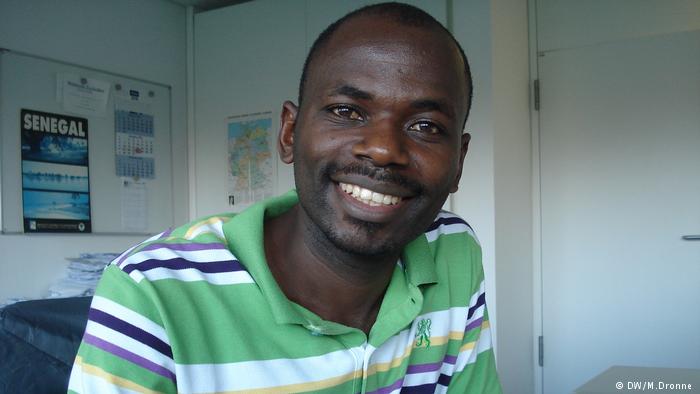
Germany’s international broadcaster DW demanded the immediate release of its correspondent Antediteste Niragira, arrested by members of the Congolese intelligence service (ANR) while reporting on Burundian refugees in the Democratic Republic of Congo .
In a statement issued on 21 May, DW said Congolese authorities were refusing to provide further information on accusations of espionage against Niragira.
‘Baseless accusations’
“The accusation that our correspondent is a spy is outrageous and baseless,” said DW spokesman Christoph Jumpelt. “We demand that the authorities in the DR Congo release Antediteste Niragira immediately and provide for his safe return to Burundi.”
Niragira had been preparing to file a report on Burundian refugees living in desolate conditions in a camp near the town of Kavimvira when he was arrested by ANR members and transferred to a prison in Uvira.
A lawyer commissioned by DW has been able to establish that Niragira has not been physically harmed.
Update – 23 May
Since news of his disappearance came through, DW has been working through all available channels to secure his release. On Tuesday 23 May, it was announced that Antediteste had been released and had returned to Burundi.
22 May 2017
Intelsat S.A. (NYSE: I), operator of the world’s first Globalized Network and leader in integrated satellite communications, announced that Globecast signed a multi-year agreement with the company to distribute the English version of TRT World in high definition format to cable outlets in Asia and the Americas via the Intelsat 20 and Intelsat 21 satellites using IntelsatOne® terrestrial fiber and teleport services.
Globecast is expanding its longstanding relationship with Intelsat to distribute TRT World content to Asia and Latin America on Intelsat’s highly penetrated video neighborhoods. Intelsat 20, located at 68.5 East degrees, is the leading distribution and Direct-to-Home distribution platform serving Africa and the Indian Ocean region. Intelsat 21, located at 302 degrees East, is one of four satellites comprising Intelsat’s powerful video neighborhoods serving the Latin America region.
“It is our goal to provide our customers with efficient distribution into new growth markets around the world. Intelsat’s globalized network, and its highly penetrated video neighborhoods, provide maximum viewers for our content owners,” said Philippe Bernard, CEO at Globecast.
Deputy Director General of TRT Ibrahim Eren stated that it is important for TRT World to be available on Intelsat 20 and 21. “Intelsat is renowned for its advanced fleet of satellites and overall expertise in the business. Through their help, coupled with sophisticated technology from Globecast, we’re delighted to expand TRT World to millions of viewers across the Americas and Asia.”
“A valued partner, Globecast’s relationship with Intelsat spans many years and many continents,” said Rhys Morgan, Intelsat’s Managing Director, Europe. “We continue to invest in our media neighborhoods to ensure that we can support the growth of customers, such as Globecast and TRT World, who distribute new high definition programming around the world. We welcome TRT World to the Intelsat network and the nearly 5,000 channels we deliver globally.”
Supporting Resources:
(Source: Intelsat press release)
15 May 2017
The ransomware attack that was unleashed on to computers in over 100 countries on Friday 12 May demonstrated just how important it is for media companies to take the issue of cyber security seriously.
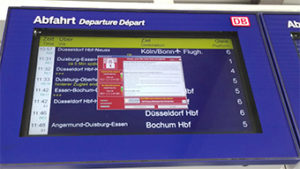 Companies and organisations as diverse as Britain’s National Health Service, Germany’s Deutsche Bahn rail network (pictured left), Spanish telecommunications company Telefonica and car manufacturers including Nissan and Renault, each suffered from the consequences of this immense cyber attack. The Association for International Broadcasting’s own Cyber Security Working Group is actively collating data on any impact there has been on media companies from this attack.
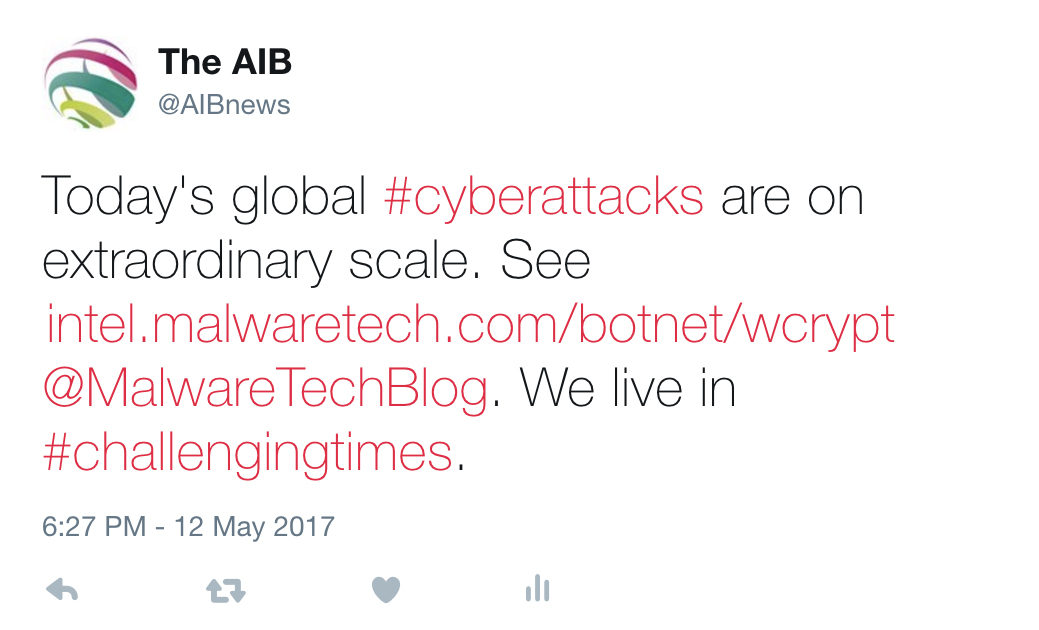
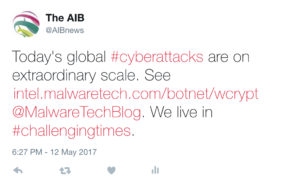 On Friday evening, the AIB’s Twitter feed (right) linked to a map of incidents traced around the world produced by a UK-based IT expert going under the name of Malwaretechblog. This 22-year-old was subsequently reported to have discovered the “kill switch” for the ransomware, bringing much of the attack to a halt (http://www.bbc.co.uk/news/technology-39907049).
“The Association for International Broadcasting has been actively working on the issue of cyber security with its Members,” said Simon Spanswick, chief executive of the AIB. “Since the attacks on Sony and TV5 Monde, the AIB has been bringing its Members together to share information and intelligence and to explore how to encourage the entire media industry to work together, and with suppliers, to combat the threat of attack. We have been telling media companies that the issue of cyber security is one of their major governance challenges. It requires board level discussion and for a board member to take responsibility for the issue as this is not simply an IT issue. It goes to the heart of a company’s responsibility to protect itself and its employees, and to ensure that it can continue to operate in a worst case scenario. The AIB is there to support its Members on this crucial, mission-critical issue.”
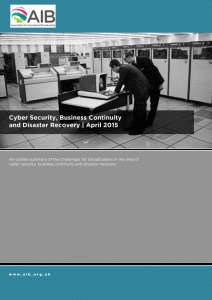 As part of the AIB’s work on cyber security, the Association is pressing home the need to take the entire security issue seriously at the highest levels in all organisations. In April 2015, the AIB published advice to its Members in a briefing document that remains relevant today. AIB Members can request a copy from the Secretariat.
In October 2015, the AIB worked with Deloitte to deliver a high-level confidential briefing event on the issues of cyber security. The one-day conference brought together representatives of many AIB Members, as well as key players in cyber security including Britain’s GCHQ that has responsibility for the nation’s cyber security (now separated into the National Cyber Security Centre). At that event, high-level GCHQ speakers noted the need for governments to include media companies in national work on cyber security and their classification as critical national infrastructure.
Since then, the AIB’s cyber security working group has developed a work programme that aims to share information and intelligence among AIB Members while at the same time pressing suppliers to the industry to respond to broadcasters’ security needs and requirements. The chair of the working group, Denis Onuoha (CISO at UK transmission company Arqiva), has spoken at major broadcasting events including NAB to highlight the ever more urgent need for the entire media industry – broadcasters and suppliers – to respond to the constantly increasing number of threats that exist from both nation states and cyber criminals.
At the European Broadcasting Union’s International Broadcasting Assembly in Sofia on 18-19 May, the AIB will be presenting to a range of international broadcasters about the threat posed to their businesses from cyber attack. In June, the AIB will be meeting with national security agencies to develop collaborative links that benefit AIB Members in protecting their businesses against cyber attack.
“This is a piece of work that will continue to develop and grow over the coming months and years,” says Simon Spanswick. “The AIB is working hard on behalf of its Members to ensure that they can protect themselves, their brands and their reputations in a world where the threats from cyber criminals has never been more challenging. The media industry needs to stay one step ahead of those who work to wreck businesses and those who – knowingly or unknowingly – derail broadcasters from their missions to inform, educate and entertain.”
Advice from the UK National Cyber Security Centre on tackling this attack is here: https://www.ncsc.gov.uk/guidance/ransomware-guidance-enterprise-administrators
14 May 2017
Arabsat workshop in cooperation with Algeria Telecom Satellite 15 + 16 May 2017
Arab Satellite Communications Organization – Arabsat – in coordination with Algeria Telecom Satellite (ATS) are holding a workshop in Algiers on 15 + 16 May 2017 where Arabsat will showcase its satellites’ latest capabilities and demonstrate how Arabsat can provide up to date technical solutions for satellite telecommunications & Internet services covering the entire Algerian territory. The workshop will be attended by figures and entities working in the satellite telecommunications sector in Algeria from both the public and the private sector.
Arabsat will showcase, in addition to its new satellite Badr – 7 , the capabilities of its new 6th generation satellites that include at present 4 satellites. Three of those are under manufacture and the 4th is still in the process of research and design. The first satellite is scheduled to be launched by the end of 2017, while the other two satellites will be launched in 2018 on Arabsat various orbital positions.
The Arabsat workshop includes various forums & seminars attended by international experts in the field of satellite telecommunications & Internet. The latest technology in the field of mobile Telecommunications will also be discussed in addition to Ka-band huge capacities coverage that meets the future demand of the market.
(Source: Arabsat press release)
12 May 2017
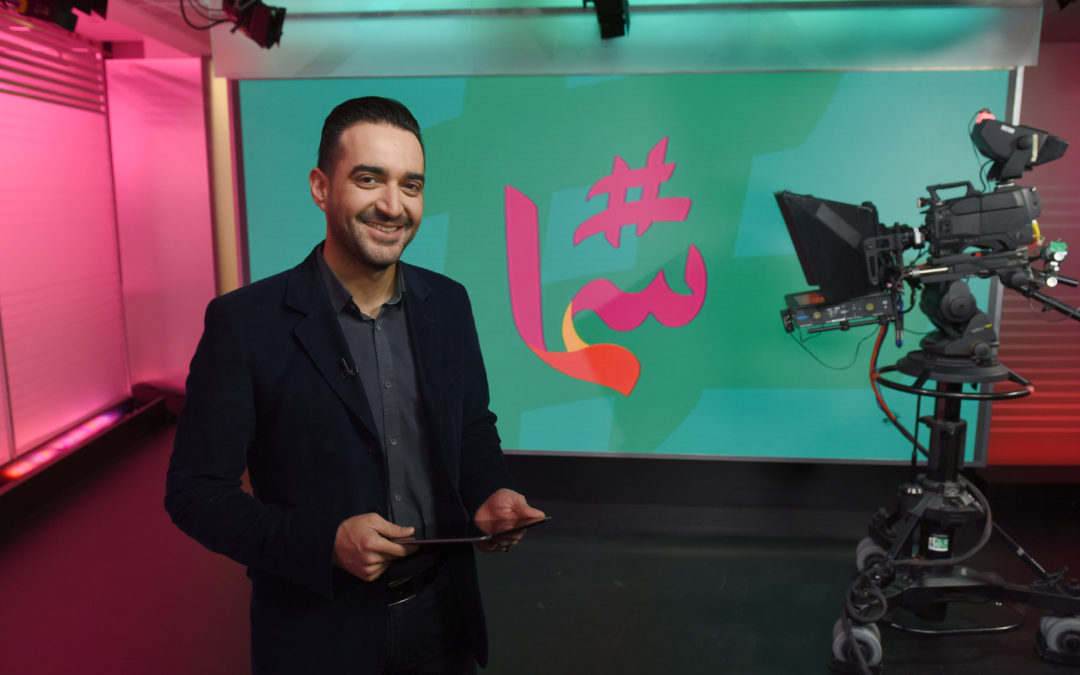
In the run-up to the elections in Iran, BBC Persian is launching its digital-first TV programme. From Saturday, 13 May, #Shoma invites audiences across platforms to share their opinions and stories.
Saturday to Wednesday live interactive programme, #Shoma (“#You”) delivers innovative and creative ways to engage with the audience on TV, the website and via social media, bringing an even greater variety of stories to the BBC Persian output. It will specifically target young digital audiences and women as well as wider TV audiences.
In addition to coverage of the daily news, #Shoma also reflects stories trending in BBC Persian’s target market across its social-media platforms: Facebook, Twitter, Instagram and Telegram messenger service. It will engage audiences in discussions about what matters to Persian-speaking viewers and listeners in Iran and across the globe.
#Shoma will be live on TV (and streamed via BBC Persian website), from Saturday 13 May at 15.00 GMT (19.30 Tehran Time, 20.30 Kabul Time, 11.00 ET), Saturday to Wednesday. It adds to the BBC Persian early evening broadcast mix of news and features.
Presenter of #Shoma, Ehsan Amertousi, sees the new programme as an exciting opportunity to deepen BBC Persian’s engagement with its audience: “In the run-up to the elections in Iran, it’s really important we give our audience the chance to share their opinions on the issues that really matter to them. Regardless of where or who you are, how old you are, #Shoma will be the place to come and tell us what is happening in your life and what you want for the future.”
The programme’s Editor, Leyla Khodabakhshi, says that #Shoma will give the audience the chance to participate and shape part of BBC Persian’s daily news agenda: “Combining the informality of social with the sense of drama often only TV programmes can bring, and delivered and shared on digital platforms, #Shoma is designed to reflect how our audience today wants to interact with us. This is a great opportunity for them to be at the heart of the BBC Persian output, and I’m so pleased we’re launching just before the election, so we can bring voters and commentators together as our audience debates the important issues.”
#Shoma can be reached via:
Tel: +44 2077650078; +44 2077650077 SMS: +44 7860063333 Twitter: @bbcshoma Instagram and Telegram: @bbcpersian, send message via @bbcshoma Facebook: /bbcpersian
BBC Persian is part of the BBC World Service.
12 May 2017
A district court in Baku today ruled in favor of a lawsuit blocking access within Azerbaijan to the website of Radio Free Europe/Radio Liberty’s (RFE/RL) Azerbaijani Service, azadliq.org.
RFE/RL President Thomas Kent said, “Today’s ruling is another blatant attempt by Azerbaijani authorities to try to silence our reporting in Azerbaijan. It misrepresents RFE/RL’s work in Azerbaijan, and violates Azerbaijan’s international commitments to respect media freedom. We will appeal it.”
The Sabail district court in Baku ruled that the Ministry of Transport, Communications, and High Technology’s request to block access to the websites of five news outlets — RFE/RL’s Azerbaijani Service, the nongovernmental Azadliq newspaper (unrelated to azadliq.org), Meydan TV, and the online Turan TV and Azerbaycan Saati TV channels — must be carried out.
Access to the websites has been blocked since March 27 on the instructions of the Prosecutor General’s Office, which claims that the websites “pose a threat” to Azerbaijan’s national security, and accuses them of “posting content deemed to promote violence, hatred, or extremism, violate privacy, or constitute slander.”
The March blockage followed the publication of investigations by the Azerbaijani Service, in cooperation with the Sarajevo-based Organized Crime and Corruption Reporting Project, on financial activities linked to members of the president’s family and inner circle. The Service also recently published reports raising questions about costs associated with a September 2016 referendum that extended the term of presidential office from five to seven years, and created the post of Vice President, to which President Ilham Aliyev appointed his wife earlier this year.
According to Azerbaijani legislation, a guilty judgement by the court against azadliq.org could be used as grounds to prosecute the website’s correspondents. In 2014, authorities imprisoned prominent investigative reporter Khadija Ismayilova on charges of encouraging an attempted suicide and financial crimes in a case that foreign governments and rights advocates condemned as politically motivated.
Ismayilova’s arrest came just weeks before Azerbaijani state agents raided and sealed RFE/RL’s Baku bureau, forcing it to close in May, 2015. In December 2008, RFE/RL was formally banned from FM airwaves by Azerbaijan’s National TV-Radio Council, but continues to engage with its audience via satellite and online social media platforms.
(Source: RFE/RL press release)
