The biggest media stories in December
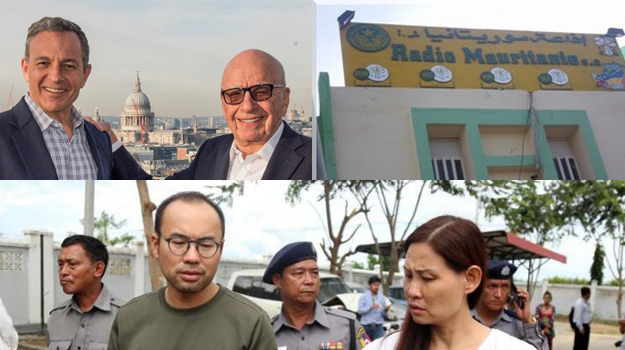
Making the greatest number of headlines in the media trade press and in the global consumer press is undoubtedly the news that 21st Century Fox has agreed to sell its entertainment business to Walt Disney. It’s an immensely expensive deal, with US$66.1bn in play for the Fox assets, assuming that the deal is cleared by regulators.
It is fitting that the deal was announced in the week of the premiere of the latest Star Wars movie. If the deal completes, Disney will become the largest media company in the world – with an empire that stretches from ABC, ESPN and A+E to Mickey Mouse and out into a galaxy far, far away.
 Murdoch will continue to own the US Fox News and Sport assets; Sky in the UK – which produces Sky News – will become part of Disney. Star, serving audiences in the growth markets of Asia, will also be part of Disney enabling them to become a prime supplier of entertainment and sport to what will become increasingly valuable – and populous – markets.
Media observers have been discussing the future of reportedly loss-making UK-based Sky News after the Disney acquisition. Whilst Disney is most likely to be interested in access to sports fans via Sky Sports, and Sky’s movie channels and services, Sky News could be an interesting addition. It has the potential to extend ABC News’ international newsgathering capabilities, helping to bolster its output in the USA against rivals including, of course, Fox News which will remain a Murdoch operation.
Disney has made no secret of its intention to launch a rival to Netflix in 2019. It will gain a 30% stake in Hulu through the deal, which it could integrate into its planned OTT service. Disney’s movie portfolio will cease to be carried on Netflix – and presumably other streaming services – when its own service launches. This new deal provides immense marketing opportunities for Disney that could enable it to eclipse Netflix and other operators providing streaming services.
We believe that there will be many episodes to this story, so it could be a good time to order lots of popcorn.
TVN fine
A high value fine was imposed on Poland’s TVN this month. The Polish media regulator, KRRIT, fined TVN24 €350,000 for allegedly violating the country’s Radio and Television Act. The regulator said that TVN24’s coverage of anti-government protests in Warsaw at the end of last year promoted “illegal behaviour that posed a threat to public security”.
TVN, which was founded in 1997, has protested that the fine is unwarranted and says that it will appeal. TVN is owned by USA-based Scripps Networks Interactive.
TVN has been joined in protests against the regulator’s decision by the European Parliament and the US State Department, as well as local media in Poland. Gazeta Wyborcza, a daily newspaper, described the fine as “giant” and “unprecedentedly high”. The US State Department said: “The United States is concerned by Poland’s decision to fine the private TV broadcaster TVN for alleged biased reporting of demonstrations outside parliament last December. This decision appears to undermine media freedom in Poland, a close ally and fellow democracy. Free and independent media are essential to a strong democracy.”
The fine comes at a time when Poland is slipping down the list of countries that have free media. It is now described as only partially free by Freedom House, while Reporters Without Borders’ global ranking of press freedom has seen Poland has fall to 54th from 18th in 2015.
It’s perhaps worth noting that Poland has been pressing in European debates to change the Audiovisual Media Services Directive to allow regulation of channels in the country of reception, rather than country of origin. The Country of Origin rule is one of the cornerstones of European media regulation.
The issue of media freedom is one that will be discussed in a high-level conference that the AIB is planning for late February 2018. More details will appear on the AIB website shortly.
Mauritania
It’s a country twice the size of France, yet has a population of just 4.5m. It’s mainly desert, and is on some governments’ lists of “only travel there if essential” destinations. And now it’s in the media news as the head of state-run Radio Mauritanie has been dismissed for fraud.
In a country where the average household income is well under US$500, general manager Abdallahi O. Hormetalla has been dismissed for allegedly making fraudulent payments totalling 33m Mauritanian Ouguiya – around GBP70,000, mostly to relatives and fictitious companies likely controlled by relations. The annual budget of Radio Mauritanie is understood to be around GBP1.77m. Hormetalla, who had been appointed in 2016, has been replaced by presidential adviser Abdallahi O. Ahmed Damou.
Journalists under pressure
Journalists trying to cover stories in Bahrain and Kyrgyzstan have been barred from entering the countries over the past few weeks, while in Myanmar, they’ve been sentenced for illegal filming.
A Tel Aviv-based US journalist working for Al Jazeera has been accused of trying to enter Bahrain illegally, the country’s Ministry of Information Affairs said in the first week of December. The journalist, a correspondent for Al Jazeera in Iraq and Israel, arrived in Bahrain without, it is claimed, having applied for a media visa and without possessing an invitation from the organisers of the event he was reportedly planning to cover, the Ministry said.
 The Kyrgyzstan government used similar tactics against AFP journalist Chris Rickleton (pictured). He reportedly has been barred from the country for “breaking the visa regime”. Rickleton has lived in the Kyrgyz capital Bishkek with his wife and daughter, who have Kyrgyz citizenship, since 2010. Rickleton has appealed to President Jeenbekov to lift the ban on his entering the country.
In Myanmar, two journalists working for TRT WORLD have been jailed for two months for allegedly contravening the country’s Aircraft Act. Singaporean Lau Hon Meng Malaysian Mok Choy Lin, as well as their local interpreter Aung Naing Soe and driver Hla Tin, were detained on October 27 while filming a programme for TRT WORLD. They were accused of trying to use a drone to record video images of the Hluttaw, or House of Representatives building, in the Myanmar capital allegedly without permission.
According to TRT WORLD, Lau and Mok had entered Myanmar on journalist visas on October 21. They were filming a documentary and had “shot in various locations with conventional cameras as well as with a drone, up until October 27”.
“The Myanmar Information Ministry was previously informed about all filming activities and the filming schedule,” TRT World said.
“According to information TRT World has gathered from local journalists who are in touch with Myanmar security officials and our team, our crew wanted to film the Parliament building in the capital with a drone after conducting an interview with a member of Parliament. They were detained by security officials before flying the drone.”