25 May 2018
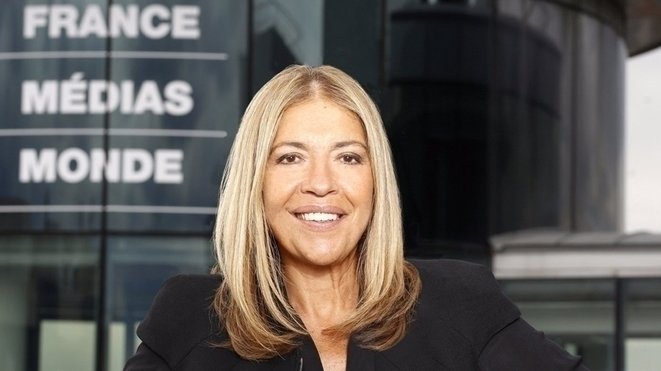
On 18 April, Marie-Christine Saragosse was reappointed CEO of the France Médias Monde (FMM) the group in charge of French international broadcasting for another five-year term. Saragosse, who had been in charge of FMM since 2012, had to leave her post in mid-February when her mandate lapsed after she failed to provide details of her statement of assets and interests on time owing to an administrative oversight.
France Médias Monde, includes the news channels France 24 (in French, English, Arabic and Spanish), RFI (Radio France Internationale), the news and current affairs radio station that broadcasts worldwide in French and in 13 other languages, and the Arabic-language radio station Monte Carlo Doualiya, which broadcasts from Paris to the Middle East, Mauritania, Djibouti, and South Sudan on medium wave, FM, via satellite and partner radio stations. FMM employs 1,856 people (full time equivalent).
According to the draft budget law being currently examined in Parliament France Médias Monde 2018 budget is to be set at some €263m.
Saragosse presented her Strategic Plan for FMM in April.
This plan lists FMM’s core principles as the need to abide by the group’s code of ethics, to defend freedom of information through increased security, including cyber security, and to combat fake news.
The plan stresses also that FMM is to strive to promote respect for human rights and diversity, by combating stereotypes.
FMM’s missions include, among others, “telling France’s narrative” in all its aspects, including in the political, social and economic spheres, but also its cultural and research achievements.

25 May 2018
Deutsche Welle (DW), Germany’s public international broadcaster, marked its 65th anniversary in May.
DW was launched on 3 May 1953 with a speech by then Federal President Theodor Heuss who addressed the “dear listeners in faraway countries”. DW started broadcasting three hours a day on shortwave in German only. It added five-minute news bulletins in English, French, Spanish in October 1954 and gradually expanded its offer.
No longer just an international radio broadcaster DW is now a global multimedia network.
DW introduced television in 1992, DW TV is now available round-the-clock in four languages: German, English, Arabic (Middle East, North Africa and Europe) and Spanish (for Latin America).
DW offers a variety of audio content and publishes online news in 30 languages on dw.com. It is seen as a trustworthy service, according to 96 per cent of its worldwide users.
In 1965 Deutsche Welle launched its Academy which has trained thousands of journalists from around the world.
Deutsche Welle’s 2017 budget was around €326m, from the federal tax budget.
DW says it employs some 3,400 people from 60 countries in Bonn and Berlin.
The Channel interviewed then DW DG Erik Bettermann in 2103 when DW marked its 60th anniversary.
25 May 2018
VRT to drop digital terrestrial TV broadcasts in December
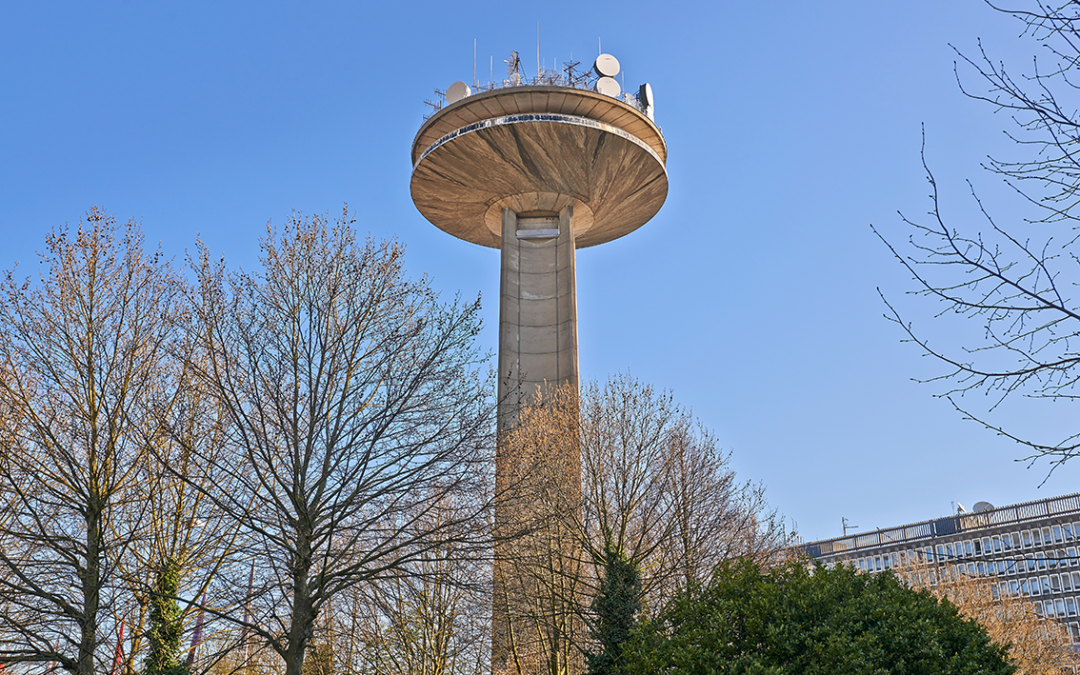
Flemish public broadcaster VRT has announced that it is to end its DVB-T digital terrestrial TV (DTT) broadcasts on 1 December.
VRT DTT offer is available in Flanders and the Brussels region. VRT says that the high cost of operating this service (€1m a year) is not justified by the relatively small number of users (45,000). VRT signalled that it was willing to discuss with TV Vlaanderen, a private digital satellite TV and DTT (using DVB-T2) service provider for the Flanders region, to make its offer available on TV Vlaanderen DTT services.
VRT also indicates that its offer is available via VRT NU (VRT Now), which is accessible on any device and offers also rewind / forward features and catch-up services, via cable (Telenet), IPTV (Proximus-Scarlet-Orange), satellite (TV Vlaanderen) and also via platforms such as Stievie.
Given the long advance notification it is to be expected that most current users of VRT DTT offer are unlikely to lose the service.

22 May 2018
Digital disruptions have created new ways to reach, talk to and analyse consumers, forcing media entities to redefine their business models away from their legacy roots.
Broadcasters, publishers and content providers alike must adapt to change and invest in technology to bring them closer to their audience.
MediaTech 360 will help you do just that.
Join us as we take the next steps in content evolution and explore the application of emergent technologies, their impact on business strategy, and where the opportunities and challenges lie as the marketplace evolves. AIB members can benefit from a 20% discount on tickets, simply use the following code when booking: AIBMT20

22 May 2018
SatADSL’s VSAT solutions are set to provide ubiquitous coverage to a range of enterprises and communities across the country.
Yaoundé, Cameroon, and Brussels, Belgium, May 21, 2018 – SatADSL, a provider of professional VSAT services via satellite, and Camtel – Cameroon’s national telecommunications provider – today announced a new partnership to provide satellite connectivity across Cameroon.
The formal agreement follows a pilot launch of SatADSL’s range of competitive satellite connectivity solutions across a variety of public and private enterprises and communities in Cameroon, including schools, post offices, hospitals and banks.
SatADSL now plans to integrate and deploy its VSAT services across the central African country, enabling Camtel to offer competitive broadband packages to even the most rural areas.
“We chose to partner with SatADSL because its solutions will enable us to target the widest possible spectrum of end-users, meaning the broadband services will truly benefit entire communities,” said David Nkoto Emane, CEO Camtel. “SatADSL’s knowledge of the region and technical expertise played a big role in the pilot’s success and we look forward to extending the project.”
Under the agreement, SatADSL will fulfil all of Camtel’s satellite connectivity requirements across all frequency ranges, Ku-, Ka- and C-band.
Camtel is the latest telecommunication operator in Africa to deploy SatADSL’s which are offered through the unique Cloud-based Service Delivery Platform (C-SDP). The complete OSS/BSS, carrier-grade, fully redundant platform allows operators to easily outsource satellite services, reducing the cost of providing ubiquitous connectivity by enabling fast, flexible and future-proof satellite connectivity via the cloud for the first time, eliminating the need for physical infrastructure.
Founder and Chief Operations Officer at SatADSL Caroline De Vos said: “As an organization that strives to bridge the digital divide in Africa, we are delighted to partner with Camtel to blanket Cameroon with much-needed connectivity. Our innovative C-SDP also means Camtel will be able to offer highly competitive packages for a range of end-users.”
About SatADSL
SatADSL (www.satadsl.net) is a satellite Service Provider which designs and offers innovative satellite networking solutions to banks, microfinances, broadcasters, NGOs, Governments, ISPs, telecom operators and other companies in Africa and the Middle East in remote areas or where terrestrial infrastructure is not reliable.
Founded in 2010, SatADSL has already installed more than 3,000 VSAT networks in more than 45 countries. It specializes in providing tailor-made solutions based on customers’ specific requirements and flexible service plans that meet its clients’ budgets.
Through its carrier-grade Service Delivery Platform (SDP), which integrates the most advanced technologies, SatADSL provides custom-made networking solutions, tailor-made service plans and value-added services, including hierarchical service control and monitoring, traffic prioritization and online billing and payments, for any frequency band and any access technology.
About Camtel
Cameroon Telecommunications (Camtel) is the national telecommunications provider of Cameroon (www.camtel.cm). Created in 1998, the company provides operators across the country with a fiber optical network to enable services such as Internet access, Voice over IP (VoIP), VPN connections, security, and so on. Camtel aims to enhance connectivity in Cameroon by maintaining, installing and operating telecommunications infrastructure and provide essential services to the whole country.
PR Contacts
SatADSL
Caroline De Vos
Co-Founder & COO
+32 478 31 13 76
Caroline.devos@satadsl.net
and
Jayne Brooks
+44 1636 704 888
jayne.brooks@proactive-pr.com
Camtel
Benjamin Gérard Assouzo’o
Marketing and Communication Director
+ 237 242 02 01 91
gerard.assouzoo@camtel.cm
21 May 2018
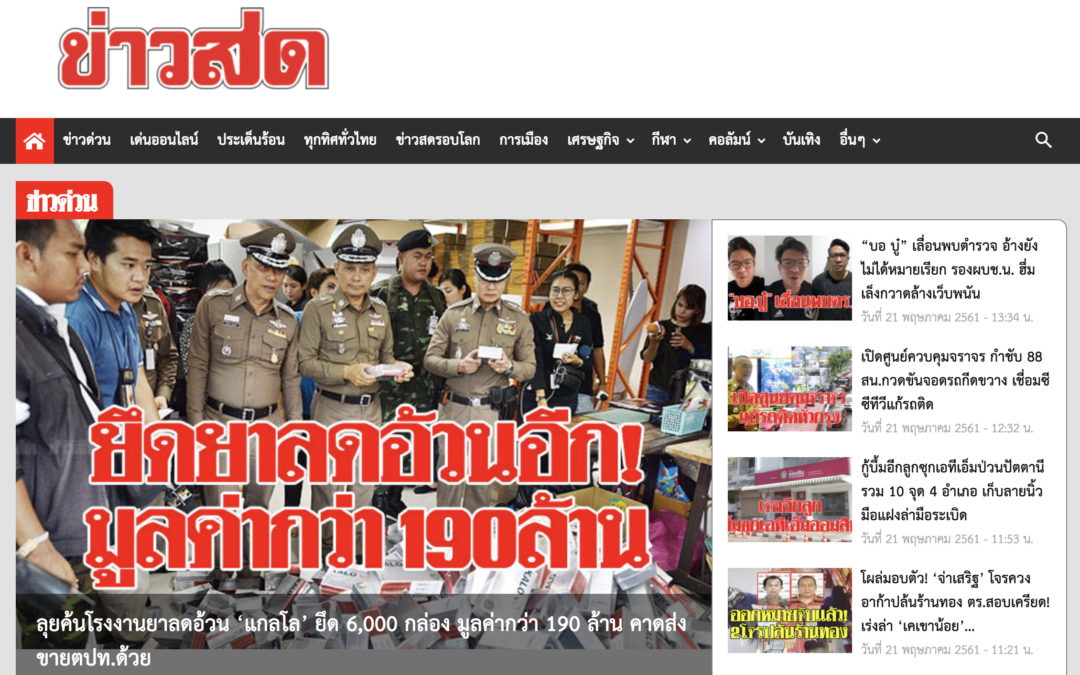
News content from the BBC in Thai and Burmese is now available via Thailand’s leading news website, Khaosod. Selected daily updated stories from the BBC News Thai website, bbc.com/thai, and the BBC News Burmese website, bbc.com/burmese, appear on Khaosod’s Thai- and Burmese-language indexes.
BBC News Thai Editor, Nopporn Wong-Anan says: “I am delighted to see our news stories published on a respected website such as Khaosod. I hope that, thanks to this collaboration, new users in Thailand will be able to sample our journalism – from BBC News Thai and our colleagues at BBC News Burmese – and be informed by the BBC’s globally trusted news coverage.”
 Executive Editor of Khaosod, Chumchan Chamniprasart (pictured right), commented: “Khaosod is excited to enter a partnership with the BBC in disseminating news, articles and interviews with various viewpoints from BBC News Thai and BBC News Burmese in an age when vast amounts of information circulate. We are firm in our belief that, as accurate mainstream news sources, both Khaosod and BBC serve the public through journalism.”
BBC News Thai reaches around 1.6m people every week via its website bbc.com/thai and social platforms such as Facebook (with over 2.2m followers), Instagram and YouTube. The service covers national, regional and international politics, as well as business, culture, health, technology, science and entertainment, women’s issues and social affairs. BBC News Thai also carries material from BBC Learning English for Thai-speaking learners.
BBC News Burmese reaches a weekly audience of 6m via the website bbc.com/burmese, Facebook (with over 13.3m followers, more than a million of whom are in Thailand), Twitter and YouTube, daily radio broadcasts and a Monday to Friday TV news programme.
BBC News Thai and BBC News Burmese are part of the BBC World Service.