
19 September 2018
The 2018 International Broadcasting Convention (IBC), held in Amsterdam (13-18 September) attracted large numbers of visitors, exhibitors and speakers, like in previous years.
More than ever before, the broadcasting industry is in a state of flux. It went through major changes at all levels in recent years, on the business and technical sides in particular.
Technology
A trend observed in recent years is the growing reliance of the broadcasting industry on IT services.
These include a major transition to IP-based solutions for broadcast TV production and delivery. Another major development observed in many domains is the introduction of Artificial Intelligence (AI), which is itself closely tied to Machine Learning (ML).
AI and ML have made possible major improvements in Virtual Reality (VR), Augmented Reality (AR) and Mixed Reality (MR), important for games, but also essential now in visual broadcast production.
In addition, AI and ML are proving central to applications, such as speech to text for subtitling, archiving, data mining, improved protection of content against piracy and hacking, to name just a few.
Leveraging the power of cloud services for post-production, storage and security applications is set to magnify the potential of these technologies and of their applications in the media industry.
Business
From the business perspective, these new technologies and services represent challenges for established broadcasters, whilst opening up opportunities for new players, such as technology companies and platforms.
Many players aware of these challenges are looking at ways of cooperating on a wide range of projects to find business models that would benefit both sides.
The AIB will be reporting on some of these developments in the near future.
17 September 2018
At the International Broadcasting Convention (IBC) held every year in Amsterdam, news was the focus of some of the conferences at a time when news media organisations, broadcasters in particular, face a number of challenges from new players, social media platforms and questions about their perceived lack of credibility and balance in some countries.
AIB leads debate with industry senior representatives
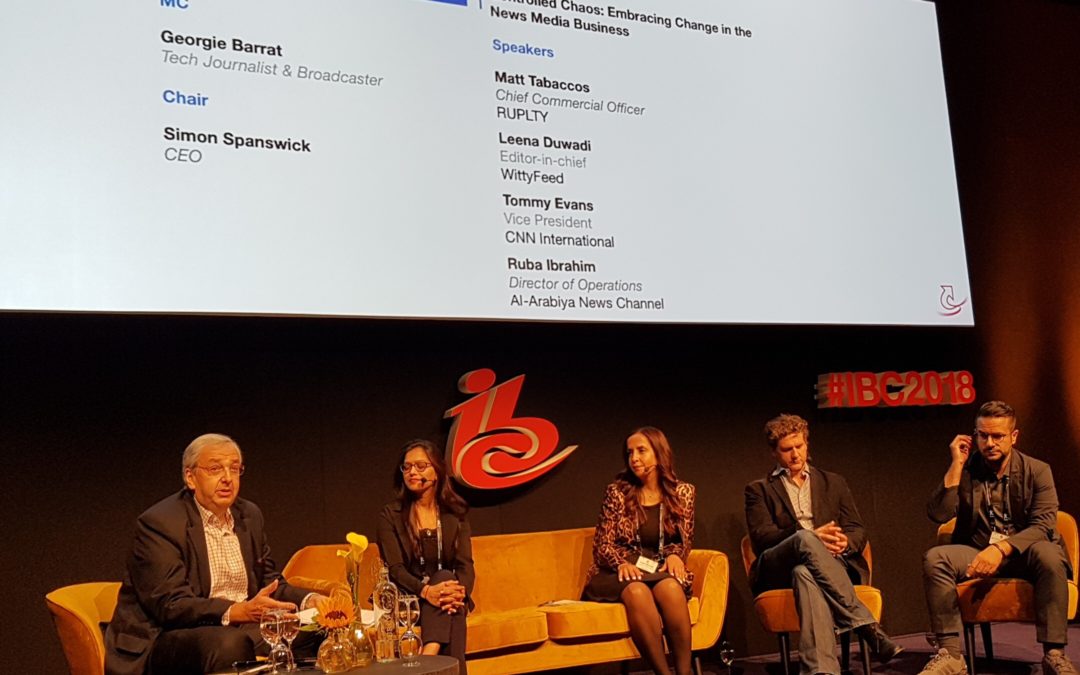
The AIB was at the centre of one of these conferences with its CEO, Simon Spanswick, chairing a session, entitled “Controlled chaos: Embracing change in the news media business”.
In this meeting, senior representatives from well-established broadcast organisations as well as from relatively new players, discussed the issues they faced and how they worked to best deal with these.
Panellists explained how their respective organisations were embracing media changes, both as regards the use of technological innovations, and the need to meet audience expectations.
The panellists, Leena Duwadi, Editor in Chief, WittyFeed, Ruba Ibrahim, Director of Operations, Al-Arabiya News Channel, Tommy Evans, VP CNN International and Matt Tabaccos, Chief Commercial Officer, of the Ruptly video news agency, described how their organisations addressed the various issues.
Shifting content, audience expectations
WittyFeed understood that the whole concept of content on the Internet was shifting, and WittyFeed idea from its creation in 2014, was to offer “content for the Millenials, produced by Millenials,” Duwadi said. From its beginning, WittyFeed proposed “vivid formats, ranging from stories to videos which differentiate it from other large Indian media companies that have hundreds of millions of users, listeners and viewers.”
Reaching a diverse Arab world audience
Ruba Ibrahim, director of operations of the Dubai-based Saudi-owned 24/7 free-to-air Al-Arabiya pan Arab News Channel launched in 2003, described the main channel and its younger “sister”, Al-Hadath, launched in 2012, which offers more in-depth, extensive coverage of political news.
Al-Arabiya has an English website also and is present and very active on digital platforms and social media.
Ibrahim explained how different content was tailored in content and length to meet the diverse requirements of the multiple platforms, showing examples of reports for online and mobile devices.
Spanswick asked how the channels were tackling the issue of addressing audiences across the entire Arab world. Ibrahim said that Al-Arabiya was primarily targeting audiences in the Gulf area, where audiences share the same language, issues and challenges, covering news, business and sports, and offering documentaries. Following the “Arab Spring”, Al-Arabiya’s extensive, but still limited resources didn’t allow it to cover all the news across the entire Arab world, so Al-Hadath was tasked with covering more specifically news and issues about Yemen, Iraq, the Levant and North Africa.
CNN: Golden age of news, healthy mix of news needed
Tommy Evans, VP of CNN International and CNN London bureau chief, said that “it was the golden age of news. US President Trump makes a lot of news and news is good for CNN and other news organisations.”
The key to success, he added, was “good content”, but he also advised for a varied and balanced mix between hard and soft news. “You can’t expect the audience to be brutalised by bad news constantly. You have to have a healthy mix of stories,” Evans warned.
CNN was established as a cable news network in 1980, but gained international recognition when it was the only channel broadcasting from inside Iraq from the beginning of the first Gulf War in January 1991. CNN launched its website, CNN.com in August 1995. It is now one of the most popular news websites in the world.
CNN has a wide offer of different programmes and online services that cover travel, style (arts, design fashion, architecture), health (food, health, wellness, fitness, etc.), features (freedom project, Impact your world, Inside Africa, climate / environment issues, etc) and even a virtual reality (VR) service, CNNVR.
Ruptly introduced flexible model, imaginative approach
Matt Tabaccos, Chief Commercial Officer, of the Berlin-based Ruptly video news agency, created in 2013 and owned by Russia’s RT television network, detailed the services offered by Ruptly.
These include an offer of real-time and archive visual news content to all media, from broadcast networks large and small to online content providers, including broadcast, digital and mobile platforms.
Ruptly value proposition, Tabaccos said, was “to try to be first, to pioneer new ways of telling stories.” Ruptly was one of the first news organisations to fly drones over war zones, which was the kind of content that resonated over the different platforms, online and broadcast, he said.
“Technology has been one of our main selling points,” Tabaccos added pointing out that Ruptly now gets some 500 million views across platforms every month. The idea is to service broadcasting organisations, start-ups and ordinary users, through flexible models, he said.
Tabaccos announced that Ruptly had just expanded its offer with Ruptly Pass, a “disrupting” subscription-based model “for individuals and growing media entities”, which gives users unlimited access to video and live events on the service for €12.50 a month.
The “Controlled chaos” conference provided a comprehensive overview of the diverse and imaginative approaches adopted by just four media organisations with different audiences to address some of the many challenges faced by the whole broadcast news media industry today.

14 September 2018
Agreement will enable SatADSL to deliver its services globally while its Cloud-based Service Delivery Platform (C-SDP) will expand Marlink’s offerings
Brussels, Belgium, and Paris, France, September 14, 2018 – SatADSL, a provider of professional VSAT services via satellite, and Marlink Group (Marlink) today announced a new partnership which will grow both companies’ offerings worldwide.
Under the agreement, SatADSL will be able to link directly to Marlink’s Newtec Dialog® platform to provide high-bandwidth C- and Ku-band VSAT services across its coverage footprint. This will give SatADSL a global presence for the first time.
Marlink, the world’s leading provider of end-to-end managed connectivity and IT solutions, will utilize SatADSL’s Cloud-based Service Delivery Platform (C-SDP) to extend voucher-based and congestion-based services to customers, expanding its technology-leading portfolio of business-critical solutions.
“We are very pleased to be entering into this partnership with SatADSL which will allow us to further build on our smart connectivity strategy and existing value proposition,” said Olivier Gommes, Director of Technology and Innovation at Marlink. “The capabilities of the C-SDP will be offered as an add-on to our customers, helping them to manage their connectivity solutions more efficiently.”
SatADSL’s C-SDP provides a Platform-as-a-Service (PaaS) solution, supporting operators in delivering a full range of satellite-based connectivity services without investing in physical infrastructure.
“By securing this partnership and combining our C-SDP with Marlink’s expertise, we will be able to provide our breadth of services worldwide for the first time,” said Michel Dothey, CCO and Co-founder of SatADSL. “This will open up our services to new markets, helping to bridge the digital divide by providing cost-effective satellite solutions in areas currently underserved by terrestrial networks.”
SatADSL will showcase its services and highlight the benefits of its C-SDP at IBC2018 at booth 5.C31. For more information, please see: www.satadsl.net.
ENDS
About SatADSL
SatADSL (www.satadsl.net) is a satellite Service Provider which designs and offers innovative satellite networking solutions to banks, microfinances, broadcasters, NGOs, Governments, ISPs, telecom operators and other companies in Africa and the Middle East in remote areas or where terrestrial infrastructure is not reliable.
Founded in 2011, SatADSL has already installed more than 3,000 VSAT networks in more than 45 countries. It specializes in providing tailor-made solutions based on customers’ specific requirements and flexible service plans that meet its clients’ budgets.
About Marlink Group
The Marlink Group is the world’s leading provider of end-to-end managed connectivity and IT solutions. The group which includes Marlink, Telemar, Palantir, Livewire Connections and OmniAccess, provides maritime and enterprise customers with an integrated offering of reliable broadband communications and IT, digital solutions, bridge electronics, and flexible service and maintenance.
The Marlink Group’s unrivalled portfolio of multi-band communication solutions covering Ku-, Ka-, C- and L-band services is augmented with mobile and terrestrial links and an industry-unique range of digital solutions. With more than 1000 employees worldwide, the Group serves enterprise and maritime customers globally, including: Shipping, Offshore, Cruise & Ferry, Yachting and Fishing, as well as Mining, Oil & Gas, Utilities, Humanitarian & NGO, Media & Events.
The Marlink Group delivers solutions with unrivalled service and support through an enhanced global footprint, including a network of sales and service locations ensuring customer proximity. Our 24/7 service desk, local presence on all continents and a network of 1250 service points staffed with highly qualified service engineers support our customers globally to operate their business in an ever smarter, safer and more profitable way.
More than 70 years’ experience, combined with our strong satellite network and hardware manufacturer partnerships, enables Marlink to bring the power of smart connectivity solutions to customers worldwide, helping them to digitalise their remote business operations wherever they are.
The Group is led by Erik Ceuppens as CEO.
www.marlink.com
www.telemarspa.it
www.palantir.no
13 September 2018
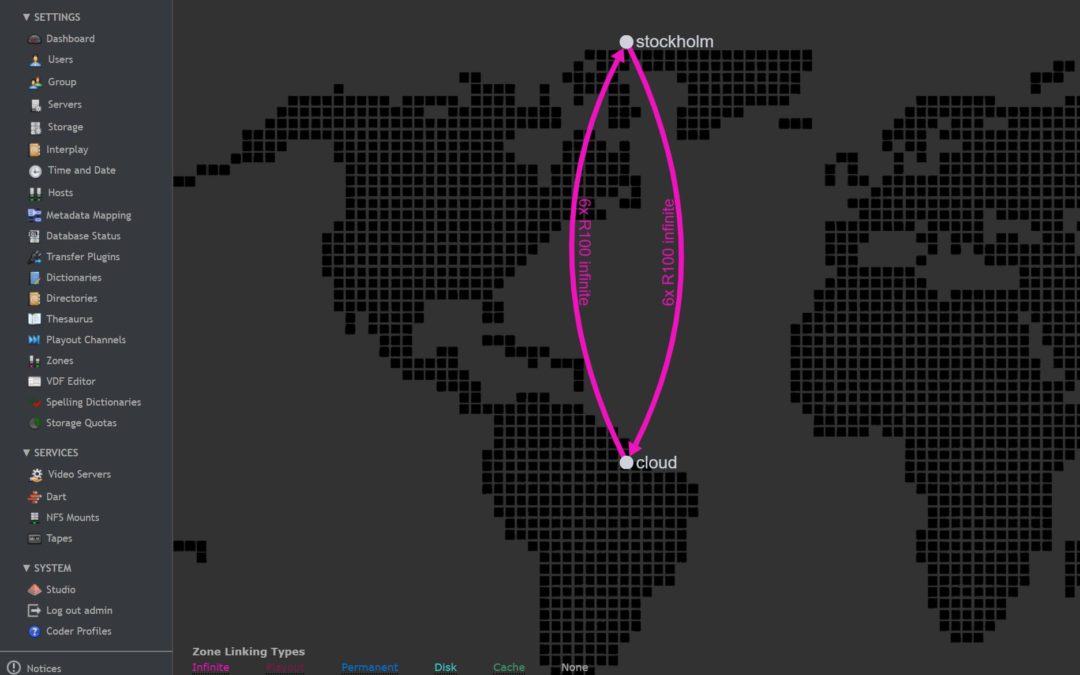
The new version extends Viz One with higher resource efficiency across multiple cloud infrastructure zones and increased automation, while leveraging Cloud Technologies to improve video production workflows and IT return on investment.
At the 2018 IBC Show, Vizrt, the leader in powerful visual storytelling tools for the media industry, will present the latest version of its media asset management (MAM) system on stand 7.B01. Viz One 6.1 introduces a new smart transfer system, optimized search for millions of assets and extended media support.
MAM across multiple cloud infrastructure zones
Media companies have the flexibility to access their content anywhere with Viz One on Amazon Web Service. The new cloud infrastructure zones allow Viz One to manage compute, storage and transcode resources across multiple cloud and on-premise zones. This technology is also extremely useful for connecting multiple physical data centers or production facilities under a single Viz One system. Amazon Web Services support includes Amazon EC2, S3, Glacier, RDS/PostgreSQL, EFS and EBS. Support for these technologies enables both cloud and hybrid architectures.
“Viz One with multiple cloud infrastructure zones give media companies added flexibility by coherently managing both in-cloud and on-premise resources,” said Vizrt Product Manager for MAM Oscar Tengwall. “This allows pre-existing infrastructures to be connected and augmented with the most attractive cloud services. Users can securely access content on Viz One from any location using the improved two-factor authentication in-cloud or on-premise.”
A smarter transfer system
The new smart transfer system adds optimized restore decision for tape libraries, saving up to 10x in restore time for common restore scenarios. It also introduces group-based storage quotas. This enables different production teams to work on the same system without using each other’s resources. The transfer system supports automatic playout staging of media to multiple tiers of storage with different timings. In addition, it adds the ability to send stories across different sites.
Optimizing search for millions of assets
The search engine has been optimized for large datasets with millions of assets. This improves the responsiveness and user experience of working with these large systems. Improvements have also been made to the search system.
A more interactive thesaurus allows users to make changes to an existing thesaurus to keep it relevant, while providing managers with review functionality to keeping it consistent.
Viz One will be part of the Journalist at the Center of Production presentation at the Vizrt Live Stage on stand 7.B01.
About Vizrt
Vizrt is a worldwide market leader in the areas of real-time 3D graphics, studio automation, sports analysis and asset management tools for the media and entertainment industry. This includes interactive and virtual solutions, animations, maps, weather, social media, video editing, compositing, and multiplatform VOD and live playout tools. Vizrt has customers in more than 100 countries worldwide including CNN, CBS, Fox, BBC, BSkyB, Sky Sports, CBS Sports, Fox Sports, Al Jazeera, NDR, ITN, ZDF, VICE, The Washington Post, TF1, CCTV, NHK and the list keeps growing. Vizrt has nearly 600 employees and operates in 40 offices worldwide. Vizrt is a privately owned company by Nordic Capital Fund VIII. For further information please refer to www.vizrt.com

13 September 2018
New use of Ka-Band will also simplify deployments for end users without compromising on speed of connectivity
London, UK, and Brussels, Belgium, September 12, 2018 – A new low-cost satellite broadband service will be launched across Iraq and Afghanistan as SatADSL, a provider of professional VSAT services via satellite, and Talia agreed to expand their long-term partnership.
The two companies’ current agreement lets SatADSL link directly to Talia’s teleport to provide services across the whole of Africa, with Talia’s equipment providing high performance and low-cost per megabit. Under the new deal, SatADSL will also be able to access Talia’s new platform in Jordan Media City, enabling it to offer Ka-band services across Iraq and Afghanistan.
“We are taking our relationship with Talia to the next level by using its facilities to offer our innovative services across Iraq and Afghanistan,” said Caroline De Vos, Co-founder and Chief Operations Officer at SatADSL. “The use of Ka-band High Throughput Satellite capacity, combined with Talia’s equipment means the services we provide can be quickly and easily installed by users and offered at an extremely competitive price, taking a significant step towards bridging the digital divide.”
By connecting its Cloud-based Service Delivery Platform (C-SDP) to Talia’s hub, SatADSL will be able to offer the full range of services available on its platform in Iraq and Afghanistan, including vouchers, VNOFlex, Wi-Fi Hotspots, etc. The C-SDP is a Platform-as-a-Service (PaaS) solution which enables operators to deliver a full range of satellite-based connectivity services without investing in physical infrastructure. SatADSL expects to have worldwide coverage by the end of the year, further expanding the reach of its C-SDP.
To enable connectivity, Talia uses capacity on the Arabsat 5C Ka-band satellite, located at 20o East. Talia is offering its services based on the Newtec Dialog® multiservice platform which features small VSAT antennas (75cm) on the remote site to create a new lower price point for Internet access and innovative setup guides for self-installation via a smartphone app. A variety of Newtec’s broadband satellite modems have also been deployed, supporting different bandwidth allocations to ensure optimal bandwidth usage. This includes Newtec’s dynamic Mx-DMA technology to achieve the efficiency of SCPC with the dynamic bandwidth allocation of MF-TDMA.
“We see this next chapter with SatADSL as building upon what has so far been a hugely successful partnership in Africa, enabling many developing countries to have access to affordable fast satellite Internet,” said Jack Buechler, VP Business Development at Talia. “Just as in Africa, the services which SatADSL will provide in Afghanistan and Iraq, using our infrastructure will help bridge the digital and economical divide and transform societies for the better.”
SatADSL will showcase its services and the benefits of its C-SDP at IBC 2018 at booth 5.C31. For more information, please see: www.satadsl.net.
About SatADSL
SatADSL (www.satadsl.net) is a satellite Service Provider which designs and offers innovative satellite networking solutions to banks, microfinances, broadcasters, NGOs, Governments, ISPs, telecom operators and other companies in Africa and the Middle East in remote areas or where terrestrial infrastructure is not reliable.
Founded in 2011, SatADSL has already installed more than 3,000 VSAT networks in more than 45 countries. It specializes in providing tailor-made solutions based on customers’ specific requirements and flexible service plans that meet its clients’ budgets.
Through its carrier-grade Cloud-based Service Delivery Platform (C-SDP), which integrates the most advanced technologies, SatADSL provides custom-made networking solutions, tailor-made service plans and value-added services, including hierarchical service control and monitoring, traffic prioritization and online billing and payments, for any frequency band and any access technology.
About Talia
Talia (https://www.talia.net/) is a market-leading teleport, satellite and terrestrial network operator and systems integrator; providing global ICT solutions that allow enterprises to thrive. Our hybrid infrastructure supports international businesses with connectivity wherever and whenever they need it.
With headquarters in the UK, Talia owns and operates their teleport facility in Germany. With international offices across the Middle East, Africa, South Asia, Europe, North and South America, Talia is ideally positioned to meet the growing demand of today’s global market.
Talia delivers solutions for enterprises, media companies, NGOs, government agencies and many others.
SatADSL
Caroline De Vos
Co-Founder & COO
+32 478 31 13 76
Caroline.devos@satadsl.net
and
Jayne Brooks
+44 1636 704 888
jayne.brooks@proactive-pr.com

11 September 2018
Vizrt to show multiple advanced image creation workflows with Viz Engine real-time rendering at the core
At the 2018 IBC Show, Vizrt, the leader in powerful visual storytelling tools for the media industry, will spotlight the power, versatility, and scalability of its Viz Engine real-time rendering system. Presentations at stand 7.B01 will highlight several new features and native support for third-party formats and systems, including the latest version (3.11) of the Viz Engine rendering and design software.
Vizrt’s render engine now allows producers to bring their graphics to a new quality level by rendering in the full HDR color range, using the latest IP streaming technologies, adding new levels of motion capture for augmented reality (AR).
Real-time motion capture and augmented reality
Vizrt will present The Big AR Show on its exhibit stand showing the latest in advanced augmented reality storytelling. This year’s show features the new bone and skin-based mesh deformation tools as well as real-time motion capture and photorealistic rendering—powered by Viz Engine. With the introduction of bones and skin based mesh deformation, along with physical based rendering, Viz Engine/Viz Artist 3.11 allows for complex storytelling with a new degree of interactivity. Three-dimensional models can be imported with predefined animations, but can also be driven by live motion capture streamed to Viz Engine.
Motion capture for The Big AR Show is provided by Motion Analysis Corp. as a live stream from their stand (Hall 7.B60). Motion Analysis is the sole provider of robust real-time retargeted skeleton data directly into the Viz Engine. The results will be a fully interactive AR 3D model interacting with the presenter during the presentation.
AR tools for esports
At IBC 2018 Vizrt is partnering with tracking company Ncam Technologies and Unreal Engine. During the Big AR Show, Vizrt will demonstrate the latest version of NcamAR for Unreal Engine 4 (UE4) integrated with Viz Engine. The new architecture enables Vizrt customers to combine template-based graphics and texts with Unreal Engine game assets for enhanced storytelling within live productions.
HDR workflows
High Dynamic Range (HDR) is gaining momentum among high-end film productions, live music concerts and sporting events due to its advanced color rendition attributes. Vizrt has developed and implemented HDR in Viz Engine supporting the HLG and PQ HDR formats. We will now show full compatibility with the S-Log3 HDR format developed by Sony. This is a high-quality digital intermediate process for a variety of post-production workflows.
At the IBC Show, Vizrt shows the S-Log3 capability at the Sony booth (13.A10) as a part of live production workflow where S-Log3 live video is converted to HLG and SDR.
Comprehensive IP Support
At IBC, Vizrt, which supports all flavors of video over IP, will show the continued advancement of its product portfolio for SMPTE 2110 IP-based production and distribution environments. At the core of these workflows is Viz Engine, providing graphics rendering, clip players, audio, downstream keyers and DVEs. The system is format agnostic, giving media companies the flexibility to move forward with quickly evolving IP standards. In addition, this ensures video, audio and graphics systems will continue to perform regardless of the choice of house format.
As part of this company-wide IP initiative, Vizrt is integrating the Matrox X.mio5 Q25 SMPTE ST 2110 NIC card with multi-channel 4K support over 25GbE, making Viz Engine ready for a wide variety of IP-based productions. With compositing NDI and SDI inputs, streaming via WebRTC and support for up to 16 RTP stream inputs, Viz Engine defines a new level of possibilities on any IP-based workflow.
About Vizrt
Vizrt is a worldwide market leader in the areas of real-time 3D graphics, studio automation, sports analysis and asset management tools for the media and entertainment industry. This includes interactive and virtual solutions, animations, maps, weather, social media, video editing, compositing, and multiplatform VOD and live playout tools. Vizrt has customers in more than 100 countries worldwide including CNN, CBS, Fox, BBC, BSkyB, Sky Sports, CBS Sports, Fox Sports, Al Jazeera, NDR, ITN, ZDF, VICE, The Washington Post, TF1, CCTV, NHK and the list keeps growing. Vizrt has nearly 600 employees and operates in 40 offices worldwide. Vizrt is a privately owned company by Nordic Capital Fund VIII. For further information please refer to www.vizrt.com
