3 September 2019
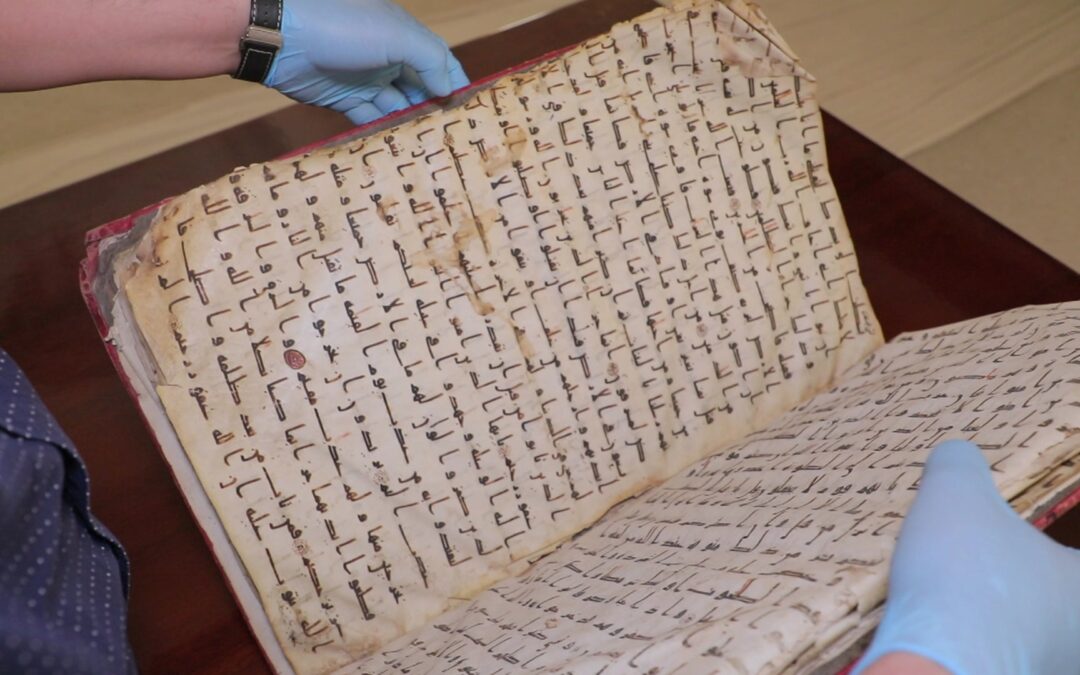
The ancient “Katta Langar” Qur’an, named after the Uzbek village – its centuries-long home – is the subject of a 40-minute documentary now live on the website bbc.com/uzbek and the BBC News Uzbek YouTube channel. In Katta Langar Qur’oni izidan (In search of Katta Langar Qur’an) BBC News Uzbek teams up with Uzbekistan’s popular TV channel, Sevimli TV, to trace the twists and turns in the life of the unique manuscript.
The documentary editor, BBC News Uzbek’s Diloram Ibrahimova, says: “Telling the story of the rare 8th century Qur’an demanded great sensitivity and a very careful approach. Our film is a culmination of months-long collaboration between BBC News Uzbek and Sevimli TV and showcases the expertise and creativity of the BBC teams in London and Sevimli TV film crew in Tashkent.”
The idea of the joint project came from the Head of Sevimli TV, Firdavs Abdukhalikov, following the signing of a memorandum of understanding on editorial collaboration with BBC News Uzbek. He supported the project from the start. Throughout the month of Ramadan, as the documentary was being filmed, Sevimli TV featured daily primetime series in which the fascinating discoveries made by the joint team were shared with the channel’s viewers. Firdavs Abdukhalikov says: “Our joint project is a great contribution to the research into the ‘Katta Langar’ Qur’an. I am really happy that Sevimli TV viewers can now watch the BBC News Uzbek film about this manuscript that is unique in the Muslim world.”
Joint BBC and Sevimli TV team travelled to the remote mountainous village of Katta Langar in Uzbekistan, home to the manuscript considered to be one of the very first written versions of the Qur’an. The documentary presenter and producer, Luiza Iskandariy, says: “It was fascinating to learn how this little village harboured its great treasure. Throughout our journey every new discovery kept adding new questions and intricacies to our story, also reflecting the history of the region.”
The film probes various explanations of how the “Katta Langar” Qur’an appeared in Central Asia and how its pages ended up in different countries. Luiza speaks with the villagers whose ancestors and relatives trace their proud guardianship from the 15th century. The cherished manuscript, which survived a journey from Arabia via Iran and Afghanistan to Central Asia, was seized many times – by the colonising tsarist Russian army, by the KGB in the Soviet times, and finally, for safekeeping by newly independent state of Uzbekistan. The investigation also takes the joint crew to an Uzbek village whose residents claim their ancestry from the Arabian Peninsula and still display elements of the Arab culture.
The documentary establishes that the bulk of the missing pages – a total of 81 – are kept in the St Petersburg Institute of Oriental Manuscripts. Twelve pages are in treasury of the Spiritual Directorate of the Muslims of Uzbekistan in Tashkent while random pages are in other locations in Tashkent, and in a museum and a library in Bukhara. An estimated hundred pages of the “Katta Langar” Qur’an are still unaccounted for.
Now live on the BBC News Uzbek website, Katta Langar Qur’oni izidan will air on Sevimli TV this week. It also will be broadcast on BBC News Uzbek TV partner station in Afghanistan, Arezo TV.
BBC News Uzbek, which has a weekly reach of 2.3m across platforms, offers content tailored for Uzbek-speakers in Uzbekistan as well as Afghanistan and the rest of the world, and is one of the largest international news providers in the region. In addition to the website bbc.com/uzbek, BBC News Uzbek connects with audiences via Facebook, YouTube, Instagram, Twitter and Odnoklassniki as well as Telegram. The BBC’s 10-minute TV news bulletin for Uzbek-speakers in Afghanistan has a weekly audience of 1.8 million.
BBC News Uzbek is part of BBC World Service.
(Source: BBC press release)
28 August 2019
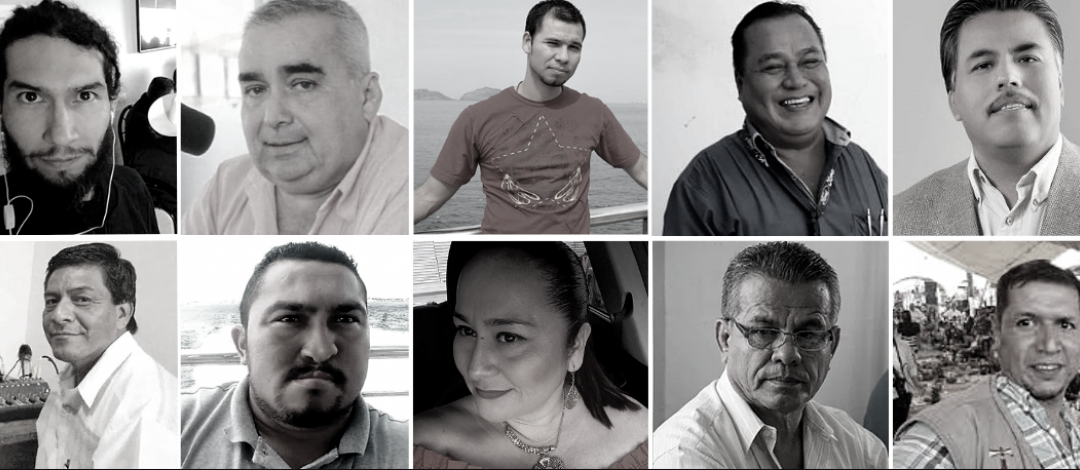
As Reporters Without Borders (RSF) reports on its website, two more murders in August have brought the number of journalists killed in connection with their work in Mexico in 2019 to at least ten, confirming Mexico’s status as the world’s deadliest country for the media. In the absence of a strong reaction from the government, RSF offers its recommendations on how to address this extreme level of violence and the almost total impunity.
More than 90% of the crimes of violence against journalists in Mexico go unpunished, fuelling the vicious cycle of violence and impunity. It was for this reason that, in March 2019, RSF asked the International Criminal Court to look into the impunity for murders and disappearances of journalists from 2006 to 2018, under President López Obrador’s two predecessors, Felipe Calderón and Enrique Peña Nieto.
In response to the surge in the number of journalists murdered in 2019, RSF has provided the Mexican authorities, including the president’s office, with its recommendations on the measures that need to be taken.
RSF recommends that the Mexican authorities should:
1) Reinforce journalists’ safety:
– By improving the effectiveness and response time of the Federal Mechanism for the Protection of Human Rights Defenders and Journalists, increasing its human and financial resources and enhancing its role in preventing risks, especially in the most dangerous states.
– By rapidly implementing the recommendations of the “Diagnosis of the Functioning of the Mechanism”, that the Office of the UN High Commissioner for Human Rights gave to the Mexican authorities on 29 July and made public on August 26.
– By implementing a general policy for taking care of journalists and family members who are the victims of forced displacement.
2) Reinforce investigative resources
Given that the Special Prosecutor’s Office for Crimes against Freedom of Expression (FEADLE) will soon be incorporated into a new Special Prosecutor’s Office for Human Rights, there is an urgent need to:
– Reinforce the FEADLE’s prerogatives and its human and financial resources.
– Quickly release the new guidelines for FEADLE investigations into crimes of violence against journalists and explain how the FEADLE’s decisions can be appealed.
– Encourage the FEADLE to make full use of its power under article 21 of the criminal code to transfer investigations into crimes against freedom of expression from the local to the federal level. RSF is of the view that this power should be used without delay in three of this year’s murder cases, those of Ruíz, Sarabia and Romero.
– Ensure that the new Approved Protocol for Investigating Crimes against Freedom of Expression, adopted in October 2018, is effectively applied.
– Ensure that the new Special Prosecutor’s Office for Human Rights – of which the FEADLE will be a section – quickly establishes close contacts with civil society organizations in order to discuss the new goals and challenges.
Mexico is ranked 144th out of 180 countries in RSF’s 2019 World Press Freedom Index.
(Source: RSF)
15 August 2019
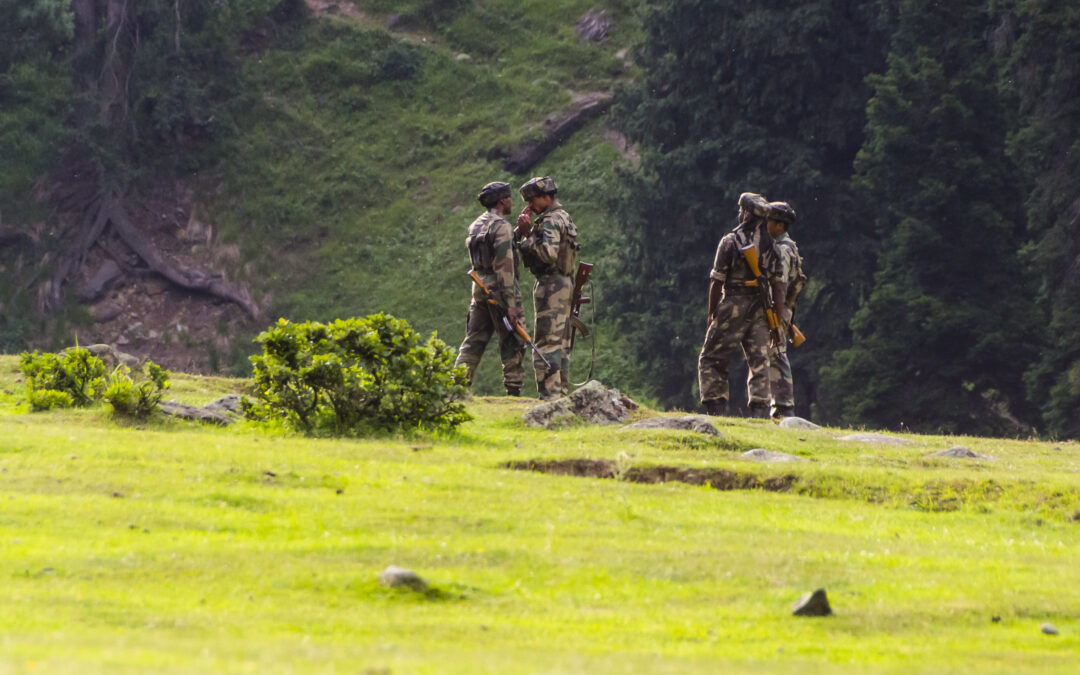
BBC World Service has extended output on shortwave radio in Indian-administered Kashmir to provide reliable news and information.
 Director of the BBC World Service, Jamie Angus (pictured), said: “The provision of independent and trusted news in places of conflict and tension is one of the core purposes of the World Service. Given the shutdown of digital services and phone lines in the region, it’s right for us to try and increase the provision of news on our short wave radio services. Audiences in both India and Pakistan trust the BBC to speak with an independent voice, and we know that our reporting through several moments of crisis this year has been popular and valued by audiences who turn to us when tensions are highest.”
BBC News Hindi radio output (9515 and 11995kHz) will be extended by 30 minutes from Friday 16 August. The full one hour news programme will be on air from 19:30 to 20:30 local time.
On Monday 19 August, BBC News Urdu will launch a 15-minute daily programme, Neemroz. Broadcast at 12.30 local time on 15310kHz and 13650kHz, the programme will focus on news coming from Kashmir and the developments around the issue, and include global news roundup tailored for audiences in Kashmir.
BBC World Service English broadcasts (11795kHz, 9670kHz, 9580kHz, 7345kHz, 6040kHz) will be expanded, with the morning programming extended by an hour, ending at 08.30 local time; and the afternoon and evening programming starting an hour earlier, at 16.30 local time.
The shutdown has left people with very few options for accessing news at this time. However, news services from the BBC continue to be available in the region – through shortwave radio transmissions in English, Urdu, Hindi, Dari and Pashto. As well as providing an important source of news to the region, the South Asian language services have brought added depth to the BBC’s coverage of the Kashmir story.
The recent introduction of four new languages services for India – Gujarati, Marathi, Punjabi and Telugu, following additional investment from the UK Government – has enabled the BBC to offer a wider portfolio of languages and distribution methods to a region that is geographically diverse as well as politically tense. This year’s Global Audience Measure for the BBC showed that India is now the World Service’s largest market, with a weekly audience of 50m.

5 August 2019
The AIB has published its latest briefing reporting on selected stories from the global media industry. From media freedom to new appointments, new programming to public service licence fee changes, the regular briefing is received by more than 27,000 people in the media industry globally.
To subscribe, fill out this form and join your industry peers in keeping up to date with news from around the world.

5 August 2019
In an unprecedented collaboration, football leagues FIFA, the AFC, UEFA, the Bundesliga, LaLiga, the Premier League and Lega Serie A have called on the authorities in Saudi Arabia to take action against pirate pay-TV operator BeoutQ. The seven leagues have said that the Kingdom of Saudi Arabia must take “swift and decisive action” against the pirate TV company. The leagues say that they have been unable to get any Saudi Arabia-based legal firm to represent them in their efforts to shut down the operation that is taking signals of Bein and rebroadcasting them to viewers in Saudi Arabia with a different logo.
The joint statement reads:
We, the rights holders of various football competitions, collectively condemn in the strongest possible terms the ongoing theft of our intellectual property by the pirate broadcaster known as ‘beoutQ’ and call on the authorities in Saudi Arabia (KSA) to support us in ending the widespread and flagrant breaches of our intellectual property rights taking place in the country.
Since May 2018, we have collectively been working with an international legal counsel to monitor and compile evidence against beoutQ, whose broadcasts are regularly and on an industrial scale made available on an illegal basis. Following thorough analysis by technical experts of how beoutQ operates from a technical perspective, we are satisfied that beoutQ is operating specifically to target customers in KSA and is utilising the facilities of at least one KSA-based entity.
Over the past 15 months, we spoke to nine law firms in KSA, each of which either simply refused to act on our behalf or initially accepted the instruction, only later to recuse themselves.
As copyright holders we have reached the conclusion, regrettably, that it is now not possible to retain legal counsel in KSA which is willing or able to act on our behalf in filing a copyright complaint against beoutQ. We feel we have now exhausted all reasonable options for pursuing a formal copyright claim in KSA and see no alternative but to pursue beoutQ and a solution to this very serious problem of piracy by other means.
beoutQ’s infringement of our rights inevitably harms every aspect of the industry, from the rights holders to legitimate licensees, consumers and fans, participants (including players, clubs and national teams) and ultimately, the sport itself.
We have welcomed previous statements by the Saudi Ministry of Culture and Information and the Saudi Government against beoutQ. However, given the scale of beoutQ’s piracy in KSA and that the piracy continues unabated, we request that the Ministry and the Saudi Government take swift and decisive action against beoutQ.
We are committed, collectively and individually, to working with all relevant authorities to combat the beoutQ piracy.
The piracy affects other sporting rights holders, including Wimbledon and Formula 1.
2 August 2019
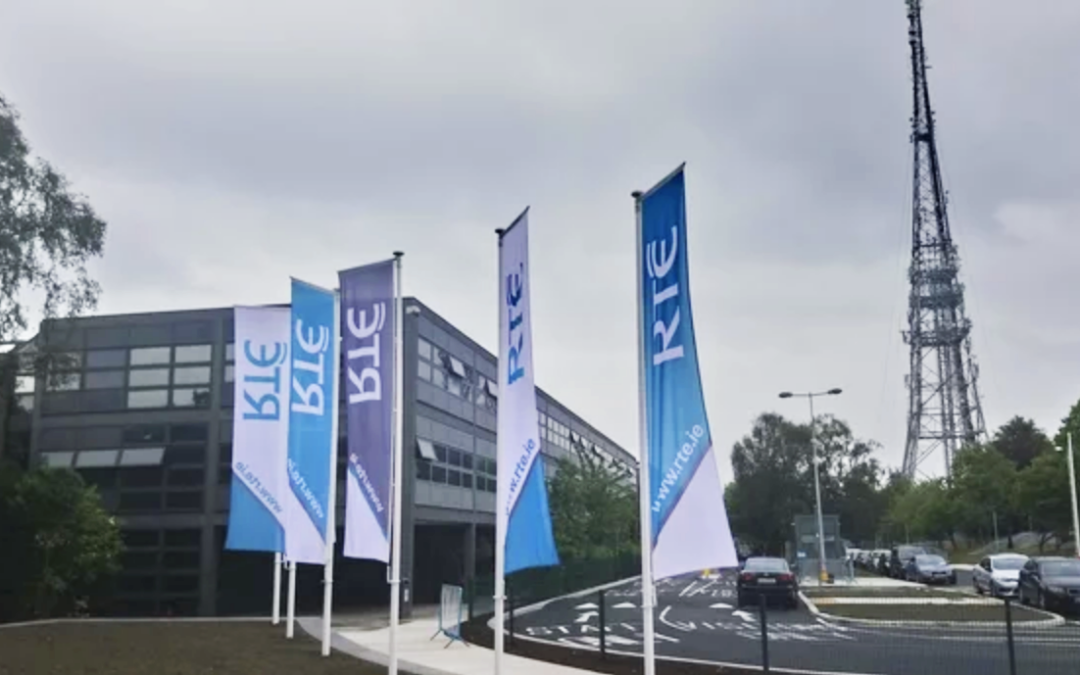
The Irish government is to replace the traditional TV licence fee – currently EUR160 – with a new “device-independent broadcasting charge”. The change was announced by Ireland’s Minister for Communications Richard Bruton on 2 August and forms part of a comprehensive reform of the country’s TV licence fee system.
The changes come as consumption patterns and devices radically alter. According to RTÉ, it’s estimated that 10% of Irish homes now access content on devices that are not covered by the current licence fee. According to an RTE spokesman, licence evasion levels are 13%, far higher than in the UK and other European countries.
“The fact is that the number of homes that do not have a traditional television set – but who are nonetheless consuming public service content – is increasing rapidly and the current television licence fee mechanism reflects less and less how people consume public-service content,” said the RTE spokesman. “When added to the evasion rate, currently close to 25% of homes are now not paying the TV licence due to an outdated and inefficient system. This is resulting in tens of millions in lost funding for public media and the broader sector each year.”
The Minister also announced a review of the Broadcasting Act, to evaluate the proportion of the TV licence revenue which is allocated to the Sound and Vision Scheme which supports the independent sector and native Irish content. The review will also consider the minimum amount of funding that RTÉ is obliged to spend on commissioning external content. In 2018 this amounted to €39.7m and the Minister said that increasing this amount would provide an important stimulus to the independent production sector.
The changes in Ireland follow a referendum in Switzerland which agreed to keep the licence fee in the country in March last year.
