1 August 2014
The Stalwarts share their journey to excellence
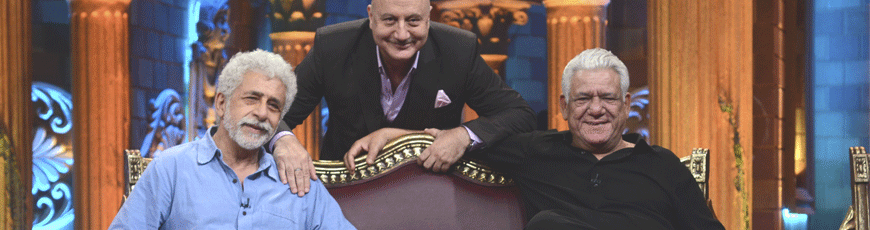
It’s rare enough to see Naseeruddin Shah or Om Puri bare their hearts. But the first episode in August of The Anupam Kher Show – Kucch Bhi Ho Sakta Hai will bring together both these stalwarts as they recount their journey from being simpletons to the superstars that they are today.
For Naseeruddin Shah, it was always about literature and art. His interest in being on the stage peaked when in Std. 9 he got an opportunity to be a part of Shakespeare’s famous play, The Merchant of Venice. This first stint on stage made Naseeruddin Shah fall in love with acting while creating a sense of self-worth and belonging. As he ventured deeper into the world of theatre and entertainment, Naseeruddin Shah joined the National School of Drama – a phase which he claims was the happiest in his life. Along with a stipend of Rs.200, his experience at NSD earned him the friendship of Om Puri, a classmate whom he has known since 1970.
Om Puri’s tryst with entertainment began when he was offered Rs.150 to act in a play. Om says, “If Naseeruddin didn’t push me at NSD, I wouldn’t be sitting here on the couch today.” The two, collectively, as seniors to Anupam Kher at NSD, are also responsible for taking Bollywood to international waters.
In fact, when Om Puri received a National Award for his role in Arth Satya, Naseeruddin openly commented that he was envious of Om because he would never have been able to pull off the role. Elaborating further, Naseeruddin said, “Om was born with a wooden spoon. I’m proud to see him here today.”
If this intrigues you about the relationship between Bollywood’s most legendary actors and their life and times, all we can say the episode will surely blow you away!
The show airs every Sunday at 8 PM on AIB member COLORS.
23 June 2014
 The Association for International Broadcasting (AIB) today [23 June 2014] protested the sentencing of three journalists working for Al Jazeera English in Egypt.
The guilty verdicts were announced on Monday 23 June in a court in Cairo. The journalists – Peter Greste, Mohamed Fahmy and Baher Mohamed – had been charged with aiding the Muslim Brotherhood and reporting false news. Greste and Fahmy were sentenced to seven years in prison. Baher Mohamed was sentenced to a total of ten years in prison.
The prosecution alleged that Greste, Al Jazeera’s East Africa correspondent, and his two colleagues from the Network’s Egypt bureau, aided the Brotherhood and produced false news reports about events in Egypt. All three journalists vehemently denied the charges. The prosecution produced a range of items as evidence that were completely unrelated to the charges, including a BBC podcast, a news report produced when none of the three accused was in Egypt and a pop video by Gotye, an Australian singer.
“AIB and its members have been shocked by both the verdicts and the sentencing in this case. The case against the journalists was repeatedly demonstrated to be flawed. This Association joins the international call for the case to be reviewed immediately and the journalists released,” said Simon Spanswick, AIB Chief Executive. “Not a single piece of evidence was found to support the charges against them in a court case that at times bordered on the farcical. AIB calls on the Egyptian authorities to release the three Al Jazeera journalists and start an immediate, thorough and transparent review of the case to restore some level of international trust in Egypt’s justice system.”
Al Anstey, Al Jazeera English managing director, said the verdicts defied “logic, sense, and any semblance of justice”.
“Today three colleagues and friends were sentenced, and will continue to be kept behind bars for doing a brilliant job of being great journalists. ‘Guilty’ of covering stories with great skill and integrity. ‘Guilty’ of defending people’s right to know what is going on in their world,” Anstey said in a statement.
Context about the journalists [source: BBC Monitoring]
Peter Greste
Australian journalist Peter Greste, 48, worked for a number of news organizations including Reuters and the BBC before joining Al Jazeera’s team.
An experienced correspondent, Greste started out reporting on Bosnia and South Africa and then moved on to cover Afghanistan, Mexico, and the Middle East. He was the BBC’s Kabul correspondent in 1995, where he watched the Taleban emerge, and he returned after the Taleban lost control of the capital in 2001.He has lived in Nairobi, Kenya since 2009 where he has covered Horn of Africa countries with a particular focus on Somalia. His documentary Somalia: Land of Anarchy won a Peabody award in 2011.
 His story on the relationship between a baby hippo and a giant tortoise inspired a best-selling children’s book, Owen & Mzee [pictured right].
Greste has written open letters from Tora Prison expressing his frustration at being locked up on charges of falsifying news and damaging Egypt’s reputation. “After more than 20 years as a foreign correspondent, I know what is safe ground. And we didn’t stray anywhere near that edge,” he wrote a month into his incarceration.
He says that the “new normal” in Egypt has shifted so far from the middle ground that routine journalists’ work suddenly appears threatening. “How do you accurately and fairly report on Egypt’s ongoing political struggle without talking to everyone involved?” he asked.
Mohamed Fahmy
Al-Jazeera English’s bureau chief in Cairo, Mohamed Fahmy, 40, was born in Egypt but moved to Canada with his family in the early 1990s.
He is known for his keen professional interest in the Middle East and North Africa and has extensively reported on events there for other major news outlets such as CNN and the New York Times. Mr Fahmy is also the author of “Egyptian Freedom Story”, an account of the 2011 revolution that led to the fall of the regime of the then President Hosni Mubarak. In May 2014, the Canadian Committee for World Press Freedom honoured the journalist with its annual award.
In a letter smuggled out of his prison cell, Mohamed Fahmy said that “A key part of our defence has been to convince the judge of our professional integrity; to prove to him that we are journalists striving for the truth; and not agents of terror. This award will go a long way toward making our case.”
Some prominent figures in Egypt have voiced their support for the journalist. Among them is former Arab League Secretary-General Amr Moussa, who wrote to the court saying that Mohamed Fahmy was “known as competent, has integrity and is objective”.
Baher Mohamed
Al-Jazeera producer Baher Mohamed, 30, has worked for various international media in Egypt since he graduated from Cairo University in 2005.
He was with Japan’s Asahi Shimbun newspaper from 2008 to 2013, and did freelance reporting for CNN and Iran’s English-language Press TV. Baher Mohamed joined Al Jazeera English in May 2013 and covered the protests in Cairo that started on 30 June and led to the ousting of the country’s Islamist President Mohammed Morsi.
According to transcripts from Baher Mohamed’s interrogations by the prosecution, published in Egypt’s al-Ahram daily, the journalist said that his father was a member of the Muslim Brotherhood and made him go to religious classes organised by the Islamists.
Baher Mohamed is quoted as saying that he refused to attend them as they were “boring”.
4 June 2014

On June 6th, to mark the 70th anniversary of D-DAY and the battle of Normandy, France 24 will offer a special broadcast on its three channels – in English, in French and in Arabic – dedicated to the ceremonies that will take place throughout the day in Normandy.
On FRANCE24.COM, in addition to the livestreaming of the ceremonies, a liveblog will allow users to get a behind-the-scenes insight in real time. Web users and TV viewers are invited to comment and share their reactions on social networks via the #France24DDay hashtag.
Starting at 9:00am*, France 24 will propose a special edition dedicated to the national ceremony for civilian victims, presided by French President Hollande at the Caen Memorial.
A second special live edition will start at 2:00pm* with the international ceremony in Ouistreham in the presence of several Heads of State and Government.
In addition to the 10 journalists who will report all day long from the beaches of Normandy, France 24 will also propose various reports dedicated to the most emblematic characters and places of D-Day: the 82nd Airborne Division, several portraits of North American veterans, the legendary Kieffer commando and the Operation Dingson in Morbihan.
16 May 2013
AP reports that a Vietnamese satellite TV platform has dropped BBC World News and CNN from its channel line-up on Thursday 16 May. K+, a joint venture between a Vietnamese company and Canal Overseas, part of the Canal+ Group, appears to be interpreting the “Decision 20” regulation – which places onerous conditions on foreign TV channels – in a particular way, in direct contrast to a majority of other Vietnam-based platforms.
AIB has been lobbying on the issue over the past few months and is now seeking further clarification both from K+ and the Vietnamese Ministry of Information and Communication.
“We are disappointed that Vietnamese audiences are having their choice of international TV channels restricted,” said Simon Spanswick, AIB chief executive. “There is still uncertainty around the proposed pay-TV regulations promulgated in Vietnam. K+ appears to be out of step with the Vietnamese market and the latest interpretation of Decision 20. We look forward to the channels that have been taken off air being restored very quickly.”
As of the European afternoon on 16 May, the K+ website was still showing BBC World News and CNN as channels available to the platform’s subscribers.
6 March 2013
Access to arabic.rt.com, the site of Rusiya Al-Yaum, RT’s Arabic channel, has been restricted in Libya. As a result, online traffic coming from Libya has dropped by 98%.
 “We are addressing the situation in the most urgent manner possible. We have sent inquiries to all government agencies in Libya to find out the reasons why the site is being blocked. RT is doing everything it can to restore full accessibility to what is one of the main news resources in the country and the region,” said Margarita Simonyan (left), RT’s editor in chief.
In December 2012 Rusiya Al-Yaum’s website was ranked in the top three online TV channels in the Arab world by Forbes Middle East. The site, arabic.rt.com, recorded more than 50 million visitors in a year and the highest new visit rate amongst the top three channels. Forbes used data from Google Analytics in its rankings.
Rusiya Al-Yaum is an award-winning news channel that began broadcasting from Moscow in 2007. As of December 2013, Rusiya Al-Yaum, alongside all of RT’s other channels, has been available in the HD format. The channel is available to more than 350 million viewers across Middle East, North Africa and Europe. According to a Nielsen study, more than 5 million people watch Rusiya Al-Yaum in Syrian, Lebanon, Kuwait, UAE, Jordan, Egypt and Saudi Arabia*.
RT is a global international news network that broadcasts in English, Arabic and Spanish from its studios in Moscow and Washington, DC, and is available to 630 million viewers worldwide. Pew Research Center’s 2012 study named RT, whose YouTube channel has passed 940 million views, as the largest provider of news video footage on the world’s largest video sharing platform. RT is the only Russian TV channel to garner two nominations for the prestigious Emmy International Award.
*Monthly audience

