
26 July 2017
Following a statement of intent in February, leading UK communications infrastructure company Arqiva and Samsung Electronics announced on 25 July that the first field trial of 5G Fixed Wireless Access (FWA) technology in the UK and Europe is now live in central London.
Powered by Samsung’s 5G network solution and customer premises equipment (CPE), and using Arqiva’s 28GHz millimetre wave (mmWave) spectrum, the 5G FWA system consists of three main components:
A Radio Access Unit located on the rooftop of Arqiva’s Fitzrovia office wirelessly links to an easily installable CPE – or router – located by a window inside Arqiva’s nearby headquarters. Samsung’s system – which implements intelligent beam-forming technology and high-frequency mmWave spectrum – then provides high bandwidth connectivity. In commercial implementations, the compact access unit can be mounted on lampposts or similar street furniture to provide reliable gigabit-per-second service to neighbourhoods and businesses alike. The final component is Samsung’s virtualised core – responsible for managing user connections and data routing from Arqiva’s network to the internet – which is running on Arqiva’s data centre servers.
The primary aim of the trial is to demonstrate the stability of the FWA service, and its potential as a fast-to-market and cost-effective alternative to fibre for connectivity to homes and businesses. Despite a link distance of several hundred meters, the system has established a stable two-way mmWave link with downlink speeds of around 1GB per second at the CPE. Allowing for simultaneous streaming of more than 25 UHD 4K TV channels as an illustration, this more than meets the needs of today’s typical household with considerable room for future growth.
As the trial progresses, both companies look forward to further maximising the performance capability of the system, improving the value of future network infrastructure and spectrum investments.
Paul Kyungwhoon Cheun, Executive Vice President and Head of the Next Generation Communications Business Team at Samsung, said: “One of the most exciting prospects that 5G is expected to bring to the table is the exploration of powerful new use cases outside of traditional smart device mobile connectivity. Our trial efforts with Arqiva give us the chance to demonstrate this first hand, and we view this demonstration as a door-opener for new and compelling connected service opportunities in the UK, Europe and worldwide.”
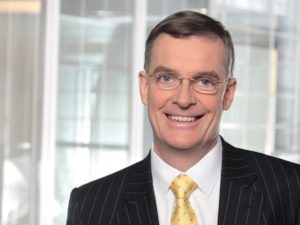 Simon Beresford-Wylie, CEO of Arqiva (pictured), commented: “This trial is the first of its kind in Europe, let alone the UK – and we are hugely excited about the high data rates, low latency and growth potential we’re going to be able to demonstrate. Though only a proof of concept at this stage, we are confident that this trial with Samsung will showcase not only 5G FWA’s potential for delivering ultrafast broadband but also the value of the 28GHz band in helping achieve this.
“We’ve seen a great level of response so far from our entire customer base, including leading mobile operators, fixed broadband providers, broadcasters and media companies. This trial will be particularly interesting for this audience as it looks to a future of ubiquitous UHD, and the file sizes that go with it.”
The showcase consists of a series of six stations. These include an overview of FWA technology and how it works, examples of 5G use cases, demonstrations of 4K UHD and Virtual Reality (VR) content streaming, and a look at possible applications of 5G in the future.
The trial will run for a four-month period, during which time anticipated visitors include representatives from the UK Government, Mobile Network Operators (MNOs), Fixed Network Operators, media companies, analysts and more. There are also plans to extend the trial’s coverage to additional nearby buildings over its duration.
For more information visit Arqiva5G.com or samsungnetworks.com. To register interest visit Arqiva5G.com.
5 July 2017
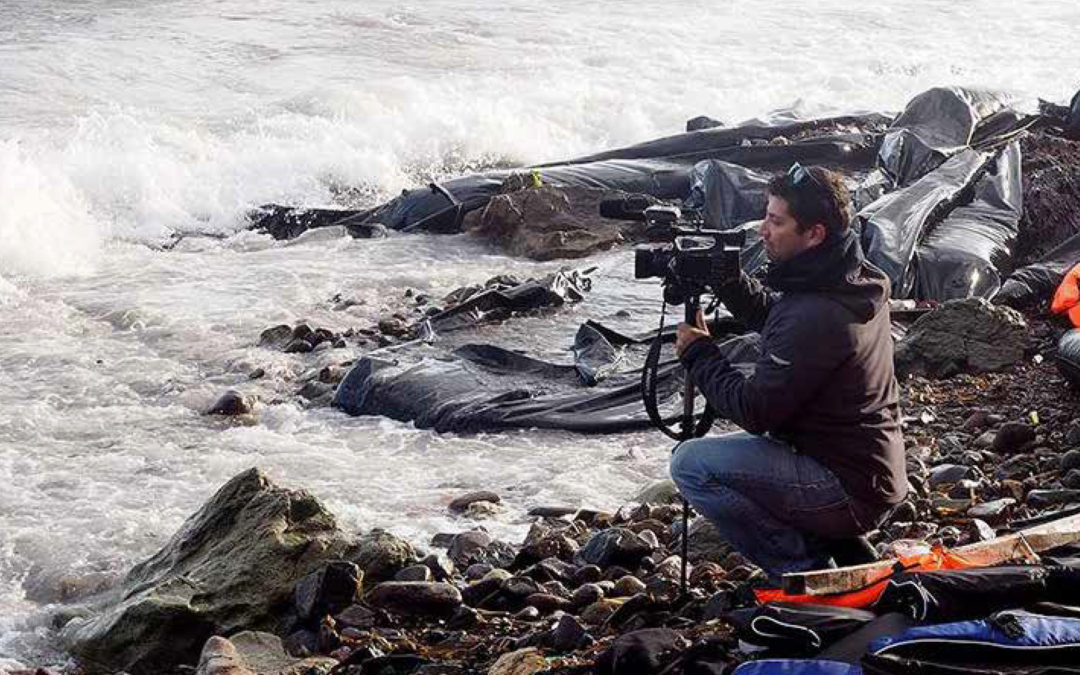
Journalists covering the refugee crisis have been affected by moral injury, according to a report published by the International News Safety Institute (INSI), which warns that this issue has the potential to have a significant impact on their mental health if nothing is done to prevent or treat it.
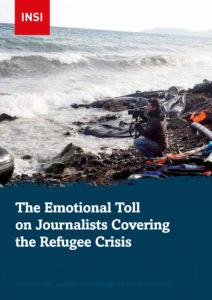 “The Emotional Toll on Journalists Covering the Refugee Crisis” is the first study of its kind into the response of news media professionals covering a humanitarian crisis and was prompted by the arrival in Europe by sea of more than one million migrants in 2015.
Published by the Reuters Institute for the Study of Journalism, it shows how moral injury – a condition linked to experiencing events and behaviour that violate one’s moral compass – emerged as the biggest psychological challenging faced by those covering the refugee crisis.
“We recognise that the trauma experienced by journalists as witnesses could never be equated with the suffering endured by the migrants, but we wanted to try to better understand what some journalists were experiencing so we could ensure those covering the refugee crisis could continue their important work of recording history,” said Hannah Storm, INSI director, and co-author of the report with neuropsychiatrist Professor Anthony Feinstein.
Nine major European and North American news organisations took part in the survey, which included 114 journalists. In addition to the quantitative survey, various industry-wide interviews and meetings were carried out which corroborated the survey findings.
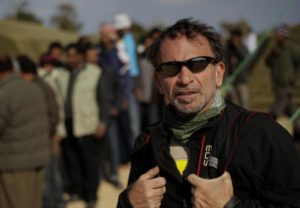 Yannis Behrakis (pictured left) turned his camera on his home country of Greece where he began covering the story in April 2015.
“A lot of times you are not sure what to do: leave the camera and actively help people come out of the sea or do practical things for them, drive them up the road, or give them clothes, or take their pictures,” said Behrakis, who works for Reuters, in an interview for the report.psiphon apk download
“Of course, I always think this is the way I help and this is my job to make sure that everybody around the world knows what is happening and that is my mission.”
Key findings from the survey included:
- Local journalists, parents and those working alone with no previous experience covering war are more likely to experience moral injury.
- Moral injury is linked to an increased workload and a perceived lack of support from employers.
- Neither post-traumatic stress disorder (PTSD) nor depression posed a significant risk for journalists covering the refugees.
“Moral injury is not a mental illness, which can be reassuring, but it should not be taken lightly for it comes with its own set of challenges,” said Feinstein. “It is to be hoped that the results of our study act as the impetus for an industry-wide discussion on how moral injury can be addressed and what changes need to take place,” Feinstein added.
The report concludes with a set of considerations for the news industry on how to support and educate those at risk of developing moral injury, and shows how its findings could have relevance to those working in other stories in non-conflict areas that have a traumatic content, such as domestic terror threats.

5 July 2017
Two major industry associations to work on cyber security and other key issues; AIB endorses NABA/DPP Security Requirements
The Association for International Broadcasting, the trade association for television, radio and online across the world, announces that it is to collaborate closely with the Digital Production Partnership (DPP),
DPP’s membership represents the whole media supply chain: production companies, manufacturers, suppliers, service providers, post production facilities, consultancies, broadcasters, distributors, and not-for-profit organisations. Besides working on the development of specifications and best practice in content exchange, a major DPP focus is the issue of cyber security.
Cyber security is also a key issue for the Association for International Broadcasting. The AIB has been working on the subject for the past three years and its specialist Working Group brings together broadcasters and key suppliers from across the globe, ranging from New Zealand to the USA. As a result of this new collaboration, the AIB is announcing that it is endorsing and backing the NABA/DPP Broadcaster Cyber Security Requirements for Suppliers.
Through this new collaborative venture, DPP will become an associate member of the AIB, and the AIB will become a DPP member.
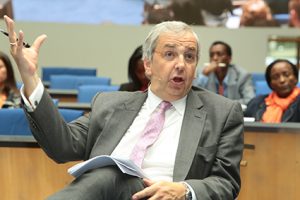 “This new collaboration between the AIB and DPP is important for the whole broadcasting industry,” comments Simon Spanswick, AIB chief executive (pictured right). “There is much commonality between the aims and the work programme of our two organisations and cyber security is at the top of both organisations’ agendas. In endorsing the NABA/DPP security requirements document, the AIB is reaffirming its commitment – and that of its Members – to driving the media industry towards increased security to protect broadcasters from devastating cyber attack. We will work closely with our DPP colleagues over the coming months on this critical issue.”
 Mark Harrison, Managing Director DPP, added “There are few more important areas for change in the media sector than the improvement needed in security practices throughout the supply chain. The DPP believes that pan-industry change such as this can only be delivered by collaboration. So we are really delighted to be working more closely with the AIB, who are just as committed to this area as we are. The North American Broadcasters Association (NABA) defined some important, pragmatic cyber security requirements in broadcasting; and now the DPP and AIB will work together to drive their implementation.”
The new collaboration between the AIB and DPP will also allow the exchange of information on a wide range of other issues, and lead to closer co-operation between Members of the two organisations.
14 June 2017
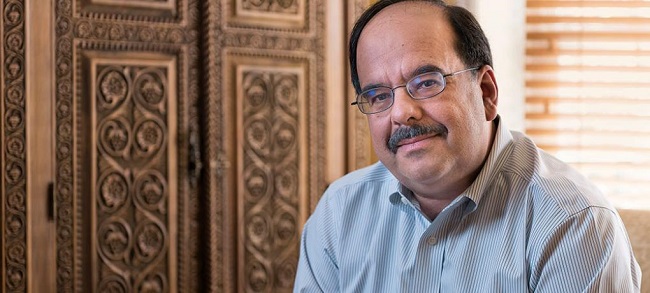
The Broadcasting Board of Governors (BBG) has announced that Ambassador Alberto M. Fernandez will join the Middle East Broadcasting Networks, Inc. (MBN) as its new president on July 17, 2017. In this role, he will oversee MBN’s multimedia operations in the U.S. and across the Middle East, including its digital properties, Alhurra Television networks and Radio Sawa.
MBN is a private, not for profit, multimedia corporation funded by the BBG that provides news and information to the 22 Arabic speaking countries across the Middle East and North Africa. With a weekly audience of more than 27.5 million people, MBN supports democratic values by expanding the spectrum of ideas in the region and producing accurate, professional and independent news and information on all media platforms; and is a trailblazer in audience engagement.
Brian Conniff, BBG veteran and current MBN President, is leaving the company after 11 years. Under his leadership, MBN has grown to be a forward-looking, flexible organisation responding to the region’s evolving media environment and challenges. “It has been a pleasure to work with the professionals of MBN,” said Conniff. “This transition comes at a time of strategic importance as the organisation continues to focus its content and seek new ways to increase its impact. I am confident that Ambassador Fernandez will advance MBN’s important work and continue to increase its impact.”
In response to Conniff’s announcement, John Lansing, CEO and Director of the BBG said, “Brian has played a significant role in BBG’s growth throughout the years, and his expertise and counsel has been invaluable to me. He is an extraordinary leader and has worked very closely with other network leadership to streamline our collective and individual efforts, and to develop creative programming that demonstrates real impact. Ambassador Fernandez is inheriting a first class team with a portfolio of major initiatives.”
best wireless router 2017
Ambassador Fernandez, a fluent Arabic speaker, will join BBG from the Middle East Media Research Institute (MEMRI), where he served as Vice President from 2015 to 2017. During his Foreign Service career, he was widely regarded as one of the most knowledgeable and impactful US Foreign Service voices in the Arabic-language media. Ambassador Fernandez held numerous roles at the U.S. Department of State, including the Department’s Coordinator for the Center for Strategic Counterterrorism Communications, U.S. Ambassador to the Republic of Equatorial Guinea, Chief of Mission in Sudan, Director for Near East Public Diplomacy and Director for Iraq Public Diplomacy. He was a career member of the Senior Foreign Service with the rank of Minister-Counselor and was a recipient of a 2008 Presidential Meritorious Service Award, the 2006 Edward R. Murrow Award for Excellence in Public Diplomacy, and a 2003 Superior Honor Award for his work in Afghanistan, among other awards. He also served as a Foreign Service Officer in Iraq, Kuwait, Nicaragua, the Dominican Republic, and the United Arab Emirates, and as USIA desk officer for Egypt, Yemen, and Sudan.
Ambassador Fernandez is a graduate of the University of Arizona and the Defense Language Institute. Ambassador Fernandez has also lectured and debated on U.S. foreign policy in numerous public venues, and has published in several publications, including Brookings Institution publications, the Foreign Service Journal, Journal of International Security Affairs, Soundings: An Interdisciplinary Journal, Cipher Brief, Providence, the Harvard Review of Latin America, Middle East Quarterly and the Journal of the Assyrian Academic Society (JAAS). He is also a Non-Resident Fellow in Middle East Media and Politics at the TRENDS Foundation in Abu Dhabi, United Arab Emirates.
Kenneth Weinstein, Chairman of the Board for the Middle East Broadcasting Networks, conveyed the Board’s support for the selection, “Ambassador Fernandez shares our values and focus on long-term growth,” he said. “He has the perfect combination of skill, experience, and regional expertise that we need to continue driving forward at MBN. We are pleased that he accepted this challenge and look forward to working with him. The Board and I are also very grateful to Brian Conniff for his passion and leadership, and thank him for his accomplishments over many years of dedicated service to the agency.”
“I am truly honored and humbled to join the Broadcasting Board of Governors as the President of the Middle East Broadcasting Networks,” said Fernandez. “I am delighted to have an opportunity to contribute to the impact the BBG’s networks have on millions of lives around the world. MBN is a media leader in the region, and I look forward to joining with its dedicated and accomplished staff to continue its growth momentum in new and creative ways.”
Source: MBN press release

25 May 2017
The BBC is reaching a record weekly audience of 372m around the world, a rise of 7 per cent year on year, new audience figures published on 25 May 2017 reveal.
These figures – the Global Audience Measure (GAM) – show how many individuals the BBC reached weekly with its news and entertainment content in the year 2016/17.
The data show the BBC’s weekly global news audience has risen by 8 per cent to 346m, with TV, audio and social media driving the increase.
The BBC World Service has seen an increase of 9 per cent since last year, taking its total audience to 269m.
Global News Ltd, which comprises BBC World News television and BBC.com, now has an audience of 121m, an increase of 12 per cent, with weekly BBC World News TV viewers rising to 99m.
World Service English has seen another significant rise, with an audience of 75m around the world, a 14 per cent increase. This has been driven both by syndication and by the growth of digital audio, including internet audio and podcasts. The number of listeners accessing World Service English through internet audio has shot up by 147 per cent to 21m.
The GAM figures show the BBC is on track to achieve the target set by the Director General of a 500m weekly audience by 2022, the BBC’s centenary year.
 Francesca Unsworth, Director of the BBC World Service Group, says: “In a turbulent year for international news, with mounting concern about fake news and social media filter bubbles, more people than ever before are turning to the BBC for reliable, impartial information they can trust.
“We will shortly launch the first new language services in the biggest expansion of the World Service since the 1940s. Today’s audience figures show the need for the BBC is greater than ever.”
 Tim Davie, Director of Global and CEO of BBC Worldwide, says: “It is encouraging to see that BBC branded services continue to be the trusted go-to platforms for audiences across the globe.”
- Facebook is by far the biggest source of the BBC’s social media reach globally, but there are regional variations – in Iran alone BBC reaches 1.4m people on the encrypted messaging app Telegram, from a total BBC audience of 12.6m in that country.
- The top ten markets for the BBC’s international news services are Nigeria (36m), USA (34m), India (28m), Bangladesh (16m), Egypt (15m), Pakistan (13m), Iran (13m), Tanzania (10m), Indonesia (7.6m), and Canada (7.5m), where the BBC significantly boosted its presence last year.
- BBC radio saw a 12 per cent uplift in audience figures in the USA during an eventful election year – taking weekly reach to 14.6m people

24 May 2017
The Middle East Broadcasting Networks (MBN) launched the Maghreb Voices website to inform and engage with the people of the Maghreb region in North Africa. The website targets nearly 100 million people and focuses on issues that resonate with them, such as countering ISIS, the rights of women, human rights, corruption, human trafficking, slavery, minorities’ rights and illegal immigration.
 “Maghreb Voices will provide its audience an unmatched opportunity to participate in important discussions and share their ideas, issues and concerns openly and freely,” stated Brian Conniff, President of MBN (pictured right). MBN manages and oversees Maghreb Voices. “Maghreb Voices will meet the tremendous need for an uncensored interactive platform in this underserved part of the world.”
The launch of Maghreb Voices comes after the success of Raise Your Voice-Iraq, which communicates with Iraqis about the future of their country. Similarly, engagement is Maghreb Voices main feature, using Community Managers to facilitate dialogue and interact with its audience. It goes to the streets of Morocco, Algeria, Tunisia, Libya and Mauritania to interview ordinary citizens and get their views on important topics that matter to them. The website also covers the news of the Maghreb community in the United States, Netherlands, France and Spain.
Maghreb Voices also utilises social media properties to facilitate the two-way conversation. It provides a 24/7 discussion forum for all voices on topics of concern through Facebook, Instagram, Snapchat, Twitter and WhatsApp.
There are several unique sections to Maghreb Voices. One of them is dedicated to defectors’ stories. This section includes interviews and first-hand accounts of people who joined and then left extremist groups such as ISIS after they became disillusioned. Another section of the website invites readers to ask any question they have about the U.S., to be answered by the Maghreb Voices staff, or outside experts. Audiences will also find video content, polls, question of the day, citizen journalist content and articles.
Maghreb Voices incorporates VOA’s Learning English into its website, so that its audience will have access to their videos and English language tools. More information about Maghreb Voices can be found on its website and Facebook page.
Maghreb Voices is operated by the non-profit corporation (MBN). MBN is financed by the U.S. Government through a grant from the Broadcasting Board of Governors (BBG), an independent federal agency. The BBG serves as a firewall to protect the professional independence and integrity of the journalists.
(Source: MBN press release)
